

What if the most exhausting administrative hurdle on your regulatory calendar actually became your firm’s most efficient, billable service? For many Australian accountants, the 1 July 2026 commencement of Tranche 2 obligations has introduced a new layer of complexity to daily operations. You’ve likely spent time wrestling with disparate spreadsheets or considering the implications of AUSTRAC audits, all while managing the impact of non-billable overheads. Implementing the right AUSTRAC annual compliance report software doesn’t just tick a box; it replaces manual data entry with a streamlined, automated workflow that protects your practice.
We recognise that navigating these new requirements is a complex transition, but it’s also an opportunity to modernise your internal systems and add value. This guide will show you how to automate your annual compliance reporting and transform a regulatory burden into a streamlined, billable professional service. We’ll explore the path toward a push-button reporting experience, ensuring your documentation is always audit-ready while positioning your firm as a proactive leader in the new regulatory landscape.
Key Takeaways
- Master the mandatory components of the AUSTRAC self-assessment, focusing on governance oversight and evidence-based risk assessments for your entire client base.
- Avoid the “spreadsheet trap” by implementing AUSTRAC annual compliance report software that ensures data integrity through automated, timestamped record-keeping.
- Establish a standardised workflow for designated services such as tax and trust setup to ensure your firm remains audit-ready throughout the financial year.
- Learn how to transform mandatory compliance from a non-billable administrative burden into a streamlined, revenue-generating professional service.
- Discover the strategic advantage of using a platform designed specifically for Australian accountants to achieve compliance readiness within a 30-day timeframe.
Understanding the AUSTRAC Annual Compliance Report for Accountants
The annual compliance report is far more than a simple administrative task; it’s a mandatory self-assessment that serves as a health check for your practice’s regulatory standing. Submitted via the AUSTRAC Online portal, this report provides the regulator with a detailed account of how your firm met its Anti-Money Laundering and Counter-Terrorism Financing (AML/CTF) obligations over the previous calendar year. It’s a transparent reflection of your internal controls, risk management strategies, and overall commitment to financial integrity.
For Australian accounting firms, the 2026 cycle represents a critical milestone. With Tranche 2 obligations commencing on 1 July 2026, the industry is moving from a period of preparation into a new era of active accountability. Failing to submit this report is a serious oversight. It can lead to formal directions from the regulator or significant financial penalties that could impact your firm’s reputation and bottom line. Understanding AUSTRAC’s role and history helps clarify why this reporting is essential for protecting the broader financial system from criminal exploitation.
Who is Required to Submit a Report?
Any firm providing “designated services” as defined under the AML/CTF Act is required to submit. For accountants, this typically includes services such as tax planning, insolvency management, or the creation of trusts and companies. While large financial institutions have managed these requirements for years, SME accounting firms are now firmly in the regulatory spotlight. Your obligation to report is fundamentally linked to your enrolment with AUSTRAC. Once you’re registered as a reporting entity, the annual report becomes a non-negotiable part of your professional calendar. Using dedicated AUSTRAC annual compliance report software ensures that the data required for these disclosures is captured accurately throughout the year.
Key Dates and Reporting Periods for 2026
The standard reporting window opens on 1 January and closes on 31 March each year. During this period, you must report on your activities from the preceding calendar year. However, 2026 is uniquely positioned as the “readiness year” for the accounting profession. While the Tranche 2 start date is mid-year, firms must treat the preceding months as a vital transition phase. Partners need to realise that AUSTRAC expects robust systems to be in place from day one of the new regime. Adopting AUSTRAC annual compliance report software early allows your team to move away from manual tracking and toward an automated, audit-ready framework. This proactive approach ensures that when the 2026 reporting window arrives, your firm is prepared to demonstrate compliance with confidence rather than scrambling to compile disparate data points at the last minute.
Key Components of the Report: What You Must Disclose
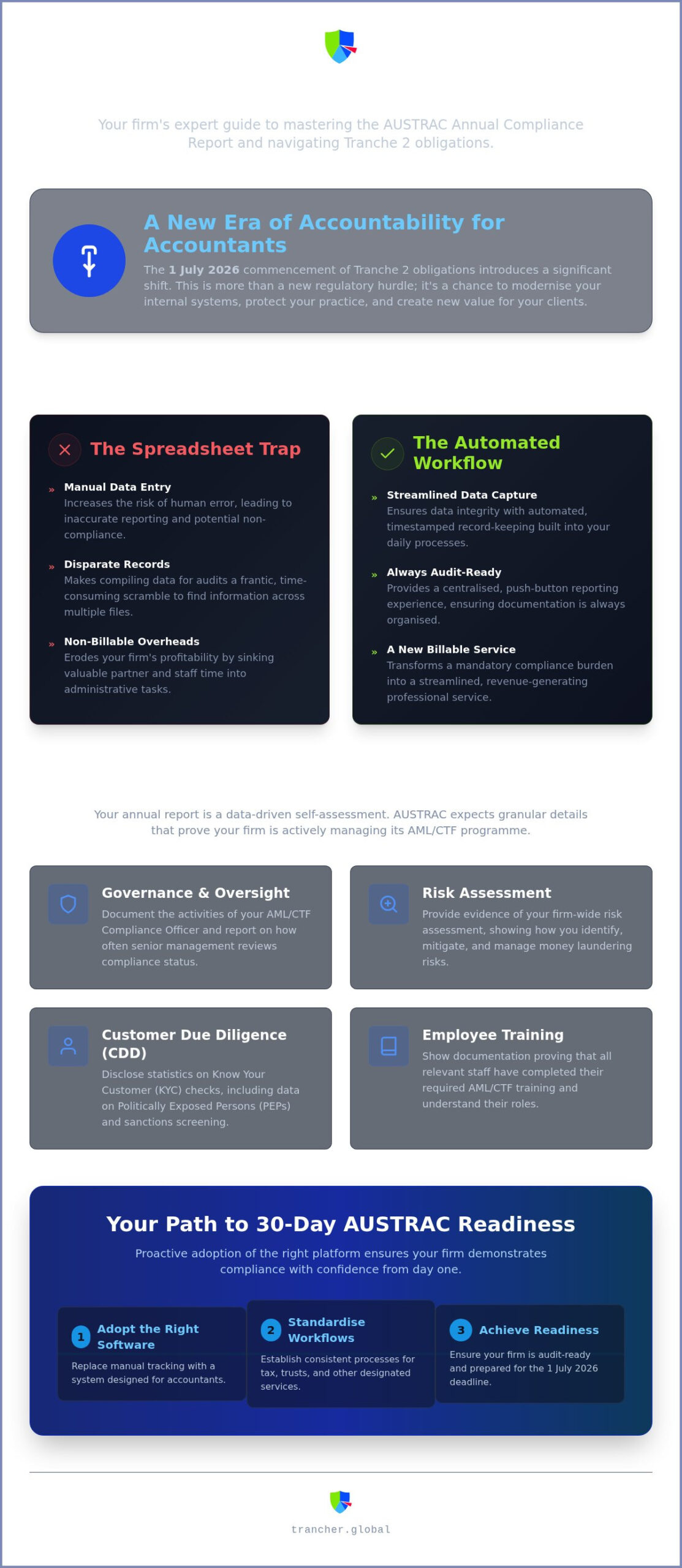
Completing your annual submission requires more than a simple confirmation of your firm’s existence. It is a data-driven exercise that asks you to quantify your adherence to your own AML/CTF programme. AUSTRAC expects specific, granular details that prove your practice isn’t just aware of its obligations but is actively managing them on a daily basis. By utilising dedicated AUSTRAC annual compliance report software, you can pull these metrics directly from your workflow rather than attempting to reconstruct them from memory or manual logs.
The report typically focuses on four primary pillars of compliance:
- Governance and Oversight: You must report on the activities of your designated AML/CTF Compliance Officer. This includes documenting how often senior management reviewed compliance reports and the level of oversight provided by the partners.
- Risk Assessment: This section requires evidence of your firm-wide risk assessment. You’ll need to disclose how you’ve identified, mitigated, and managed specific money laundering risks inherent in your client base and service offerings.
- Customer Due Diligence (CDD): AUSTRAC requires statistics on the number of Know Your Customer (KYC) checks performed. This includes specific data on Politically Exposed Persons (PEPs) and any sanctions screening conducted throughout the year.
- Employee Training: You must provide documentation showing that all relevant staff members have completed their required AML/CTF training modules and understand their role in protecting the firm.
The Role of Independent Reviews
A common point of confusion for many partners is the distinction between the annual self-assessment and an independent review. While the annual report is your firm’s own disclosure to the regulator, you are also required to state when your last independent AML/CTF programme review occurred. These reviews must be conducted by a person not involved in the development or implementation of the programme itself. Maintaining audit ready compliance records is essential for these evaluations. If your records are disorganised, an independent review becomes a costly, time-consuming exercise. Automated software ensures that every decision and check is timestamped, making the review process significantly more efficient.
Reporting Suspicious Matters (SMRs)
Consistency is the hallmark of a healthy compliance culture. Your annual report will ask for a summary of your firm’s activity regarding Suspicious Matter Reports (SMRs). AUSTRAC looks for alignment between your reported risk profile and your actual filing history. If you claim to have a high-risk client base but have filed zero SMRs over twelve months, it may trigger further enquiry from the regulator. Our platform helps you maintain a steady pulse on client activity, ensuring that your ongoing risk monitoring is both documented and defensible. This alignment ensures that when you submit your annual disclosure, the data reflects a consistent and proactive approach to monitoring suspicious activity rather than a reactive scramble.
Manual Spreadsheets vs. Automated Software: The Efficiency Gap
Many accounting firms fall into what we call the “Spreadsheet Trap.” It starts simply enough with a shared Excel file to track client risk, but as your practice grows, this manual system inevitably fractures. Version control issues, accidental deletions, and inconsistent data entry create significant gaps in your regulatory history. When it’s time to submit your annual disclosure, these gaps transform from minor annoyances into major liabilities. Relying on AUSTRAC annual compliance report software eliminates these risks by providing a standardised, secure environment for every piece of compliance data.
The difference in efficiency is stark. A manual data collection process for a mid-sized firm can easily consume up to 40 hours of a senior staff member’s time. This involves chasing partners for client files, verifying training dates, and cross-referencing spreadsheets with actual bank records. With an automated system, this exhaustive process is reduced to a 10-minute export. Beyond the time savings, there is a profound psychological benefit. By removing the “March Madness” stress of deadline-driven reporting, your team can focus on client value rather than administrative survival.
The Risk of Human Error in Regulatory Reporting
Inconsistent record-keeping is the primary reason for AUSTRAC enforceable undertakings in Australia. Manual systems often fail because they lack the “hard stops” required to ensure every step of a process is completed. Software prevents “missing” KYC files or expired PEP screenings by alerting your team before a deadline passes. It creates a single source of truth for all CDD and KYC requirements in Australia, ensuring that every check is timestamped and recorded. This level of data integrity is impossible to achieve through manual entry alone.
Real-Time Compliance Monitoring
The “set and forget” strategy is no longer a viable option for Australian firms. Regulatory expectations have shifted toward a model of continuous oversight. Using ongoing risk monitoring software allows you to feed live data directly into your annual report. This means your compliance health dashboard is visible every day, not just once a year. It’s an empowering shift. Instead of wondering if your firm is compliant, you have real-time visibility into your risk profile, allowing you to address issues as they arise rather than discovering them during a high-stakes audit.
How to Organise Your Practice for Seamless Annual Reporting
Organising your practice for AUSTRAC reporting isn’t about a year-end sprint; it’s about embedding compliance into your firm’s DNA. When you treat the annual report as a byproduct of your daily work rather than a separate administrative project, the entire process becomes frictionless. By implementing AUSTRAC annual compliance report software, you can move away from reactive data gathering and toward a proactive, organised framework that serves your firm’s interests throughout the financial year.
To ensure your practice remains ready for the 2026 reporting cycle and beyond, we recommend following these five strategic steps:
- Step 1: Enrol with AUSTRAC and designate your Compliance Officer immediately. This establishes your firm’s formal accountability and ensures you receive direct updates from the regulator.
- Step 2: Implement a standardised workflow for all “designated services.” Whether your team is handling tax planning, insolvency matters, or trust setups, the compliance steps must be identical and repeatable.
- Step 3: Automate the evidence trail. Use a dedicated AML platform to capture KYC data and risk assessments at the point of client onboarding.
- Step 4: Conduct quarterly “mini-audits.” Briefly review your records every three months to ensure training modules are completed and screening results are up to date.
- Step 5: Use the annual report as a prompt for advisory. The data gathered for your report offers a clear view of client risk profiles, providing a natural opening for billable AML advisory conversations.
Turning Compliance into a Billable Asset
Compliance doesn’t have to be a sunk cost that erodes your margins. By using compliance ROI tracking software, you can justify the professional fees associated with these essential checks. When you communicate the value of AML checks to your clients as a security feature that protects their reputation and assets, it becomes a premium service. Automation is the most effective path to AML CTF compliance costs reduction, allowing you to maintain high standards without inflating your overheads. If you’re ready to transform your regulatory obligations into a strategic advantage, you can get started with our automated AML platform today.
Staff Training and Culture
A healthy compliance culture starts with the Compliance Officer but lives within every member of your team. Moving beyond “compliance for the sake of it” requires making the process as approachable as possible. Automating training reminders ensures that the “Training” section of your AUSTRAC report is always 100% complete without manual follow-up from partners. In this model, the Compliance Officer acts as a strategic guide who oversees the automated reporting workflow, ensuring the firm’s risk awareness remains high while the administrative burden remains low.
The Trancher Advantage: 30 Days to AUSTRAC Readiness
Trancher was designed with a single purpose: to solve the specific regulatory challenges faced by Australian accounting firms. Unlike generic platforms built for massive banking institutions, our software is tailored to the workflows of accountants managing Tranche 2 obligations. We understand that your time is your most valuable asset. That’s why we offer a 30-day compliance-ready guarantee. We ensure your practice is fully equipped to meet its obligations within a month of onboarding, providing a steady hand through the transition.
Our AUSTRAC annual compliance report software takes the complexity out of your year-end obligations. Instead of manually compiling data from various sources, you can generate and export the necessary reports in seconds. This level of automation is supported by Aaron Soh and the local Trancher team, providing you with expert guidance whenever you need it. We aren’t just a software provider; we’re your partner in navigating the changing regulatory landscape with confidence and ease.
From Administrative Burden to Advisory Opportunity
We believe that compliance shouldn’t just be a box-ticking exercise that drains your firm’s resources. Our platform actively tracks billable compliance hours to protect your margins and demonstrate the value of your work. During your trial, you’ll receive a detailed ROI report that shows exactly how much time and money your firm has saved through our automated systems. This transforms the annual report from a stressful deadline into a strategic review of your firm’s risk profile, allowing you to offer high-value advisory services to your clients based on real data.
Start Your Complimentary 3-Month Trial
Taking the first step toward a more efficient compliance framework shouldn’t feel like a risk. We invite you to experience the ease of automated KYC, sanctions screening, and reporting firsthand with a complimentary 3-month trial. You’ll have no-obligation access to the full suite of Trancher AML tools, allowing you to see the impact on your practice before making a long-term commitment. Firms that choose to continue with us after the trial will also receive a 20% discount on their first year’s subscription. It’s time to stop worrying about audits and start seeing compliance as an avenue for growth. Claim your trial and discount today and let us help you secure your firm’s future.
Transforming Regulatory Compliance into Strategic Growth
Transitioning into the Tranche 2 regime doesn’t need to be a source of stress for your firm. By moving away from the “spreadsheet trap” and adopting a standardised, automated workflow, you ensure that your practice remains resilient and audit-ready. The shift to dedicated AUSTRAC annual compliance report software allows you to capture every required metric in real-time. This effectively turns a once-daunting administrative task into a seamless byproduct of your daily operations, protecting your margins while maintaining high standards of integrity.
You now have the roadmap to move from manual data collection to a “push-button” reporting experience. With our 30-day compliance-ready guarantee and audit-ready documentation, you can focus on what you do best: providing expert financial guidance to your clients. We’re here to act as your strategic guide, helping you navigate these changes with confidence and professional ease. It’s an opportunity to modernise your internal systems and unlock new advisory potential.
Get AUSTRAC-ready in 30 days with a complimentary 3-month Trancher trial.
We look forward to supporting your firm’s journey toward a more efficient, billable, and secure future.
Frequently Asked Questions
What is the deadline for the 2026 AUSTRAC annual compliance report?
The standard reporting window is 1 January to 31 March each year, covering the previous calendar year. However, for accounting firms entering the regime on 1 July 2026, your first full reporting cycle will follow the 2027 calendar year. It’s vital to stay informed via the AUSTRAC portal, as late submissions can trigger formal directions or financial penalties. We recommend setting internal reminders in January to ensure you have ample time for data verification.
Do small accounting firms really need dedicated AML software for reporting?
Small firms benefit significantly from dedicated AUSTRAC annual compliance report software because it eliminates the “spreadsheet trap.” Manual tracking often leads to data gaps that are difficult to defend during a regulatory enquiry. Software provides a standardised framework that ensures every KYC check and risk assessment is timestamped and stored securely. This level of organisation protects your practice from human error while freeing up senior staff to focus on billable client work.
What happens if I make a mistake on my AUSTRAC compliance report?
If you discover an error after submission, you should contact AUSTRAC immediately to rectify the information. The regulator generally views proactive disclosure more favourably than errors discovered during an audit. Using automated software reduces this risk by pulling data directly from your daily workflows, ensuring the figures in your report match your actual activity. Maintaining a transparent relationship with the regulator is always the best path for long-term compliance health.
Can I use my existing practice management software for AUSTRAC reporting?
Most practice management tools aren’t designed to handle the specific complexities of AML/CTF legislation. While they manage general client data, they often lack the integrated PEP screening, sanctions checks, and automated risk scoring required for a robust compliance programme. Dedicated AUSTRAC annual compliance report software works alongside your existing tools, providing the specialised reporting engine needed to generate audit-ready documentation and track specific “designated services” without creating friction in your daily operations.
How much does AUSTRAC annual compliance report software cost?
Pricing for compliance software varies based on the size of your firm and the volume of client verifications required. Most providers offer tiered subscription models that scale with your practice’s needs. At Trancher, we focus on providing a clear return on investment by tracking billable compliance hours and reducing administrative overheads. You can explore our full feature set and value proposition by starting a complimentary 3-month trial to see how it fits your firm’s budget.
Is the AUSTRAC annual report the same as an independent review?
No, these are distinct requirements under the AML/CTF Act. The annual report is a mandatory self-assessment submitted directly to the regulator to disclose your compliance activities. An independent review is a separate evaluation of your AML/CTF programme conducted by an internal or external party not involved in its daily operation. While the annual report happens every year, independent reviews occur periodically to ensure your systems remain effective and compliant with current standards.
How do I report “designated services” if I only provide tax advice?
Tax advice is classified as a “designated service” under the expanded Tranche 2 regulations. When completing your report, you must disclose the volume and nature of these services as they relate to your AML/CTF obligations. This includes performing KYC checks and risk assessments for all tax clients. Using an automated platform ensures that these specific services are tracked correctly throughout the year, making it easy to quantify them for your annual submission without manual counting.
What evidence does AUSTRAC require to back up my annual report claims?
You must maintain comprehensive records of your KYC checks, risk assessments, staff training logs, and any suspicious matter reports. AUSTRAC requires these records to be kept for seven years; they must be readily accessible for inspection. Our platform ensures that all this evidence is automatically organised and stored in an audit-ready format. This means you can confidently stand by your report claims, knowing every data point is backed by a verifiable, timestamped digital trail.