

Did you know that over 90,000 Australian professional firms are now officially under the AUSTRAC microscope following the 1 July 2026 Tranche 2 deadline? If you’re feeling the weight of this transition, you’re certainly not alone. Most practitioners find that manual KYC checks and selecting the right AML software can feel like a significant drain on billable hours. It’s natural to worry that these requirements will become a non-billable time-sink that pulls focus away from your client relationships.
This guide will show you how to choose a platform to automate these obligations, ensuring you remain audit-ready while transforming compliance into a recoverable, profitable service. We’ll explore the essential features of modern platforms, how to integrate them seamlessly into your existing workflow, and the specific steps you can take to protect your firm from potential penalties of up to $33 million. By the end of this article, you’ll see exactly how to turn a complex regulatory hurdle into a strategic advantage for your practice’s long-term growth and operational ease.
Key Takeaways
- Grasp the specific obligations for accountants providing designated services under the Tranche 2 reforms that commenced on 1 July 2026.
- Evaluate how integrated AML software replaces manual spreadsheets to provide the rigorous audit trail and automated reporting AUSTRAC requires.
- Move beyond simple identity verification by implementing an end-to-end workflow that integrates with your current practice management tools.
- Follow a clear, 30-day implementation strategy to organise your firm’s compliance program and ensure your team is ready for any potential audit.
- Learn to frame compliance as a recoverable professional service, allowing you to capture billable value while meeting your regulatory duties.
The Shifting Landscape: Why Australian Accountants Need AML Software in 2026
The regulatory environment for Australian accountants changed fundamentally on 1 July 2026. This date marked the commencement of Tranche 2 reforms, bringing thousands of practitioners under the direct supervision of the Australian Transaction Reports and Analysis Centre (AUSTRAC). For many, this transition feels like a significant administrative hurdle. However, it’s also an opportunity to modernise your internal systems and practice management.
In this context, AML software acts as a digital shield and a strategic partner. It’s designed to automate the complex “heavy lifting” of Know Your Customer (KYC) and Customer Due Diligence (CDD), ensuring that your practice remains compliant without sacrificing efficiency. By moving away from manual spreadsheets and paper-based records, you protect your firm from the inherent risks of human error and missed screenings. It’s about building a foundation of reliability that allows you to focus on your clients’ success.
Understanding Tranche 2 and Your New Obligations
The Tranche 2 reforms specifically target “gatekeeper” professions that could be exploited for money laundering. If your firm provides designated services, such as managing client money, buying or selling businesses, or creating legal entities like companies and trusts, you are now a reporting entity. This means your obligations go well beyond standard tax compliance or basic bookkeeping.
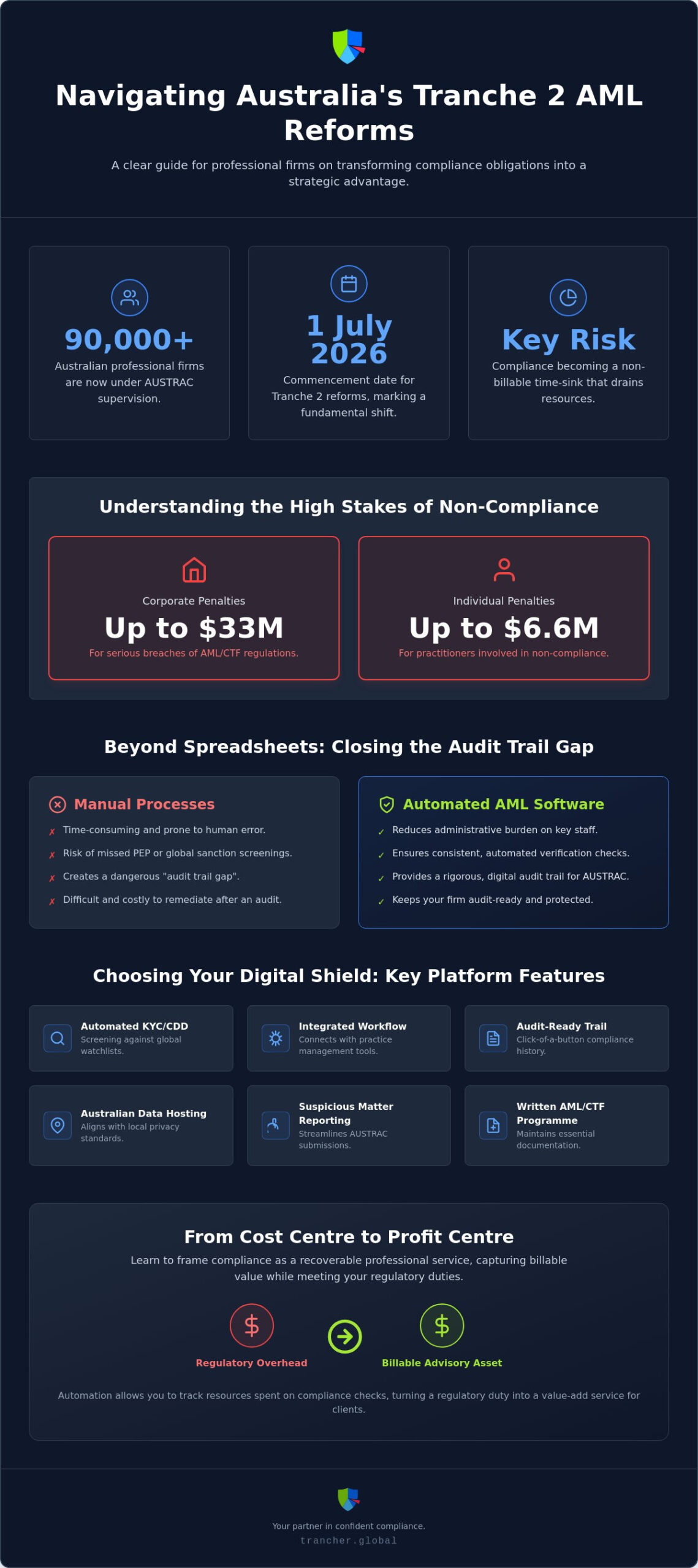
Standard accounting work often requires a deeper level of scrutiny now. You must identify and verify your clients, report suspicious matters, and maintain a written AML/CTF programme. The stakes are high; AUSTRAC has the power to conduct audits, and the financial penalties for non-compliance are substantial. Corporate breaches can attract fines of up to $33 million, while individual practitioners could face penalties of up to $6.6 million. Being proactive isn’t just about avoiding fines; it’s about maintaining your professional reputation.
The Cost of Doing Nothing vs. The Value of Automation
Relying on manual systems is a gamble that rarely pays off in a modern practice. Manual identity checks are time-consuming and prone to oversight, especially when it comes to Politically Exposed Person (PEP) screenings or checking global sanction lists. These gaps are exactly what AUSTRAC looks for during an audit. Manual processes create an “audit trail gap” that can be difficult and expensive to fix after the fact.
Choosing to implement AML software removes the administrative drudge that often falls on senior partners or key staff members. Instead of chasing physical documents and manually cross-referencing databases, your team can rely on automated verification. This allows you to frame compliance as a recoverable professional service. When you track the time and resources spent on these essential checks, you can turn a regulatory overhead into a billable advisory asset. It’s a shift from a reactive mindset to one of business-minded optimism.
Evaluating AML Software: Key Features for Australian Practice Management
Selecting the right AML software requires a strategic shift in perspective. It’s not simply about finding a standalone tool to verify a driver’s licence; it’s about integrating a comprehensive compliance layer into your existing practice management architecture. As firms adapt to AUSTRAC’s AML/CTF reforms, the focus must move toward end-to-end workflows that provide a single source of truth for every client interaction. Fragmented tools often lead to data silos, which can create significant blind spots during a regulatory review.
For an Australian accounting firm, certain features are non-negotiable. Data sovereignty is a primary concern. You should prioritise solutions that offer Australian-hosted data to ensure alignment with local privacy standards and regulatory expectations. Your platform must also provide audit-ready documentation and record-keeping that satisfies the seven-year retention requirement. When an auditor asks for proof of your compliance journey, you need a system that can produce a detailed, chronological history of every check and decision at the click of a button.
Automated KYC and CDD Screening
There is a fundamental difference between basic identity verification and the more rigorous CDD and KYC requirements in Australia. Effective software should automate the screening of clients against global sanctions lists, Politically Exposed Person (PEP) registers, and adverse media reports. This process isn’t just about ticking a box. It’s about utilising “safe harbour” provisions in digital verification to gain a high level of confidence in your client’s identity. By automating these complex cross-references, you allow your team to focus on interpreting the results rather than performing the manual data entry.
Ongoing Risk Monitoring and Reporting
Compliance is never a “set and forget” task. Your obligations continue throughout the entire lifecycle of the client relationship. Utilising ongoing risk monitoring software ensures that your practice is alerted to any changes in a client’s risk profile, such as new sanctions or suspicious transaction patterns. This proactive approach is essential for the timely reporting of suspicious activities to AUSTRAC. High-quality AML software will streamline this reporting process, ensuring that Suspicious Matter Reports (SMRs) are filed within the strict three-day window (or 24 hours for terrorism-related suspicions). If you’re looking for a partner to simplify these complex requirements, exploring how Trancher supports local firms can provide a clear path forward.
Beyond Identity Checks: Why Automation Trumps Manual Spreadsheets
A common misconception among smaller Australian practices is that a well-organised spreadsheet is “good enough” for compliance. While Excel is a powerhouse for financial modelling, it’s fundamentally unsuited for the rigours of AUSTRAC’s 2026 requirements. Manual systems lack the robust security needed to store sensitive client identification documents; keeping passports or driver’s licences in unencrypted server folders is a significant data breach waiting to happen. It’s a risk that modern firms simply can’t afford to take.
Beyond security, the most critical failure of manual processes is the “audit trail gap.” AUSTRAC doesn’t just want to see that you verified a client; they want to see exactly how and when you did it. AML software bridges this gap by creating non-repudiable logs of every action taken. It ensures that every team member, from the graduate accountant to the senior partner, follows the exact same process every single time. This level of consistency is your firm’s best defence against accidental oversight and human error.
The Hidden Costs of Manual Compliance
The hours your team spends on manual data entry, chasing missing documents, and cross-referencing sanctions lists are hours that aren’t being billed to clients. This administrative drudgery often leads to compliance fatigue, where small but vital details are missed during a busy tax season. It’s also virtually impossible to maintain a firm-wide AML CTF compliance dashboard using manual methods. Automation replaces this administrative burden with a clear, visual overview of your firm’s current risk status, allowing you to manage by exception rather than by manual checking.
Ensuring Audit Readiness with Every Click
Modern AML software is built to generate audit-ready compliance records automatically as you work. Every search, screening, and risk assessment is time-stamped and logged, providing a centralised “source of truth” that is always current. This system also manages version-controlled AML policies, ensuring you always have the correct documentation ready for an inspection. When the regulator calls, you won’t be scrambling through old emails or paper files; you’ll have everything organised, secured, and accessible in seconds.
Implementation Strategy: Getting Your Firm AML-Ready in 30 Days
Many practitioners feel a sense of paralysis when considering the transition to a formal compliance framework. There’s a common misconception in the industry that establishing a robust system takes six months of billable downtime and endless paperwork. In reality, with a structured approach and the right AML software, your firm can move from uncertainty to full operational readiness in just 30 days. This accelerated timeline is possible when you lean on expert support to handle the technical configurations, allowing you to focus on your core professional duties.
The key to a stress-free rollout is a phased approach that prioritises your firm’s most critical “designated services” first. By breaking the process into manageable fortnightly goals, you can maintain your usual client service levels while building a more resilient practice. We recommend a “try before you buy” evaluation to ensure the platform fits your specific team culture. This risk-free period allows you to test integrations and see the automation in action before making a long-term commitment.
Week 1-2: System Integration and Policy Alignment
The first fortnight focuses on the technical foundation. Your primary goal is to connect your AML software to your existing practice management tools, ensuring that client data flows securely without manual re-entry. During this phase, you’ll customise your AML/CTF programme framework to reflect the specific services your firm provides. This isn’t a generic template; it’s a tailored document that identifies your firm’s unique risk profile. Once the system is configured, you’ll conduct an initial firm-wide risk assessment to identify any existing gaps that need immediate attention.
Week 3-4: Staff Training and Client Onboarding
The second half of the month is about empowering your people and communicating with your clients. Rolling out role-based training ensures that every staff member, from the front desk to the senior partners, understands their specific obligations under the law. You’ll use proven templates to inform your clients about the new verification requirements, framing them as a standard part of your professional duty of care. This is also the time to generate your first ROI report. By tracking the efficiency gains and billable compliance activities from day one, you can immediately see the financial value the system brings to your firm. To experience this streamlined transition for yourself, you can explore the Trancher 30-day guarantee and secure your practice today.
The Trancher Advantage: Transforming Compliance into a Profitable Service
Trancher stands as the specialist expert companion for Australian accountants, designed to bridge the gap between regulatory necessity and firm profitability. While some AML software providers focus solely on the administrative burden, we view these requirements as an avenue for growth. It’s about more than just meeting a deadline; it’s about refining your internal systems to reflect the high professional standards your clients already expect. We’re here to act as a steady hand, ensuring your transition is both manageable and advantageous.
Turning Obligations into Advisory Revenue
The most significant hurdle for many firms is the belief that compliance is a sunk cost. Trancher changes this narrative through our dedicated compliance ROI tracking software. This feature identifies specific, billable compliance activities that add value to your client relationships, allowing you to justify the investment to your partners with concrete data. By shifting your team’s mindset from “policing” to “protecting and profiting,” you transform a mandatory task into a high-value advisory service that strengthens your practice’s financial health.
Local Support for a Seamless Transition
Navigating the complexities of AUSTRAC reporting requires more than just a software login. It requires a partner who understands the local Australian market. Our team of Australian-based experts provides ongoing guidance and on-call support for those complex “suspicious matter” queries that can cause undue stress. You aren’t just adopting a platform; you’re joining a community of forward-thinking firms that are thriving under the Tranche 2 framework. We prioritise the removal of friction, ensuring your staff feel supported at every step of the journey.
We’re so confident in our ability to support your practice that we offer a 30-day compliance-ready guarantee. We’ll ensure your firm is AUSTRAC-ready within a month, or you’ll receive your money back. To help you get started with total confidence, we invite you to take advantage of our complimentary 3-month trial. This allows you to experience the full Trancher advantage and see the efficiency gains firsthand before making any long-term commitment. It’s time to turn regulatory hurdles into strategic advantages for your firm’s future.
Securing Your Practice’s Future Beyond the 2026 Deadline
The shift to Tranche 2 compliance doesn’t have to be a source of stress or administrative burden for your firm. By moving away from manual spreadsheets and adopting a specialised AML software solution, you’ve already taken the most important step toward protecting your practice and your professional reputation. You now understand that these obligations are more than just a box-ticking exercise; they’re a genuine opportunity to streamline your operations and capture new billable value through automated ROI and billable activity reporting.
With our 30-day AUSTRAC-ready guarantee and dedicated Australian expert support, you can navigate this transition with complete confidence and professional ease. You’re not just meeting a regulatory requirement; you’re building a more resilient, modern practice that’s prepared for any future audit. Start your complimentary 3-month trial of Trancher today and see how simple it is to turn compliance into a strategic advantage. We’re here to guide you every step of the way as you lead your firm into this new era of professional excellence and operational clarity.
Frequently Asked Questions
What exactly is AML software for accountants?
AML software is a dedicated digital platform designed to automate the anti-money laundering and counter-terrorism financing (AML/CTF) obligations of an accounting practice. It moves beyond simple identity checks to include complex screening, risk assessment, and ongoing monitoring. These systems are built to replace manual, error-prone processes with a secure, audit-ready digital environment that ensures consistent compliance across your entire team.
Is my accounting firm required to use AML software under Tranche 2?
While AUSTRAC doesn’t explicitly mandate the use of specific software, you must comply with the Tranche 2 regulations if you provide “designated services” as of 1 July 2026. These services include managing client money, buying or selling businesses, or creating legal entities. Given the complexity of the requirements and the potential for severe penalties, using professional software is the most reliable way to ensure your practice remains compliant and audit-ready.
How much does AML software typically cost for a small Australian firm?
Pricing for compliance platforms varies based on the volume of clients and the specific features required, such as automated screening or ROI tracking. Most providers offer tiered subscription models or pay-per-check options to suit different firm sizes. It’s best to look for a solution that offers a transparent fee structure without hidden setup costs, allowing you to scale the service as your practice grows.
Can AML software integrate with Xero or other practice management tools?
Yes, modern compliance platforms are designed to integrate seamlessly with popular Australian practice management tools like Xero, MYOB, or Karbon. This integration ensures that client data flows securely between systems, reducing the need for manual data entry and minimising the risk of human error. Connecting these tools creates a unified workflow that saves significant time during the client onboarding process.
How does AML software help with AUSTRAC reporting?
The software automates the collection and organisation of data required for mandatory reports, such as Suspicious Matter Reports (SMRs) and Threshold Transaction Reports (TTRs). It ensures that all relevant details are captured in the correct format, making the submission process to AUSTRAC much faster and more accurate. By maintaining a centralised record of all transactions and assessments, the system provides a clear, time-stamped audit trail for regulatory reviews.
What is the difference between KYC and AML software?
KYC (Know Your Customer) is a specific component of a broader framework that focuses on identifying and verifying a client’s identity. Comprehensive AML software goes much further by including ongoing risk monitoring, screening against global sanctions lists, and regulatory reporting. While KYC is the first step, an end-to-end AML solution manages the entire lifecycle of your compliance obligations and protects your firm from evolving risks.
How long does it take to implement an AML software solution?
With the right partner, your firm can be fully operational and AUSTRAC-ready within 30 days. This timeline includes the initial system configuration, policy alignment, and role-based staff training. Proactive providers often offer structured implementation plans that minimise disruption to your daily billable work, ensuring a smooth transition that builds team confidence from the very first week.
Can I use AML software to bill my clients for compliance work?
Absolutely, and many firms now treat compliance as a recoverable professional service rather than an overhead cost. Advanced platforms include ROI and billable activity reporting to help you track the time and resources spent on each client’s due diligence. This transparency allows you to incorporate compliance fees into your engagement letters, turning a regulatory requirement into a sustainable and profitable advisory service.