

What if identifying a suspicious transaction wasn’t a source of anxiety, but a seamless, high-value part of your firm’s professional workflow? For many Australian practitioners, the looming July 1, 2026, compliance deadline feels like a moving target, especially regarding the nuances of reporting suspicious activities AUSTRAC requires under the new regime. It’s completely natural to feel a sense of administrative overwhelm or to worry about the legal ramifications of “tipping off” a client during a standard tax or insolvency engagement.
We understand these specific pressures, and we’re here to help you transform these regulatory hurdles into robust internal systems that actually support your business growth. This guide will help you master the essentials of Suspicious Matter Reporting (SMRs), ensuring you can protect your practice while meeting your Tranche 2 obligations with absolute confidence. We’ll explore a practical framework for spotting red flags in everyday accounting work, improving your operational efficiency, and ensuring your firm is fully audit-ready well before the new reporting systems are introduced.
Key Takeaways
- Understand the fundamental shift in reporting obligations for accountants and why the 1 July 2026 deadline marks a critical turning point for your firm’s compliance.
- Develop a clear framework for identifying “reasonable grounds” using professional judgement to spot red flags like complex structures and unusual transaction patterns.
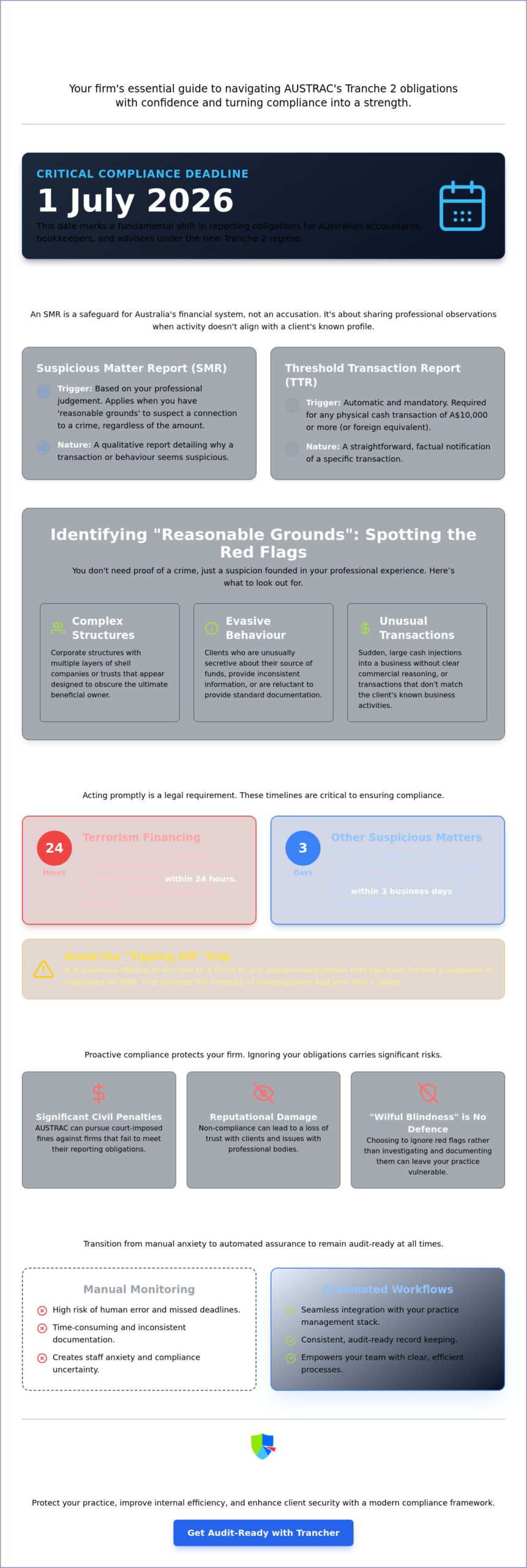
- Master the precise timelines for reporting suspicious activities AUSTRAC requires, including the critical 24-hour window for terrorism financing matters to avoid legal pitfalls.
- Transition from manual monitoring to automated workflows that integrate seamlessly with your practice management stack, ensuring you remain audit-ready at all times.
- Learn how to position AML/CTF compliance as a valuable advisory service, protecting your practice while improving internal efficiency and client security.
What is an AUSTRAC Suspicious Matter Report (SMR)?
At its core, a Suspicious Matter Report (SMR) is a legislative safeguard designed to protect the integrity of the Australian financial system. Under the Anti-Money Laundering and Counter-Terrorism Financing Act 2006, it’s the primary tool used by the Australian Transaction Reports and Analysis Centre (AUSTRAC) to track and disrupt financial crime. For many years, these obligations were largely the domain of banks and casinos. However, the 1 July 2026 “Tranche 2” deadline brings SME accountants directly into this regulatory fold. Reporting suspicious activities AUSTRAC receives isn’t about becoming a detective; it’s about sharing professional observations when a client’s behaviour or transaction doesn’t align with their known profile.
Your firm’s AML/CTF Compliance Officer plays a pivotal role in this process. They act as the central point for evaluating staff concerns and determining if a matter reaches the threshold for reporting. It’s important to distinguish SMRs from other obligations like Threshold Transaction Reports (TTRs). While a TTR is a mandatory notification for physical cash movements of $10,000 or more, an SMR is driven by professional judgement. It doesn’t require a specific dollar amount. If a transaction feels “off” or lacks a clear business purpose, it may trigger an SMR regardless of the sum involved.
When SMR Obligations Apply to Accountants
In the eyes of the law, accountants provide “designated services” when they manage client funds, facilitate company formations, or provide sophisticated tax and insolvency advice. These activities place you in a unique position to see financial patterns that others might miss. Having a formal AML/CTF programme in place is your firm’s operational blueprint. It ensures that when you’re providing tax advice or managing a liquidation, your team knows exactly how to handle reporting suspicious activities AUSTRAC expects from the profession.
The Consequences of Non-Reporting
The stakes for non-compliance are high, but they’re entirely manageable with the right support. AUSTRAC has the authority to pursue significant civil penalties for firms that fail to meet their obligations. Beyond the risk of court-imposed fines, the reputational fallout can lead to a loss of trust with clients and potential issues with professional registration. It’s vital to recognise that “wilful blindness” is not a valid legal defence. Choosing to ignore red flags rather than documenting them can leave your practice vulnerable to regulatory action.
By viewing these requirements as a structured professional service rather than an administrative burden, your firm can maintain its standing as a trusted advisor. Modern compliance is about readiness, and with a clear framework, these obligations become a seamless part of your daily operations.
Identifying “Reasonable Grounds”: Spotting Red Flags in Your Practice
Understanding “reasonable grounds” is often the most significant hurdle for practitioners. It’s a common misconception that you need absolute proof of a crime before reporting suspicious activities AUSTRAC requires. In reality, the threshold is much lower. It simply means that a reasonable person, given your professional expertise and the facts at hand, would find the situation suspicious. You aren’t expected to be a forensic investigator; you’re expected to use your professional judgement to identify when a client’s financial activity lacks a clear, legitimate purpose.
Spotting these red flags early is vital for protecting your firm. Common indicators often involve:
- Complex ownership: Corporate structures with multiple layers of shell companies that seem to obscure the ultimate beneficial owner.
- Evasive behaviour: Clients who are unusually secretive about their source of wealth or provide inconsistent answers during the onboarding process.
- Unexplained capital: Sudden, large cash injections into a struggling business that cannot be justified by revenue or documented commercial loans.
These patterns don’t always mean a crime is occurring, but they do require you to pause and ask more detailed questions.
Red Flags in Tax and Business Advisory
Your daily tax and advisory work provides a unique window into a client’s true financial position. Pay close attention to stark inconsistencies between a client’s declared taxable income and their actual lifestyle or asset accumulation. “Round-tripping” is another classic indicator, where funds are transferred to offshore entities only to return as “director loans” or capital investments. Trust accounts also require diligent oversight. Frequent, round-sum payments or unexplained transfers without supporting documentation should always prompt a closer look into the underlying transaction.
The Importance of Enhanced Customer Due Diligence (ECDD)
When red flags appear, your firm must move from standard Know Your Customer (KYC) procedures to Enhanced Customer Due Diligence (ECDD). This process involves a deeper investigation into the client’s source of funds and the nature of their business dealings. Thoroughly documenting these findings is essential. It provides the necessary evidence to support your “grounds for suspicion” and ensures your firm remains audit-ready.
Managing these investigations manually is often where administrative overwhelm begins to set in. Utilising automated screening tools can significantly reduce this friction by instantly identifying Politically Exposed Persons (PEPs) or individuals on global sanctions lists. This proactive approach allows your team to focus on high-value advisory work while maintaining a robust compliance posture.
The Reporting Timeline and the Tipping Off Trap
Once your firm identifies a potential red flag, the regulatory clock begins to tick. The timelines for reporting suspicious activities AUSTRAC requires are precise and leave little room for hesitation. For matters involving suspected terrorism financing, the deadline is a strict 24 hours from the moment suspicion is formed. For all other suspicions, such as money laundering or proceeds of crime, you have 3 business days. It’s vital to understand that this timeframe doesn’t start when you have gathered every piece of evidence; it starts the moment you or your staff form a reasonable suspicion based on the information at hand.
This urgency often creates a fear of the “Tipping Off” trap. Alerting a client, or any third party, that an SMR has been or will be lodged is a criminal offence in Australia. This includes even subtle hints that might lead a client to deduce they are under scrutiny. While this feels like a significant professional burden, the law provides robust “safe harbour” protections. You are legally immune from civil or criminal liability for the act of reporting in good faith. This protection is designed to ensure you can act as a steady hand in the financial system without fear of personal or professional reprisal.
How to Submit an SMR via AUSTRAC Online
Submitting a report is a methodical process that your Compliance Officer should lead. Follow these three steps to ensure accuracy and efficiency:
- Step 1: Internal Escalation. Staff should immediately notify the Compliance Officer of any concerns. This centralises the decision-making process and ensures consistency across the firm.
- Step 2: Fact Gathering. Collect the “Who, What, Where, When, Why, and How.” This includes transaction dates, amounts, and specific behavioural observations that triggered the concern.
- Step 3: Narrative Drafting. Write a clear, objective “Grounds for Suspicion” narrative. Avoid emotive language and focus on why the activity is inconsistent with the client’s known profile.
Maintaining Client Relationships Post-Report
Managing the client relationship after an SMR is lodged requires a calm, professional approach. If a client asks why a transaction is delayed or why extra documentation is needed, stick to standard business explanations regarding internal review policies. You don’t have to terminate the relationship immediately. Instead, use a risk-based approach to decide if the client still fits your firm’s risk appetite. It is also essential to implement internal communication protocols. Only staff who “need to know” should be aware of the report to prevent any accidental disclosure or “tipping off” during casual client interactions.
Operationalising Your Reporting: From Manual to Automated Workflows
Moving from regulatory theory to daily practice is where many firms encounter their greatest challenge. Historically, many SME practices relied on manual spreadsheets to track client risks, but in the new regulatory environment, this approach is a “licence-ending” risk. Manual systems are prone to human error, lack robust audit trails, and often fail to capture the subtle patterns that trigger reporting obligations. By integrating AML monitoring into your existing practice management stack, you transform compliance from a disjointed task into a seamless part of your firm’s operational DNA. This transition ensures that reporting suspicious activities AUSTRAC expects is handled with the precision and speed that manual processes simply cannot match.
Audit-readiness is built on the foundation of comprehensive record keeping. It’s a common mistake to only document the matters that result in an SMR. However, your firm must maintain a clear record of every suspicion raised by staff, even if the Compliance Officer ultimately decides not to lodge a report. Documenting the rationale behind these decisions is vital. It demonstrates to AUSTRAC that your firm has a proactive, functioning compliance culture and that you’re actively monitoring risks rather than just checking boxes. This level of transparency provides a “steady hand” during regulatory reviews and protects the firm’s professional standing. A well-configured AML CTF compliance dashboard can centralise all of this documentation, giving your Compliance Officer a single source of truth for every escalated matter and decision record.
Building a Scalable AML Workflow
Standardising the escalation process allows junior staff to raise concerns without hesitation. Using automated triggers to flag high-risk transactions or unusual client behaviours ensures that nothing slips through the cracks. This structured approach maintains consistency across multiple partners and offices, ensuring that your firm’s risk appetite is applied uniformly. It turns a perceived administrative burden into a strategic advantage by improving internal visibility and operational control.
Role-Based Training for Your Team
Every staff member needs a foundational understanding of SMRs to prevent accidental “tipping off” and to recognise red flags early. Training should be specifically tailored for those on the “front line” of client onboarding and business advisory, where suspicious patterns often first appear. Trancher provides the targeted training modules and expert support needed to empower your team, ensuring they feel confident and supported in their compliance roles.
Ready to modernise your firm’s compliance? Automate your AML workflows with Trancher to ensure your practice remains audit-ready and operationally efficient well before the July 2026 deadline.
Transforming Compliance into Advisory with Trancher
The transition to the Tranche 2 regime represents more than just a regulatory shift; it’s an opportunity to redefine the value your firm provides. While the administrative weight of reporting suspicious activities AUSTRAC mandates can feel daunting, the right platform turns this obligation into a structured professional service. Trancher is designed to move your practice beyond simple “tick-box” compliance. By automating the heavy lifting of client screening and risk monitoring, we allow your team to focus on delivering high-level insights that protect both your firm and your clients’ financial interests.
Our approach is built on the foundation of business-minded optimism. We believe that robust AML/CTF systems should enhance your firm’s operational health rather than hinder it. With our 30-day guarantee, your practice can achieve full readiness without the stress of disjointed manual processes. Trancher acts as your expert compliance companion, providing a steady hand as you integrate these new workflows. This partnership reduces firm-wide anxiety, ensuring that every partner and staff member feels supported by a reliable, authoritative system.
Turning a Burden into an Opportunity
Modern accounting firms are increasingly moving away from “administrative overhead” toward “profitable advisory.” Trancher facilitates this by helping you track billable compliance hours and demonstrate a clear ROI on your risk management efforts. When you communicate the value of AML compliance to your clients, you aren’t just discussing a legal requirement; you’re highlighting your role as a protector of their business integrity. Leveraging Trancher’s detailed ROI reports allows you to prove the efficiency of your internal systems, making compliance a transparent and justifiable part of your professional fee structure.
Ready for July 2026
With the 1 July 2026 deadline for full AML/CTF obligations approaching, starting your journey now provides a significant strategic advantage. Early adoption allows your team to refine their internal protocols and master the nuances of reporting suspicious activities AUSTRAC expects before the regulatory pressure intensifies. Trancher’s end-to-end platform simplifies the entire SMR process, from initial detection to final lodgement, ensuring you remain audit-ready and proactive.
Don’t let regulatory changes create friction in your practice. Book a consultation with Aaron Soh to secure your firm’s future and discover how seamless, automated compliance can drive your firm’s growth and efficiency.
Secure Your Firm’s Regulatory Future
The path to compliance is paved with clear processes and the right technology. By standardising your approach to reporting suspicious activities AUSTRAC mandates, you move from a reactive posture to a proactive, strategic advantage. You’ve seen how identifying red flags and adhering to strict reporting timelines protects your practice from legal risks and the “tipping off” trap. Now is the time to transition from administrative overwhelm to operational ease.
Trancher was built specifically for Australian accounting firms to simplify this transition. Our platform helps you turn compliance into a profitable advisory service while ensuring you’re audit-ready at all times. We guarantee AML/CTF compliance readiness within 30 days, giving you the confidence to navigate the changing landscape with a steady hand and a clear vision for growth.
Start your complimentary 3-month trial and get AML-ready in 30 days
We’re here to act as your expert compliance companion every step of the way. Let’s work together to make your firm’s transition to the new regime both seamless and advantageous, ensuring your practice remains a leader in professional integrity. To discover how to further strengthen your firm’s culture of accountability, visit Core Integrity.
Frequently Asked Questions
How long do I have to report a suspicious activity to AUSTRAC?
You must lodge a report within 24 hours if the suspicion relates to terrorism financing or within 3 business days for all other suspicious matters. This timeline begins the moment you form a reasonable suspicion, rather than when you have confirmed a crime has occurred. Acting quickly is essential to ensure your firm remains compliant with the strict reporting activities AUSTRAC mandates.
Can I tell my client that I have filed a Suspicious Matter Report?
No, you cannot disclose to a client or any unauthorised person that a report has been or will be filed. This action is known as “tipping off” and is a serious criminal offence in Australia. You should continue your professional relationship as normally as possible while your internal compliance officer manages the confidential reporting process.
What happens if I suspect something but I am wrong?
You are legally protected under “safe harbour” provisions if you report a suspicion in good faith. The law does not require you to have absolute proof of illegal activity; it only requires professional judgement. You will not face civil or criminal liability for filing an SMR even if the underlying activity is later found to be legitimate.
Do I need to report a suspicion even if I don’t provide the service?
Yes, the obligation to report exists if a suspicion is formed during the course of providing, or even discussing, a designated service. Even if the engagement is never finalised or the client withdraws their request, you must still fulfil the requirements for reporting suspicious activities AUSTRAC expects from practitioners who encounter red flags during the onboarding phase.
What are the penalties for “tipping off” a client in Australia?
Tipping off is a criminal offence that carries a maximum penalty of two years imprisonment and significant financial fines. These penalties can apply to the individual staff member and the firm itself. Maintaining strict internal confidentiality is the only way to protect your team and your practice from these severe legal consequences.
How do I know if my accounting firm is a “reporting entity” under Tranche 2?
Your firm is a reporting entity if you provide “designated services” such as tax advice, insolvency services, or managing client money and assets. Most Australian accounting practices will be covered under the Tranche 2 expansion. It is vital to review your service offerings against the AML/CTF Act well before the July 2026 deadline.
What records do I need to keep regarding suspicious matters?
You must maintain records of the SMR and all supporting documentation for a period of seven years. This includes internal files that document the rationale behind your decision to report, or even your decision not to report a matter that was escalated. These records are your primary evidence of compliance during a regulatory audit.
Can I automate the process of identifying suspicious activities?
Yes, you can integrate automated screening and risk monitoring tools into your existing practice management systems to flag unusual patterns. Automation identifies Politically Exposed Persons (PEPs) and individuals on sanctions lists much faster than manual checks. This proactive approach reduces the administrative burden on your staff and ensures more consistent detection of red flags.