

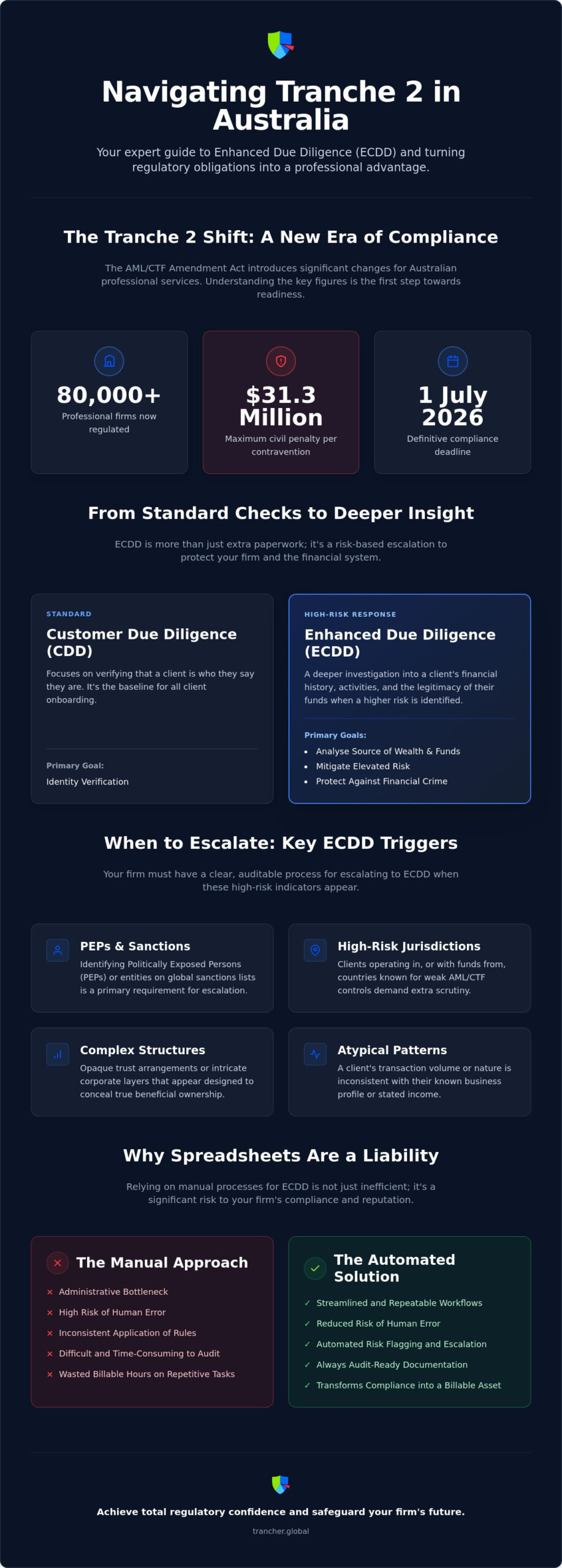
With more than 80,000 Australian professional firms now regulated under the Tranche 2 reforms, the prospect of a $31.3 million civil penalty can feel like a heavy weight on your practice. You’ve likely already felt the squeeze on your billable hours as you try to untangle complex trust structures or verify beneficial owners manually. It’s a common frustration to find that these essential safety checks are becoming an administrative bottleneck. However, implementing the right enhanced due diligence software Australia doesn’t just tick a box for AUSTRAC; it transforms a regulatory hurdle into a streamlined, professional standard that safeguards your firm’s reputation.
I’m here to help you move past the stress of manual spreadsheets and into a position of total regulatory confidence. In this guide, we’ll walk through how you can achieve full Tranche 2 readiness by automating your workflows and ensuring your documentation is always audit-ready. You’ll discover practical ways to master complex verifications and, importantly, how to turn compliance from a cost centre into a transparent, recoverable part of your business model. Let’s look at how you can secure your firm’s future and find peace of mind well before the final enrolment deadlines pass.
Key Takeaways
- Learn the specific risk-based triggers that require your firm to escalate from standard checks to more rigorous enhanced due diligence.
- Discover how implementing enhanced due diligence software Australia can eliminate administrative bottlenecks and reduce the risk of human error in complex verifications.
- Understand the critical importance of choosing a platform that integrates with your existing tools and provides local, expert support for the Tranche 2 transition.
- Identify ways to transform your compliance obligations into a billable asset by accurately tracking and recovering the costs of your professional due diligence work.
- Gain peace of mind with a structured approach to documentation that ensures your firm remains audit-ready and fully protected against regulatory penalties.
What is Enhanced Due Diligence (ECDD) in the Australian Context?
Enhanced Due Diligence (ECDD) isn’t just a more thorough version of your standard identity checks; it’s a specific, risk-based response required under the AML/CTF Act 2006. While standard Customer Due Diligence (CDD) focuses on verifying that a client is who they say they are, ECDD demands a deeper investigation into their financial history and the legitimacy of their activities. It’s essentially the high-resolution version of Know Your Customer (KYC), applied when the risk of money laundering or terrorism financing is elevated.
By looking past the immediate transaction to the underlying source of wealth, you protect the integrity of the Australian financial system from sophisticated threats. For many years, this level of scrutiny was largely the domain of big banks. However, the passage of the AML/CTF Amendment Act in late 2024 changed the game. The 1 July 2026 deadline serves as a definitive line in the sand for Australian professional service providers. If you provide “designated services” after this date, your firm must have a robust, auditable ECDD process in place or face civil penalties that can reach $31.3 million per contravention.
Adopting dedicated enhanced due diligence software Australia helps you manage this transition with confidence. It replaces the guesswork of manual filing with a structured, repeatable framework. Instead of feeling overwhelmed by the sheer volume of data, you can rely on automated systems to flag risks that might otherwise slip through the cracks of a busy practice.
The Tranche 2 Impact on Australian Accountants
The 1 July 2026 deadline fundamentally alters what it means to be a “reporting entity” in Australia. For accounting firms, the definition of designated services now encompasses everything from managing client money to setting up complex company structures. You’re no longer just verifying a driver’s licence. You’re now tasked with understanding a client’s “Source of Wealth” and “Source of Funds” for high-risk engagements. This shift requires moving from reactive, once-off checks to a proactive, ongoing risk management mindset where you’re constantly aware of changes in a client’s risk profile.
Key Triggers for Enhanced Due Diligence
Knowing when to escalate a check is just as important as the check itself. There are several non-negotiable triggers that require your firm to move into ECDD mode immediately:
- PEPs and Sanctions: Identifying Politically Exposed Persons or individuals on global sanctions lists is a primary requirement.
- High-Risk Jurisdictions: Clients operating in or receiving funds from countries with weak AML/CTF controls demand extra scrutiny.
- Complex Structures: Dealing with opaque trust arrangements or intricate corporate layers that seem designed to hide beneficial ownership.
- Atypical Patterns: When a client’s transaction volume or nature doesn’t align with their known business profile or stated income.
When these triggers appear, your enhanced due diligence software Australia provides the necessary tools to document your findings clearly. This ensures that if AUSTRAC ever requests an audit, you can demonstrate exactly why you took certain steps and how you mitigated the identified risks.
When Must Your Firm Perform Enhanced Due Diligence?
The Australian AML/CTF framework operates on a risk-based approach. This means you aren’t required to perform deep-dive investigations on every client, but you must have a clear system for deciding when a standard check is no longer sufficient. Moving from standard Customer Due Diligence (CDD) to Enhanced Due Diligence (ECDD) is a deliberate step. It’s a professional escalation that occurs when your initial risk assessment identifies a high level of money laundering or terrorism financing risk. Choosing an enhanced due diligence software Australia allows your team to set automated triggers that flag these risks instantly, ensuring you never miss a required escalation.
A critical component of this process is the “Reasonable Grounds” test. Under the AML/CTF Act, if your firm forms a suspicion that a client or a transaction might be related to criminal activity, you’re legally obligated to conduct ECDD. This isn’t just about following a checklist; it’s about professional judgement. If something feels off, or if a client provides inconsistent information, you must dig deeper. For Australian firms, this often manifests during high-value property transactions or when dealing with complex corporate setups that appear to lack a clear commercial purpose. In these moments, your software acts as a steady guide, prompting the right questions to satisfy regulatory requirements.
AUSTRAC doesn’t just want to see the final result of your checks. They want to see the “why” behind every decision. During an audit, you must be able to demonstrate the logic used to determine a client’s risk level and the specific evidence gathered during the ECDD process. Maintaining these records manually is a significant administrative burden. However, a structured digital system ensures that every decision is documented in real-time, creating a clear, audit-ready trail of your firm’s compliance efforts.
The Role of PEPs and Sanctions Screening
Manual screening against global lists is no longer a viable strategy in a Tranche 2 environment. The sheer volume of data and the speed at which sanctions change make it nearly impossible to keep up without automation. It’s also vital to distinguish between domestic PEPs, such as local members of parliament, and international PEPs, who often carry a higher inherent risk. Implementing PEPs and sanctions screening software allows you to perform these checks instantly and continuously, protecting your firm from accidentally engaging with high-risk individuals.
Verifying Beneficial Ownership and Complex Structures
Unmasking the individuals who truly control a discretionary trust or a shelf company is a “fair dinkum” challenge for many accountants. These structures are often opaque by design, making it difficult to identify the Ultimate Beneficial Owners (UBOs). Using automated client verification Australia simplifies this discovery by pulling data from multiple sources to map out ownership hierarchies. This removes the friction of manual data entry and ensures you have a reliable record of who you’re actually doing business with. If you’re looking to streamline these complex verifications, you might find that partnering with a specialist platform can help you achieve full readiness in as little as 30 days.
Manual vs. Automated ECDD: Why Spreadsheets are a Risk
Relying on spreadsheets for complex compliance isn’t just an outdated habit; it’s a significant operational risk. Many firms are currently paying a hidden “compliance tax” in the form of lost billable hours spent on manual data collection and follow-ups. When you calculate the time senior staff spend chasing identity documents or cross-referencing trust deeds, the true cost of manual processes becomes clear. This manual approach often follows the “Swiss Cheese” model of failure, where small, individual errors in data entry or filing eventually align to create a major regulatory breach.
AUSTRAC has made it clear that they look far more favourably on firms that employ structured, automated systems. This preference exists because automation removes the variability of human memory and ensures every check is performed the same way, every time. Beyond the regulatory benefits, there’s a real psychological toll on your team when they’re forced to manage fragmented, high-stakes compliance tasks alongside their core professional work. It’s much easier to retain talent and maintain morale when you provide your staff with the right tools to do their jobs efficiently.
Adopting enhanced due diligence software Australia allows you to move away from these fragile manual systems. It replaces the stress of “did we check that?” with the certainty of “it’s already done.” By automating the heavy lifting, you allow your team to focus on high-value advisory work rather than administrative data entry.
The Inefficiency of Fragmented Systems
Storing sensitive AML documents in general practice management folders is a recipe for disaster. It’s too easy for a crucial verification record to be misplaced or for a staff member to overlook a reporting deadline because the information is scattered across different platforms. These “broken” workflows are often where suspicious matter oversights occur. By centralising your processes within a single source of truth, you ensure that all CDD and KYC requirements Australia are met without the friction of manual filing or the risk of data silos.
Licence Risk and AUSTRAC Penalties
The consequences of non-compliance under the 2026 framework are substantial. With civil penalties reaching up to $31.3 million, the financial and reputational damage of a failed audit can be catastrophic for an SME firm. It’s a sobering reality that “I didn’t know” or “we were too busy” is no longer a valid defence. Using enhanced due diligence software Australia provides a vital “compliance shield” for your practice. It creates an immutable audit trail that proves your firm has acted with due care and diligence, turning a potential liability into a documented strength.
Choosing the Best Enhanced Due Diligence Software in Australia
Selecting the right platform for your firm is a strategic decision that extends far beyond simple regulatory box-ticking. The ideal enhanced due diligence software Australia should act as a silent partner, integrating seamlessly with your existing practice management tools to prevent the creation of inefficient data silos. If a software solution doesn’t “talk” to your current systems, it quickly becomes another administrative hurdle rather than a solution. You need a platform that pulls client data automatically, reducing the need for repetitive manual entry and ensuring your records remain consistent across the board.
Local support is another non-negotiable factor. When you’re facing a complex compliance query or a technical glitch, waiting for a response from a different time zone isn’t an option. Having access to a real person in Australia who understands the specific nuances of the Tranche 2 landscape provides immense peace of mind. Additionally, the software must be intuitive enough for junior staff to navigate the KYC process independently. This frees up partners to focus on high-level advisory work rather than intervening in every routine verification. Finally, look for robust reporting features that can generate one-click summaries for your AUSTRAC annual compliance reports, saving you days of manual preparation.
Essential Features for SME Accounting Firms
For smaller firms, the software must be both powerful and practical. Look for automated risk rating engines that you can customise to align with your firm’s specific risk appetite and internal policies. This ensures that your compliance programme is tailored to your unique client base rather than being a generic, one-size-fits-all approach. Built-in staff training modules are also vital, as they ensure your entire team remains up to date with their obligations without requiring expensive external consultants. Guided prompts for Suspicious Matter Reporting (SMR) are also incredibly helpful; they act as a checklist to ensure no critical detail is missed when you’re required to notify AUSTRAC of a potential concern.
The Trancher Difference: 30 Days to Readiness
We understand that the transition to Tranche 2 can feel daunting, which is why we’ve designed a process that prioritises speed and support. Trancher provides a 30-day compliance-ready guarantee, taking the guesswork out of your implementation timeline. Instead of leaving you to figure things out with generic tutorials, we offer expert-led onboarding that guides you through every step of the setup. To ensure the platform is the right fit for your practice, you can take advantage of our complimentary 3-month trial. This allows you to test the features in a live environment and see the efficiency gains for yourself. If you’re ready to secure your firm’s future, you can start your 30-day journey to readiness with our expert team today.
Transforming ECDD from a Burden into a Billable Asset
Many Australian firms view the upcoming Tranche 2 requirements as a purely administrative overhead. This perspective, while common, misses a significant opportunity to improve your practice’s bottom line. Compliance isn’t a tax on your time; it’s a professional service that requires high-level expertise to navigate. When you spend hours unmasking beneficial owners or investigating source of wealth for a high-risk engagement, you’re providing a valuable risk-mitigation service that protects your client as much as it protects your firm. Reframing these activities as billable professional services allows you to move away from absorbing costs and toward a more sustainable business model.
Utilising enhanced due diligence software Australia is the key to making this shift practical. Instead of compliance being a “black hole” of unrecorded time, a structured platform allows you to treat it with the same rigour as tax planning or audit work. When you’re transparent with clients about the necessity and value of these checks, you build deeper trust. They see a firm that’s not only regulatory-compliant but also deeply committed to the integrity of their financial affairs. This transparency often opens doors to high-value advisory conversations, as the data gathered during the ECDD process provides unique insights into a client’s broader corporate health and risk exposure.
Tracking Billable Compliance Activities
The mechanics of capturing revenue start with visibility. You need to know exactly how much time your team is dedicating to each verification. By using compliance ROI tracking software, you can log time spent on specific client files and identify hours that would otherwise go unbilled. Trancher’s built-in billing support features help you generate detailed reports that prove the efficiency of your automated stack. These reports allow you to justify compliance fees to clients with clear, data-backed evidence, ensuring your firm remains profitable while meeting its obligations.
A Proactive Roadmap to July 2026
The 1 July 2026 deadline is approaching, and starting your transition now provides a distinct competitive advantage. Firms that are already compliant will find it much easier to attract and retain top talent who are looking for modern, efficient workplaces rather than those bogged down by manual paperwork. We encourage you to take advantage of the “early bird” benefits, including a 20% discount for early adopters and expert guidance throughout your journey. Your path to readiness starts with a simple step. Start your complimentary 3-month trial with Trancher today and see how we can help you turn compliance into a strategic asset.
Securing Your Practice for the 2026 Transition
Integrating enhanced due diligence software Australia into your daily operations is more than a defensive move against potential penalties; it’s a strategic investment in your firm’s operational maturity. By moving away from manual processes and adopting automated workflows, you ensure that complex verifications like trust structures and source of wealth checks are handled with absolute precision. This proactive approach not only protects your professional reputation but also allows you to recover compliance costs as a transparent, billable service.
We’re here to act as your steady guide through every step of this regulatory shift. With our 30-day compliance-ready guarantee and dedicated local Australian support, you can transition with confidence. Secure your firm’s future with a complimentary 3-month trial of Trancher today to experience our expert onboarding and lock in a 20% discount for early participants. Taking action now ensures your practice remains resilient, profitable, and ready for the future.
Frequently Asked Questions
Is enhanced due diligence mandatory for all Australian accounting clients?
Enhanced Due Diligence (ECDD) is not mandatory for every client; instead, it is a targeted requirement for those identified as high-risk. You only need to escalate to ECDD when specific triggers are met, such as a client being a Politically Exposed Person (PEP) or if you form a suspicion about a transaction. This risk-based approach ensures your firm’s resources are focused where they are most needed while maintaining full regulatory compliance.
How does enhanced due diligence software differ from standard KYC tools?
Standard KYC tools focus on verifying a person’s identity, whereas enhanced due diligence software Australia provides a deeper analysis of a client’s financial background and risk profile. While standard tools check drivers’ licences and passports, ECDD software investigates source of wealth, unmasks complex beneficial ownership in trusts, and monitors for ongoing risk. This additional layer is essential for meeting the more stringent requirements of the Tranche 2 reforms.
What are the specific triggers for ECDD under Tranche 2 regulations?
Triggers for ECDD include engaging with Politically Exposed Persons (PEPs), clients from high-risk jurisdictions, or those using opaque corporate structures like discretionary trusts. You must also escalate if a transaction pattern doesn’t align with a client’s known business profile. Having clear, automated triggers helps your team identify these moments instantly, ensuring you remain compliant without having to manually review every single file for subtle risk indicators.
Can I perform enhanced due diligence manually using government databases?
You can technically perform ECDD manually using databases like ASIC or the ABN Lookup, but this approach carries significant risk of human error and oversight. Manual searches are time-consuming and often fail to capture real-time changes in global sanctions or PEP lists. Relying on manual processes also makes it difficult to produce the immutable audit trail that AUSTRAC expects during a formal inspection of your compliance programme.
How long does it take to implement enhanced due diligence software?
Implementation timelines vary across providers, but our structured approach ensures your firm is compliance-ready within 30 days. This includes the initial setup, platform integration, and staff training modules. By following a guided roadmap, you can transition from manual spreadsheets to a fully automated system without disrupting your firm’s billable work or client service delivery during the setup phase.
What information must be collected for “Source of Wealth” checks in Australia?
Source of Wealth checks require you to understand the activities that generated a client’s entire net worth, not just the funds for a single transaction. You might collect documents such as audited financial statements, property sale records, or grant of probate for inheritances. The goal is to ensure the client’s wealth has been accumulated through legitimate means, providing a comprehensive picture of their financial history to satisfy regulatory scrutiny.
How does Trancher ensure my firm is audit-ready for an AUSTRAC inspection?
Trancher ensures your firm is audit-ready by automatically generating immutable records of every due diligence decision and verification step. Our enhanced due diligence software Australia captures the logic behind your risk ratings, creating a clear chronological trail for AUSTRAC inspectors. This centralisation of documentation means you can produce comprehensive compliance reports with a single click, proving that your firm has consistently met its legal obligations.
Is there a cost-benefit to automating ECDD for a small firm with fewer than 10 staff?
Small firms often see the greatest benefit from automation because they have fewer resources to dedicate to administrative tasks. Automating ECDD allows your limited staff to focus on high-value advisory work instead of manual data entry. Additionally, using our ROI tracking features helps you identify and recover compliance costs from clients, turning what was once a sunk cost into a transparent, billable professional service.