

What if the looming July 2026 deadline wasn’t a source of administrative dread, but the catalyst for your firm’s most efficient onboarding system yet? It’s completely understandable if you feel a sense of unease regarding the updated CDD and KYC requirements Australia has introduced for the accounting sector. Between the weight of potential AUSTRAC penalties and the complexity of identifying “designated services,” the transition to Tranche 2 can feel like a significant burden on your practice’s resources.
This guide is designed to help you master the essentials of Customer Due Diligence, ensuring you meet the new standards with absolute confidence. We’ll provide a clear, repeatable workflow for client verification that minimises friction, clarifies your reporting obligations, and shows you how to turn compliance into a value-add service. By the end of this article, you’ll know exactly how to implement a risk-based approach that keeps your firm both protected and profitable.
Key Takeaways
- Distinguish between initial identity verification and the broader framework for managing ongoing risk to ensure your practice remains fully protected.
- Prepare for the July 2026 deadline by mastering the updated CDD and KYC requirements Australia now mandates for the accounting sector.
- Implement a three-tiered approach to due diligence, allowing you to streamline checks for low-risk entities while focusing your resources on more complex profiles.
- Establish “audit-ready” record-keeping habits that satisfy AUSTRAC’s seven-year storage rules without overwhelming your internal filing systems.
- Transition compliance from an administrative burden into a billable advisory service by leveraging automation to remove manual friction from your workflow.
What are CDD and KYC Requirements in Australia for 2026?
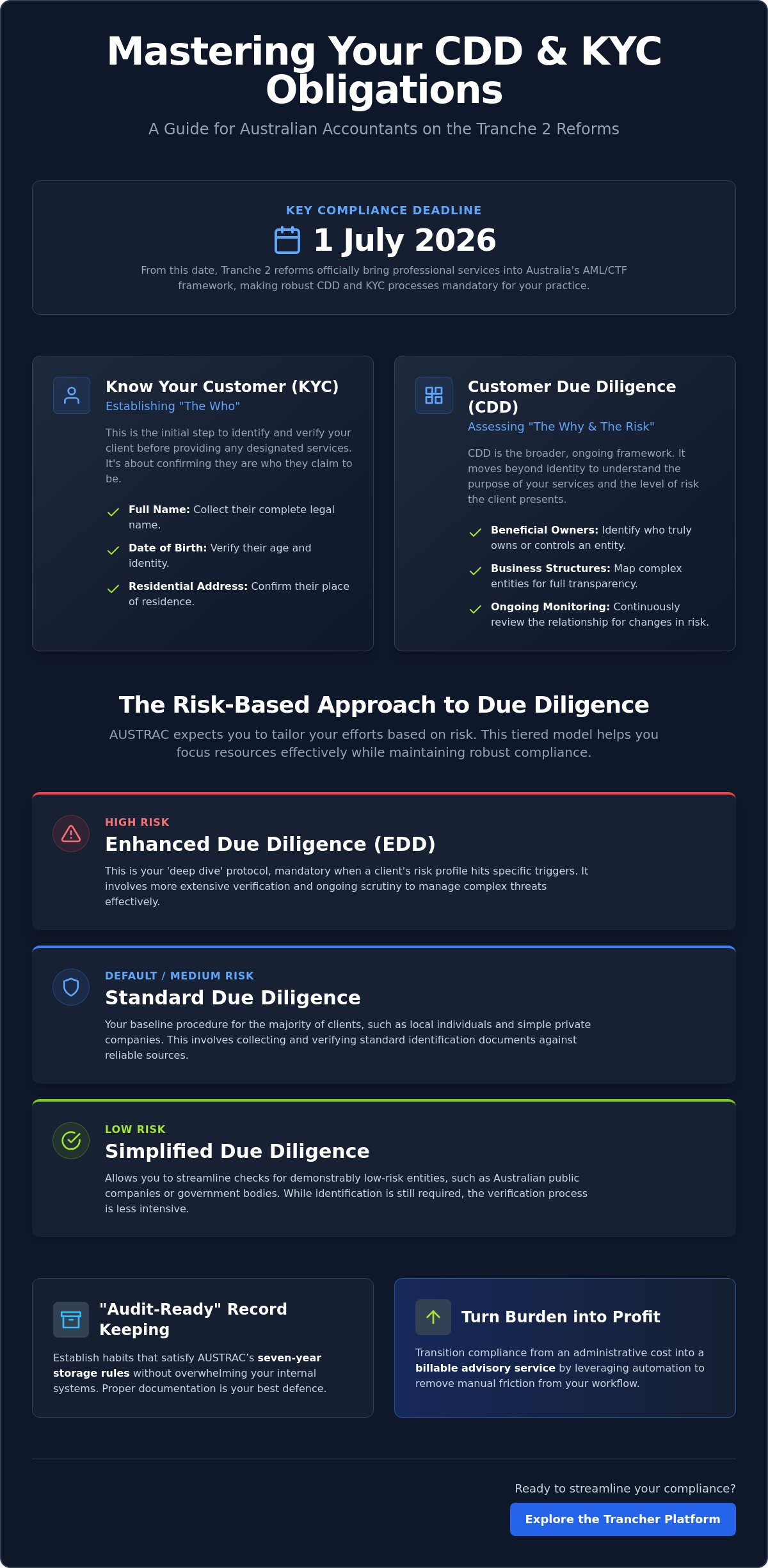
The regulatory environment for Australian accountants is undergoing its most significant shift in decades. From 1 July 2026, the Tranche 2 reforms officially bring professional services into the anti-money laundering and counter-terrorism financing (AML/CTF) framework. This means the CDD and KYC requirements Australia has established are no longer just for big banks. They’re now a core part of your daily practice and professional responsibility.
AUSTRAC is moving away from simple tick-box compliance. Instead, the focus is on a risk-based approach. You need to prove you actually understand who you’re doing business with and what risks they might pose to the financial system. It’s about achieving real security outcomes rather than just collecting a stack of photocopied IDs. This transition isn’t just a hurdle; it’s a chance to modernise your firm’s internal systems.
The Core Components of KYC
Know Your Customer (KYC) is the initial hurdle of the compliance journey. It’s the process of identifying and verifying your client’s identity before you provide any designated services. For an individual, this involves collecting three pillars of data: their full name, date of birth, and residential address. You’re effectively establishing the “who” of the client relationship.
Verification must rely on reliable and independent sources. While physical passports and driver’s licences were once the only standard, the 2026 standards embrace digital verification to make the process seamless for your team and your clients. You also need to document the nature and purpose of your business relationship. Are they seeking a one-off tax return or a complex trust restructure? The answer changes your risk profile significantly and determines how much further you need to look.
The Difference Between KYC and CDD
It’s common to hear these terms used interchangeably, but they serve different roles. KYC is essentially the “who.” It confirms the person sitting across from you is who they claim to be. Customer Due Diligence (CDD), however, is the broader framework. It asks “why” they’re using your services and “how much risk” they bring to your firm. Understanding these CDD and KYC requirements Australia mandates is the first step toward building a resilient practice.
A robust CDD process involves more than a simple ID check. It includes:
- Identifying Ultimate Beneficial Owners (UBOs): You must see who truly owns or controls a company or trust to prevent hidden interests.
- Understanding Business Structures: Mapping out complex entities ensures transparency across the entire client profile.
- Ongoing Monitoring: This is the “O” in CDD that many firms overlook. It involves spotting unusual transaction patterns over the life of the relationship.
In the 2026 landscape, compliance is a living process. It requires regular reviews and updates to ensure your client’s risk profile hasn’t shifted since they first walked through your door. By automating these checks, you can turn a manual burden into a smooth, professional workflow that adds real value to your client onboarding.
The Three-Tiered Approach to Due Diligence
Compliance doesn’t have to be an all-or-nothing endeavour. In fact, a sophisticated approach to CDD and KYC requirements Australia expects you to tailor your efforts based on the actual risk a client presents. This risk-based model ensures you aren’t wasting resources on low-risk files while leaving your firm’s “back door” open to more complex threats. By categorising your clients into three distinct tiers, you can maintain a high standard of security without sacrificing operational efficiency.
Standard CDD serves as your baseline. It’s the default procedure for most local individual clients and simple private companies. You collect the necessary identification, verify it against reliable sources, and move on. Simplified CDD, on the other hand, allows you to “dial down” these checks for low-risk entities like Australian public companies or government bodies. According to AUSTRAC’s customer due diligence guidance, you still need to identify these clients, but the verification process is significantly more streamlined. If you’re looking to simplify your workflow, you can explore our platform integrations that help categorise these risks automatically.
When to Apply Enhanced Due Diligence
Enhanced Due Diligence (EDD) is your “deep dive” protocol. It’s mandatory when a client’s risk profile hits specific triggers. You must apply EDD if you’re dealing with Politically Exposed Persons (PEPs), their family members, or close associates. These individuals hold positions that could potentially be abused for money laundering. You’ll also need to escalate your checks if a client is based in a “high-risk” jurisdiction or operates in an industry prone to financial crime, such as those that are heavily cash-reliant. For firms looking to manage these high-risk cases efficiently, purpose-built enhanced due diligence software Australia can automate the most complex verification workflows and keep your documentation audit-ready.
Risk isn’t static. A client who starts in the standard tier might move to EDD mid-engagement if their transaction patterns become unusually complex or opaque. Recognising these shifts early protects your firm from becoming an unwitting participant in illicit activity. It’s about keeping a steady hand on the pulse of your client relationships.
Verifying Beneficial Owners and Control
One of the most frequent points of confusion for accountants involves the “25% rule.” You’re required to identify any individual who ultimately owns or controls 25% or more of a client entity. This sounds simple for a basic company, but it becomes challenging when you encounter “cascading” structures involving multiple trusts or offshore holding companies. You need to look through the layers until you find the natural person at the top of the chain.
Managing these intricate webs manually is a significant drain on time. For those navigating these complex structures, utilising automated client verification Australia can significantly reduce the manual burden. Automated systems can map out beneficial ownership and screen for PEPs or sanctions in seconds, ensuring your “audit-ready” documentation is flawless while you focus on providing high-level advisory work.
The Tranche 2 Transition: Why July 2026 Matters
The date 1 July 2026 marks a defining moment for the Australian professional services sector. On this day, the “Tranche 2” reforms officially take effect, bringing accountants, lawyers, and real estate agents under the regulatory gaze of AUSTRAC. While the banking sector has operated under these rules for years, the expansion recognises that professional advisors are often the first line of defence against financial crime. It’s a significant shift, but it’s one that can be managed with the right preparation and a proactive mindset.
Waiting until June 2026 to begin your implementation is a recipe for disaster. The CDD and KYC requirements Australia mandates require more than just a quick software update; they require a change in how you onboard and monitor your clients. While there is a transitional period for existing reporting entities until March 2029, new obligations for ongoing monitoring begin as early as 31 March 2026. This means the time to build your compliance framework is now, not when the deadline is looming. For a comprehensive look at what’s required, AUSTRAC’s official overview of CDD provides the regulatory foundation you’ll need.
AUSTRAC typically views the initial implementation phase through a lens of education and support. During this period, the regulator is often more interested in seeing that you have a structured plan in place and are making a good-faith effort to comply. However, this supportive stance shouldn’t be confused with an exemption. Having a documented AML/CTF programme and a designated compliance officer by the 29 July 2026 notification deadline is a non-negotiable requirement for newly regulated firms.
Common “Designated Services” for Accountants
Not every task an accountant performs triggers AML/CTF obligations. The requirements are tied to “designated services.” For most firms, this includes setting up companies, trusts, or other complex legal arrangements. If you manage client money, securities, or other assets, you’re also providing a regulated service. Even acting as a nominee shareholder or director for a client falls under this umbrella. Identifying which of your service lines are designated is the first step in mapping out your firm’s risk profile.
Preparing Your Firm for the Deadline
Preparation starts with a clear-eyed look at your current client base. Conduct an initial risk assessment to see where your firm might be vulnerable. You’ll also need to update your engagement letters to include necessary AML/CTF disclosures, ensuring your clients understand why you’re asking for additional information. It’s about being transparent and maintaining that expert advisor relationship. To help you navigate this process, we’ve developed a Tranche 2 readiness checklist that provides a step-by-step roadmap for your practice. By starting early, you can ensure your team is trained and your systems are robust well before the 2026 deadline arrives.
Record-Keeping and Ongoing Monitoring Obligations
Compliance isn’t a “one-and-done” task. It’s a continuous lifecycle. Under the CDD and KYC requirements Australia enforces, your firm must maintain a clear, chronological trail of every compliance decision made. AUSTRAC requires you to keep these records for seven years after the client relationship ends or the last designated service is provided. This isn’t merely about archiving old files. It’s about being ready to demonstrate your due diligence at a moment’s notice during a regulatory review.
Maintaining these records manually is often where firms feel the most administrative strain. However, when you view record-keeping as a protective layer for your practice, the value becomes clear. Well-organised documentation proves you’ve taken reasonable steps to mitigate risk. If your monitoring uncovers something concerning, you may need to file a Suspicious Matter Report (SMR). It’s vital to do this without “tipping off” the client, as alerting them to a report can lead to significant legal consequences for your firm and your staff.
Setting Up an Audit-Ready Filing System
The shift toward digital practice management has made physical filing cabinets largely obsolete. Cloud-based automation is now the standard for firms that want to remain both compliant and efficient. When you store sensitive data, you must ensure you’re meeting the Australian Privacy Principles to protect your clients’ personal information. We define “Audit-Ready” as having all verification evidence, risk scores, and approval timestamps time-stamped and retrievable within minutes. If an AUSTRAC auditor requests a file, you shouldn’t be hunting through emails or paper folders. A centralised, secure digital vault ensures that everything you need is exactly where it should be. For a detailed breakdown of how to structure your documentation to meet the mandatory seven-year retention period, our guide on audit ready compliance records for Australian accounting firms provides a step-by-step workflow built specifically for the 2026 requirements.
Implementing Ongoing Risk Monitoring
A client’s risk profile can change overnight. Perhaps a director is appointed to a new board, or a company relocates its operations to a higher-risk region. These are “trigger events” that require a fresh look at your existing KYC data. Relying on manual annual reviews is risky and time-consuming. Instead, many firms are automating PEPs and sanctions screening software to perform daily checks in the background. This proactive approach ensures you’re alerted to changes the moment they occur.
Effective monitoring isn’t just about spotting trouble. it’s about maintaining the integrity of your client data over time. For more detailed steps on this process, you can read our Ongoing risk monitoring software guide. By integrating these checks into your daily operations, you remove the friction of compliance and create a more reliable practice. You can automate your record-keeping and monitoring today to ensure your firm is always prepared for an audit.
Operationalising Compliance: Turning Burden into Profit
Many partners view the incoming CDD and KYC requirements Australia has introduced as a purely administrative expense. This perspective misses a significant commercial opportunity for the modern accounting practice. When you formalise your compliance framework, you aren’t just satisfying AUSTRAC; you’re enhancing your firm’s professional value and risk management capability. By shifting your mindset, you can transform these obligations from a drain on your resources into a sustainable revenue stream that strengthens your client relationships.
Transparent communication is the key to introducing AML-related fees without friction. Clients already value your role as a trusted advisor who keeps their financial affairs secure. Framing compliance as a dedicated “Client Onboarding and Risk Assessment” service makes the value proposition clear. Most clients understand that in a heightened regulatory environment, thorough verification is a sign of a high-quality, professional practice. It demonstrates that you take their security and your own professional standing seriously.
Compliance as a Billable Activity
Transitioning from manual spreadsheets to automated workflows can be achieved in under 30 days with the right partner. This isn’t just about speed; it’s about accuracy and recoverability. By using compliance ROI tracking software, your firm can accurately capture the time spent on due diligence and treat it as a recoverable asset. This ensures that the expertise required to navigate complex beneficial ownership structures is appropriately billed, rather than absorbed as overhead. It turns a mandatory task into a transparent, value-added service for the client.
Why Automation is the Only Path Forward
The hidden cost of manual KYC is often far higher than firms realise. It’s found in the hours staff spend chasing documents, the risk of human error during manual screening, and the potential for missed deadlines. Automation eliminates these inefficiencies by creating a standardised, firm-wide onboarding process. This removes the risk of “rogue” onboarding where different partners might apply different standards, ensuring your practice remains consistently audit-ready and professional. It provides the steady hand needed to navigate a changing landscape with absolute confidence, much like how global enterprises use computermarketresearch.com to automate their complex channel management workflows.
Ultimately, the Trancher philosophy is about removing the administrative weight so you can focus on the high-level advice your clients truly value. We’re here to act as your expert compliance companion, providing the tools and guidance needed to make this transition seamless and profitable. Ready to be Tranche 2 ready? Start your 30-day compliance guarantee with Trancher today and see how operational ease leads directly to business growth.
Future-Proof Your Practice Before July 2026
The shift toward Tranche 2 compliance is a significant milestone for the Australian accounting profession. By mastering the CDD and KYC requirements Australia has set forth, you’re doing more than just avoiding AUSTRAC penalties. You’re building a more resilient, transparent, and digitally mature firm. Successful implementation relies on moving beyond manual checks and embracing a risk-based approach that actually protects your practice. Transitioning early ensures your team is confident and your systems are audit-ready well before the mandatory deadline arrives.
Compliance shouldn’t be a drain on your firm’s productivity. With our 30-Day Compliance Guarantee, we help you turn regulatory obligations into billable assets. Our platform is built specifically for Australian accounting firms and includes ROI reporting to track your billable compliance hours with precision. Get Tranche 2 Ready in 30 Days — Start Your Free Trial. We’re here to be your steady partner as you navigate this new landscape, helping you turn every requirement into an avenue for operational excellence and practice growth.
Frequently Asked Questions
What is the difference between KYC and CDD in Australia?
KYC is the initial identity verification process, essentially confirming the “who” of the relationship. CDD is the broader, ongoing framework that assesses the “why” and “how much risk” a client presents. While KYC is a one-time check at onboarding, CDD involves identifying beneficial owners and monitoring transaction patterns. Mastering both is essential for meeting the CDD and KYC requirements Australia mandates for the accounting profession.
Does my accounting firm really need to comply with Tranche 2 by July 2026?
Yes, any accounting firm providing “designated services” must comply with Tranche 2 obligations by 1 July 2026. These services include creating companies or trusts, managing client assets, and acting as a nominee director. If your practice performs these tasks, you’re required to enrol with AUSTRAC and implement a formal AML/CTF programme. This ensures your firm isn’t unwittingly used to facilitate financial crime.
How long do I need to keep KYC records for AUSTRAC?
AUSTRAC requires you to maintain all relevant compliance records for a minimum of seven years. This period begins from either the date the client relationship ends or the date the last designated service was provided. These records must be “audit-ready,” meaning they’re easily retrievable and contain clear evidence of verification, risk assessments, and any suspicious matter reports filed during the life of the engagement.
What happens if I fail to verify a client properly?
Failing to verify a client properly leaves your firm vulnerable to regulatory intervention and significant financial crime risks. AUSTRAC may conduct audits or enforcement actions if they find your internal processes are lacking. Beyond the risk of penalties, your firm’s reputation is at stake. Proper verification acts as a shield, ensuring you aren’t facilitating money laundering or terrorism financing through your professional practice.
Can I rely on a third party to do my KYC verification?
You can use third-party platforms or agents to perform KYC checks, but the legal responsibility remains entirely with your firm. It’s important to choose a provider that understands the specific CDD and KYC requirements Australia expects from accountants. While automation simplifies the process, your compliance officer must still oversee the programme and ensure the third-party data meets AUSTRAC’s standards for reliability and independence.
What are the penalties for non-compliance with CDD requirements?
Penalties for non-compliance are serious and can include substantial civil fines or infringement notices from AUSTRAC. The regulator has the authority to seek court-ordered penalties for systemic failures in an AML/CTF programme. However, AUSTRAC often focuses on education for firms that show a proactive, good-faith effort to comply. The goal is to ensure you have robust, repeatable systems in place to detect and report suspicious activity.
Do I need to re-verify all my existing clients before July 2026?
You don’t need to re-verify everyone instantly, as existing reporting entities have a transitional period until March 2029 to move to the new initial CDD standards. However, all reporting entities must comply with updated ongoing monitoring obligations by 31 March 2026. This means if an existing client’s risk profile changes after that date, you’ll need to perform a KYC refresh immediately to remain compliant with the new framework.
How much does it cost to implement an AML/CTF program?
The cost of implementing an AML/CTF programme depends on your firm’s size and the level of automation you choose. While there’s an initial investment in software and staff training, many firms recover these costs by treating compliance as a billable onboarding service. Using automated tools reduces manual labour costs significantly, making it easier to maintain high standards without ballooning your practice’s overhead or administrative burden.