

What if the 1 July 2026 deadline wasn’t a looming threat to your firm’s productivity, but the catalyst for its most significant operational upgrade? Many practitioners currently view the new regulations for AML for trust and company service providers Australia as a heavy administrative weight. You’re likely concerned about the manual KYC burden and the daunting reality of AUSTRAC penalties, which can reach $36.4 million for serious corporate breaches. It’s natural to feel that these requirements are simply a non-billable overhead that pulls your focus away from high-value advisory work.
We’re here to help you move past that friction. This guide provides a clear roadmap to master your Tranche 2 obligations while transitioning your firm from regulatory risk to peak operational efficiency. You’ll discover how to build a defensible AML/CTF programme that doesn’t just satisfy the regulator but actually simplifies your client onboarding. By the end of this article, you’ll have the tools to turn mandatory compliance into a professional, billable service that strengthens your firm’s bottom line. We’ll explore the specific designated services that trigger your duties, the essential steps for AUSTRAC enrolment, and the automation strategies that remove the stress from ongoing monitoring.
Key Takeaways
- Prepare for the 1 July 2026 commencement by identifying which specific designated services, such as company formation or nominee roles, trigger your reporting duties.
- Navigate the core requirements of AML for trust and company service providers Australia, including the mandatory enrolment with AUSTRAC and the appointment of a dedicated Compliance Officer.
- Transition from manual, spreadsheet-based tracking to automated workflows to reduce administrative friction and eliminate the risk of significant regulatory penalties.
- Learn the framework for reframing compliance as a recoverable professional service, transforming a perceived cost centre into a billable asset for your firm.
- Leverage your AML/CTF data to gain deeper client insights, turning a regulatory necessity into a strategic advantage for operational excellence.
Understanding Tranche 2: Why TCSPs are Now Under the AUSTRAC Microscope
The Anti-Money Laundering and Counter-Terrorism Financing Amendment Act 2024 has established a non-provisional commencement date of 1 July 2026 for all Tranche 2 entities. This reform brings approximately 100,000 new businesses under the direct supervision of AUSTRAC (Australian Transaction Reports and Analysis Centre). For many firms, this marks a fundamental shift from a voluntary approach to a mandatory, high-stakes regulatory environment. Implementing a robust framework for AML for trust and company service providers Australia is now a core operational requirement rather than an optional safeguard.
While the transition might feel daunting, it’s a necessary step to protect your firm and the broader economy. AUSTRAC’s initial focus will likely target those who wilfully ignore these duties. However, the potential costs of serious non-compliance are substantial, with corporate civil penalties reaching up to $36.4 million. Approaching these changes with a proactive mindset allows you to manage these risks while modernising your internal systems and improving your data integrity.
The Role of TCSPs in the Global AML Landscape
Trusts and complex corporate structures are frequently misused to hide beneficial ownership, making them high-risk vehicles for financial crime. Global standards set by the Financial Action Task Force (FATF) have identified these gaps, leading to the current Australian reforms. The focus on AML for trust and company service providers Australia reflects a global trend toward transparency in corporate and trust structures. By acting as gatekeepers to the financial system, TCSPs play a critical role in preventing illicit funds from entering legitimate channels. A reporting entity in this sector is any business providing a designated service, such as acting as a nominee director or providing a registered office, which necessitates a formal compliance programme.
The 1 July 2026 Deadline: Why Early Preparation is Vital
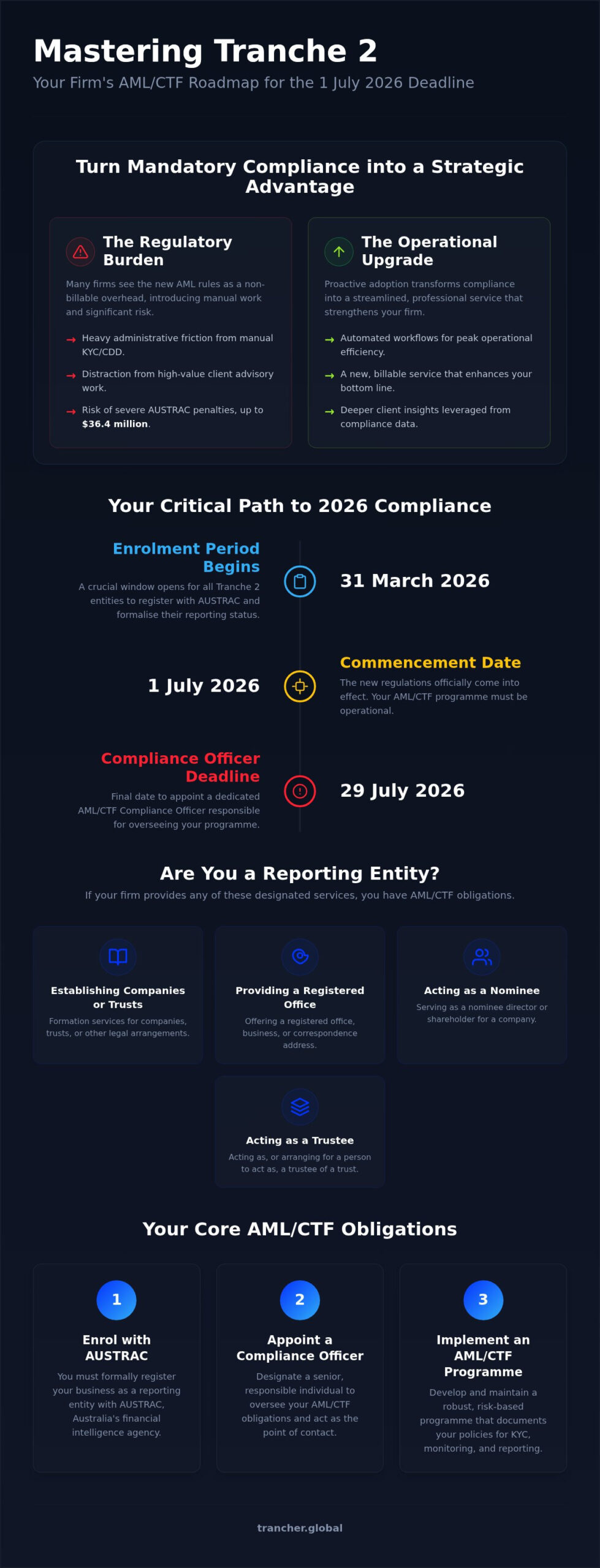
The enrolment period for Tranche 2 entities began on 31 March 2026, providing a narrow window to align your operations before the final 29 July deadline for appointing a compliance officer. Waiting until the last minute creates unnecessary friction and increases the likelihood of administrative errors. Early adoption allows your team to integrate CDD and KYC requirements Australia into your daily workflows without disrupting your billable hours. This period of preparation lets you test your automation tools and refine your processes, ensuring that when the “go-live” date arrives, your firm is already operating with confidence and efficiency.
Identifying Your Designated Services: Are You a Reporting Entity?
AUSTRAC does not simply regulate business categories. It regulates specific activities known as “designated services”. Under the AML/CTF Amendment Act 2024, your firm’s status as a reporting entity depends entirely on the specific functions you perform for your clients. If you provide even one designated service, you must comply with the full suite of obligations. This applies to any service with a geographical link to Australia, meaning the service is provided at or through a permanent establishment in Australia or by an Australian resident. Identifying these triggers for AML for trust and company service providers Australia is the first step toward building a compliant and efficient practice.
Determining your status doesn’t have to be a complex legal exercise. Most firms can identify their reporting triggers by reviewing their standard service agreements. If your firm provides any of the following, you are likely operating as a reporting entity:
- Establishing companies, trusts, or other legal arrangements.
- Providing a registered office or business address.
- Acting as a nominee director or shareholder for a company.
- Acting as a trustee for a trust.
- Arranging for another person to act as a nominee or trustee.
Company and Trust Formation Services
Acting as a formation agent is one of the most common triggers for accounting firms. This includes establishing Australian companies, discretionary trusts, or Self-Managed Superannuation Funds (SMSFs). Your obligations begin the moment you agree to provide the service. You must verify the identity of the person “arranging” the formation, which may be an individual client or a representative of another firm. This requirement ensures that the people behind new legal structures are transparently identified from the outset. Integrating these checks into your standard engagement letters allows you to automate your compliance triggers and maintain a professional workflow.
Nominee and Registered Office Services
Providing a registered office address is now a regulated activity because these locations serve as the official point of contact for legal and regulatory oversight. Similarly, acting as a nominee director or shareholder carries significant weight under the new reforms. These roles involve a high level of trust and, consequently, a higher risk of being exploited for anonymity. Long-term engagements like these require ongoing risk monitoring software to track changes in client profiles or beneficial ownership over time. By using modern tools, you can ensure that your firm remains protected throughout the entire lifecycle of the client relationship, rather than just at the point of onboarding.
The Operational Shift: Moving from Administrative Burden to Professional Service
The most common objection to the new Tranche 2 requirements is the perception that compliance is merely a time-consuming cost centre. Many practitioners fear that AML for trust and company service providers Australia will drain resources without providing any tangible return. This transition actually offers a unique opportunity to modernise your firm’s operations. By shifting from manual processes to structured, automated systems, you can transform a regulatory burden into a streamlined professional service. This evolution doesn’t just satisfy the regulator; it enhances your firm’s internal data quality and reinforces the trust your clients place in your professional oversight.
Managing the complexities of AML for trust and company service providers Australia through manual means is a recipe for operational fatigue. Firms that embrace digital transformation find that they can process client information more accurately while reducing the time spent on administrative “chasing”. This shift allows your team to focus on high-value advisory work, positioning your firm as a forward-thinking partner in a regulated landscape.
The Problem with Manual AML Compliance
Relying on manual, spreadsheet-based systems creates significant hidden costs that often go unnoticed until an audit occurs. Staff spend valuable hours on repetitive data entry, identity verification, and manual screening, all of which are prone to human error. Without a centralised platform, maintaining audit-ready compliance records becomes an administrative nightmare. Manual systems frequently fail during AUSTRAC independent audits because they lack a clear, chronological trail of due diligence actions. These fragmented processes create friction during client onboarding, potentially driving away high-value prospects who expect a seamless, digital-first experience.
Compliance as a Profitable Professional Service
Reframing your AML/CTF obligations as a value-add service allows you to recover the costs associated with these new duties. Clients understand that operating in a transparent, regulated environment protects their own interests and reputations. By using Trancher, your firm can precisely track the time spent on compliance tasks and generate detailed ROI reports that demonstrate the efficiency of your internal programmes. The platform provides a structured framework for “recoverable compliance activity”, ensuring that every verification and risk assessment is documented as a professional deliverable. Automated evidence generation creates a clear record of the work performed, which directly supports your ability to include compliance as a transparent, billable component of your professional engagements. This approach turns a mandatory requirement into a sustainable and profitable part of your business model, allowing you to scale your services without increasing your administrative overhead.
How to Implement Your AML/CTF Program Before the 1 July Deadline
Navigating the requirements for AML for trust and company service providers Australia requires a methodical approach. The implementation process is manageable when broken down into logical steps that align with your existing business cycles. Your first priority is enrolment. The AUSTRAC enrolment window opened on 31 March 2026, and you must notify the regulator of your appointed Compliance Officer by 29 July 2026. This individual oversees the daily operation of your AML/CTF programme and acts as the primary point of contact for regulatory enquiries.
Conducting a Business Risk Assessment (BRA) is the foundation of your strategy. You must identify how your specific services might be exploited for money laundering. For TCSPs, this often involves assessing the risks associated with discretionary trusts or acting as a nominee for foreign entities. Once your risks are identified, you must document your Part A (risk identification and management) and Part B (customer identification and verification) procedures. Implementing automated KYC/CDD tools is the most effective way to handle these requirements without hiring additional staff. Finally, you must train your staff on these new protocols and establish a regular review cycle to ensure your programme remains effective as your firm grows.
Designing a Defensible AML/CTF Program
AUSTRAC expects your AML/CTF Program to be “appropriate” for your firm’s specific size and risk profile. Small to medium firms typically implement a standard programme, while larger groups with multiple reporting entities may opt for a joint programme. Role-based training is essential for a defensible strategy. Your front-line staff need to understand how to spot red flags during onboarding, while senior management must understand their oversight duties. A defensible programme is one that is documented, followed in practice, and regularly updated to reflect new threats in the AML for trust and company service providers Australia landscape.
The 30-Day Compliance Guarantee
Building these systems from scratch can take months of expensive consulting time. Trancher accelerates this implementation, moving your firm from zero to full readiness in just weeks. Our structured onboarding process includes local Australian expert support to help you navigate the technicalities of the legislation. Because we believe in the efficiency of our platform, we offer a complimentary 3-month trial to help you transition without upfront financial pressure. It’s the most secure way to ensure you meet the 1 July deadline while protecting your firm’s profitability. You can start your complimentary trial today to secure your firm’s future and ensure your operations are audit-ready from day one.
Future-Proofing Your Firm: Transforming Compliance into a Recoverable Asset
The journey toward full regulatory readiness often begins with a sense of administrative weight. However, as you move through the process of establishing AML for trust and company service providers Australia, that weight shifts into a source of operational strength. By the time the 1 July 2026 deadline arrives, your firm will have transitioned from initial confusion to a state of operational excellence. This isn’t just about satisfying AUSTRAC. It’s about building a firm that is more transparent, more efficient, and more resilient to the risks of the modern financial landscape.
A well-organised compliance programme acts as a strategic guide for your practice. It provides a structured way to understand your clients’ complex legal arrangements and beneficial ownership structures. When you view these obligations as an avenue for growth rather than a hurdle, you unlock new ways to provide value. You’re not just checking boxes; you’re refining your internal systems to support long-term sustainability and client trust.
Leveraging Compliance for Client Advisory
Utilising the data collected during your KYC and CDD processes provides a powerful tool for proactive client advisory. When you map out trust structures or identify beneficial owners, you often uncover details that warrant deeper professional discussion. You might find that a client’s trust deed requires updating or that their corporate structure is no longer tax-efficient for their current goals. This level of insight allows you to offer high-value advisory services that clients genuinely appreciate. Achieving AML CTF compliance costs reduction through automation also means your team can spend less time on paperwork and more time on these billable advisory opportunities. A compliance-ready firm is a more valuable and reputable firm in the eyes of sophisticated clients.
Final Steps: Starting Your Conversation with Trancher
Setting up your framework for AML for trust and company service providers Australia doesn’t have to be a lonely or exhausting process. Our 30-day implementation path is designed to fit seamlessly into your existing workflows without disrupting your daily operations. You can access our complimentary 3-month trial to experience the ease of automated risk monitoring and reporting firsthand. This trial includes access to our ROI efficiency reporting, giving you clear visibility into how compliance can become a profitable part of your business model. You don’t have to do this alone. We’re here to act as your expert companion, providing the support and local expertise you need to turn regulatory requirements into a strategic advantage. Take the first step toward operational ease and secure your firm’s future today.
Securing Your Firm’s Future Beyond the 2026 Deadline
The 1 July 2026 deadline represents a significant milestone in the modernisation of the Australian professional services sector. By identifying your designated services early and moving away from manual, spreadsheet-based systems, you’ve already taken the most difficult steps toward readiness. Transitioning your framework for AML for trust and company service providers Australia from an administrative cost into a billable, value-add service is the ultimate goal. This shift ensures your firm remains protected from AUSTRAC penalties while simultaneously improving your client onboarding experience and internal data quality.
You don’t have to navigate these regulatory changes without a strategic guide. Trancher offers a guaranteed path to full compliance within 30 days, backed by dedicated local Australian support to answer your specific questions. Every partnership includes a detailed ROI Efficiency and Profitability Report to help you track the financial health of your compliance activities. Start your journey with a complimentary 3-month trial of Trancher today. We’re here to ensure your firm’s transition is seamless, professional, and profitable. With the right systems in place, you can face the new regulatory landscape with complete confidence.
Frequently Asked Questions
What are the main obligations for Tranche 2 entities starting in 2026?
Starting from 1 July 2026, your primary obligations include enrolling with AUSTRAC and appointing a dedicated AML/CTF Compliance Officer. You must also develop a written AML/CTF Programme divided into Part A, covering risk identification and management, and Part B, focusing on customer identification. Ongoing requirements involve conducting customer due diligence, monitoring transactions for suspicious activity, and maintaining audit-ready records for seven years. These steps ensure your firm meets the rigorous standards of AML for trust and company service providers Australia.
Do I need to enrol with AUSTRAC if I only provide registered office services?
Yes, providing a registered office address is a designated service that requires you to enrol with AUSTRAC. Even if you don’t offer complex trust formation, acting as the official address for a company triggers reporting entity status under the new reforms. You’ll need to implement a formal compliance programme to manage the risks associated with this service. This ensures transparency for regulatory bodies and prevents legal structures from being used for anonymous or illicit financial activities.
How much does it cost to implement an AML program for a small TCSP?
Implementation costs vary significantly depending on your firm’s approach. Government impact analysis suggests a typical small-to-medium firm might face upfront costs of A$28,650 and ongoing annual expenses of A$33,230. However, adopting specialised RegTech software often reduces these figures considerably compared to hiring external consultants, who may charge between A$10,000 and A$50,000 for initial setup. Automation streamlines these processes, making compliance a more manageable operational expense for growing Australian practices.
Can I bill my clients for the time spent on AML compliance?
You can certainly structure compliance as a billable professional service. Many firms are now adopting a “recoverable compliance activity” framework to offset the costs of meeting their obligations. By using automated systems to track the time spent on KYC and risk assessments, you can provide clients with transparent evidence of the work performed. This approach reframes AML for trust and company service providers Australia as a premium protective service rather than a hidden overhead.
What happens if my firm is not compliant by the 1 July 2026 deadline?
Failing to meet the 1 July 2026 deadline exposes your firm to significant regulatory action. AUSTRAC has the authority to issue infringement notices, remedial directions, or require an expensive external audit at your firm’s expense. For serious or systemic breaches, corporations can face civil penalties of up to A$36.4 million. While AUSTRAC initially focuses on good-faith efforts, a total lack of a programme by the commencement date is considered a major risk factor for enforcement.
Is a manual KYC process enough to satisfy AUSTRAC requirements?
While manual KYC isn’t strictly prohibited, it’s increasingly difficult to maintain to a defensible standard. Manual systems are prone to human error, missed screening updates, and fragmented record-keeping that often fails during an independent audit. AUSTRAC requires your programme to be “appropriate” for your risk level. For most TCSPs, automated tools are the only practical way to ensure consistent identity verification and ongoing monitoring without creating an overwhelming administrative burden on your staff.
How does Trancher guarantee compliance within 30 days?
Trancher guarantees compliance within 30 days by providing a highly structured onboarding path and pre-configured templates tailored to Australian regulations. Our platform replaces months of manual policy drafting with automated workflows that integrate directly into your existing client systems. By combining local expert support with pre-built risk assessment frameworks, we remove the guesswork from implementation. This methodical approach ensures your firm meets all Part A and Part B requirements well before the regulatory deadline.
What is the difference between a TCSP and a standard accounting firm under Tranche 2?
The distinction lies in the specific “designated services” provided rather than the job title. A standard accounting firm might focus purely on tax returns, whereas a TCSP provides services like company formation, trust administration, or nominee roles. In practice, most Australian accounting firms that establish SMSFs or discretionary trusts will be classified as TCSPs under the new reforms. Both must comply with identical AUSTRAC obligations if they provide any service listed in the 2024 Amendment Act.