

What if the July 2026 deadline isn’t a threat to your firm’s productivity, but the catalyst for your most profitable service line yet? With the Anti-Money Laundering and Counter-Terrorism Financing (AML/CTF) Amendment Act 2024 now in effect, many Australian accountants feel a sense of dread regarding the July 1 commencement date. It’s understandable to worry about non-billable administrative hours or the risk of AUSTRAC penalties. However, your Tranche 2 readiness checklist shouldn’t be a source of stress. We’re here to help you move from confusion to confidence.
We understand that the transition for approximately 100,000 affected businesses feels daunting, especially when you’re trying to identify which specific services are officially “designated.” This article provides a comprehensive operational roadmap that shifts your focus from regulatory fear to strategic growth. You’ll learn how to integrate AML requirements into your existing workflows without any friction. We’ll outline the essential steps for enrolment, the appointment of your compliance officer by July 29, and the best ways to turn these mandatory obligations into a steady stream of advisory revenue.
Key Takeaways
- Grasp the essentials of the 2024 reforms and how the July 2026 commencement date affects your specific service offerings.
- Follow a structured Tranche 2 readiness checklist to appoint your compliance officer and develop a tailored AML/CTF programme.
- It’s time to replace manual administrative hurdles with automated workflows that keep your practice audit-ready and operationally efficient.
- Unlock new revenue streams by transforming mandatory compliance into a high-value, billable advisory service for your clients.
- Access a clear 30-day path to AUSTRAC enrolment and full regulatory compliance with Trancher’s expert companion approach to onboarding.
What is Tranche 2? Understanding the 2026 AUSTRAC Reforms
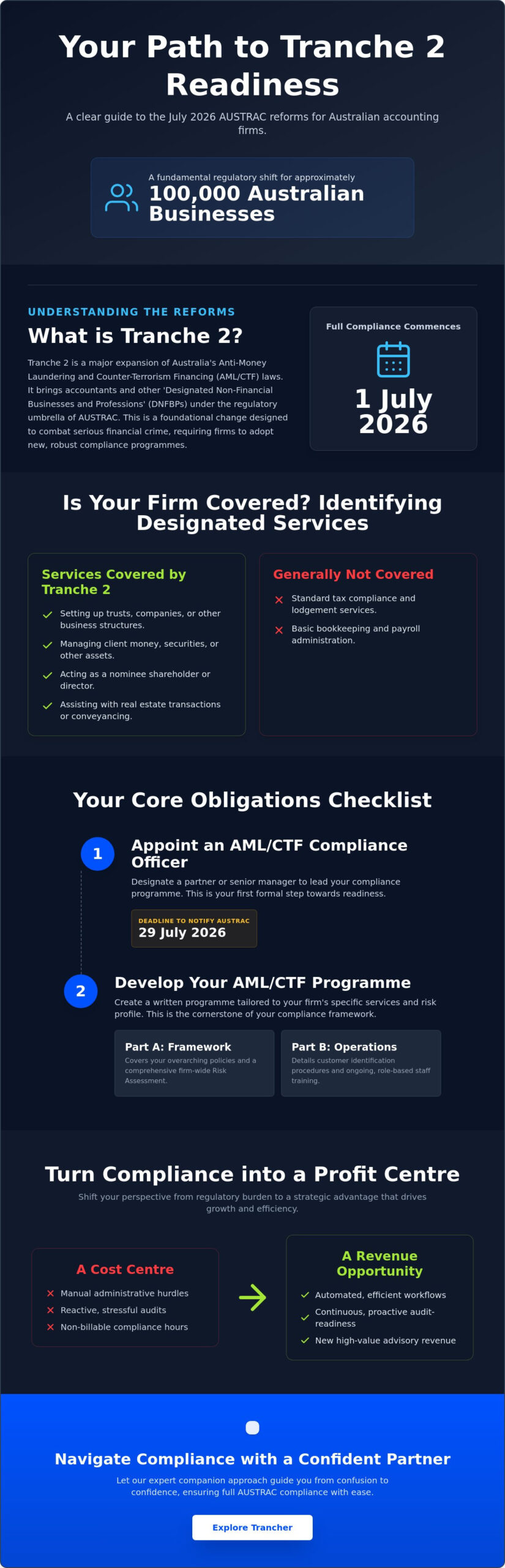
Tranche 2 refers to the significant legislative expansion that brings “Designated Non-Financial Businesses and Professions” (DNFBPs) under the regulatory umbrella of the Australian Transaction Reports and Analysis Centre (AUSTRAC). This shift isn’t just a minor tweak to existing rules; it’s a fundamental change in how Australian accounting practices operate. The Anti-Money Laundering and Counter-Terrorism Financing (AML/CTF) Amendment Act 2024 received Royal Assent on 10 December 2024, setting the stage for a new era of transparency. For your firm, the most critical date is 1 July 2026. This is when your full compliance obligations officially commence.
Think of this transition as an opportunity to modernise your internal systems. While the primary intent is to combat serious financial crimes like money laundering and terrorism financing, the practical outcome for your practice is a more robust, risk-aware business model. Approximately 100,000 Australian businesses will be affected by these reforms. Utilising a Tranche 2 readiness checklist now ensures you aren’t caught in the last-minute rush that often accompanies major regulatory shifts.
Is Your Firm Covered? Identifying Designated Services
Not every task an accountant performs falls under the new rules, but many core advisory services certainly do. If your firm provides “designated services,” you are legally required to comply. This includes setting up trusts or companies, managing client money or assets, and acting as a nominee shareholder. Even assisting with real estate transactions or conveyancing triggers these obligations. For instance, when Australian clients engage in overseas property ventures through agencies like chainexrealestate.com, the associated financial advisory and money management tasks fall squarely within the scope of Tranche 2. It’s important to distinguish these from standard tax compliance or basic bookkeeping. If your service has a “geographical connection to Australia” and involves the movement or management of significant value, it likely requires a formal AML/CTF programme. Identifying these services early allows you to categorise your client base accurately and apply the right level of due diligence.
The Consequences of Procrastination
Delaying your preparation until June 2026 is a risky strategy that could impact your firm’s stability. AUSTRAC has the authority to seek court-imposed civil penalties for serious non-compliance, and the reputational damage of being linked to financial crime can be irreparable. Procrastination often leads to operational bottlenecks. Waiting until the final month makes it nearly impossible to provide thorough staff training or integrate new software effectively. By starting your Tranche 2 readiness checklist today, you secure the time needed to refine your workflows. Early adoption isn’t just about avoiding fines; it’s about maintaining your status as a reliable, steady hand for your clients while ensuring your team feels supported rather than overwhelmed.
The Tranche 2 Readiness Checklist: Core Obligations
Transitioning your firm toward full compliance involves more than a few administrative adjustments; it requires a foundational shift in how you manage client risk. Your Tranche 2 readiness checklist begins with the appointment of an AML/CTF Compliance Officer. This individual, typically a partner or senior manager, acts as the strategic lead for your programme. You have until 29 July 2026 to notify AUSTRAC of this appointment. It’s a role that carries significant responsibility, ensuring that your firm’s policies aren’t just written on paper but are active in your daily operations.
Beyond the compliance officer, your practice must develop and maintain a written AML/CTF Programme. This document is the cornerstone of your regulatory defence. It must be tailored specifically to your firm’s risk profile, accounting for the types of clients you serve and the specific services you provide. While the first independent review of your programme won’t be due until 1 July 2029 at the earliest, establishing a robust framework now prevents operational friction later. We can help you organise your compliance framework to ensure every requirement is met with confidence.
Designing Your AML/CTF Programme
A standard programme is split into two functional parts. Part A covers your overarching policies, including how you identify and manage risks. You’ll need to conduct a thorough Risk Assessment to pinpoint where your practice is most vulnerable to financial crime. Part B focuses on the granular details of customer identification. It’s vital to implement role-based staff training across your entire team. When everyone understands their reporting duties, you create a culture of transparency that protects the firm’s reputation and its bottom line.
Mastering Customer Due Diligence (CDD)
Verification is often the most time-consuming part of the Tranche 2 readiness checklist. You must apply different levels of scrutiny based on risk: Standard, Simplified, or Enhanced Due Diligence (EDD). While verifying an individual is relatively simple, Australian accounting often involves complex trusts and corporate structures that require deeper investigation. Integrating ongoing risk monitoring software allows you to automate client screening. This ensures you’re alerted to changes in a client’s risk profile immediately, rather than waiting for an annual review, keeping your practice safe and audit-ready at all times.
Finally, your firm must establish clear protocols for Suspicious Matter Reporting (SMR). If you encounter activity that doesn’t align with a client’s known financial profile, you’re obligated to report it to AUSTRAC. This isn’t about being an investigator; it’s about being a gatekeeper for the Australian financial system. By setting up these protocols early, you ensure your staff feel supported and know exactly what steps to take when they spot a red flag.
Operationalising Compliance: Integrating AML into Practice Workflows
Once you’ve ticked off the high-level items on your Tranche 2 readiness checklist, the focus shifts to your daily operations. The most significant risk to an Australian practice isn’t just the regulation itself, but the administrative weight of manual compliance. Relying on spreadsheets to track client risk might seem cost-effective initially, but it’s a recipe for regulatory disaster. Manual logs are prone to human error, difficult to version control, and almost impossible to defend during a formal AUSTRAC audit. A single missed cell or an outdated file could lead to significant oversight.
Integrating AML into your existing workflows ensures that compliance becomes a natural part of your client journey. This journey begins at the very first discovery call. Mapping this process involves identifying every touchpoint, from the initial contact to the ongoing annual review. By embedding identity verification directly into your onboarding software or CRM, you capture necessary data before the engagement even starts. This proactive approach removes friction, ensuring that by the time you’re ready to provide advice, the heavy lifting of due diligence is already complete. It’s about creating a system where compliance happens in the background while you focus on your client relationships.
Avoiding the “Administrative Heavy” Trap
Many firms fear that Tranche 2 will require doubling their administrative staff. Your Tranche 2 readiness checklist should prioritise automated workflows to ensure sustainability. The key is identifying friction points where compliance typically slows down onboarding. Automation reduces manual data entry and ensures that risk assessments remain consistent across the firm. Instead of fragmented folders and disparate emails, a unified compliance dashboard provides a single source of truth. This allows your team to focus on high-value advisory work rather than chasing identity documents or re-keying data into multiple systems.
If you find that automation isn’t enough and you need to expand your team to handle these new requirements, keep in mind that the recruitment process has also become highly automated; many top-tier candidates now use Rezumi to ensure their professional history is properly parsed by modern hiring systems.
Record Keeping and Audit Readiness
Under AUSTRAC requirements, your firm must adhere to a strict 7-year rule for document retention. This isn’t just about keeping a copy of a driver’s licence; it’s about maintaining a comprehensive record of every compliance decision made during the client lifecycle. To be truly “audit-ready,” your digital files should be structured so an independent reviewer can understand your rationale in minutes. Automated tools can generate a timestamped paper trail of your screening results and risk justifications. This level of organisation transforms a potential burden into a streamlined, professional system that protects your practice for the long term. It ensures that when the first independent review deadline arrives in 2029, your firm can demonstrate a history of diligent, consistent compliance.
Compliance as a Profit Centre: Transforming Obligations into Revenue
Many Australian practitioners view the July 2026 deadline with a sense of financial trepidation, fearing that non-billable hours will erode their margins. This is the “cost centre” myth. It’s time to reframe these obligations. When you perform due diligence, you are providing a high-value security service that protects your client’s interests and the integrity of the Australian financial system. By using compliance ROI tracking software, you can capture every minute spent on these activities, ensuring that what was once considered overhead becomes a billable asset.
While the earlier parts of your Tranche 2 readiness checklist focus on legal safety, this stage focuses on financial sustainability. Communicating this value to your clients is essential. Most business owners understand that regulatory landscapes are shifting. When you explain that your firm’s rigorous AML protocols protect them from being inadvertently involved in illicit activity, you justify a revised fee structure. Transparency is your best tool here; showing clients the depth of the verification work performed builds trust rather than resentment. A comprehensive Tranche 2 readiness checklist should therefore include a clear plan for value-based pricing and proactive client communication.
Tracking Billable Compliance Activity
The key to a profitable transition is categorising AML tasks as recoverable professional services. This shift requires moving away from the idea that compliance is just “part of the job.” Whether it’s verifying a complex trust structure or conducting a screening of a Politically Exposed Person (PEP), these are discrete tasks that require expertise and time. Using Trancher to generate detailed ROI reports allows you to prove the value of your automated workflows to your partners and stakeholders. It provides the evidence-based data needed to support your billing decisions. If you’re ready to stop losing hours to administrative drift, you can explore our revenue tracking tools today.
The Advisory Opportunity
The process of Enhanced Due Diligence (EDD) often reveals deep insights into a client’s financial world that might otherwise remain hidden. For example, a thorough investigation into a client’s source of wealth (SOW) can naturally lead to strategic conversations about tax optimisation, estate planning, or business restructuring. These aren’t just compliance checks; they are gateways to high-level advisory work. By positioning your firm as a high-integrity partner, you attract premium clients who value security and transparency. Developing specific service packages around AML advisory for your business clients turns a regulatory hurdle into a unique selling proposition that sets your practice apart from less proactive competitors.
The 30-Day Path to AUSTRAC Readiness with Trancher
Closing the gap between regulatory theory and daily practice shouldn’t take months of trial and error. We’ve designed a 30-day path to AUSTRAC readiness specifically for Australian SME accounting firms. This isn’t just about providing a software login; it’s about acting as an “Expert Companion” to guide you through every step of the transition. Our 30-day compliance guarantee ensures that your firm moves from a static Tranche 2 readiness checklist to a fully operationalised system in four weeks. To give you complete peace of mind, we offer a complimentary 3-month trial. This allows your team to test our automated workflows in a live environment without any upfront financial commitment.
Transitioning from a list of obligations to a profitable system requires a steady hand. We understand that your primary focus is serving your clients, not managing complex regulatory paperwork. By the end of our onboarding process, your firm won’t just be compliant; it’ll be more efficient. We help you move beyond the stress of the 1 July 2026 commencement date by building a framework that supports growth and protects your professional reputation.
Why Trancher is Built Specifically for Accountants
Most compliance platforms are designed for large-scale financial institutions with massive departments. We focus on the unique workflows of accounting practices. Our platform integrates with your existing practice management tools to remove friction from the client onboarding process. We provide role-based training and expert support to ensure every staff member understands their specific duties. This focus on “audit-readiness” gives partners the confidence that their record-keeping meets AUSTRAC standards well before the deadline arrives.
Next Steps: Start Your Conversation Early
The transition to Tranche 2 is a significant milestone for the Australian profession. We want to reward firms that take a proactive approach to their operational health. Early adopters who transition to a full plan following their trial period are eligible for a 20% discount. You can book a discovery call with Aaron Soh to assess your firm’s specific needs and identify any remaining gaps in your Tranche 2 readiness checklist. Don’t wait for the deadline to arrive. Turn these new obligations into your practice’s next competitive advantage today.
Ready to Lead Your Firm Through 2026?
The transition to Tranche 2 is a significant milestone that demands more than just a reactive approach. We’ve seen how the July 2026 deadline represents a fundamental shift for Australian accounting practices. By moving from manual spreadsheets to automated workflows, you protect your firm’s profitability while meeting strict AUSTRAC standards. You can transform these mandatory obligations into high-value advisory services that strengthen client relationships and improve your bottom line. Completing your Tranche 2 readiness checklist is just the first step in this strategic journey toward operational excellence.
Our team, led by local expert Aaron Soh, provides the steady guidance you need to succeed. We back our platform with a 30-day compliance readiness guarantee and offer a 20% discount for early 12-month subscriptions. Don’t let administrative friction hold your practice back. Secure your firm’s future with a complimentary 3-month Trancher trial. You’ve got the roadmap; now it’s time to build a more resilient, profitable, and future-proof practice. We’re here to help you every step of the way.
Frequently Asked Questions
Is my small accounting firm really required to comply with Tranche 2?
Yes, any Australian accounting practice that provides “designated services” must comply, regardless of the firm’s size or number of employees. The legislation focuses on the nature of the services you offer rather than your annual turnover. Approximately 100,000 professional service providers across Australia are entering the regulatory net, so it’s essential to determine if your specific activities trigger these new obligations before the July 2026 commencement.
What are the specific “designated services” for an accountant under the AML/CTF Act?
Designated services include activities where accountants interact with the financial system in ways that could be exploited for money laundering. Common examples include setting up companies or trusts, acting as a nominee shareholder, managing client money or property, and assisting with real estate transactions. If your firm moves beyond simple tax compliance into these advisory and structural areas, you’ll need to follow a formal Tranche 2 readiness checklist to ensure you’re fully prepared.
How much does it cost to implement an AML/CTF programme in a small practice?
The cost of implementation depends largely on whether you choose manual processes or automated systems. While manual record-keeping might seem cheaper initially, the long-term cost of non-billable administrative hours can be significant. Many firms find that investing in purpose-built automation actually improves their bottom line by allowing them to recover costs through specific compliance billing. We focus on helping you turn these requirements into a sustainable, billable service rather than a sunk overhead.
Can I use my existing practice management software for AUSTRAC compliance?
Most standard accounting and practice management tools aren’t designed to meet the specific “Know Your Customer” (KYC) or suspicious matter reporting requirements set by AUSTRAC. While they’re excellent for workflow, they often lack the integrated PEP and sanction screening or the audit-trail depth required for a formal AML/CTF programme. The most efficient approach is to use platform integrations that allow your existing software to “talk” to a dedicated compliance system, removing the need for double data entry.
What happens if we miss the 1 July 2026 deadline for Tranche 2?
Missing the commencement date exposes your firm to significant regulatory risks, including civil penalties and enforceable undertakings. AUSTRAC has indicated that while they’ll support firms making a good faith effort to comply, they’ll take a firmer stance against those who wilfully disregard their obligations. Beyond the legal risks, missing the deadline can cause operational bottlenecks as you scramble to enrol and notify AUSTRAC of your compliance officer by the 29 July 2026 cut-off.
Do I need to hire a dedicated AML Officer, or can a partner take the role?
You don’t need to hire a new staff member; an existing partner or senior manager can be appointed as your AML/CTF Compliance Officer. This individual must have the authority to implement the programme and report directly to the board or senior management. The key is ensuring they have the right tools and training to manage the role effectively without it consuming their entire professional week. We provide the expert support and documentation needed to make this role manageable for busy partners.
How do I explain new AML fees and identity checks to my long-term clients?
The best approach is to reframe these checks as a high-value security service that protects the client’s own reputation and assets. Explain that these are mandatory Australian legal requirements designed to keep the financial system safe from illicit activity. Most clients appreciate the transparency when you position your firm as a high-integrity partner. By including these checks in your Tranche 2 readiness checklist, you can standardise your communication and justify a revised fee structure for the additional due diligence performed.
What is the difference between KYC and a full AML/CTF Programme?
KYC, or “Know Your Customer,” is just one component of a much broader regulatory framework. It’s often referred to as “Part B” of your programme, focusing specifically on identifying and verifying your clients. A full AML/CTF Programme also includes “Part A,” which covers your firm-wide risk assessment, staff training, ongoing monitoring, and suspicious matter reporting. Think of KYC as the entry point and the full programme as the ongoing system that keeps your practice secure and audit-ready.