

What if the administrative weight of AUSTRAC Tranche 2 wasn’t a drain on your firm’s bottom line, but actually a driver for its next phase of growth? Since the 1 July 2026 commencement date, many partners have felt the pressure of managing new obligations without seeing a clear path to cost recovery. You likely feel that tracking time for KYC and CDD is a tedious necessity that risks client friction if it ends up on an invoice. It’s a common concern, especially when you’re trying to figure out how to bill for AML compliance without compromising long-standing professional relationships.
We agree that compliance shouldn’t be an unbillable burden that erodes your margins. This guide promises to show you how to transform these regulatory hurdles into a transparent, profitable professional service. We’ll provide a clear framework for recovering AML/CTF costs while maintaining the trust you’ve built with your clients. You will learn how to move beyond manual tracking and adopt a model that delivers audit-ready billing evidence and improved practice profitability. From understanding fee structures to leveraging automation, we’re here to help you navigate this transition with confidence and operational ease.
Key Takeaways
- Reframe mandatory AUSTRAC obligations as a professional service to move from a cost-centre model to a profitable practice mindset.
- Identify how to bill for AML compliance through fixed-fee bundles or disbursement models that align with your existing client engagement letters.
- Utilise a “warm expert” approach to discuss new fees, framing them as a necessary investment in identity protection and regulatory security.
- Streamline your recovery process by automating the tracking of KYC and CDD activities to produce precise, audit-ready billing evidence.
- Implement ROI tracking to ensure your compliance workflow is not only manageable but also contributes to your firm’s overall financial health.
Transforming AML Compliance from a Cost Centre to a Profit Centre
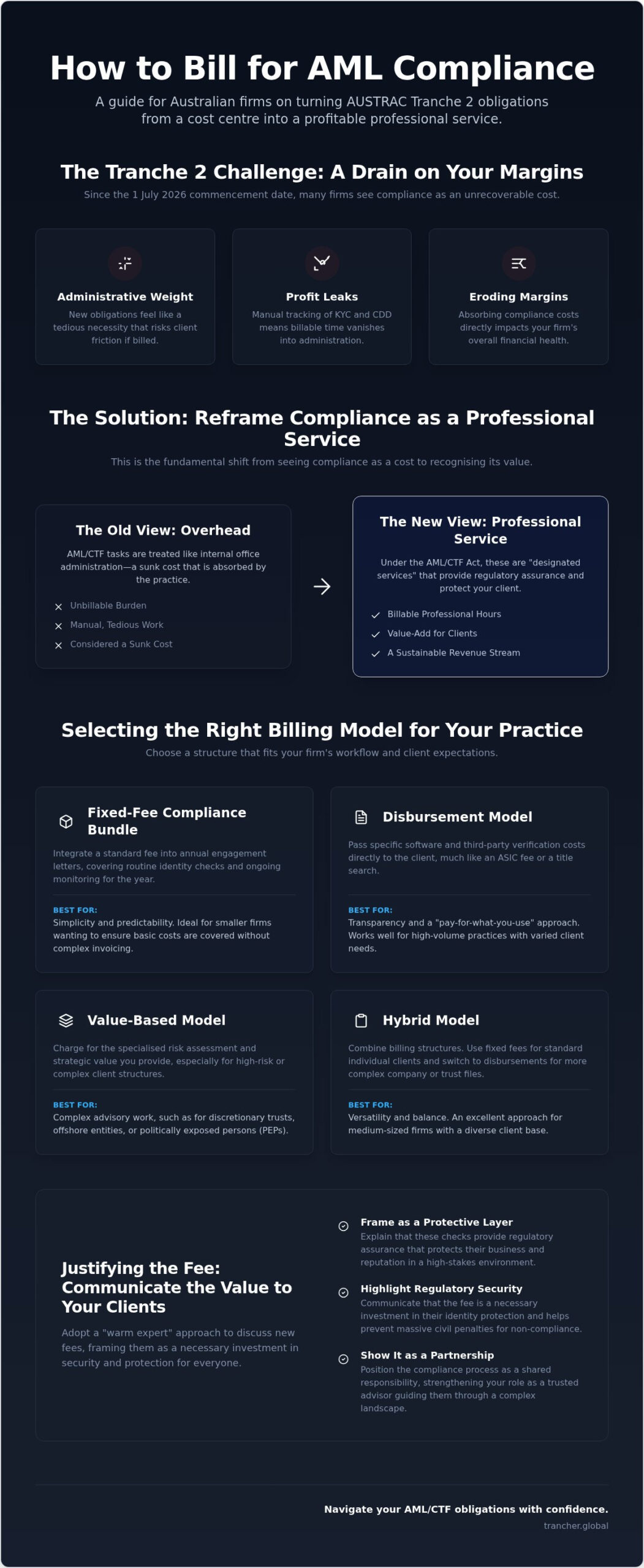
The 1 July 2026 commencement of Tranche 2 isn’t just another regulatory box to tick; it marks a fundamental change in how Australian accounting firms operate commercially. For years, many practices viewed internal checks as a sunk cost. However, the expansion of Anti-Money Laundering (AML) regulations means that your firm is now providing “designated services” that carry significant legal weight. Under the AML/CTF Act, providing a designated service creates a natural billing event, as these tasks require specific expertise and professional liability. When you perform these checks, you aren’t just doing paperwork. You’re providing regulatory assurance that protects your client’s business and reputation.
The Reality of Tranche 2 for SME Practices
The workload associated with Know Your Customer (KYC), Customer Due Diligence (CDD), and ongoing monitoring is substantial. If your team is still relying on manual spreadsheets to track these tasks, you’re likely experiencing profit leaks where billable time simply vanishes into the administrative ether. For SME practices, protecting 2026 margins requires a proactive approach to cost recovery. Instead of absorbing the cost of compliance, you can position these activities as a protective layer for the client. It’s about ensuring they remain compliant in a high-stakes environment where a single breach can lead to massive civil penalties. By framing the work this way, you move from being a cost-absorber to a value-provider.
Moving from “Overhead” to “Professional Service”
Success lies in distinguishing between internal office administration and client-facing regulatory work. Administrative tasks are overheads, but AML compliance is a professional service necessitated by the client’s specific risk profile. You can categorise tasks like risk assessments and verification as billable professional hours, much like you would for tax planning or audit preparation. Understanding how to bill for AML compliance starts with this mindset shift. Compliance-as-a-Service represents a sustainable new revenue stream for 2026 that turns a regulatory requirement into a value-add for your firm’s portfolio. By moving away from an overhead mentality, you ensure your practice remains both compliant and commercially resilient while providing the steady guidance your clients expect.
Selecting the Right Billing Model for Your Practice
While many discussions focus on the legal obligations of the new era, the real challenge for partners is the commercial implementation of fees. Choosing a billing structure depends on your firm’s size, your service mix, and the complexity of your client base. Determining how to bill for AML compliance requires a model that fits your firm’s operational rhythm and client expectations without creating unnecessary friction. Most practices find success by moving away from ad-hoc charges toward structured, predictable billing events that reflect the professional value provided.
Small firms often prefer the simplicity of a Fixed-Fee Compliance Bundle. This involves integrating a standard fee into annual engagement letters, covering routine identity checks and ongoing monitoring. It’s predictable for the client and ensures your firm recovers basic costs without manual invoicing. Conversely, a Disbursement Model works well for high-volume practices. You pass through specific software and verification costs directly, much like a title search or ASIC fee. This transparency can be reassuring for clients who value a “pay-for-what-you-use” approach. For more complex advisory work, a Value-Based Model allows you to charge for the specialised risk assessments required for high-risk entities.
Fixed-Fee vs. Disbursement: Which Suits Your Workflow?
To calculate a flat “Compliance Onboarding Fee”, consider the average time spent on verification plus the direct software costs. If you’re unsure where to start, looking at automated ROI tracking tools can provide the data you need to set a fair price. While disbursements offer transparency, they can create administrative friction if handled manually. The goal is to balance practice profitability with a seamless client experience. Medium-sized firms often find that a hybrid approach, using fixed fees for standard individuals and disbursements for more complex files, provides the best of both worlds.
Hybrid Models for Complex Client Structures
Complex client structures, such as discretionary trusts or offshore entities, require significantly more effort. These aren’t standard files. They demand Enhanced Due Diligence (EDD), which should always be a separate billable event. Global standards for risk-based AML/CFT programs highlight that higher risk necessitates more intensive scrutiny. You can use our guide on CDD and KYC Requirements Australia to explain to these clients why their file requires additional professional hours. Charging for complex risk assessments isn’t just about time; it’s about the specialised knowledge required to unmask beneficial ownership and mitigate risk effectively.
Justifying the Fee: Communicating Value to Your Clients
Introducing a new fee structure often feels like a professional hurdle, but it’s actually an opportunity to demonstrate your firm’s commitment to client security. Since the 1 July 2026 commencement, the conversation has moved from “if” to “how”. Adopting a “warm expert” approach allows you to guide your clients through AUSTRAC requirements without sounding alarmist. Instead of framing the charge as a compliance tax, position it as “Identity Protection and Regulatory Assurance”. This shift in language helps clients understand that the fee isn’t just for paperwork; it’s for the robust defence of their financial integrity and personal data.
Transitioning existing clients who are used to these services being absorbed as overhead requires clear, proactive communication. You aren’t just adding a line item; you’re reflecting the increased professional responsibility and specialised technology required to meet modern standards. Using standardised client notification templates can help you maintain a consistent, professional message across your entire base. This ensures every client understands that how to bill for AML compliance is based on the tangible value of keeping their business safe from regulatory risk and identity theft.
Scripts for Success: What to Say to Clients
When discussing these changes, explain that the 2026 regulatory updates are part of a broader national security measure designed to protect the Australian economy. You can tell your clients: “To ensure your data remains secure and our practice meets the latest national standards, we’ve invested in specialised platforms like Trancher.” This highlights that the firm is taking proactive steps to protect their interests. Emphasise the “peace of mind” that comes with having audit-ready records and a verified identity profile. It’s about being a steady hand in a changing landscape, ensuring they can focus on their business while you handle the complex regulatory heavy lifting.
Handling Pushback and Objections
You may occasionally encounter a client who questions the need for a new fee. In these instances, it’s helpful to compare the compliance fee to a “Digital Security Levy” or “Regulatory Assurance Fee”, similar to how banks or government agencies operate. This contextualises the cost as a standard part of doing business in a regulated economy. It is vital to remain firm on your AML CTF compliance costs reduction goals. Absorbing these costs yourself is no longer sustainable for SME practices. By standing your ground with calm, solution-oriented confidence, you reinforce the professional nature of the service and ensure your practice remains both profitable and compliant.
Best Practices for Tracking and Recovering Compliance Costs
Tracking compliance costs accurately is the final piece of the profitability puzzle for Australian accounting firms. While previous sections explored how to frame and communicate fees, the actual recovery of those costs depends on your ability to produce precise, undeniable evidence of work. Manual time-tracking for KYC is a losing game; it’s prone to human error and often results in significant under-billing. When staff members have to stop their workflow to log a five-minute identity check, those minutes frequently go unrecorded. Over a month, these minor omissions aggregate into substantial profit leaks that undermine your firm’s margins.
Generating automated billing reports allows you to link every specific compliance activity directly to a client invoice. This level of granularity provides a transparent audit trail that serves as your ultimate billing justification. If a client questions a charge, you can show them exactly what was performed, from PEP and sanction screenings to beneficial ownership unmasking. Understanding how to bill for AML compliance effectively means moving away from guesswork and toward a data-driven model where every action is logged, valued, and recovered. To see how your practice can capture every billable event automatically, you can explore Trancher’s automated ROI tracking and billing support.
Integrating Tracking into Practice Management
Success in cost recovery lies in the seamless connection between your AML platform and your existing billing software. Every time a “Designated Service” is triggered under the AML/CTF Act, your system should capture that event for recovery without requiring manual intervention from your team. This ensures that high-value tasks, like Enhanced Due Diligence for complex trust structures, are never overlooked during the invoicing cycle. These Audit Ready Compliance Records serve as your billing “proof of work,” providing the professional documentation needed to satisfy both the client’s curiosity and AUSTRAC’s rigorous standards.
The Role of ROI Reporting in Practice Growth
Reviewing your ROI is essential for measuring the long-term health of your compliance workflow. By using detailed ROI reports, you can identify specific bottlenecks in your onboarding process where manual intervention is still driving up costs. Comparing the expense of traditional, manual compliance against the efficiency of automated recovery reveals the true value of your digital transition. Automated tracking ensures no billable hour is lost in the Tranche 2 transition. This proactive approach allows your firm to scale its client base without a linear increase in administrative overhead, turning a regulatory requirement into a sustainable engine for practice growth.
Scaling Your Compliance Revenue with Trancher
Scaling your firm’s revenue isn’t just about doing more work; it’s about doing work more intelligently. Trancher is designed to help you bridge the gap between regulatory obligation and commercial success. By automating the tracking of “Designated Services,” our platform ensures that every minute spent on compliance is accounted for and ready for recovery. This level of precision is exactly what’s needed when you’re refining how to bill for AML compliance in a way that is both profitable and defensible to your clients. We provide the tools to turn an administrative chore into a high-margin professional service that actually enhances your firm’s value proposition.
Our 30-day compliance guarantee ensures you achieve readiness and billing capability quickly, without the typical implementation headaches. We also provide a complimentary 3-month trial for accounting firms, which includes full ROI reporting. This allows you to test different billing models in a real-world environment before making a long-term commitment. It’s about giving you the data and the confidence to see compliance not as a hurdle, but as a strategic avenue for practice growth. When you can see the direct link between a compliance check and your firm’s bottom line, the entire regulatory landscape feels much more manageable.
Leveraging Automation for High-Margin Recovery
Trancher is built specifically for the unique billing needs of SME accounting firms, where every billable hour counts. Our platform streamlines the entire process, allowing you to focus on your clients while the software handles the complex background checks and activity logs. To support your long-term success, we offer a 20% discount for firms that continue after their initial 3-month trial, maximising your first-year ROI. You aren’t just buying software; you’re gaining a partner. You’ll have access to local Australian support from Aaron Soh and our expert team, providing the steady guidance you need to navigate changing requirements with ease and professional confidence.
Preparing for the 1 July 2026 Deadline
While the 1 July 2026 deadline marks the start of your official obligations, creating a 12-month roadmap for your billable compliance program is a vital step for your practice’s health. Starting early prevents the “compliance bottleneck” that occurs when firms scramble to verify their entire client base at the last minute, often losing revenue in the process. By implementing your billing structures now, you ensure a smooth transition that protects your margins and maintains client trust. We invite you to start a conversation with Trancher today to secure your practice’s profitability and transform your regulatory obligations into a professional service edge.
Secure Your Practice’s Future and Profitability
Navigating the shift to AUSTRAC Tranche 2 doesn’t have to be a source of stress or financial strain. By reframing these obligations as a high-value professional service, you protect your firm’s margins and provide your clients with essential regulatory assurance. We’ve explored how identifying the right billing model and automating your tracking can eliminate the administrative burden of manual spreadsheets. Mastering how to bill for AML compliance is the key to transforming this transition into a strategic advantage for your practice.
Taking the first step toward a more profitable workflow is simple. You can start your complimentary 3-month Trancher trial today to see exactly how our platform automates recovery and provides audit-ready evidence. With our 30-day compliance guarantee and the support of Aaron Soh’s local Australian expert team, you’ll have the steady guidance needed to succeed. Plus, you’ll receive 20% off your first 12-month subscription after the trial. We’re ready to help you build a more resilient, efficient, and profitable firm.
Frequently Asked Questions
Is it legal to bill clients for AML/CTF compliance in Australia?
Yes, it’s absolutely legal and increasingly common for Australian firms to charge for these services. Since the 1 July 2026 Tranche 2 commencement, the AML/CTF Act requires accountants to perform specific “designated services.” These are professional obligations that carry liability and resource costs. Just as you bill for tax compliance or audit work, you’re entitled to recover costs for the specialised regulatory assurance you provide to protect the client and the firm.
How much should an accounting firm charge for a standard KYC check?
There isn’t a single mandated fee, as the cost often depends on the complexity of the client’s structure. Firms generally set prices based on the time required for verification and the direct software costs incurred. A simple individual check costs less than unmasking beneficial owners in a complex discretionary trust. You should evaluate your internal resource usage to determine a fair professional fee that reflects the value of the regulatory protection provided.
Should I charge for AML compliance as a disbursement or a fixed fee?
Both models have distinct advantages depending on your practice size. A fixed fee is often easier to integrate into annual engagement letters and provides clients with cost certainty. A disbursement model is highly transparent, as you pass through specific verification costs directly on each invoice. Many SME practices find a hybrid approach works best, using a fixed onboarding fee for standard clients and separate disbursements for more complex, high-risk files.
How do I explain new AML fees to my existing accounting clients?
The most effective way is to frame the fee as “Identity Protection and Regulatory Assurance.” Explain that since 1 July 2026, national standards have changed to better protect the Australian economy from financial crime. By positioning the charge as a necessary investment in their own data security and compliance health, you shift the focus from a new cost to a protective service that ensures their business remains audit-ready and secure.
What happens if a client refuses to pay the compliance fee?
If a client refuses, it’s important to explain that these checks are a legal requirement for the firm to provide designated services. You cannot bypass these obligations under the AML/CTF Act. You might explain that the fee covers the specialised technology used to keep their sensitive data safe. Ultimately, if a client won’t cover the costs of mandatory compliance, the firm must assess whether the engagement remains commercially viable and risk-appropriate.
Can I include AML compliance costs in my annual engagement letter?
Yes, including these costs in your annual engagement letter is a best practice for transparency. It sets clear expectations from the start of the professional relationship. You can specify a “Compliance Onboarding Fee” or a recurring “Regulatory Monitoring Fee.” This ensures that how to bill for AML compliance is formalised and agreed upon upfront, which significantly reduces the likelihood of client pushback or fee disputes later in the year.
How does Trancher help with tracking billable compliance hours?
Trancher automates the entire “Designated Service” tracking process, removing the need for manual time-logging. The platform captures every KYC and CDD event as it happens, linking the activity directly to the client file. This creates a precise, audit-ready record of work performed. With built-in ROI reporting, your firm can see exactly which activities are being recovered, ensuring that no billable professional time is lost during the Tranche 2 transition.
What is the most efficient way to recover the costs of AUSTRAC Tranche 2?
The most efficient method is combining automated activity tracking with a structured billing model. By using a platform like Trancher to log every compliance event, you eliminate the “profit leaks” associated with manual administration. This allows you to generate accurate billing reports that justify the professional fee to the client. Integrating these recovered costs into your standard invoicing cycle ensures that how to bill for AML compliance remains a seamless, profitable part of your practice.