

What if the administrative burden of AUSTRAC compliance wasn’t a cost centre, but actually a new, predictable revenue stream for your practice? We understand that for many Australian accountants, the 1 July 2026 deadline for Tranche 2 reforms feels like another layer of manual, non-billable heavy lifting. By integrating ongoing risk monitoring software into your workflow, you can move past the fear of penalties and the stress of manual reviews. It’s completely natural to feel concerned about the volume of paperwork required to maintain audit-ready records, but these obligations can be managed with a steady, automated hand.
This guide will show you how to transition from static periodic reviews to an automated, billable framework that secures your practice for the long term. We’ll explore how to move toward a professional system that ensures you’re always ready for AUSTRAC while capturing every billable hour spent on compliance. You’ll discover how to turn reactive administrative stress into proactive oversight that protects your licence and your bottom line with confidence.
Key Takeaways
- Move beyond static annual reviews to adopt a “living” compliance framework that provides real-time oversight of your entire client base.
- Understand how ongoing risk monitoring software automates the tracking of PEP and Sanction status changes to eliminate the risk of human error.
- Replace error-prone spreadsheets with automated workflows that maintain a permanent, audit-ready record for potential AUSTRAC inspections.
- Establish clear internal escalation paths that empower your team to recognise and report suspicious activity during regular tax and accounting engagements.
- Discover how to transform compliance into a billable professional service that uncovers new advisory opportunities through deeper client data insights.
Beyond Onboarding: Why Static Client Reviews Fail in the Tranche 2 Era
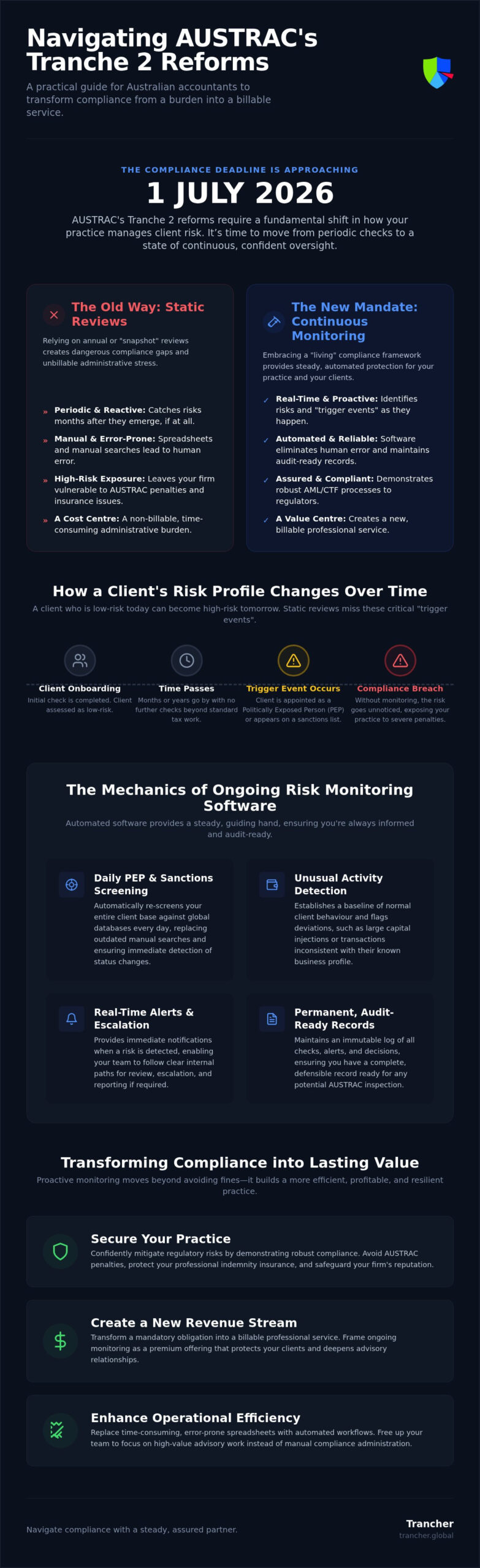
Ongoing risk monitoring is the perpetual, proactive tracking of your clients’ profiles and their financial activities. It represents a fundamental shift from the “snapshot” approach of initial onboarding to a model of continuous oversight. While many firms have historically relied on annual reviews, the 1 July 2026 Tranche 2 reforms make this periodic method insufficient. AUSTRAC now expects “ongoing due diligence” under the AML/CTF Act, meaning your practice must be equipped to identify risks as they emerge, not months after the fact.
Relying on a “set and forget” strategy for long-term client portfolios is increasingly risky. A client who was low-risk three years ago may have recently changed their business structure or started dealing with high-risk jurisdictions. Without ongoing risk monitoring software, these shifts often go unnoticed until it’s too late to mitigate the threat. It’s about moving from a reactive posture to a steady, guided state of readiness.
The Shift from Periodic to Continuous Oversight
A client’s risk profile can change overnight. A simple tax return might not reveal that a long-standing client has been appointed as a director of a foreign entity or has suddenly become a Politically Exposed Person (PEP). These are “trigger events” that require immediate attention. Using modern Anti-money laundering (AML) software allows you to establish a clear baseline for what constitutes “normal” behaviour for each client. When an activity deviates from this baseline, the system alerts you. This ensures you don’t miss critical red flags during the standard rush of tax season. It’s a supportive way to maintain oversight without adding to your daily mental load.
Regulatory Consequences of Monitoring Gaps
The stakes for failing to maintain these systems are high. AUSTRAC has the power to issue significant civil penalties and enforceable undertakings, even for smaller SME accounting practices. Beyond direct fines, there is a growing impact on professional indemnity insurance. Insurers are increasingly scrutinising how firms manage their AML/CTF obligations; a lack of robust monitoring can lead to higher premiums or even a refusal of cover. You don’t want your insurance position compromised by an administrative gap.
Ultimately, it’s about maintaining your firm’s reputation within the Australian financial landscape. Being proactive isn’t just about avoiding a fine. It’s about demonstrating to your clients and the regulator that you are a reliable, competent partner. Implementing ongoing risk monitoring software transforms this requirement from a stressful administrative hurdle into a manageable, automated part of your professional service delivery. It provides the steady hand you need to navigate these changing requirements with optimism.
The Mechanics of Ongoing Risk Monitoring for Australian Accountants
To implement a compliant program, you must first identify which of your offerings qualify as “designated services.” According to the Tranche 2 reporting entities factsheet, this includes activities like managing client funds, acting as a company secretary, or facilitating business sales. Once these services are identified, the mechanics of monitoring involve tracking changes in client status and transaction patterns that could signal financial crime. It’s a process of staying informed about who you are doing business with on a daily basis.
Effective monitoring requires more than just a cursory glance at bank statements. It involves setting threshold-based triggers that alert you to unusual activity. For an accounting firm, this might mean flagging a sudden, large capital injection into a previously dormant trust or identifying transactions that don’t align with a client’s known business profile. Ongoing risk monitoring software automates these detections, providing a steady hand that guides your practice through complex regulatory waters.
Screening for PEPs, Sanctions, and Adverse Media
Many firms rely on manual Google searches during onboarding, but this “snapshot” becomes outdated almost immediately. Automated software provides a more reliable alternative by performing daily re-screening against global databases. This process ensures you’re alerted if a client is suddenly listed on a sanctions list or becomes a Politically Exposed Person (PEP). Handling “false positives” is a common concern; however, sophisticated algorithms now filter out irrelevant matches so your team doesn’t waste billable hours. By integrating these checks with your broader CDD and KYC requirements Australia, you create a seamless workflow that protects the firm without the administrative headache.
Tracking Changes in Client Entities and Control
Risk isn’t just about the individual; it’s about the structures they control. Monitoring ASIC data for changes in directors or significant shareholders is a critical component of continuous Know Your Business (KYB) protocols. If a client expands into a new, higher-risk jurisdiction or introduces a complex trust structure, your risk assessment must be updated. This isn’t a one-off task but a continuous cycle of oversight. If you find the technical side of these requirements daunting, using a platform like Trancher can simplify the transition by automating these complex data feeds into a single, intuitive dashboard. This allows you to maintain oversight with confidence, ensuring your practice remains both compliant and efficient.
Automation vs. Manual Spreadsheets: Choosing Your Framework
Excel is a reliable tool for balance sheets, but it’s a significant liability for AUSTRAC compliance. Many Australian accounting firms initially attempt to manage their new obligations using manual spreadsheets. While this feels cost-effective, the hidden expenses of manual oversight are substantial. Between the risk of human error and the lack of a verifiable audit trail, fragmented manual processes often leave practices vulnerable during a regulatory review. Transitioning to ongoing risk monitoring software isn’t just a tech upgrade; it’s a strategic move to protect your practice’s future.
Automated systems create a “living risk register” that updates in real-time as client circumstances change. Instead of a static document gathering digital dust, you gain a dynamic overview of your firm’s risk appetite and exposure. This centralised approach ensures that your audit ready compliance records are always accurate and accessible. When everything is stored in one place, you don’t have to scramble for documentation if a regulator requests a review. It’s about building a foundation of operational ease and confidence.
The Pitfalls of Fragmented Manual Processes
Spreadsheets fail to provide a “single version of truth” during an audit. When multiple partners and staff members update different versions of a file, consistency vanishes. This fragmentation makes it nearly impossible to prove to AUSTRAC that your monitoring was continuous and systematic. Beyond the risk, there’s the sheer cost in lost billable time. Every hour a senior accountant spends manually cross-referencing Sanction lists is an hour not billed to a client. Manual oversight is often a non-recoverable overhead that eats into your firm’s profit margins. It’s a heavy lifting exercise that no longer makes sense in a modern practice.
Key Features of Purpose-Built AML Software
Modern ongoing risk monitoring software provides automated escalation workflows that guide your staff through the correct steps when a red flag appears. You don’t need to be a financial crime expert to stay compliant; the software acts as your steady guide. Role-based dashboards allow partners to see a high-level overview of the firm’s risk profile at a glance, ensuring nothing slips through the cracks. Perhaps most importantly, sophisticated platforms now include “Compliance ROI” reports. These reports track the billable hours spent on compliance activities, allowing you to justify the investment and even turn these obligations into a recoverable professional service. It’s an optimistic reframe of a complex requirement, turning a burden into a strategic advantage.
Implementing a Monitoring Workflow: From Detection to Reporting
Establishing a robust workflow is what separates a compliant practice from one that merely has a tool in place. While your ongoing risk monitoring software handles the heavy lifting of data screening, your team remains the first line of defence. Training staff to recognise red flags during standard tax preparation is essential. It’s about noticing when a client’s source of wealth suddenly doesn’t align with their reported income or when business structures become unnecessarily opaque. When these flags appear, you need a pre-defined path to follow that takes the guesswork out of the situation.
Documenting the rationale behind every risk rating change is a non-negotiable requirement for future AUSTRAC reviews. If you decide to escalate a client from “low” to “medium” risk, the regulator needs to see the “why” behind that decision. This narrative evidence proves that your firm is actively engaging with its AML/CTF programme. Moving from an internal suspicion to a formal Suspicious Matter Report (SMR) should be a calm, methodical process rather than a panicked reaction. With the right system, this transition feels like a natural extension of your professional duty.
Defining Your Firm’s Risk Appetite and Triggers
Every accounting firm has a unique client base, and your monitoring should reflect that. A firm specialising in local retail will have different risk thresholds than one handling international trade or high-net-worth family offices. You can tailor your software to flag specific industry-based risks, ensuring you aren’t overwhelmed by irrelevant alerts. In an accounting context, a trigger event is any significant change in a client’s profile, behaviour, or transaction pattern that deviates from their established baseline and necessitates a risk re-evaluation. Setting these thresholds correctly ensures your oversight remains sharp and purposeful.
The Step-by-Step Escalation Framework
When a flag is raised, your team needs to know exactly how to investigate without “tipping off” the client. Tipping off is a serious offence, so internal discussions must remain strictly confidential. Your workflow should involve collecting all relevant evidence and saving it directly into your centralised system. This level of detail is vital for AML CTF independent audit preparation, as it demonstrates a clear chain of command and thorough due diligence. If an investigation confirms your suspicions, you can then move toward reporting with confidence. If you’re ever unsure about a specific case, seeking expert guidance from your compliance partner can provide the steady hand you need. To simplify these complex workflows and protect your practice, you can organise a demonstration of our automated monitoring tools.
Transforming Compliance into Value with Trancher
Trancher is designed to bridge the gap between regulatory necessity and firm profitability. While many practices view AUSTRAC requirements as a persistent cost centre, our platform reframes this obligation as a strategic asset. By utilising ongoing risk monitoring software that integrates directly into your existing workflow, you aren’t just ticking boxes for a regulator. You’re building a deeper, more transparent understanding of your clients’ financial health. This level of oversight often reveals new advisory opportunities, such as the need for corporate restructuring or succession planning, that might have otherwise remained hidden in manual files.
Securing your practice’s future doesn’t have to be an expensive or overwhelming endeavour. We focus on reducing AML CTF compliance costs by replacing manual, error-prone labour with precision automation. Our 30-day compliance readiness guarantee ensures your firm is fully prepared for the 1 July 2026 deadline without the usual administrative stress. It’s a calm, guided path to full readiness that allows you to focus on what you do best: providing expert financial guidance to your clients.
Tracking Billable Hours and ROI
Trancher helps you move from treating compliance as an administrative burden to a profitable professional service. The platform features automated tracking of billable compliance hours, providing the granular evidence you need to support transparent client billing. We don’t believe compliance oversight should eat into your profit margins. To prove the value of this approach, we provide a formal ROI report after our complimentary 3-month trial. This report gives you a clear, data-driven view of how the system has paid for itself through recovered time and improved internal efficiency. It transforms a regulatory hurdle into a measurable business advantage.
Your Expert Compliance Companion
Successfully managing the Tranche 2 transition requires more than just a digital tool; it requires a partner who understands the local Australian accounting landscape. Our team provides expert-led onboarding and local support specifically tailored for the needs of accounting practices. We act as your steady guide, ensuring your staff feel confident and supported as the 2026 deadlines approach. You can approach this regulatory shift with optimism, knowing your systems are robust, audit-ready, and strategically aligned with your firm’s growth. To begin your transition with confidence, start your complimentary 3-month trial and secure your 20% discount today.
Securing Your Practice’s Future with Confidence
The shift toward Tranche 2 compliance doesn’t have to be a source of persistent stress for your firm. By moving away from static annual reviews and embracing ongoing risk monitoring software, you protect your practice’s licence while streamlining your internal operations. Automation eliminates the heavy lifting of manual spreadsheets, ensuring your records are always audit-ready for AUSTRAC without the risk of human error. Most importantly, you can now track billable compliance hours; this turns a regulatory requirement into a professional service that supports your bottom line and uncovers new advisory opportunities.
We’re here to act as your expert companion during this transition. With our local Australian compliance expertise and a 30-day AUSTRAC readiness guarantee, we ensure you stay ahead of the July 2026 requirements with ease. You can start your complimentary 3-month trial with Trancher today and secure a 20% discount for early Tranche 2 adopters. Let’s work together to make your compliance journey manageable, profitable, and completely secure. We look forward to helping your practice thrive in this new regulatory landscape.
Frequently Asked Questions
What is ongoing risk monitoring in the context of AUSTRAC Tranche 2?
Ongoing risk monitoring is the continuous process of reviewing client information and transaction patterns to ensure their risk profile remains accurate. Under the Tranche 2 reforms, it’s a legal requirement to move beyond initial onboarding and maintain a “living” understanding of your clients. This ensures that any changes in their business structure or political exposure are identified and managed promptly.
How often should an accounting firm perform risk re-assessments for existing clients?
While high-risk clients may require formal annual reviews, ongoing risk monitoring software allows for continuous oversight triggered by specific events. You should re-assess a client’s risk whenever a “trigger event” occurs, such as a change in beneficial ownership or a shift into a high-risk industry. Automated systems ensure these critical moments aren’t missed during the busy tax season.
Can I use my existing practice management software for AML monitoring?
Most standard practice management tools aren’t designed for the complex screening requirements of the AML/CTF Act. They typically lack the live data feeds needed to monitor PEPs, sanctions, and adverse media in real-time. Using purpose-built software that integrates with your existing tools is the most reliable way to maintain compliance without disrupting your current professional workflows.
What are the specific “red flags” accountants should look for during ongoing monitoring?
Accountants should watch for discrepancies between a client’s reported income and their actual source of wealth or lifestyle. Other red flags include the use of overly complex trust structures with no clear commercial purpose or sudden, large capital injections from unknown sources. Identifying these patterns is a core part of your professional duty as a “gatekeeper” in the financial system.
How does automated software help during an AUSTRAC independent audit?
Automated software provides a centralised, immutable audit trail that proves your firm has followed its AML/CTF program consistently over time. During an independent audit, you can easily produce reports showing exactly when checks were performed and how specific flags were resolved. This level of transparency gives both the auditor and AUSTRAC confidence that your oversight is systematic rather than ad-hoc.
Is ongoing risk monitoring a billable service for accounting clients?
Yes, ongoing risk monitoring is a professional service that provides significant value by protecting both the client and the firm. By utilising ongoing risk monitoring software that tracks billable hours, you can recover the costs of compliance effectively. Many Australian firms now include these activities as part of their standard advisory or engagement fees to ensure continued profitability.
What happens if we identify a suspicious matter during a routine tax return?
If a suspicious matter is identified, you must follow your firm’s internal escalation path to the designated AML/CTF Compliance Officer. It’s critical to document your findings thoroughly while ensuring you don’t “tip off” the client that a report may be filed. If the suspicion remains, your officer will file a Suspicious Matter Report (SMR) with AUSTRAC within the required statutory timeframe.
How long does it take to implement an automated monitoring system like Trancher?
Implementing a comprehensive system like Trancher is a streamlined process designed to minimise disruption to your practice. With our 30-day compliance readiness guarantee, we guide your team through the setup and staff training phases quickly. Our goal is to move your firm from manual uncertainty to automated confidence in less than a month, ensuring you’re ready for the 2026 requirements.