

What if the regulatory requirements you currently view as a hurdle could actually become the most efficient, billable part of your professional practice? For many Australian firms, the traditional approach of manual document scanning is becoming a significant liability; it’s slow, insecure, and often leaves clients frustrated by redundant paperwork. As we approach the Tranche 2 reforms on 1 July 2026, implementing robust electronic identity verification Australia is no longer just a security upgrade. It’s a strategic necessity for staying competitive and compliant.
We’re here to help you navigate this transition with confidence and ease. You’ll learn how to move away from fragmented tools and build a defensible AML/CTF program that satisfies AUSTRAC without the administrative headache. This guide explores how to turn compliance into a seamless part of your workflow, allowing you to recover costs through billable activity while onboarding clients faster than ever. From understanding the Digital ID Act 2024 to managing your due diligence obligations, we’ve organised everything you need to ensure your firm is ready for the future of digital identity.
Key Takeaways
- Understand the critical shift from sighting physical documents to verifying authoritative data to meet the upcoming 1 July 2026 AML/CTF requirements.
- Discover how electronic identity verification Australia leverages the Document Verification Service (DVS) and biometric matching to ensure secure, fraud-resistant client onboarding.
- Learn how to significantly reduce your firm’s data breach risk by moving away from the storage of sensitive physical identity scans.
- Identify the practical steps to audit your current onboarding workflow and integrate automated tools that remove administrative friction for your team.
- Explore how to transform compliance from a traditional overhead into a billable professional service that generates a clear ROI for your practice.
What is Electronic Identity Verification (eIDV) for Australian Firms?
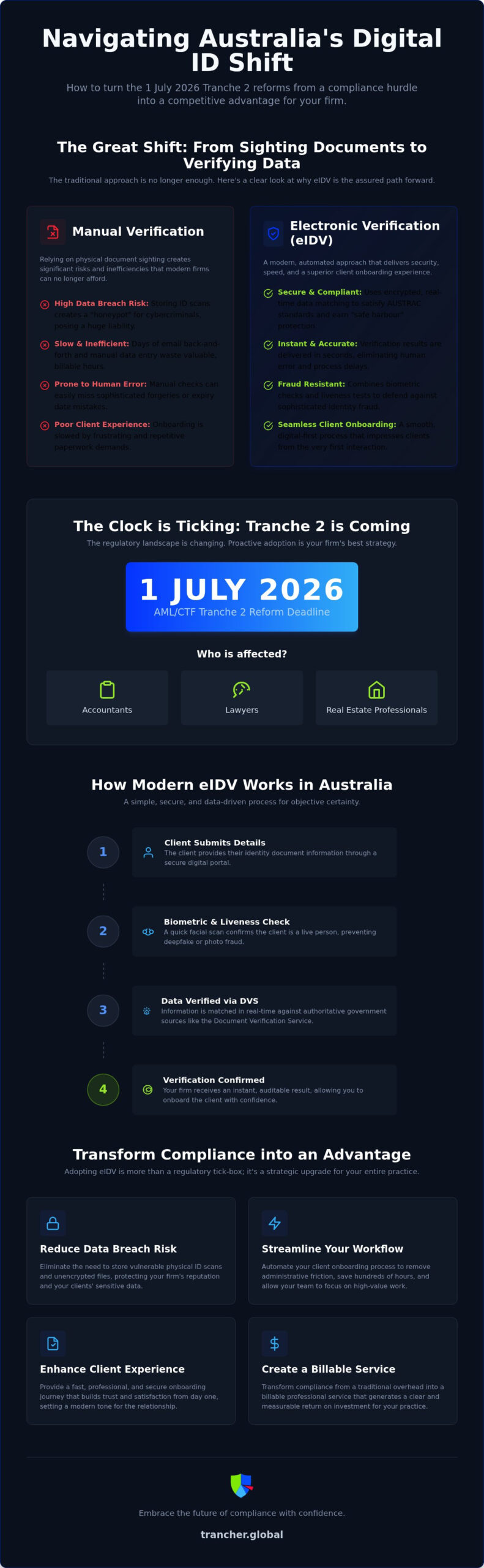
Electronic identity verification is the automated process of validating a client’s identity by matching their personal details against authoritative data sources. In the context of Electronic identity verification Australia, this usually involves real-time checks against the Document Verification Service (DVS), which accesses birth, marriage, and citizenship records. This technology represents a significant evolution from traditional methods. We are moving away from the simple act of “sighting documents” and moving toward “verifying data” directly at the source. This transition is a core component of modern Electronic identification (eID) frameworks globally.
For decades, the standard practice involved photocopying a passport or driver’s licence and filing it away. However, these manual methods are now considered high-risk. Physical copies are static, easily forged, and create a dangerous “honeypot” for cybercriminals. If your firm stores thousands of unencrypted ID scans, you aren’t just managing compliance; you’re managing a significant data breach liability. Implementing eIDV serves as the essential first step in a robust CDD and KYC requirements Australia framework, ensuring that the person you are dealing with is exactly who they claim to be before any professional relationship begins.
The AUSTRAC Tranche 2 context for 2026
The regulatory environment is shifting rapidly. By 1 July 2026, the AML/CTF “Tranche 2” reforms will officially include accountants, lawyers, and real estate professionals as “designated service providers.” This means your firm will have formal, legally binding obligations to verify client identities to an AUSTRAC-mandated standard. You can’t afford to wait until the last minute. Adopting eIDV now provides your practice with “safe harbour” protections. When you use an accredited digital verification process, you demonstrate a proactive commitment to compliance that manual sighting simply cannot match. It transforms a looming deadline into an opportunity to modernise your internal systems.
eIDV vs. Manual Verification: A risk-based analysis
When we compare digital systems to manual workflows, the advantages are clear and immediate. Speed is the most obvious benefit. While manual follow-ups can take days of back-and-forth emails, Electronic identity verification Australia delivers results in seconds. This creates a much smoother onboarding experience for your clients, who are often frustrated by repetitive paperwork. Accuracy is equally vital. Digital systems eliminate the human error inherent in manually recording long document numbers or misinterpreting expiry dates. Finally, security is vastly improved. By using an encrypted verification platform, you minimise the physical storage of sensitive documents, drastically reducing your firm’s attack surface and protecting your professional reputation.
How Electronic Identity Verification works in the Australian landscape
The mechanics of Electronic identity verification Australia rely on a sophisticated ecosystem of government-backed data and advanced security protocols. It’s no longer a matter of simply trusting your eyes; it’s about leveraging a system that cross-references information in real-time. This process ensures that the credentials presented by a client aren’t just valid in appearance, but are currently active and legitimate in the eyes of the issuing authorities. It’s a shift from subjective observation to objective, data-driven certainty.
To prevent sophisticated fraud, modern eIDV platforms incorporate biometric matching and “liveness” tests. These tools require the client to perform a simple action, like a head turn or a blink, during a facial scan. This ensures that the person completing the verification is a live human being and not a high-resolution photo or a deepfake video. By combining biometric data with authoritative record matching, your firm creates a formidable barrier against identity theft while maintaining a smooth, digital-first experience for your clients.
Authoritative data sources: The DVS and beyond
At the heart of this landscape is the Document Verification Service (DVS), a key component of Australia’s Identity Verification Services. When a client provides their Medicare card, driver’s licence, or passport details, the eIDV system sends an encrypted query to the DVS. This service matches the provided information against the original state or federal database. Sighting a document is no longer enough because it doesn’t account for cancelled, expired, or stolen credentials. For high-risk engagements, many firms are now adopting Face Verification Services (FVS), which match a live image against government-held photo records for an even higher level of assurance.
Screening for risk: PEPs, Sanctions, and Adverse Media
Identity verification is only half the battle. To truly satisfy your obligations, you must also understand who your client is in a broader regulatory context. This involves screening for Politically Exposed Persons (PEPs) and checking against global sanctions lists. Automating these checks ensures your firm isn’t inadvertently facilitating business with individuals or entities restricted by international law. It’s also vital to monitor for adverse media, which can highlight reputational risks before they become legal ones. Because risk profiles change, ongoing monitoring is essential; a client who is “clean” today might appear on a watchlist tomorrow.
Keeping your audit ready compliance records updated with these screening results is a non-negotiable part of a defensible program. Managing these multi-layered checks manually is often where firms experience the most friction. You might consider how an automated compliance workflow can handle these tasks in the background, allowing your team to focus on high-value advice. Once a check is complete, the system generates a time-stamped verification certificate. This document serves as your primary evidence during an AUSTRAC audit, proving that you performed the necessary due diligence at the exact time of onboarding. It’s a precise, reliable way to demonstrate your firm’s commitment to integrity.
Privacy, Security, and the Digital ID Shift
The Office of the Australian Information Commissioner (OAIC) has made it clear: identity documents are the most sensitive and costly records to lose in a data breach. As we move closer to the 1 July 2026 deadline, the strategy for Electronic identity verification Australia is shifting from a focus on collection to a focus on validation. This means your firm’s primary goal should be reducing your “attack surface.” Every physical scan or unencrypted photo of a passport you store is a potential liability waiting to be exploited. By adopting a “validation-first” mindset, you can prove you’ve done your due diligence without the burden of holding onto the underlying sensitive data.
Australia’s Digital ID System, bolstered by the Digital ID Act 2024, is designed to facilitate this shift. It allows private professional practices to act as “relying parties,” verifying a client’s identity without ever actually seeing or holding their source documents. This “privacy-preserving” approach is a game-changer for the professional services sector. Instead of managing a database of sensitive images that require high-level encryption and constant monitoring, you receive a cryptographically secure “Yes” or “No” result from an accredited provider. You get the certainty you need for your AML/CTF program, while your clients get the peace of mind that their most private information isn’t sitting in a vulnerable digital filing cabinet.
Minimising data retention risks
Emailing a photo of a driver’s licence was once standard practice, but in 2026, it’s a significant security failure that invites unnecessary risk. Emails are easily intercepted and often sit in “Sent” folders or on unsecured servers for years, long after the initial onboarding is complete. Modern eIDV platforms act as secure vaults, storing only the necessary evidence of verification required by law rather than the documents themselves. This allows you to meet your 7-year record-keeping obligations under the AML/CTF Act without the constant shadow of a data breach hanging over your practice. It’s about being compliant while remaining secure, ensuring your firm’s longevity and reputation.
Building client trust through modern tech
Clients are more aware of data privacy than ever before, often following news of major breaches with a sense of trepidation. When you explain that you use a secure portal for Electronic identity verification Australia specifically to protect their information, you aren’t just being compliant; you’re being a proactive protector of their digital life. Positioning your firm as a leader in data security builds a level of trust that traditional “more paperwork” methods never could. By leveraging the national “Digital ID” narrative, you can turn a regulatory requirement into a demonstration of your firm’s technical sophistication and commitment to client safety, making the onboarding process feel like a premium, secure service.
Steps to implement eIDV in your accounting practice
Implementing Electronic identity verification Australia isn’t just about switching on a new software tool; it’s about evolving your firm’s operational DNA. Start by looking at your current onboarding process. Where do the delays happen? If your team is still waiting for clients to post certified copies or bring passports into the office, you’ve identified your primary bottleneck. By integrating Electronic identity verification Australia into your workflow, you can begin the transition to a digital-first model. This isn’t just a compliance tick-box; it’s a way to reclaim hours of lost administrative time and protect your practice from the risks associated with manual data handling.
After selecting a provider, you must formally update your written AML/CTF Program. This document needs to reflect that you now use electronic methods as your primary means of verification. It should also outline how you communicate this to clients. Instead of framing it as “more compliance,” present it as a premium security upgrade. Let them know you’re using bank-grade technology to safeguard their identity. This proactive stance builds confidence and explains why you’re moving away from insecure email attachments.
Integration: Making eIDV part of the furniture
Standalone tools often create more work than they solve. For a system to be truly effective, you need AML compliance workflow integration that fits into your existing day-to-day operations. Ideally, the verification should be triggered automatically when a new client engagement is initiated in your practice management system. This ensures that no client slips through the cracks and that all verification data is synchronised directly with your CRM. It removes the need for double data entry and ensures your records are always audit-ready.
Training your team for Tranche 2
Your team is your first line of defence. Training should be role-based to ensure everyone understands their specific responsibilities. Admin staff need to know how to initiate requests and guide clients through the process, while Partners must understand how to interpret results. It’s vital to have a clear protocol for “amber” or “red” flags. If a verification fails, your team should know exactly when to escalate the matter to Enhanced Due Diligence (EDD). Having access to steady guidance from an expert companion can help your staff resolve these compliance roadblocks without feeling overwhelmed.
To get your firm ready for 1 July 2026, you can book a platform demonstration today to see how these steps look in practice.
Compliance as a Profit Centre: The Trancher Advantage
While many practitioners view the upcoming Tranche 2 changes with a sense of trepidation, the most forward-thinking firms are already reframing their perspective. Instead of seeing Electronic identity verification Australia as a sunken administrative cost, these firms are positioning it as a high-value professional service. The reality is that identity verification and risk assessment require professional judgement and sophisticated tools; there’s no reason your practice should absorb those costs as overhead. By formalising these steps into your engagement letters, you can transform a regulatory burden into a predictable, billable revenue stream that reflects the true value of your firm’s expertise.
Moving away from a “sunk cost” mindset requires the right tools to measure and justify the work being performed. When you stop treating compliance as an “extra” task and start treating it as a core part of your professional engagement, your clients’ perception changes. They see a firm that is serious about security, data privacy, and regulatory integrity. This business-minded optimism allows you to build stronger internal systems while ensuring your firm’s financial health remains a top priority during this period of significant change.
Tracking ROI on compliance activities
Proving the value of your work is essential for client transparency and fee recovery. Using compliance ROI tracking software allows you to capture every minute spent on due diligence, from the initial digital scan to the final risk review. This data doesn’t just help with recovery; it provides a clear audit trail and helps you identify new advisory opportunities. For example, a high-risk result in a client’s profile might trigger a more detailed structural review, opening the door for additional high-value advice. Recovering the direct costs of Electronic identity verification Australia through transparent, itemised billing ensures your margins remain protected as the regulatory environment becomes more complex.
The 30-day readiness roadmap
We understand that the transition to a formal AML/CTF framework can feel like a daunting task, especially with the 1 July 2026 deadline approaching. That’s why we’ve designed a structured system that eliminates the administrative heavy lifting. Our 30-day compliance-ready guarantee is built on a partner-led implementation process that gets your practice up to speed quickly and without the usual friction. We handle the technical setup, from configuring your automated workflows to training your team on how to interpret results. By starting this conversation now, you avoid the inevitable last-minute rush. Auditing your onboarding process today ensures that by the time the reforms take effect, your practice won’t just be compliant; it will be more efficient and more profitable than it was before.
Securing Your Firm’s Future for 2026
The transition to Electronic identity verification Australia represents a significant milestone in the evolution of professional services. By moving away from manual document sighting and adopting automated, data-driven verification, you significantly reduce your firm’s exposure to data breaches. This shift doesn’t just satisfy AUSTRAC; it builds deeper trust with your clients by demonstrating a proactive commitment to their privacy. As we’ve explored, the path to 1 July 2026 is an opportunity to refine your onboarding and turn compliance into a profitable, billable asset.
Trancher is designed specifically for SME Australian accounting practices, providing the tools you need to manage this change with absolute confidence. Our platform allows you to track billable compliance hours and identify new revenue streams, all while backed by our 30-day compliance-ready guarantee. We’re here to act as your steady guide, ensuring your firm remains resilient and ready for the future of digital identity. You don’t have to navigate these reforms alone.
Take the first step toward a more secure and efficient practice when you start your complimentary 3-month trial of Trancher today. We look forward to helping you master the shift to electronic verification.
Frequently Asked Questions
Is electronic identity verification mandatory for Australian accountants under Tranche 2?
While AUSTRAC doesn’t explicitly mandate the specific method you use, you must meet strict verification standards starting from 1 July 2026. Electronic identity verification Australia is the most practical way to achieve “safe harbour” status. Manual sighting is increasingly difficult to defend during an audit because it lacks the objective, third-party validation that digital systems provide as standard.
What documents can be used for eIDV in Australia?
Most digital platforms match details against the Document Verification Service (DVS), which includes a wide range of authoritative sources. You can typically verify Australian passports, driver’s licences, Medicare cards, and birth certificates. Some systems also support citizenship certificates and marriage certificates, ensuring a comprehensive profile that satisfies your due diligence requirements.
How does eIDV protect my firm from data breaches compared to manual scans?
Digital verification protects your practice by shifting the focus from “document collection” to “data validation.” Instead of storing sensitive, high-resolution scans of passports in your email or on local servers, you only retain a secure verification certificate. This significantly reduces your “attack surface” and ensures you aren’t holding a “honeypot” of sensitive data that cybercriminals find attractive.
Can I use eIDV for foreign clients or non-residents?
You can use electronic verification for non-residents, provided your provider has access to international authoritative databases. Many advanced platforms can verify passports from over 200 countries. For these clients, it’s essential that your process also includes PEP and sanctions screening to manage the naturally higher geographical risk profile effectively.
Do I need to re-verify existing clients when Tranche 2 commences?
You’ll likely need to re-verify existing clients if your current records don’t meet the updated AUSTRAC standards. When the reforms commence on 1 July 2026, you must ensure your entire client base is assessed under a risk-based approach. If your legacy files lack the necessary evidence of verification, performing a digital check is the fastest way to bring your practice up to a consistent, audit-ready standard.
How much does electronic identity verification typically cost per client?
The investment for Electronic identity verification Australia varies based on the volume of checks and the complexity of the screening required. While there’s a per-verification cost, most firms find this is quickly recovered by the hours of administrative time saved. By tracking these activities as billable compliance hours, you can ensure the process remains a financially sustainable part of your practice.
What happens if a client’s identity cannot be verified electronically?
If a digital check fails, you must move to a manual verification process or initiate Enhanced Due Diligence (EDD). This usually involves sighting original documents in person or obtaining certified copies. A failure isn’t always a sign of fraud; it simply means the data didn’t match the government records and requires a more hands-on approach to satisfy your professional obligations.
How do I explain the need for electronic verification to my long-term clients?
The best approach is to frame the change as a security and privacy upgrade for the client. Explain that your firm has adopted bank-grade technology to safeguard their identity and protect them from the rising risk of data theft. Most clients value the fact that you’re taking proactive steps to secure their information while making the onboarding process faster and more convenient.