

What if the administrative weight of AUSTRAC compliance wasn’t a drain on your firm’s resources, but actually a driver of new, billable revenue? Since the Tranche 2 reforms and the no-threshold Travel Rule became reality on 1 July 2026, the challenge of automating transaction monitoring for crypto exchanges has moved from a future goal to an immediate necessity. It’s understandable to feel overwhelmed by the threat of significant penalties or the prospect of manual reviews that eat into your profit margins.
We believe that meeting these rigorous standards shouldn’t come at the cost of your operational efficiency. This guide explores how to turn a complex regulatory burden into a streamlined, audit-ready process. You’ll learn how to simplify your KYC and CDD workflows, ensure total compliance with the 2024 Amendment Act, and ultimately transform these mandatory checks into a recoverable professional activity. From managing the shift to Virtual Asset Service Provider (VASP) status to implementing robust risk-tracking, we’ll show you how to maintain a steady hand in this changing landscape.
Key Takeaways
- Understand the expanded definition of “virtual assets” under the 2024 Amendment Act and how it broadens your AUSTRAC obligations beyond simple fiat-to-crypto exchanges.
- Discover how automating transaction monitoring for crypto exchanges allows your firm to handle the “no-threshold” Travel Rule without increasing your administrative overhead.
- Learn to integrate on-chain blockchain data with off-chain identity records to identify high-risk wallets and mixer services in real-time.
- Follow a clear, five-step roadmap to achieve audit-ready compliance and complete your mandatory risk assessments within just 30 days.
- Shift your perspective on compliance from a non-billable cost to a recoverable professional service that adds tangible value to your client advisory offerings.
Understanding Transaction Monitoring for Australian Crypto Exchanges
Transaction monitoring is the heartbeat of a healthy compliance programme. It involves the ongoing oversight of customer activity to identify, analyse, and report suspicious patterns that might indicate money laundering or terrorism financing. For Australian Digital Currency Exchanges (DCEs), this process is no longer a simple background task. It’s a core operational requirement that ensures every transfer is screened against risk profiles and regulatory benchmarks.
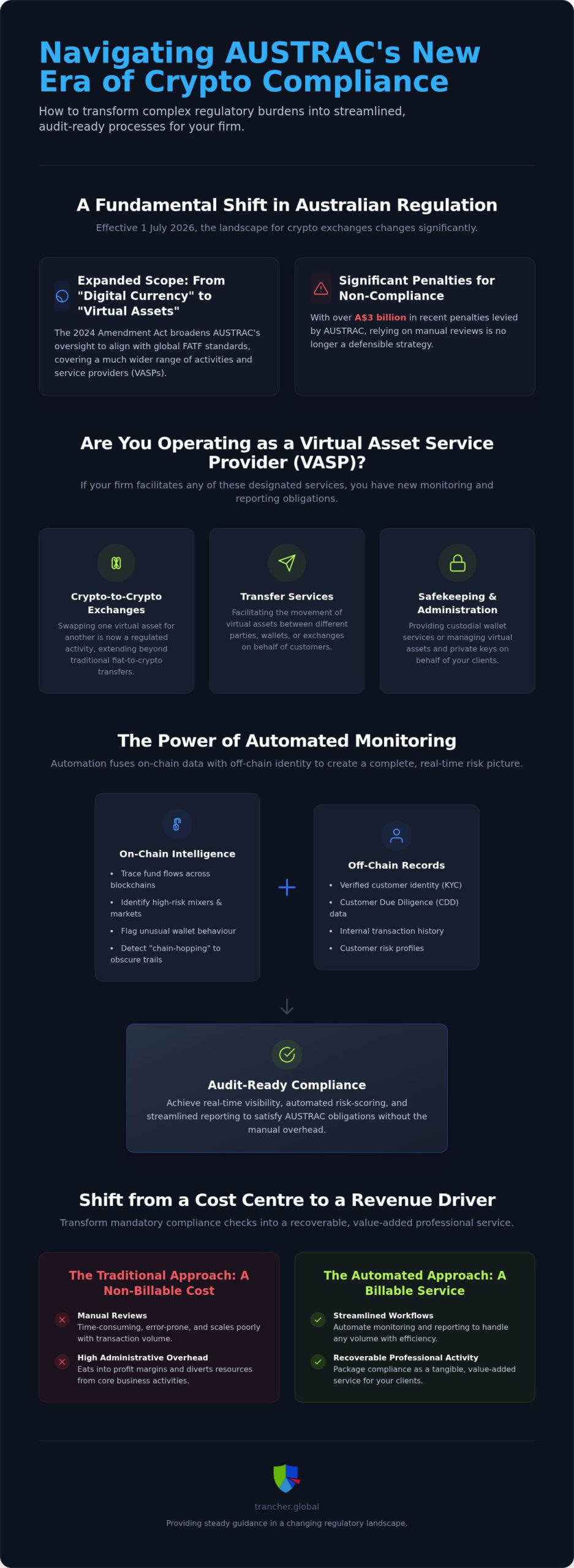
The 1 July 2026 commencement of the AML/CTF Amendment Act 2024 represents the most significant shift in local regulation for a decade. We’ve moved away from the narrow “digital currency” terminology to the internationally recognised “virtual asset” definition. This isn’t just a semantic change; it’s a widening of the net. AUSTRAC now oversees a broader range of Virtual Asset Service Providers (VASPs), ensuring Australia aligns with global standards like FATF Recommendation 15. Because the volume of data is so vast, automating transaction monitoring for crypto exchanges has become the only viable path for firms that want to remain compliant without sacrificing growth.
The Tranche 2 Regulatory Landscape
The new era of Australian compliance is defined by proactive oversight rather than reactive reporting. The 2024 reforms require firms to demonstrate a deep understanding of their risk environment at all times. Relying on manual reviews or basic spreadsheets is no longer a defensible strategy when AUSTRAC expects real-time visibility. Modern transaction monitoring systems provide the necessary infrastructure to flag high-risk activity instantly. This transition doesn’t have to be a hurdle. Instead, it’s an opportunity to build more resilient internal systems that protect your business from the A$3 billion in penalties AUSTRAC has levied against major institutions in recent years.
Designated Services in the Virtual Asset Sector
Identifying which activities trigger AUSTRAC obligations is the first step toward readiness. Under the updated rules, the list of “designated services” has expanded significantly. If your firm facilitates any of the following, you’re likely operating as a VASP:
- Crypto-to-crypto exchanges: Swapping one virtual asset for another is now a regulated activity, moving beyond just fiat-to-crypto transfers.
- Transfer services: Facilitating the movement of virtual assets between different parties or wallets.
- Safekeeping and administration: Providing custodial wallet services or managing virtual assets on behalf of clients.
These changes mean your monitoring must cover the entire lifecycle of a transaction, not just the entry and exit points. By integrating automated workflows, you can manage these complex layers of data with confidence and ease.
How Automating Transaction Monitoring Works for Virtual Assets
Monitoring virtual assets requires a dual-lens approach that bridges the gap between anonymous blockchain activity and verified customer identities. Unlike traditional banking where transactions stay within proprietary ledgers, crypto transactions are visible on public chains but often lack context. By automating transaction monitoring for crypto exchanges, firms can instantly fuse on-chain data with their internal records. This creates a complete picture of where funds originated and where they’re headed, ensuring you aren’t just ticking boxes but actually managing risk.
On-Chain vs. Off-Chain Intelligence
The true power of modern compliance lies in layering blockchain analytics over your existing database. On-chain intelligence allows you to trace fund flows across multiple blockchains and decentralised platforms, identifying if a customer’s assets have recently touched a high-risk mixer or a darknet market. However, blockchain data alone isn’t enough for AUSTRAC. You must layer your CDD and KYC requirements Australia over this transaction data to meet the full scope of your obligations.
Automated systems can flag unusual wallet behaviour, such as “chain-hopping” where a user moves assets between different protocols to obscure the trail. When these alerts are automated, your team doesn’t have to manually investigate every small transfer. Instead, they receive a risk-scored notification that provides the full context of the customer’s history and the transaction’s destination.
The Power of Real-Time Screening
In the fast-moving world of virtual assets, waiting for a weekly report is too slow. Real-time screening ensures that every transaction is checked against Politically Exposed Person (PEP) lists and global sanctions databases before it’s finalised. This proactive stance aligns with FATF’s global compliance standards, which emphasise that transaction monitoring and blockchain analytics are now baseline expectations for the industry.
Using intelligent risk-based logic helps reduce the burden of “false positives” that often plague manual systems. By fine-tuning your alerts, you can focus your expertise on truly suspicious activity while allowing legitimate transactions to flow seamlessly. This efficiency transforms compliance into a smooth operational process. If you’re looking to enhance your oversight, you can explore our platform integrations to see how these workflows fit into your existing systems.
Finally, every decision made by an automated system is logged in an immutable, audit-ready record. Because AUSTRAC requires records to be kept for seven years, having an automated trail ensures you’re always prepared for a regulatory review without the stress of a manual paper trail. This methodical approach gives you the steady guidance needed to scale your operations safely.
The Travel Rule and Compliance Reporting Obligations
The introduction of the “Travel Rule” on 1 July 2026 has fundamentally changed how virtual asset transfers operate in Australia. Unlike some international jurisdictions that apply a minimum value, Australia has implemented a no-threshold policy. This means every single transfer, regardless of size, requires the seamless transmission of originator and beneficiary information between institutions. This creates a significant data burden that can only be managed by automating transaction monitoring for crypto exchanges. Without these systems, the manual effort required to collect, verify, and share counterparty data would likely bring your operations to a standstill.
We see this requirement as more than just a hurdle. It’s a structured way to build trust across the virtual asset ecosystem. When your systems can automatically identify and communicate with other Virtual Asset Service Providers (VASPs), you reduce the friction of compliance. This ensures that legitimate customer funds move quickly while illicit activity is walled off. By integrating these workflows, you’re not just following the law; you’re protecting the integrity of your platform.
Meeting Travel Rule Requirements
Your obligations for transfers involve more than just sending data. You must also ensure the information you receive is complete and accurate. Managing these privacy obligations while sharing sensitive data requires a secure, automated protocol. When a transaction arrives with missing originator details, your system needs a robust “reject or hold” workflow. Automation allows you to pause these transfers instantly, giving your team the chance to request the missing information without violating AUSTRAC standards. This proactive approach prevents your firm from inadvertently facilitating anonymous transfers that could lead to regulatory scrutiny.
Automating Suspicious Matter Reporting
Suspicious Matter Reports (SMRs) are the cornerstone of your relationship with AUSTRAC. Identifying red flags in the crypto space, such as ransomware payments or interactions with darknet mixers, requires specialized forensic tracing. Automated systems excel here by triggering alerts based on specific risk typologies unique to virtual assets. Instead of your staff spending hours manually tracing a wallet’s history, the software can generate a technical narrative that outlines the suspicious activity for you.
This automation ensures that your SMRs are both timely and accurate. It also helps you maintain a defensible record of your decision-making process. Whether you decide to file a report or determine that an alert doesn’t meet the “suspicious” threshold, having an automated log of that reasoning is vital. Because AUSTRAC requires these records to be kept for seven years, having a digital trail is a reliable way to ensure you’re always audit-ready. This methodical oversight transforms a complex reporting duty into a manageable, routine part of your professional service.
Five Steps to Implementing Automated Monitoring in 30 Days
Moving toward full compliance doesn’t have to be a multi-year project. With the right framework, automating transaction monitoring for crypto exchanges can be achieved in as little as 30 days. This timeline is particularly critical as we approach the final registration deadlines following the 2024 reforms. By following a structured path, you can ensure your firm isn’t just meeting the minimum standards but is also positioned for long-term operational health.
Our methodology focuses on five core pillars to get your systems audit-ready:
- Step 1: Enrolment and registration: Formalise your status on the AUSTRAC DCE register to avoid operating as an unregistered entity.
- Step 2: Business-wide risk assessment: Evaluate your specific virtual asset risks, including customer types, delivery channels, and geographic factors.
- Step 3: Programme design: Develop your AML/CTF programme, ensuring Part A (risk management) and Part B (customer identification) are robust and integrated.
- Step 4: Tool integration: Deploy automated KYC and transaction screening tools that connect your on-chain data with identity records.
- Step 5: Review and training: Establish independent review cycles and provide role-based training to ensure your staff can manage the new workflows.
The AUSTRAC Enrolment Roadmap
Enrolment for new Virtual Asset Service Providers (VASPs) opened on 31 March 2026, with a final deadline of 29 July 2026. Missing this window can lead to severe operational disruptions. We recommend using a structured AUSTRAC enrolment checklist to ensure you don’t miss critical documentation during the DCE registration process. Many firms stumble by providing incomplete information about their beneficial owners or failing to clearly define their designated services. Preparing early helps you avoid the “regulatory rush” that typically occurs as the 1 July 2026 commencement date nears. A proactive approach ensures your application is processed smoothly, giving you the peace of mind to focus on your core business activities.
Achieving Operational Readiness
The shift from manual spreadsheets to a structured digital workflow is where the most significant efficiency gains are found. Manual monitoring is prone to human error and often lacks the speed required to flag suspicious activity in real-time. By implementing automated workflows, you can transform these administrative tasks into a seamless part of your client service. We believe that compliance should be a driver of growth, not a hurdle. This is why we focus on making the transition as smooth as possible. Our 30-day compliance guarantee removes the stress of the 2026 deadline, providing you with a clear path to readiness. With expert guidance and role-based staff training, your team will feel confident managing these new systems, turning a complex obligation into a reliable, professional advantage.
Turning Crypto Compliance into a Billable Professional Service
Most firms view AUSTRAC requirements as a sunk cost or a non-billable administrative burden. We suggest a fundamental shift in perspective. When you move toward automating transaction monitoring for crypto exchanges, you aren’t just buying software; you’re investing in a high-value advisory asset. A robust compliance framework protects your firm from regulatory risk and positions you as a premium, trustworthy partner in the digital asset space. Clients in the crypto sector value security and legitimacy, and demonstrating your commitment to these standards can be a significant competitive advantage.
By using structured data from your monitoring workflows, you can provide clients with clear evidence of the protective measures you’ve implemented on their behalf. This transparency transforms a background task into a visible professional service. When automating transaction monitoring for crypto exchanges, you also gain the ability to generate ROI reporting. These reports demonstrate exactly how much manual labour has been saved and how efficiently risks are being mitigated, allowing you to prove the health of your internal systems to stakeholders and auditors alike.
Recoverable Activity and Client Billing
Identifying billable hours within an automated workflow is the key to turning compliance into a recoverable activity. While the software handles the heavy lifting of data aggregation, your team’s expertise is still required to review complex alerts and make final reporting decisions. We provide frameworks for explaining compliance fees to crypto clients, helping them understand that these costs are an essential part of maintaining a secure trading environment. By tracking the time spent on enhanced due diligence and suspicious matter investigations, you can accurately reflect these professional services in your billing cycle. This ensures that your AML/CTF programme supports your firm’s financial health rather than draining it.
The Trancher Advantage for Crypto SMEs
We understand that the transition to the 2026 standards feels daunting for smaller operators. That’s why we focus on removing friction at every step. Our approach includes a complimentary 3-month trial, giving you ample time to see the operational benefits before making a long-term commitment. After the trial, we provide a detailed ROI and efficiency report to show you exactly how the system has performed.
You’ll also have access to local, Australian-led support from Aaron Soh and our team of experts. We’re here to act as your steady guide, ensuring your platform integrations and workflow automations are seamless. Starting the conversation now is the ultimate competitive edge. It allows you to build a resilient system well before the 1 July 2026 deadline, ensuring your firm remains a leader in the evolving Australian virtual asset market.
Securing Your Firm’s Future in the Virtual Asset Market
The regulatory landscape for Australian crypto exchanges has changed forever. With the 1 July 2026 deadline now in effect, the transition to VASP status and the implementation of the no-threshold Travel Rule require a methodical, tech-forward response. We’ve seen how automating transaction monitoring for crypto exchanges removes the friction of manual oversight, allowing you to focus on high-value advisory work while maintaining audit-ready records. This shift ensures you’re prepared for the scrutiny of the 2024 Amendment Act without sacrificing your operational efficiency.
By reframing compliance as a billable professional service, you transform a mandatory cost into a driver of business growth. You don’t have to navigate these complex AUSTRAC requirements alone. Our team provides the steady guidance needed to ensure your systems are resilient and profitable from day one. It’s about turning a perceived burden into a strategic advantage for your firm.
Discover how Trancher makes crypto compliance profitable with our 30-day compliance readiness guarantee and a complimentary 3-month trial. With specialist Australian SME support from Aaron Soh, you’ll have the expert companion you need to thrive. We’re here to help you turn these obligations into your firm’s greatest competitive advantage.
Frequently Asked Questions
Does my digital currency exchange need to register with AUSTRAC?
Yes, if you provide “designated services” in Australia, you must register. This includes exchanging virtual assets for fiat or other virtual assets. Registration on the AUSTRAC DCE register is a legal requirement. Operating without registration since the 2026 reforms is a serious breach that carries heavy penalties. You must also enrol as a reporting entity and maintain a compliant AML/CTF programme to protect your firm’s future and reputation.
What is the 1 July 2026 Tranche 2 deadline for crypto firms?
1 July 2026 marks the commencement of the AML/CTF Amendment Act 2024. This date brought crypto-to-crypto exchanges and custodial wallet providers fully into the regulatory net as Virtual Asset Service Providers (VASPs). It also introduced the Travel Rule with no minimum threshold. Firms must have their automated monitoring and reporting systems fully operational by this date to remain compliant. It’s a new era of accountability for every firm operating in the Australian digital asset sector.
How does automated transaction monitoring differ from manual checks?
Manual checks rely on human review of spreadsheets, which is slow and error-prone. In contrast, automating transaction monitoring for crypto exchanges uses real-time blockchain analytics to flag high-risk wallets and mixer interactions instantly. Automation handles vast data volumes effortlessly, ensuring you never miss a suspicious pattern. It also creates an immutable audit trail, which is essential for proving compliance during AUSTRAC reviews. This methodical approach gives you full control over your regulatory obligations.
What is the “Travel Rule” for virtual asset transfers in Australia?
The Travel Rule requires VASPs to collect and transmit originator and beneficiary information for every virtual asset transfer. In Australia, there’s no minimum transaction threshold for this rule. Every transfer requires the exchange of verified identity data between the sending and receiving institutions. Automated systems manage this complex data exchange seamlessly, preventing transaction delays while ensuring you meet your reporting obligations. This process helps build a more transparent and secure environment for all your customers.
Can I use a manual spreadsheet for crypto AML compliance?
While not strictly illegal, relying on manual spreadsheets is no longer defensible for modern crypto firms. The volume and speed of virtual asset transfers make manual oversight practically impossible to maintain accurately. AUSTRAC expects a risk-based approach that includes robust monitoring. Spreadsheets lack real-time alerts, forensic tracing, and the secure data handling required for the Travel Rule. Automation is the only reliable way to ensure you’re audit-ready and protected from administrative errors.
What are the penalties for failing to monitor crypto transactions?
Penalties for non-compliance are severe and can be business-ending. AUSTRAC has previously levied combined penalties exceeding A$3 billion against major Australian institutions for failures in transaction monitoring and due diligence. For crypto firms, failing to register or monitor transactions can lead to massive fines and loss of registration. Proactive oversight via automating transaction monitoring for crypto exchanges is your best defence against these significant regulatory risks and potential financial losses.
How much time does it take to implement an automated AML programme?
Implementation times vary, but we specialise in getting firms ready within 30 days. This accelerated roadmap covers enrolment, risk assessment, and the integration of automated screening tools. While some legacy systems take months to deploy, modern platform integrations are designed for speed and operational ease. This allows you to meet urgent regulatory deadlines without disrupting your day-to-day business activities. It’s a practical way to achieve compliance quickly and confidently for your firm.
Is there an AUSTRAC enrolment checklist for new virtual asset providers?
Yes, AUSTRAC provides basic requirements, but a structured enrolment checklist is essential for accuracy. You’ll need to provide details on beneficial owners, your AML/CTF compliance officer, and your specific virtual asset services. Using a comprehensive checklist helps you avoid common pitfalls during the registration process, such as incomplete risk assessments. Ensuring every detail is correct from the start speeds up your application and guarantees you’re ready for the 1 July 2026 deadline.