
PEP status is a risk classification, not an accusation of wrongdoing. The answer to who is a politically exposed person in Australia extends beyond elected politicians: it includes people entrusted with prominent public positions or functions, as well as certain family members and close associates. Australia’s AML/CTF framework identifies three categories: domestic, foreign and international organisation PEPs.
It’s understandable to assume PEP status applies only while someone holds public office, or only to people in Australia. In practice, former roles can remain relevant to risk assessments, and overseas connections matter too. A potential screening match needs review before it is confirmed: a name match alone doesn’t establish that someone is a PEP.
This article explains which roles may qualify, how businesses identify and assess potential matches, and why family relationships, close associates and former PEP status can affect due diligence. It also explains how foreign PEPs are treated and what these distinctions mean for Australian businesses managing AML/CTF obligations.
Key Takeaways
- PEP status can apply to people with prominent public roles in Australia or overseas, not just elected politicians.
- Use the Australian categories of domestic, foreign and international organisation PEPs to guide identification and risk assessment.
- Consider whether a customer’s immediate family relationships or close business connections bring them within the PEP framework.
- Assess former PEPs according to their current risk profile; leaving public office does not automatically remove every risk consideration.
- Review potential screening matches against relevant customer details before deciding whether they are genuine.
What is a Politically Exposed Person (PEP)?
To understand who is a politically exposed person in Australia, consider the person’s public role and influence. A PEP is an individual entrusted with a prominent public position or function in a government body or international organisation, in Australia or overseas. The position, rather than the person’s reputation or wealth, is the starting point for assessing PEP status.
Section 5 of the Anti-Money Laundering and Counter-Terrorism Financing Act 2006 defines PEPs under Australian law. The AML/CTF Rules identify relevant positions, including heads of state or government, ministers, senior government officials, certain senior judges and central bank governors. These roles carry public responsibility or influence, which can affect the assessment of a customer’s risk.
A title alone does not make every public employee a PEP. The focus is on prominent functions, so middle-ranking officials are not generally the intended focus of the PEP concept. For example, a senior government department head may qualify, while an employee without a prominent public function may not. The position’s authority and responsibilities matter more than a general connection to government.
PEP classification also extends beyond elected representatives. A senior executive at a government-owned commercial company, a senior law enforcement member or a senior religious organisation member may fall within relevant role categories. An international organisation PEP holds a prominent position in an organisation such as the United Nations or the World Trade Organisation. These examples show why role-based screening should consider more than political office.
PEP classification is a preventive risk measure, not an allegation of misconduct. A prominent position may create opportunities to conceal illicit funds or facilitate corruption or bribery, which can affect risk assessment. That possibility does not mean every PEP is involved in criminal activity. Instead, PEP status helps determine whether standard due diligence is enough or enhanced checks are appropriate.
Under sections 26F(1), 28 and 26F(3)(b) of the Act, and section 5-5 of the Rules, Australian businesses must establish on reasonable grounds whether specified individuals are PEPs before providing a customer with a designated service. Keeping clear records of how a PEP determination was reached can help a business document its decision-making. Failing to manage PEP relationships can therefore leave a business unable to meet these obligations and document its decisions. AUSTRAC says senior manager approval is required for certain designated services involving a foreign PEP, or a domestic or international organisation PEP when the customer has high ML/TF risk.
How is a PEP identified in Australia?
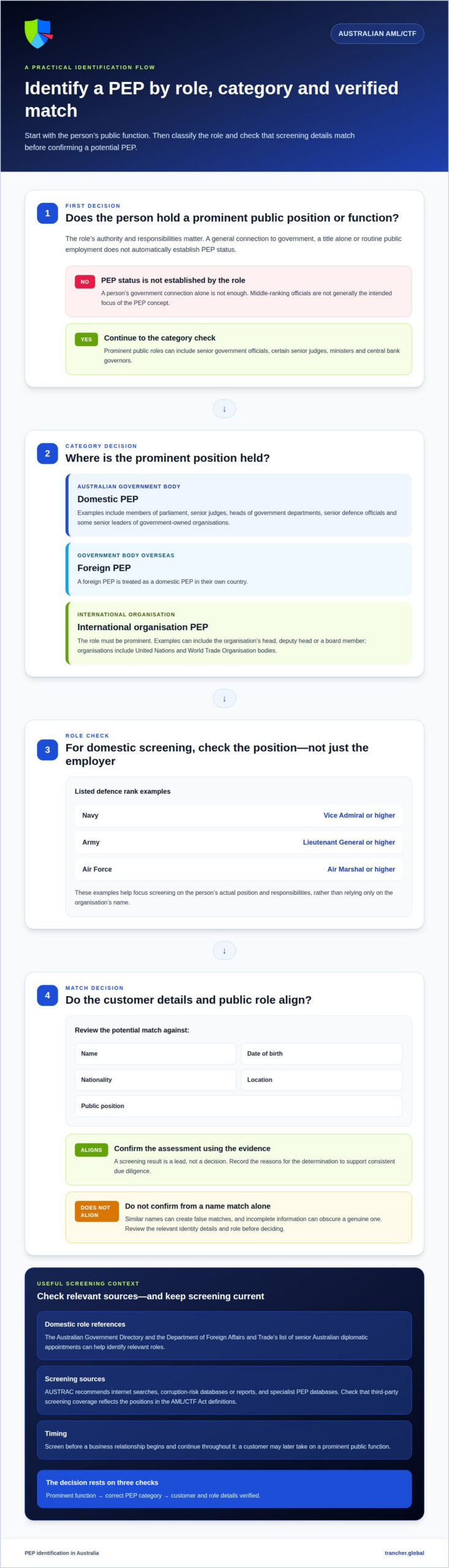
Australian identification starts with the person’s public function and the category of their position. The AML/CTF framework distinguishes domestic, foreign and international organisation PEPs.
PEP categories in Australia
A domestic PEP holds a prominent public position in an Australian government body. A foreign PEP holds such a position overseas, while an international organisation PEP holds one in an organisation such as a United Nations body. These categories matter because the person’s role and location shape how a business assesses the customer relationship and relevant risk.
A foreign PEP is treated as a domestic PEP in their own country. Examples of prominent roles in international organisations can include the organisation’s head, deputy head or board member. The role must be prominent: an ordinary connection to government or an international organisation does not establish PEP status by itself.
Domestic PEP roles
Sections 1-5 of the AML/CTF Rules address domestic PEP positions, alongside section 5 of the Act. Australian examples include members of parliament, senior judges, heads of government departments, senior defence officials and some senior leaders of government-owned organisations. The position’s responsibilities help distinguish prominent public functions from routine government employment.
The listed defence ranks provide specific examples: a Navy officer at Vice Admiral or higher, an Army officer at Lieutenant General or higher, and an Air Force officer at Air Marshal or higher may qualify. These thresholds help screening focus on a person’s actual position rather than relying only on the employer’s name.
For domestic screening, the Australian Government Directory and the Department of Foreign Affairs and Trade’s list of senior Australian diplomatic appointments can help identify relevant roles. These sources provide context about names and public functions, but a screening result still needs careful assessment.
AUSTRAC recommends checking customer backgrounds through internet searches, corruption-risk databases or reports, and specialist PEP databases. A business using a third-party screening provider should ensure its coverage reflects positions in the AML/CTF Act definitions. A database result is a lead, not a decision.
Review a potential match against the customer’s name, date of birth, nationality, location and public position before confirming or ruling it out. Similar names can generate false matches, while incomplete information can obscure a genuine one. Recording the reasons for the decision supports a consistent due diligence process.
Screening can take place before a business relationship begins and continue throughout it, because a customer may later take on a prominent public function. A name match alone does not establish that someone is a PEP; the role, identity details and relevant category must align.
Immediate family members and close associates
Australian PEP classification can extend beyond the person holding a prominent public function. The AML/CTF Rules include immediate family members and close associates in the definition. This matters during customer due diligence because a customer may be connected to a PEP without holding public office themselves. The connection is relevant to identification and risk assessment, not proof of wrongdoing.
The Rules identify specific immediate family relationships: a spouse or de facto partner, a child, a child’s spouse or de facto partner, and a parent. For example, a customer who is the child of someone holding a prominent domestic public position may fall within the family-member category. The relationship should be considered alongside the PEP’s role.
Not every relative is included in that stated list. A sibling, cousin or more distant relative does not become an immediate family member under these examples simply because of the family connection. Accurate screening therefore depends on recording the actual relationship, rather than treating all relatives as equivalent. A spouse and a cousin, for instance, fall into different relationship categories.
A close associate is identified through a specific financial or business connection. The AML/CTF Rules describe a close associate as someone known to have joint beneficial ownership with a PEP, or sole beneficial ownership of an entity or arrangement known to exist for the PEP’s benefit. The focus is on ownership and benefit, not simply working in the same industry or knowing the person socially.
Consider a company where a customer and a prominent public figure share beneficial ownership. That connection may bring the customer within the close-associate category. The same applies where the customer is the sole beneficial owner of an arrangement known to benefit the PEP. Customer due diligence should establish who owns or benefits from relevant entities and arrangements, then document the connection and its basis.
Publicly known personal associations and close business relationships can prompt closer assessment, but the defined ownership links provide a clear basis for identifying close associates. A shared business name alone does not show who controls or benefits from an entity. Reviewing ownership information and the nature of the relationship helps distinguish a relevant association from a coincidental connection.
Family or associate status does not, by itself, establish corruption, illicit funds or criminal conduct. It signals a connection that may affect the customer’s risk profile and the due diligence required. For example, a parent’s public role and a customer’s business activity are separate facts; both may inform the overall assessment without implying misconduct.
Can a former PEP still present a high ML/TF risk?
Yes. In Australia, a person who leaves a politically exposed position is no longer a PEP, but their former role can still affect their money laundering and terrorism financing risk. A former minister, for example, may retain influence or relationships relevant to assessing an ongoing business relationship. The assessment should consider current circumstances, not rely on the former title alone.
Australian businesses covered by the AML/CTF regime must identify and assess specified individuals before providing a designated service. These obligations apply to reporting entities subject to the Anti-Money Laundering and Counter-Terrorism Financing Act 2006, rather than every Australian business. During a relationship, reasonable steps must also be taken to monitor whether specified people become PEPs.
For a former PEP, risk assessment considers factors such as the person’s previous function, continuing influence, customer activity and connections to the proposed service. A domestic PEP or international organisation PEP may be assessed as low to medium risk or high risk after due diligence. The decision should reflect the person’s circumstances and the business relationship, rather than automatically treating every former office-holder as high risk.
Risk can persist where a former official retains control over relevant entities, continues to influence public decisions, or has transactions inconsistent with their known circumstances. For example, unexplained activity involving a former official’s business associates may warrant closer review. These indicators call for assessment; they do not, by themselves, establish bribery, corruption or other criminal conduct.
Where a former PEP customer is assessed as high ML/TF risk, Australian firms must apply enhanced customer due diligence. The AML/CTF Act also requires policies to provide for senior manager approval before a designated service is provided or a business relationship continued involving a person who was previously a PEP. These controls make the risk decision accountable and documented.
International organisation PEPs are individuals holding prominent functions in organisations such as a United Nations body. A former head, deputy head or board member may leave that role, yet their past authority can remain relevant to risk. Consider the person’s former international position alongside present activity, source of funds and wealth, and any continuing influence.
AUSTRAC recommends close monitoring of transactions involving high-risk PEPs. If a transaction is suspected of involving funds linked to corruption or other criminal activity, a suspicious matter report may be required. A business should also keep records of its PEP assessment and review relevant customer information as the relationship develops.
Foreign PEPs and their connections
A foreign PEP holds a prominent public position or function in a government body outside Australia. Examples include a senior minister or government official in another country. Under Australia’s AML/CTF framework, every foreign PEP must be treated as high risk. This classification reflects the potential for public influence to be misused, not an assumption that the individual has committed wrongdoing.
That high-risk status has practical consequences for an Australian business relationship. Foreign PEP status can warrant enhanced customer due diligence as part of assessing the relationship. Before providing a designated service, a business must establish on reasonable grounds the source of funds and source of wealth for specified foreign PEP customers or related individuals. Consider this information in relation to the proposed transaction or activity.
Connections also matter. A customer may be acting for another person or entity, so the relationship and relevant parties need to be understood before proceeding. Guidance recommends identifying and verifying the identity of that other person or entity. For example, where a customer acts for a foreign official’s company, the business needs to establish whom it is dealing with and who benefits from the arrangement.
Country and sector context can add further risk. Doing business with a PEP connected to a higher-risk country or industry or sector is a red flag. This calls for careful assessment alongside the customer’s role, transaction purpose and source of funds. A foreign government connection alone does not prove money laundering, but it is relevant to the overall risk picture.
Ownership structures also deserve attention. Using corporate vehicles to obscure a PEP’s ownership can indicate that the financial system may be misused. For instance, a chain of entities that conceals who ultimately benefits from a transaction warrants closer scrutiny. Distinguish legitimate complexity from arrangements that obscure beneficial ownership, then document the reasoning behind the assessment.
According to AUSTRAC, senior manager approval is required for certain designated services involving a foreign PEP. This requirement sits alongside enhanced due diligence and consideration of the source of funds and wealth. Keeping these decisions connected helps ensure that the customer’s status, proposed activity and relevant connections inform the business’s response.
Apply these measures in a consistent way across onboarding and ongoing review. If a foreign PEP’s circumstances or transaction activity change, reassess the relationship using the available customer information and risk indicators. Strengthen PEP screening and ongoing risk workflows to support a structured approach to foreign connections.
Trancher
Trancher helps Australian businesses manage PEP identification and related AML/CTF obligations through connected compliance workflows. Its platform supports client verification and due diligence, including KYC/CDD screening, followed by ongoing risk monitoring and client activity tracking as relationships develop.
When PEP checks need to connect with broader program responsibilities, end-to-end AML/CTF program management can bring those processes together. Trancher also supports regulatory and suspicious matter reporting, helping businesses maintain a structured approach as customer information and risk assessments change.
Consider Trancher when your team needs practical support to organise screening, monitoring and reporting within its AML/CTF program. Contact Trancher to discuss how its platform can support your compliance workflows.
Build a consistent PEP response
Knowing who is a politically exposed person in Australia is useful when it informs consistent decisions across your AML/CTF program. Treat PEP assessment as part of a broader operating approach, with clear ownership of screening decisions, recorded rationale and a process for revisiting customer risk as circumstances change. This helps teams respond coherently when public roles, relationships or transaction patterns shift, rather than treating each alert as an isolated event.
Next, identify where your current workflows need better coordination, from customer intake through ongoing monitoring and escalation. Aligning those stages can make compliance decisions easier to apply and maintain as your business grows. To discuss how your PEP risk processes can fit within a wider AML/CTF program, talk through your PEP risk with Trancher. A considered, documented approach gives your team a firmer basis for sound decisions.
Frequently Asked Questions
How do I run a PEP check?
Run a PEP check by screening the customer, then reviewing any possible match against reliable identity and role details. Compare information such as the person’s name, date of birth, nationality, location and public function. A matching name alone is not enough to confirm PEP status. Record the search approach, evidence considered and reason for the final decision so the result can be understood later.
Is a PEP always someone in the public eye?
No. PEP status depends on a prominent public function, not how often someone appears in the media. A senior official or judge may have little public profile but still hold a qualifying position. Conversely, a well-known entertainer or businessperson does not become a PEP solely through fame. Consider the person’s actual role and responsibilities rather than using public recognition as a shortcut.
What are the impacts of a PEP?
PEP status affects how a reporting business assesses and documents a customer relationship; it does not establish that the person has committed an offence. Depending on the category and assessed risk, the business may need enhanced due diligence, senior manager approval or closer transaction monitoring. For example, a foreign PEP is treated as high risk under Australia’s AML/CTF framework, while other cases depend on risk assessment.
What are the three types of PEPs?
The three types are domestic PEPs, foreign PEPs and international organisation PEPs. The category reflects whether the prominent function is connected to an Australian government body, an overseas government body or an international organisation. For example, a senior official in an overseas government is a foreign PEP, while a prominent role in a United Nations body may fall within the international organisation category.
What is a PEP list?
A PEP list is a screening resource containing profiles of people associated with prominent public functions. It can help identify potential matches during customer screening, but it does not replace identity checks or assessment of the person’s role. Lists may contain similar names or incomplete records. Treat a result as a prompt for review, not a final determination that the customer qualifies as a PEP.
What is the definition of a politically exposed person (PEP) in Australia?
To determine who is a politically exposed person in Australia, consider whether an individual holds, or has held, a prominent public function, or is an included family member or close associate. Section 5 of the Anti-Money Laundering and Counter-Terrorism Financing Act 2006 addresses PEPs, while the AML/CTF Rules identify relevant positions and connections. The assessment centres on the person’s role or relationship, not an assumption of criminal conduct.
Who qualifies as a domestic PEP under Australian law?
A domestic PEP may hold a prominent function in an Australian government body or another role identified by the AML/CTF Rules. Examples include members of parliament, senior judges, heads of government departments and some senior leaders of government-owned organisations. Certain senior defence ranks can also qualify. The role’s level and responsibilities matter; employment by a government body alone does not make every employee a PEP.
Which family members and close associates of Australian PEPs are included?
Included immediate family members are a spouse or de facto partner, child, a child’s spouse or de facto partner, and parent. A close associate can include someone known to share beneficial ownership with a PEP, or to be the sole beneficial owner of an arrangement known to benefit that PEP. For instance, shared ownership can be relevant; a casual acquaintance alone does not establish this connection.