
A sound AML/CTF program needs more than well-written policies: it needs independent scrutiny. Australian reporting entities must have their programs independently evaluated, but the AML/CTF Rules do not set one review interval for every business. When an independent AML review is required depends on the entity’s nature, size and complexity, and its money laundering and terrorism financing risks.
It is understandable to want a clear deadline, particularly as compliance responsibilities change. The practical approach is to set and document a review frequency that reflects your organisation’s risk profile, then ensure the evaluator is independent of both the program and the work being assessed.
This article explains which reporting entities need an independent evaluation, what it examines and how to assess the evaluator’s independence. It also covers how risk assessment and day-to-day compliance inform the review, so you can understand the obligation and plan an evaluation that is well supported.
Key Takeaways
- Set an independent evaluation schedule that reflects your reporting entity’s nature, size, complexity and money laundering and terrorism financing risks, then document the reasons for it.
- Understand the review’s scope: it assesses the AML/CTF Program, including whether its controls are properly designed and work in practice.
- Choose an evaluator who is independent of the program and risk assessment being reviewed; independence is about their involvement, not simply whether they work inside or outside the business.
- Confirm how the obligation applies to your reporting entity and program type, including whether a joint program or a specific exception affects the position.
- Use findings to identify compliance gaps and strengthen the risk assessment, policies and controls that support your AML/CTF Program.
What is an independent review of an AML/CTF Program?
An independent evaluation assesses whether an AML/CTF Program is suitably designed and works in practice. In Australia, review timing should reflect the entity’s risk, nature, size and complexity, rather than follow one schedule for every business.
Minimum evaluation frequency
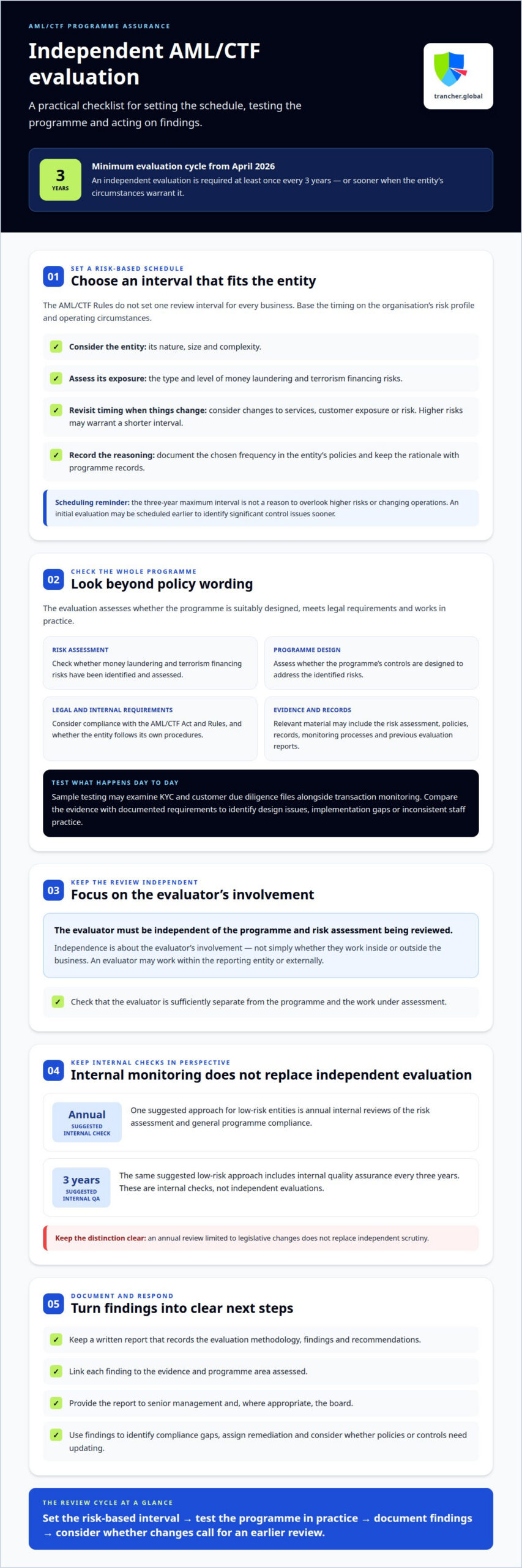
From April 2026, Australian reporting entities must have an independent AML/CTF evaluation at least once every 3 years, or sooner. The AML/CTF Rules do not prescribe one particular frequency for every entity, so the organisation’s policies must set an appropriate interval.
This distinction matters: a three-year cycle is no reason to overlook higher risks or changing operations. A business with increased money laundering or terrorism financing risks may need a shorter interval. Record why you chose the schedule so the timing can be understood alongside the evaluation findings.
Risk-based review scheduling
A risk-based schedule sets the evaluation frequency according to the organisation’s exposure and operating profile. Consider the business’s nature, size and complexity, as well as the type and level of its money laundering and terrorism financing risks.
For example, a larger entity with complex services and higher-risk customers may need more frequent evaluations than a smaller, lower-risk entity. One suggested approach for low-risk entities is annual internal reviews of risk assessment and general program compliance, plus internal quality assurance every three years. These are internal checks, not independent evaluations.
Some suggested low-risk approaches discuss extending independent reviews to five to six years where monitoring is sufficient. That interval should not be treated as overriding the post-reform requirement for evaluation at least every 3 years. Apply the relevant requirement and document why the schedule suits the entity.
AUSTRAC review requirements
AUSTRAC requires reporting entities with an AML/CTF Program to arrange regular independent evaluation, with the schedule informed by business risk and scale. From April 2026, the evaluation must occur at least once every 3 years, or sooner where the entity’s circumstances warrant it.
To set a practical schedule, identify the entity’s risk profile, consider changes to its services or customer exposure, and document the interval in its policies. An initial evaluation may be scheduled earlier to identify significant control issues sooner. Keep the rationale with program records, then consider whether new findings or changes warrant an earlier review.
Keep regular internal checks distinct from independent evaluations. An annual review limited to legislative changes, for example, does not replace independent scrutiny. The schedule should address the program and its risks, rather than simply repeat the previous review date.
Purpose and scope of an AML/CTF independent review
An independent evaluation assesses whether an AML/CTF Program meets legal requirements and operates as documented. Under Australia’s post-reform framework, it examines the whole program, including its risk assessment, design and controls in practice.
For a standard program, the Part A review must address the purpose in rule 8.6.5; for a joint program, it must address rule 9.6.5. In both cases, the review examines whether the program complies with the AML/CTF Act and Rules and whether the reporting entity follows its own procedures.
The evaluation covers more than policy wording. The evaluator may examine whether the entity identified and assessed its money laundering and terrorism financing risks, and whether its controls address them. The scope may include the documented risk assessment, AML/CTF policies, relevant records, monitoring processes and previous evaluation reports.
The evaluation can also test whether processes work consistently in daily operations. For example, sample testing may examine KYC and customer due diligence files alongside transaction monitoring. The evaluator considers whether those processes align with documented requirements and whether weaknesses indicate a design issue, an implementation gap or inconsistent staff practice.
Evaluation testing requirements
Evaluation testing compares documented procedures with evidence of how the entity applies them. This distinguishes a control that exists on paper from one that functions in practice.
Testing can sample client verification, due diligence and transaction monitoring records, then assess whether the results match the program’s risk assessment and procedures. For instance, a review of client files may reveal whether required checks were completed and recorded. Well-scoped client verification and due diligence workflows can support consistent records for that assessment.
Written evaluation reports
A written report records the evaluation methodology, findings and recommendations, giving senior management a clear basis for responding. It should link each finding to the evidence and program area assessed.
The reporting entity must provide the report to senior management and, where appropriate, its board. This helps decision-makers understand gaps, assign remediation and consider whether policies or controls need updating. Retaining the report with supporting records also helps show how the evaluation was conducted and how findings were addressed.
Evaluator independence and conflicts of interest
In Australia, an independent evaluator may work inside or outside the reporting entity. The key test is whether they are sufficiently independent of the AML/CTF procedures and risk assessment under review.
Australian AML/CTF law does not prescribe mandatory qualifications for an evaluator. The entity must be able to demonstrate the evaluator’s independence and suitability, rather than relying on their job title or external status alone.
Internal and independent evaluations
Internal program reviews and independent evaluations have different purposes, even when both examine AML/CTF controls. Regular internal monitoring can help identify gaps between evaluations, but it does not replace the independent evaluation obligation.
An internal audit department may conduct an independent evaluation if it is sufficiently separate from the program’s design and management. For example, a reviewer who helped write the risk assessment or maintain due diligence procedures may not be independent enough to assess that work objectively.
Keep the distinction clear in policies and records. An internal check of updated procedures can support ongoing oversight; a separate independent evaluation assesses the program without the reviewer assessing their own work.
Reviewer types and qualifications
An internal employee or external consultant can conduct the evaluation, provided they are independent of the procedures under review and their design, implementation or maintenance. Neither working inside nor outside the entity establishes independence on its own.
Australian AML/CTF law sets no mandatory qualifications for an independent evaluator. Instead, the entity’s policies should explain how it assessed the evaluator’s independence and suitability for the practice’s nature, size and complexity.
Address potential conflicts directly. Consider the evaluator’s role in developing or managing the AML/CTF Program, risk assessment and controls. For example, someone responsible for ongoing monitoring should not review that same work without demonstrating sufficient separation.
Document the basis for the appointment, including relevant responsibilities and how any overlap is managed. This gives senior decision-makers a clear account of why the reviewer can assess the program objectively.
Internal monitoring remains useful between evaluations. Teams can track changes to customer due diligence, controls and terrorism financing risks, then record emerging issues for management. These activities support oversight, but they are not independent just because another staff member performs them. Independence depends on the reviewer’s relationship to the work, not whether the check is conducted internally or externally.
Reporting entities covered by independent review obligations
Australian reporting entities with a standard AML/CTF Program must have Part A independently reviewed under Part 8.6 of the AML/CTF Rules. Reporting entities using a joint program in a designated business group are covered by the obligation under Part 9.6. The required review depends on the program and the entity’s regulatory position.
Some exceptions are specific. A financial advice provider that is purely an Item 54 Provider and only needs a Special AML/CTF Program does not strictly require an independent review. Clubs, pubs and hotels subject to full AML/CTF program obligations generally need an independent evaluation, subject to their licensed EGM entitlements and any applicable exemption.
Tranche 2 entities, including lawyers and accountants, must comply with AML/CTF obligations starting 1 July 2026. The Anti-Money Laundering and Counter-Terrorism Financing Transitional Rules 2026 provide staggered deadlines for first independent evaluations following that date. For eligible existing reporting entities enrolled on 30 March 2026 with a pre-reform review, the first deadline is the later of four years after their most recent review and 31 March 2027.
For an eligible organisation with a recent pre-reform evaluation, calculate the deadline using both dates, then apply the later one. Transitional timing applies only to eligible entities; it does not remove the need to maintain a compliant program or keep evaluation records.
For an AML/CTF review in Australia, keep the risk assessment, program policies, relevant records, monitoring and review details, and previous evaluation reports available. Records should also show how the evaluation was conducted and how the organisation responded to its findings.
A written evaluation report sets out the methodology, findings and recommendations. It should identify the program areas and evidence assessed, so management can understand control effectiveness and the significance of any gaps. Findings may identify non-compliance and recommend remediation, but the organisation remains responsible for acting on them.
Provide the report to senior management and, where appropriate, the board. This supports informed decisions about corrective action, assigned responsibilities and changes to policies or controls. For example, management can consider a finding about transaction monitoring alongside the relevant procedure and supporting records to determine an appropriate response.
Keep the report with supporting evaluation records. Together, they help explain the reviewer’s conclusions, show how recommendations were considered and preserve organisational knowledge when responsibilities change. A clear trail from evidence to findings to management response makes follow-up more practical and accountable.
Risk assessment and AML/CTF Program compliance
An independent evaluation should test whether the AML/CTF Program addresses the money laundering and terrorism financing risks identified by the organisation. From 31 March 2026, Australian independent evaluations must assess how well the single AML/CTF Program manages risks in the entity’s documented risk assessment. The central test is alignment: do the controls respond to the risks, and does the organisation follow its own policies?
A risk assessment is useful when it informs operational decisions. For example, if an entity identifies higher exposure in a customer group or transaction type, its program controls should address that exposure. In complex financial arrangements, this might include specialised controls such as bank instrument validation services to mitigate transaction risk. An evaluator examines whether the assessment identifies relevant risks, whether the controls are designed to mitigate them and whether staff apply them in practice.
Compliance testing should connect the documented assessment with evidence. An evaluator may compare policies with client files, screening records or monitoring activity, then consider whether staff followed the required process. A mismatch may indicate different issues: the risk assessment may miss a material exposure, a control may be poorly designed, or implementation may be inconsistent. Distinguishing these causes helps the organisation direct remediation appropriately.
Regulatory compliance also involves keeping the risk assessment and policies current. Australian reporting entities must document updates to their ML/TF risk assessment or AML/CTF policies within 14 days after making them. A service change, new customer exposure or altered transaction pattern can affect the risks the program must manage. The evaluation can assess whether relevant updates are reflected in the controls and operational procedures.
Findings should prompt a considered response, not just a revised document. If testing shows that staff do not consistently apply a control, the organisation can examine its procedures, implementation and monitoring. If a finding affects the documented risk assessment, consider whether the assessment or related policies need updating. This creates a traceable link between identified risk, control, evidence and corrective action.
Use the evaluation to examine both design and effectiveness. A policy may describe an appropriate control while records show incomplete application. Conversely, consistent activity may reveal that a control does not address the assessed risk. Reviewing both gives senior decision-makers a clearer basis for prioritising remediation and maintaining regulatory compliance.
Strengthen the operational evidence behind your assessment with ongoing risk monitoring and client activity tracking.
Trancher
Trancher helps Australian businesses manage AML/CTF obligations with its end-to-end program management platform. It brings compliance processes together, from client verification and due diligence to ongoing risk monitoring and regulatory and suspicious matter reporting.
This can help when you are aligning operational controls with your documented risk assessment or strengthening the records that support ongoing compliance. Trancher brings these program activities together, while your organisation remains responsible for its AML/CTF obligations and its response to independent evaluation findings.
For practical support managing your AML/CTF program, contact Trancher.
Build readiness into your next compliance decision
Understanding when an independent AML review is required is one part of staying prepared. The next step is ensuring your compliance processes generate clear, useful evidence between evaluations. Use findings to strengthen how responsibilities, controls and records fit together, rather than filing the report away without follow-up.
Trancher supports this ongoing work through End-to-End AML/CTF Program Management, Client Verification & Due Diligence (KYC/CDD + Screening), and Ongoing Risk Monitoring & Client Activity Tracking. These capabilities connect core compliance activities and support program readiness. Your organisation remains responsible for its obligations and for acting on evaluation findings.
If you’re considering how to strengthen your AML/CTF processes, contact Trancher to discuss your review. A clear next step can help turn compliance requirements into more consistent business practice.
Frequently Asked Questions
Should you use an external person to conduct your AML/CTF review or evaluation?
Not necessarily. An internal reviewer may conduct the evaluation if they are sufficiently independent of the work being assessed. For instance, a staff member who designed or maintains the risk assessment may have a conflict when reviewing it. An external consultant’s status alone does not establish independence. The entity should document how it assessed the reviewer’s independence and suitability for its operations.
What is an independent evaluation?
An independent evaluation assesses an AML/CTF Program through a person sufficiently independent of its design and management. It considers whether the program meets applicable requirements and whether its procedures are followed. For example, an evaluator may compare a policy’s client-checking requirements with completed customer files. The written report records the methods, findings and recommendations, giving management a basis for considering improvements.
When is an independent AML/CTF review required in Australia?
For an Australian reporting entity, determining when an independent AML review is required starts with identifying whether its AML/CTF Program must be independently evaluated. Transitional arrangements can affect the first evaluation deadline for eligible existing entities. The review obligation is separate from routine internal checks, so an internal compliance process does not replace an independent evaluation.
How often must Australian reporting entities conduct an independent AML/CTF review?
From April 2026, Australian reporting entities must have an independent evaluation at least once every 3 years, or sooner. A shorter interval may be appropriate where the entity’s risks, size, nature or complexity warrant it. For example, a substantial change in services or customer exposure may prompt an earlier evaluation. Transitional rules can also affect the first evaluation deadline for eligible existing entities.
Which Australian businesses are required to have an AML/CTF program independently reviewed?
Reporting entities required to maintain a standard AML/CTF Program are generally subject to independent review obligations, and joint programs have a corresponding requirement. A provider that is purely an Item 54 Provider and only needs a Special AML/CTF Program does not strictly require an independent review. Clubs, pubs and hotels with full program obligations may also be subject, depending on applicable exemptions and licensed EGM entitlements.
Can an employee or external consultant conduct an independent AML/CTF review?
Yes. Either an employee or a consultant may conduct the evaluation if they are independent of the procedures under review and their design, implementation or maintenance. Australian AML/CTF law does not prescribe mandatory qualifications for the evaluator. The entity’s policies should explain how it determined the person was independent and suitable for the organisation’s nature, size and complexity. Their responsibilities and involvement matter more than whether they are an employee or consultant.
What must a reporting entity do after an independent AML/CTF review identifies issues?
The entity should assess the report’s findings, decide what corrective action is appropriate and record its response. For example, a finding about inconsistent client checks may lead management to review the procedure, staff practice and supporting records. From April 2026, AML/CTF policies must specify how the entity will respond to an independent evaluation report, including addressing adverse findings and updating policies where required.
Are there different independent AML review requirements for Australian casinos, banks and small businesses?
For casinos, banks and small businesses, when an independent AML review is required depends on the entity’s program obligations and risk profile, not its sector or size alone. Banks and venues do not have a universal annual evaluation requirement. A smaller business with a standard program remains subject to applicable evaluation obligations. For a casino, the position also depends on its reporting-entity status and any applicable exemption.