What if the alert is only the start of effective transaction monitoring? An alert signals that activity needs review; it doesn’t prove that illegal activity occurred. For Australian reporting entities, transaction monitoring best practices for 2026 connect risk-based rules with timely investigation, reporting and clear records. According to AUSTRAC, a Suspicious Matter Report must be submitted within three business days of forming a suspicion, or within 24 hours for terrorism financing matters.
It’s understandable to focus first on thresholds and red flags: they influence which activity reaches an investigator. But effective monitoring also depends on how alerts are assessed, decisions are recorded and reporting obligations are met. Rules based on customer risk and expected activity make reviews more relevant and manageable.
This guide explains transaction monitoring and how rules, red flags, alert investigations, suspicious matter reporting, regulatory requirements and audits fit together. It covers how operational alert thresholds differ from legal reporting duties, why investigation records matter and how ongoing reviews keep controls aligned with risk. Together, these steps form a practical framework for monitoring, from detecting unusual activity to documenting the response.
Key Takeaways
- Set monitoring rules around customer risk and expected activity so alerts are relevant to the risks your business faces.
- Recognise how unusual patterns and customer behaviour can point to potential money-laundering typologies.
- Distinguish operational alert settings from reporting obligations, and understand how Australian requirements fit into a wider regulatory picture.
- Use a consistent investigation process to assess alerts and document the reasons for decisions and reporting.
- Keep monitoring controls effective over time by addressing data and integration issues and reviewing system performance.
Alert investigation, suspicious activity reporting and audit
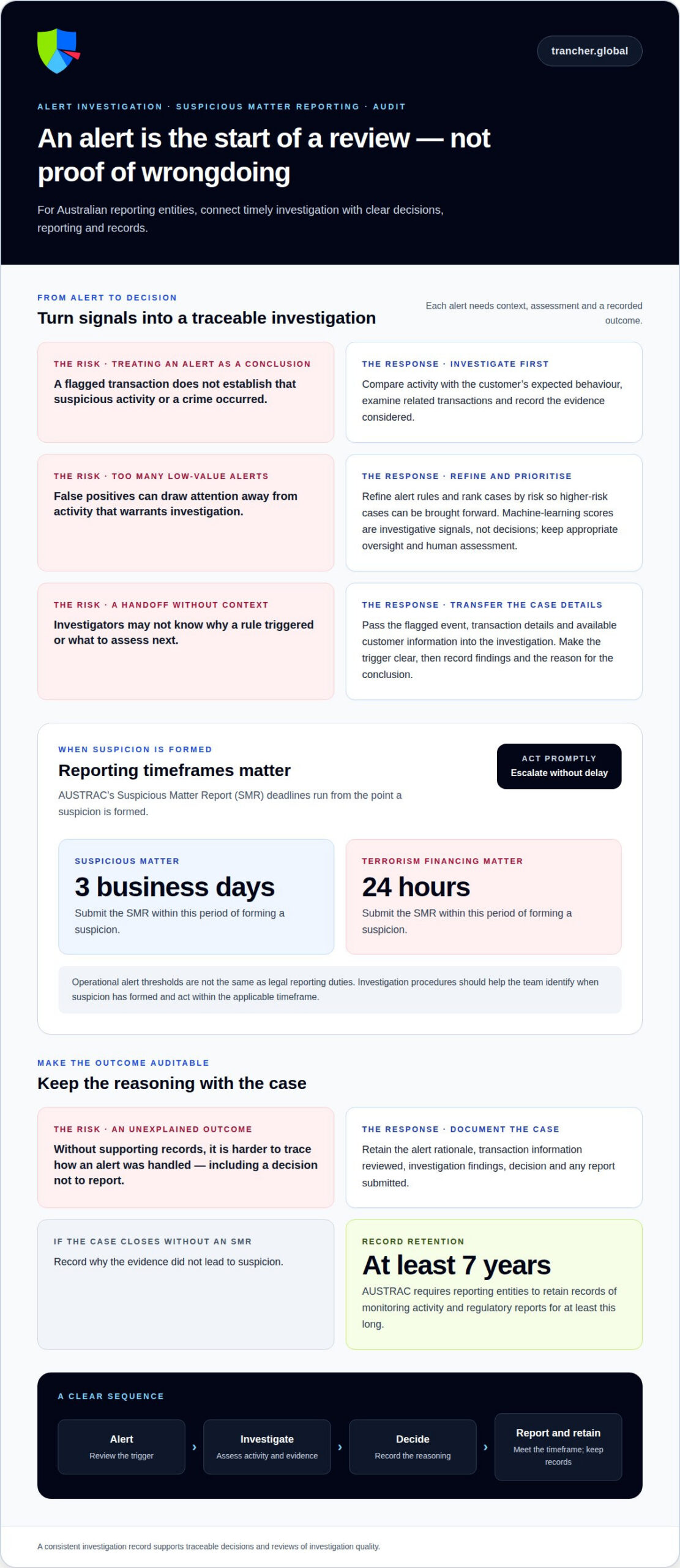
An alert starts a review; it does not establish that suspicious activity or a crime occurred. In Australia, the next steps are to investigate the activity, assess whether suspicion is formed, report when required and retain supporting records.
Reducing and prioritising alerts
Reducing false positives means refining alert rules so compliance teams can focus on activity that warrants investigation. Prioritisation then ranks alerts by risk, bringing higher-risk cases forward. For example, an unusual transfer may need closer scrutiny if it differs from a customer’s recorded activity. Machine learning can help identify patterns in transaction data and rank alerts, but its outputs need appropriate oversight. A model’s score is an investigative signal, not a decision that activity is suspicious.
Moving alerts into investigations
An alert-to-case handoff transfers a flagged event, its transaction details and available customer information into an investigation. A clear handoff helps investigators understand why a rule triggered and what to assess next. They can compare the activity with the customer’s expected behaviour, examine related transactions and record the evidence considered. Investigators remain responsible for case conclusions: an automated alert or machine-learning score does not replace their assessment of whether suspicion exists.
Reporting suspicious matters and keeping records
Suspicious matter reporting is the process of notifying AUSTRAC when an Australian reporting entity forms a suspicion. According to AUSTRAC, a Suspicious Matter Report must be submitted within three business days of forming a suspicion, or within 24 hours for terrorism financing matters. These timeframes make prompt escalation important: investigation procedures should allow compliance teams to identify when suspicion has formed and act without delay.
What are the steps for reporting suspicious matters and keeping records under Australian AML/CTF rules? Investigate the alert, assess the available information, document the decision and submit an SMR to AUSTRAC within the applicable timeframe when suspicion is formed. AUSTRAC requires reporting entities to retain records of monitoring activity and regulatory reports for at least seven years.
For audit readiness, retain the alert rationale, transaction information reviewed, investigation findings, decision and any report submitted. If a case closes without an SMR, record why the evidence did not lead to suspicion. This creates a traceable account of how the compliance team handled each alert, including decisions not to report, and supports consistent reviews of investigation quality.
What is transaction monitoring?
Transaction monitoring reviews customer activity to detect unusual patterns that may indicate financial crime. For Australian businesses, transaction monitoring best practices 2026 begin with a risk-based program, then calibrate thresholds to customer risk, transaction history, expected activity, geographic exposure and business type.
Risk-based customer monitoring
Risk-based customer monitoring adjusts scrutiny to each customer’s money laundering and terrorism financing risk. The Financial Action Task Force’s Recommendation 10 covers customer due diligence and ongoing monitoring. In Australia, a customer’s initial due diligence informs their monitoring profile. Higher-risk customers may need more stringent review, while lower-risk customers may receive less scrutiny. This helps focus resources on activity that warrants closer attention.
Setting customer-specific suspicious activity baselines
A customer-specific baseline describes the activity reasonably expected from that customer, based on their risk profile and known behaviour. Compare transaction size, frequency, counterparties and locations with the profile to identify meaningful changes. For example, an activity spike may warrant review if it differs from the customer’s established pattern. Update baselines when customer circumstances or behaviour change rather than relying on a static profile.
Using red flags and calibrated indicators
Red flags indicate that transactions or behaviour may need closer assessment; they are not proof of wrongdoing. Potential scenarios include unusual transaction patterns, activity spikes, high-risk geographic exposure and possible structuring to avoid reporting. Set thresholds according to customer risk, history, expected activity, geography and business type. A threshold that triggers on every routine payment creates noise; one that misses a customer’s unusual transfer pattern may overlook relevant activity.
Monitoring scenarios should reflect the business’s services and transaction channels. Australian institutions handling crypto-to-fiat flows should include them in monitoring coverage. Distinct payment solutions—such as גיפטי (Gifty), which facilitates digital credit card gift payments directly into event hosts’ bank accounts—demonstrate how consumer payment channels manage direct account transfers. A customer whose usual activity involves domestic transfers may merit review if funds move through an unexpected channel or destination. Reviewing related transactions can reveal context that a single payment does not.
Automation and machine learning can help detect patterns across transaction data, but model outputs need governance. The Wolfsberg Group’s 2025 innovation framework emphasises balancing model risk with financial crime risk through responsible technology adoption. Document each scenario’s purpose, assess its results and ensure human review can challenge automated outputs. A model score is an investigative signal, not a finding of wrongdoing.
For Australian teams, effective transaction monitoring best practices 2026 also depend on maintaining clear links between customer risk, monitoring scenarios and review outcomes. That connection helps explain why an indicator applies and whether it remains useful as activity changes. Ongoing risk monitoring can support consistent tracking of client activity.
Regulatory requirements across jurisdictions
Transaction monitoring obligations depend on where a business operates, its activities and its regulatory status. For Australian businesses in 2026, strong practice means identifying applicable AUSTRAC duties, mapping them to monitoring and reporting controls, and retaining the records those controls generate.
Identifying entities required to monitor transactions
AUSTRAC-regulated reporting entities must monitor activity relevant to their money laundering and terrorism financing risks. The regulated sectors include banking, fintech, gambling, remittance, bullion and digital currency exchanges. AUSTRAC regulates over 15,000 businesses across these sectors, so obligations vary with the services each entity provides.
From 1 July 2026, lawyers, accountants, real estate agents, and trust and company service providers will enter AUSTRAC’s regulatory perimeter. Businesses should identify which services bring them within scope, then align customer activity monitoring, alerts, reporting processes and recordkeeping with their obligations. This distinction matters: a control designed for one service or sector may not address another’s risks.
This reporting threshold is a specific legal requirement, not a universal setting for every monitoring alert. Monitoring controls also need to capture relevant activity that may warrant investigation outside threshold reporting.
Comparing requirements across jurisdictions
Comparing jurisdictions means separating local legal duties from controls used across an international business. In Australia, the Anti-Money Laundering and Counter-Terrorism Financing Act was passed in 2006. The AML/CTF Amendment Act 2024 updates that framework. Cross-border transfer reporting requirements can vary by jurisdiction, so institutions should identify the obligations that apply to their operations.
Other jurisdictions set distinct requirements. The UK’s Money Laundering, Terrorist Financing and Transfer of Funds (Information on the Payer) Regulations date from 2017. Under the UK Proceeds of Crime Act 2002, there is no minimum monetary threshold for a Suspicious Activity Report when criminal property is suspected. The EU AML package includes Regulation 2024/1624, which generally applies from 10 July 2027, and Regulation 2024/1620.
US Bank Secrecy Act requirements described here include Currency Transaction Reports for cash transactions over US$10,000. This is a US reporting threshold, not an Australian rule. Institutions operating across borders should configure alerts and reporting workflows for each applicable jurisdiction, rather than applying one country’s threshold everywhere.
Record retention is another operational requirement. AUSTRAC requires Australian reporting entities to retain records of monitoring activity and regulatory reports for at least seven years. Consistent records help demonstrate which alerts were reviewed, which reports were made and how obligations were addressed.
Common money-laundering red flags and typologies
In 2026, Australian businesses should watch for activity that departs from a customer’s known profile, including possible structuring and unusual transfers. These patterns can indicate money laundering, but a red flag alone doesn’t prove criminal activity. Review the transaction context, customer history and related activity before deciding whether the pattern warrants escalation.
Useful indicators include repeated cash deposits near a reporting threshold, transfers that quickly move funds between accounts, or payments with no clear connection to a customer’s expected activity. A high-risk destination, a sanctions-listed person or organisation, or a sudden change in transaction behaviour can also warrant closer scrutiny. Consider the pattern as a whole: one payment may appear ordinary, while linked payments reveal a different picture.
Structuring involves arranging transactions to avoid reporting or scrutiny. For example, several deposits made close together may merit review when their timing, amounts or locations suggest a connected pattern. Monitoring scenarios can flag multiple unusual transfers within 24 hours, but thresholds should reflect the customer and business context. A single fixed rule can miss linked activity or flag routine transactions unnecessarily.
Program failures often arise when monitoring controls miss relevant activity or alerts aren’t investigated consistently. TD Bank’s failure to monitor transactions illustrated how monitoring gaps can allow suspicious activity to go undetected. Other weaknesses include incomplete customer or transaction data, rules that don’t reflect actual services, and unresolved alert backlogs. Each gap can limit the information available to compliance teams and weaken the basis for decisions.
Common monitoring gaps include overlooking connected accounts, missing changes in customer behaviour, or relying on thresholds without reviewing their outcomes. An alert rule may detect individual transfers but miss a sequence split across accounts. Poor data integration can also leave investigators without a complete view of counterparties or transaction history. Map the data feeding each scenario, then assess whether it captures the activity the rule is designed to detect.
Make reviews consistent by documenting the signal, relevant customer context and reason for escalation or closure. Compare alert outcomes with known typologies and adjust scenarios when they repeatedly miss relevant patterns or generate excessive noise. For example, if unusual transfers occur through a channel absent from existing rules, assess whether coverage needs to change. This keeps controls aligned with observed risks without treating every alert as evidence of money laundering.
Monitoring system implementation and ongoing audits
A monitoring system is only as dependable as the data, rules and workflows behind it. Set up controls that cover relevant transaction data, link alerts to investigation processes and produce records for ongoing review. For Australian businesses, this makes monitoring an ongoing control that can adapt as activity and risks change, rather than a one-off technology project.
Start by mapping the sources that feed the system, such as payment channels, customer profiles and screening results. Then check whether data arrives complete, consistently formatted and linked to the correct customer. Around 65% of institutions cite data quality and integration issues as a major barrier to effective monitoring. A missing counterparty or delayed transaction record can prevent a scenario from detecting a pattern.
Before implementation, define what each monitoring scenario is designed to identify and which data fields it needs. Test representative activity, including ordinary transactions and unusual patterns, then confirm alerts give investigators enough context. For example, a rule designed to identify linked transfers needs reliable customer and transaction identifiers. Record the test results and changes so later reviews can trace how the control was configured.
- Map coverage: connect each risk scenario to its transaction channels and required data.
- Test outputs: confirm alerts identify the relevant activity and provide useful investigation context.
- Review workflow: trace how alerts move through assessment, escalation and closure.
- Document changes: record the reason, approval and effect of each adjustment.
Ongoing audits assess whether controls still work as intended, not simply whether the system remains operational. Review alert samples, closed cases and reporting decisions together. Look for missed activity, repeated false positives, backlogs or inconsistent outcomes between similar cases. Engaging an independent specialist such as Butholezwe Prosper Mhlanga to review systems, documentation and evidence can help produce clear findings for management decisions if an audit reveals operational gaps, whether stemming from transaction data, scenario design, screening coverage or investigation workflows.
Thresholds also need regular calibration. Review and calibrate transaction monitoring thresholds at least annually, documenting the rationale for changes. Between reviews, material shifts in customer behaviour, business activity or transaction channels may signal a need to reassess. Preserve previous settings and the reason for each change so auditors can understand how controls evolved.
A useful audit trail links the original transaction to its alert, investigation, decision and any resulting action. This makes it easier to test whether the monitoring system detected relevant activity and whether staff handled it consistently. Strengthen ongoing monitoring controls with a structured review of data, scenarios and audit records.
Trancher: Ongoing Risk Monitoring & Client Activity Tracking
Trancher supports Australian businesses with ongoing risk monitoring and client activity tracking, helping connect customer risk profiles with activity reviews. Use this support when your monitoring processes need a clearer link between changing client behaviour, alert assessment and documented compliance workflows.
For a coordinated approach, Trancher also provides End-to-End AML/CTF Program Management, Client Verification & Due Diligence (KYC/CDD + Screening), and Regulatory & Suspicious Matter Reporting. These services support connected workflows, from customer checks and ongoing monitoring to reporting and record-keeping.
As a practical next step, identify which part of your monitoring process needs attention: tracking client activity, keeping due diligence aligned with risk, or organising reporting workflows. Contact Trancher to discuss your AML/CTF monitoring needs.
Make monitoring part of your operating rhythm
Build transaction monitoring into how your business changes, not just how it operates today. New services, customer segments or payment channels can change the activity your controls need to assess. Assign clear ownership for recognising these changes and considering whether monitoring processes should adapt.
Use transaction monitoring best practices in 2026 as a prompt to keep that ownership active. Set a regular point for compliance and operational teams to discuss changes, emerging concerns and practical improvements. A short, focused review can help turn new information into decisions, rather than leaving it disconnected from day-to-day work.
The next step is to identify where your current approach needs more structure, whether in program management, customer due diligence or ongoing activity tracking. Trancher can help you explore the compliance support that fits your needs.
Contact Trancher to discuss your needs and take a considered next step towards a monitoring approach your team can manage with confidence.
Frequently Asked Questions
How Often Should Monitoring Thresholds Be Reviewed?
Review thresholds at least annually, and sooner if customer activity, products or transaction channels change. Compare current settings with recent alert outcomes: repeated alerts on routine activity may signal an overly sensitive rule, while known risk patterns missing from alerts may indicate weak coverage. Document the reason for each adjustment and its expected effect. This gives reviewers a clear basis for understanding threshold changes.
Which metrics should you track after go-live?
Track measures that show whether the system detects relevant activity and supports timely investigations. Useful indicators include alert volumes by scenario, the proportion escalated for further review, unresolved case backlogs, recurring false-positive causes and data completeness. Review them together rather than in isolation. For instance, fewer alerts may reflect better calibration, or a data feed that has stopped supplying transactions needed by a monitoring rule.
Who decides at each step of the alert path?
Assign a named role to each decision point: system-generated alerts go to an investigator, complex cases can be escalated to a designated compliance decision-maker, and reporting decisions go to the person authorised under the organisation’s procedures. The workflow should also specify who can close a case and who reviews that decision. Clear ownership reduces handoff delays and helps staff know where to direct unresolved concerns.
How can AI and machine learning improve transaction monitoring, and what governance is required?
AI and machine learning can help identify relationships or patterns in transaction data that individual rules may not capture. Their value depends on suitable data and a clear understanding of how outputs affect alert prioritisation. Govern models by recording their purpose, testing performance against relevant cases, monitoring changes in results and allowing staff to challenge outputs. Keep a person accountable for investigation and reporting decisions; a model score is not a finding of wrongdoing.
How should businesses investigate alerts, reduce false positives, and document decisions?
Investigators can reduce unnecessary escalations by comparing flagged activity with the customer’s known purpose, related transactions and available supporting information. For example, a transfer that seems unusual on its own may make sense alongside a documented business relationship. Record the evidence reviewed, questions resolved, remaining concerns and reasons for the outcome. If a case closes without escalation, capture the rationale so another reviewer can understand the decision.
How can organisations test, validate, and measure the effectiveness of transaction monitoring systems?
Test each scenario with representative transaction examples, including cases designed to trigger it and ordinary activity that should not. Confirm the required data reaches the rule, the alert provides useful context and the case workflow preserves the outcome. After changes, compare results with the previous configuration and investigate unexpected differences. Periodic samples of closed cases can reveal missed patterns or inconsistent decisions.