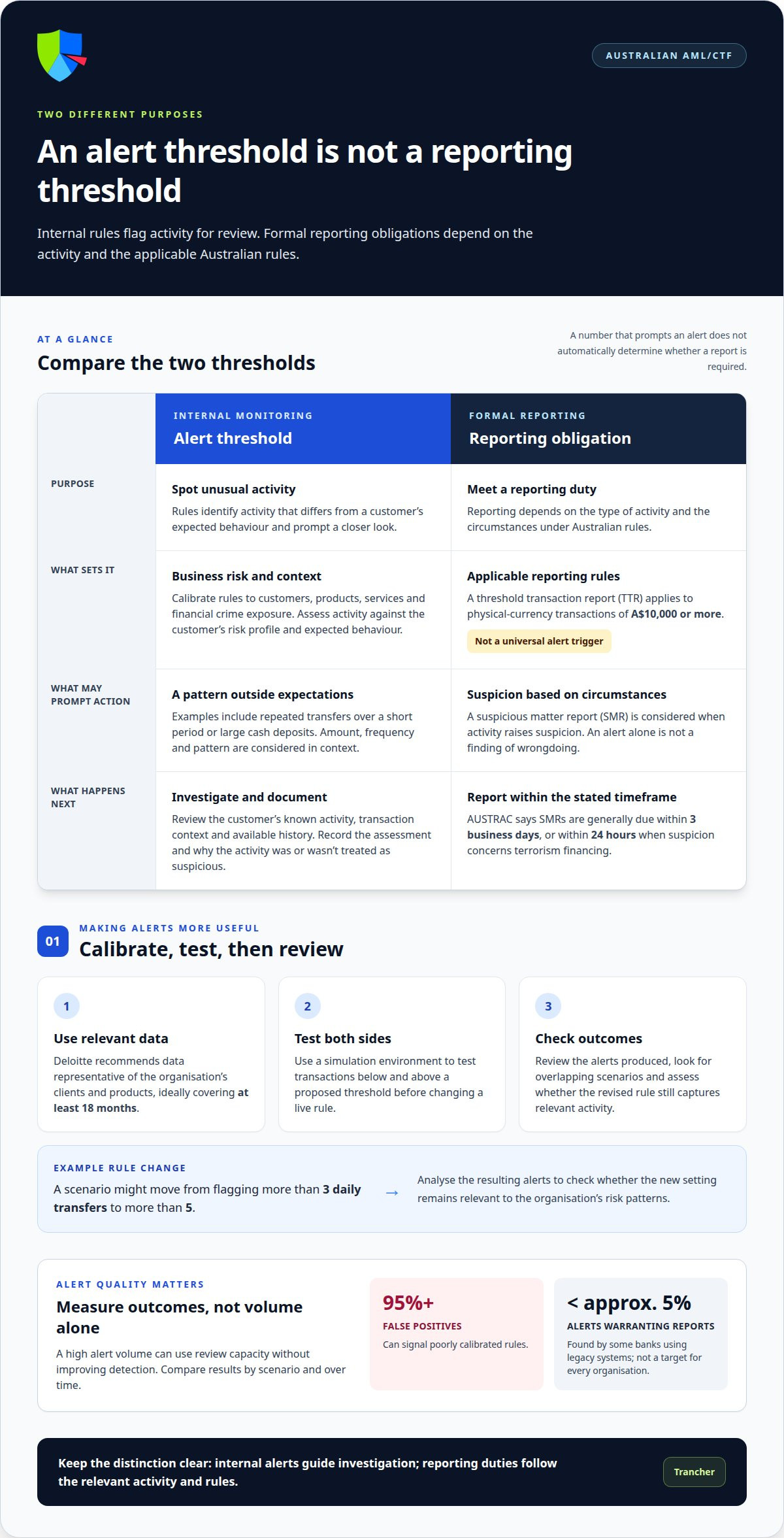
A transaction alert threshold isn’t the same as Australia’s reporting threshold. Australian transaction monitoring rules and thresholds are risk-based: rules help identify activity that differs from a customer’s expected behaviour, while alert settings are calibrated to the business and its risks. A threshold transaction report (TTR) applies to physical-currency transactions of A$10,000 or more, but that isn’t a universal trigger for monitoring alerts.
Different thresholds and reporting terms can be hard to untangle. The key is to separate internal alerts, which prompt review, from formal reporting obligations, which depend on the activity and applicable Australian rules.
This article explains how monitoring rules generate alerts, how businesses can calibrate thresholds and recognise red flags, and what happens when activity raises suspicion. It also outlines Australian reporting obligations, including suspicious matter report timeframes: according to AUSTRAC, reports are generally due within 3 business days, or within 24 hours when the suspicion concerns terrorism financing.
Key Takeaways
- Separate internal alert thresholds from formal reporting thresholds: they serve different purposes and don’t automatically match.
- Calibrate monitoring rules to customer risk and expected activity, then review whether alerts are useful or generating unnecessary investigation work.
- Look beyond transaction amounts: unusual patterns, customer behaviour and activity inconsistent with a known profile can all warrant attention.
- In Australia, a threshold transaction report applies to physical-currency transactions of A$10,000 or more; other reporting obligations depend on the circumstances.
- AUSTRAC says suspicious matter reports are generally due within 3 business days, or within 24 hours when the suspicion concerns terrorism financing.
What are AML transaction monitoring rules?
AML transaction monitoring rules assess customer activity and generate alerts when transactions match defined risk scenarios. In Australia, they help reporting entities identify unusual activity, investigate its context and decide whether a suspicious matter report (SMR) is required. Understanding how transaction monitoring rules and thresholds work together helps clarify which scenarios flag activity and which settings prompt review.
Customising rules to organisational risk
Customisable rules should reflect an organisation’s customers, products, services and exposure to financial crime risks. A pattern that is ordinary for one business may be unusual for another. One rule might flag repeated transfers over a short period, while another focuses on large cash deposits. Risk-based design keeps each scenario relevant to the activity the organisation handles.
Applying customer risk profiles
A customer risk profile brings due diligence information and expected activity together to guide monitoring intensity. An alert is more meaningful when assessed against the customer’s circumstances than against a single threshold applied to everyone. For a higher-risk customer, enhanced due diligence can include more frequent reviews and further intelligence gathering. Any change in activity can then be assessed against that profile.
Designing and calibrating risk-based rules
Rule calibration sets scenario thresholds using transaction data, so alerts are sensitive to risk without creating unnecessary duplication. Deloitte recommends using data representative of an institution’s clients and products, ideally covering at least 18 months. Calibration can take place in a simulation environment separate from live monitoring, where historical transactions generate hypothetical alerts for analysis.
Before changing a rule, test transactions both below and above its proposed threshold. For example, a scenario might move from flagging more than 3 daily transfers to more than 5. Reviewing the resulting alerts helps assess whether the revised setting still captures relevant activity. Check overlapping scenarios too, because duplicate alerts can add review work without providing distinct insight. This testing helps make transaction monitoring rules and thresholds fit the organisation’s actual risk patterns.
Analysing customers and transactions by risk
Risk-based analysis considers both the customer and each transaction, including whether the activity fits the customer’s known profile. A transaction’s amount alone may not explain its purpose. A monitoring system can compare transaction type, frequency and pattern with expected behaviour, then prompt investigation when they differ. Financial institutions can use those findings to reassess customer risk and adjust monitoring scenarios.
Record keeping supports that assessment. Australian reporting entities should retain transaction records and records of customer identification, risk analysis and assessment. Sections 107 and 111 of the AML/CTF Act are referenced in Australian record-keeping guidance. A clear record of the transaction, review and reasoning helps show how a decision was reached. AUSTRAC says suspicious matter reports are generally due within 3 business days, or within 24 hours when the suspicion concerns terrorism financing.
What is a false positive AML alert?
A false positive is an alert that an investigation finds does not indicate suspicious activity. Tracking false positives alongside genuine detections helps institutions assess whether monitoring rules produce useful signals or avoidable review work.
Tracking alert volume and false positives
Monitoring alert volume and false-positive rates means measuring how many alerts arise and how many investigations find no suspicious activity. These measures matter because a high volume can consume review capacity without improving detection. A false-positive rate of 95% or more can signal poorly calibrated rules. Compare results by scenario and over time, so one busy rule doesn’t obscure a pattern elsewhere.
Investigating transaction alerts
An investigation tests an alert against the transaction’s context and the customer’s known activity. Review the transaction pattern, relevant customer information and available history, then record why the alert was or wasn’t treated as suspicious. Several payments that seem unusual in isolation, for example, may fit an established customer pattern. Reach that conclusion through a documented assessment, not an assumption based only on the alert.
Low alert conversion deserves attention too. Some banks using legacy systems find that less than approximately 5% of alerts ultimately warrant suspicious activity reports. That figure is not a target for every organisation; it illustrates why alert outcomes should be measured alongside volume. If most investigations close without further action, examine whether the scenario captures relevant risk or flags ordinary activity too broadly.
Automated monitoring systems can analyse large transaction volumes in real time and generate alerts when activity matches defined patterns. Real-time processing can support faster review, but an immediate alert isn’t a finding of wrongdoing. The customer’s usual behaviour, transaction context and other available information still matter. This distinction helps teams respond promptly without treating every system match as a confirmed concern.
Efficiency comes from improving signal quality, not simply reducing alerts. Deloitte reports that data-driven calibration typically reduces alert volumes by 30%. A reduction is useful only if the revised settings continue to identify relevant suspicious activity. Compare alert outcomes before and after a rule change, and assess whether the remaining cases still reflect the risks the scenario was designed to detect.
For a clearer view of recurring patterns, ongoing risk monitoring can connect customer activity with alert review over time. That gives investigation teams a stronger basis for distinguishing isolated anomalies from changes in a customer’s established activity.
Transactions flagged as suspicious should be investigated to determine whether the alert is a true hit or a false positive. Legacy rule-based systems can have false-positive rates above 90%.
International regulatory approaches and reporting thresholds
Australia’s threshold transaction report (TTR) applies to physical-currency transactions of A$10,000 or more. International funds transfer instructions sit in a separate reporting category, so the cash threshold isn’t the test for an electronic transfer. Electronic transfers, cheques and card payments don’t trigger TTR requirements, even when they involve A$10,000 or more.
The transaction type matters as much as its value. A TTR is required for each separate physical-currency transaction at or above the threshold. Physical-currency instalments made as separate transactions don’t require a TTR when each is below A$10,000, even if their combined value exceeds it. However, repeated payments just below the threshold, such as A$9,999 transfers, can be a red flag for suspected structuring. Review the pattern rather than treating each transaction in isolation.
Other jurisdictions use different reporting frameworks, so an overseas threshold shouldn’t be imported into an Australian process. Canada has threshold-based reports for certain transactions, while US FinCEN rules include suspicious activity reporting. The EU’s Directive 2015/849, as amended, is cited for current transaction-monitoring obligations, and Switzerland’s FINMA AML Ordinance addresses monitoring under Article 20. These approaches show why organisations need to establish which country’s rules apply to each service and activity.
Dashboards can help teams assess whether alerts and reporting processes are working as intended. Useful views include alert volumes by scenario, investigation outcomes, recurring customer patterns and reporting timeliness. A dashboard could, for example, reveal repeated near-threshold cash deposits across an account or show that one scenario generates alerts without meaningful findings. Compare results over time and by risk category: a falling alert count alone doesn’t prove monitoring has improved.
For international funds transfer instructions, distinguish the transfer-reporting process from the TTR rules for physical currency. Don’t classify an electronic transfer as a cash transaction simply because its value reaches A$10,000. Instead, identify the transaction type, relevant jurisdiction and reporting category, then assess the activity for suspicious patterns. Australian TTRs must be submitted within 10 business days after the transaction takes place. That deadline concerns TTRs, not every alert or reporting obligation.
For banks, FinCEN’s suspicious activity report rule generally applies to suspicious transactions involving or aggregating at least US$5,000, adding a distinct trigger alongside other international reporting frameworks.
Customer, geographic and account activity red flags
A transaction may raise concern because of its pattern, location or customer context, not just its value. For Australian reporting entities, the key comparison is between observed activity and what the customer’s profile reasonably indicates.
Monitoring customer data across the lifecycle
Lifecycle monitoring compares a customer’s transaction data and behaviour over time, from onboarding through the ongoing relationship. An activity pattern that initially fits a profile may become unusual when the customer’s circumstances or behaviour change. A sudden shift from occasional account use to frequent transfers, for example, can prompt review. Keeping customer information connected to transaction history helps explain what changed and when.
Comparing profiles with expected activity
Customer due diligence builds a profile of the person or business, its expected activity and relevant risk factors. That profile gives transaction reviews a practical reference point: a large cash withdrawal may fit one business’s usual operations but be unusual for another customer. Before deciding whether a difference needs further analysis, compare the transaction’s purpose, frequency and context with the customer’s known activity.
Geography can also affect the risk picture. Dealings with people in high-risk countries or regions, as well as large cash deposits or withdrawals, are examples of activity Australian reporting entities should monitor. Geography alone doesn’t establish suspicious activity. Consider how the location relates to the customer, service and transaction, then assess whether the explanation fits the available profile information.
Changes to know your customer information can provide another signal. Frequent updates to a customer’s details may be unusual, particularly when they coincide with changes in account use or transaction patterns. Nervous, defensive or evasive conduct, rehearsed answers, or apparent direction from a third party may also warrant attention. These behaviours don’t prove wrongdoing, but they can provide context for deciding whether an alert needs closer review.
Useful red flags include unusually large or complex transactions, unusual patterns, activity with no apparent economic or lawful purpose, and transactions that seem structured to avoid reporting obligations. Several small payments that differ from a customer’s established behaviour may be more revealing as a sequence than as separate events. Assess the surrounding activity and any legitimate explanation before reaching a conclusion.
Keep decisions grounded in evidence. A customer’s profile, expected activity, business and designated service help establish whether behaviour is unusual. If account activity changes, review the relevant KYC information and transaction history together. This helps distinguish a meaningful shift from a one-off event with a straightforward explanation.
Australian AML/CTF transaction monitoring obligations
In Australia, monitoring procedures should help reporting entities identify unusual customer activity and assess whether an SMR is needed. The practical approach depends on the services provided, customer risks and the organisation’s risk assessment.
Banks, remitters, casinos and digital currency exchanges don’t use one universal monitoring rule. Their procedures need to reflect their customers, designated services, sector risks and transaction patterns, rather than applying identical scenarios to different business models.
Distinguishing monitoring and reporting thresholds
Monitoring thresholds are internal settings that identify activity for review; reporting thresholds apply to specific formal reporting obligations. Australia doesn’t prescribe one universal transaction-monitoring threshold for every reporting entity. A cash-reporting trigger, for example, doesn’t remove the need to assess suspicious activity below that threshold or involving another transaction type.
Sections 30 and 41 of the AML/CTF Act, and sections 6-35 of the AML/CTF Rules, are referenced in guidance on offences that must be monitored. Reporting entities should develop procedures to monitor customers effectively and identify whether an SMR needs submission. This means a transaction monitoring system should assess more than a single amount: patterns, customer behaviour and apparent purpose can all matter.
Understanding consequences of inadequate monitoring
Consequences depend on the breach, but inadequate monitoring can leave an entity unable to identify activity that requires assessment or reporting. The operational risk is a gap between observed transactions and the procedures intended to detect unusual activity. A system that reviews amounts but ignores repeated patterns, for example, may miss activity that warrants investigation.
Missed reporting can also mean an SMR isn’t submitted when suspicion arises. Australian SMRs are generally due within 3 business days, or within 24 hours when the suspicion concerns terrorism financing. The available facts establish monitoring and reporting obligations, but don’t provide penalty amounts; avoid assuming a single fine applies to every failure.
Choosing software and monitoring approaches
Australian businesses use transaction monitoring systems shaped by their risk assessments, customer data and services. Software can apply scenarios, generate alerts and support review records. Much transaction monitoring is conducted in batches, with transactions analysed at the end of the day. Real-time monitoring can support faster decisions, but it isn’t a regulatory requirement.
Regulators don’t require organisations to use AI. Their processes should still support ongoing review of transactions, customer behaviour and alerts, whether analysis is automated or handled another way. Retained records should connect transactions with customer identification and risk assessment, making it clear how activity was analysed.
For coordinated monitoring and reporting workflows, explore AML/CTF monitoring support and strengthen how customer activity is tracked and assessed.
Trancher: Ongoing Risk Monitoring & Client Activity Tracking
Trancher helps Australian businesses connect ongoing customer activity with risk monitoring, making changes that may need review easier to identify. Consider this support when existing processes make it difficult to track customer behaviour consistently, assess alerts in context or keep monitoring aligned with your AML/CTF program.
Client verification and due diligence establish the information used to understand expected activity. Ongoing monitoring can then help identify changes, while regulatory and suspicious matter reporting support next steps when a review raises concern. Together, these capabilities help organise monitoring and reporting within a practical compliance workflow.
Contact Trancher to discuss how ongoing risk monitoring and client activity tracking can support your business.
Build monitoring that grows with your business
As your services and customer base evolve, keep your monitoring approach aligned with the risks your business actually faces. Treat well-designed transaction monitoring rules and thresholds as an operational capability, not a set-and-forget configuration. Clear ownership, useful records and periodic review help your team adapt while keeping the purpose of each alert clear.
Trancher supports this work through End-to-End AML/CTF Program Management, Client Verification & Due Diligence (KYC/CDD + Screening), and Ongoing Risk Monitoring & Client Activity Tracking. These services connect customer information with ongoing activity and the wider compliance program, giving your team a clearer basis for monitoring decisions.
Consider the next practical improvement for your organisation: strengthening customer information, refining how activity is tracked, or bringing compliance processes together. Discuss your monitoring needs with Trancher and take a considered next step towards a monitoring approach that can adapt as your business changes.
Frequently Asked Questions
What are transaction monitoring rules under Australian AML/CTF laws?
These are procedures reporting entities use to monitor customer activity and identify possible money laundering or terrorism financing. Australian requirements call for monitoring tailored to an entity’s services and risks, rather than one universal set of alert rules. A remittance business and a professional services firm, for example, may need different scenarios because their customers and transaction patterns differ. An alert prompts assessment; by itself, it isn’t proof of a crime.
What transaction types and customer behaviours should trigger AML transaction monitoring alerts in Australia?
Alerts may be appropriate for unusually large or complex transactions, unexpected transaction sequences, or activity without an apparent economic or lawful purpose. Repeated transfers that differ from a customer’s known account use, for example, may warrant review even if each transfer seems ordinary on its own. Behaviour also provides context: rehearsed answers, evasiveness or apparent direction from another person may prompt closer assessment alongside transaction information.
What suspicious transaction indicators and red flags should Australian businesses monitor?
Look for activity inconsistent with a customer’s profile, dealings involving high-risk countries or regions, and changes that make the customer’s stated circumstances harder to reconcile. A customer or agent who appears not to be who they claim, or activity suggesting a designated service may be used for financial crime, may also need attention. Assess the indicators together and consider whether a legitimate explanation fits the customer and transaction.
How should businesses set and calibrate risk-based transaction monitoring thresholds?
Set thresholds by considering customer risk, expected activity, transaction types and the alerts each scenario produces. Test whether relevant cases fall above or below a proposed setting, and check whether scenarios overlap. The sample size should reflect available alerts and the confidence level sought. If customers frequently shift between risk segments, the categories may not clearly distinguish their behaviour. Reassess settings as customer activity and risk patterns change.