
The policy is only the start. AUSTRAC’s Tranche 2 reforms extend AML/CTF obligations to covered professional services, bringing new requirements for customer due diligence, monitoring, record-keeping and reporting. For affected Australian firms, Tranche 2 implementation challenges often centre on finding the people and systems to meet those requirements, while interpreting how they apply to different services and client risks.
It’s understandable if this feels like a substantial operational shift, particularly for firms without dedicated compliance teams or established AML processes. The work is more manageable when you separate the core obligations from the decisions that need to reflect your business.
This article explains what the reforms mean, why resourcing and interpretation can be difficult, and how those pressures affect AML/CTF program implementation. You’ll also learn what a risk-based approach involves and how practical systems and staff guidance can support consistent, well-documented compliance.
Key Takeaways
- Resource constraints and interpretative complexity can make implementation demanding, especially for firms without dedicated compliance teams.
- A risk-based AML/CTF program should reflect the services provided, customer risks and how existing processes need to change.
- Customer due diligence, ongoing monitoring, record-keeping and suspicious matter reporting are central obligations for covered entities.
- Manual identity checks, complex ownership structures and increased screening needs can place extra pressure on existing workflows.
- Understanding the transition arrangements helps firms plan their preparation and implementation work in sequence.
Implementation resource constraints and interpretative complexity
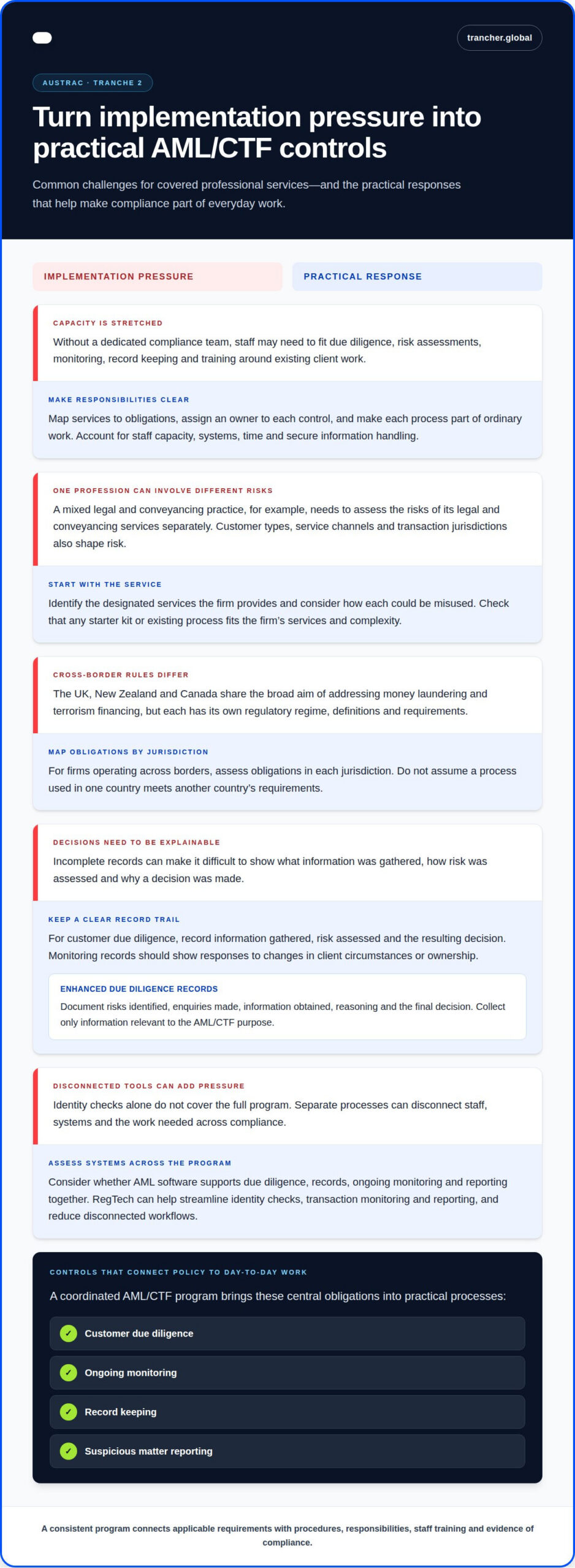
For smaller Australian law firms, accounting practices and real estate agencies, Tranche 2 can mean building AML/CTF processes without a dedicated compliance team. Staff must fit customer due diligence, risk assessments, monitoring, record keeping and training around existing client work. This creates practical pressure: the people interpreting the rules may also be delivering services and managing operations. The costs are not just financial; time, staff capacity, systems and secure information handling all compete for attention.
Australia’s approach shares the broad aim of addressing money laundering and terrorism financing with the UK, New Zealand and Canada. However, each country has its own regulatory regime, definitions and requirements. Firms operating across borders should map obligations by jurisdiction rather than assume that a process used in one country meets another’s rules.
Interpretation starts with the service, not just the profession. Identify which designated services your firm provides and assess how each could be misused. For example, a mixed legal and conveyancing practice needs to assess the risks of its legal and conveyancing services separately. Customer types, service channels and transaction jurisdictions also shape risk. A Starter Kit may not suit a practice whose services or complexity fall outside its profile.
Records make these decisions explainable over time. A useful customer due diligence record captures the information gathered, the risk assessed and the resulting decision. Monitoring records should show how the firm responded to changes in client circumstances or ownership. Enhanced due diligence needs more than a completed form: record the risks identified, enquiries made, information obtained, reasoning and final decision. Collecting only information relevant to the AML/CTF purpose also helps limit unnecessary storage and security burdens.
What penalties apply for non-compliance? Section 167 of the amended Anti-Money Laundering and Counter-Terrorism Financing Act 2006 (Cth) gives AUSTRAC power to investigate whether obligations have been met, and includes an offence and a civil penalty provision. The section establishes potential legal exposure; firms should not treat incomplete records or an unimplemented program as administrative gaps alone.
AUSTRAC’s Tranche 2 program starter kits were scheduled for release in January 2026. AUSTRAC also planned ongoing enhancements to sector-specific guidance with industry during 2026. These resources support preparation, while each firm still needs to translate applicable requirements into procedures, responsibilities, staff training and evidence of compliance.
For small and medium-sized businesses, a practical response is to map services to obligations, assign responsibility for each control, and keep decisions and monitoring outcomes together. The AML/CTF Act 2006, according to the Australian Government, is the legislative foundation. A consistent program connects that framework to everyday work, so lawyers and other professionals can identify risks, record decisions and escalate concerns through established processes.
AML/CTF program implementation
Tranche 2 preparation means turning regulatory obligations into processes that fit each entity’s services and risk profile. A program should connect policy, controls and day-to-day action, rather than treat each check as a standalone task.
Building an AML/CTF program
An AML/CTF program is the coordinated set of policies, responsibilities and processes an entity uses to manage money laundering and terrorism financing risks. It matters because documented rules alone cannot show how compliance works in practice. Australian businesses were expected to begin preparing in 2025, giving them a basis to review current controls, identify gaps and shape procedures around their services.
Start by mapping the services provided. Reporting entities should identify which designated services are captured by AML/CTF provisions, document that distinction and review it as services change. An accountant, for example, may need to distinguish covered services from other work. This mapping helps direct customer due diligence and monitoring to relevant activities, rather than applying the same process indiscriminately to every client relationship.
Technology should support the whole program. Australian Tranche 2 firms should assess whether AML software can manage compliance processes, not merely perform individual identity checks. Consider how systems handle due diligence, records, ongoing monitoring and reporting together. RegTech can help smaller firms streamline identity checks, transaction monitoring and reporting, while reducing disconnected workflows between staff and tools.
Controls also need to reflect the entity’s documented risk appetite. This gives staff a consistent basis for deciding which customers to accept, what due diligence to apply and when a relationship may need to end. Policies should cover governance, customer due diligence, monitoring, reporting, training, record keeping and independent evaluations. Assign an owner to each process and make its place in ordinary work clear.
Meeting Tranche 2 obligations
Meeting Tranche 2 obligations means putting required controls into operation and keeping evidence that they are followed. The framework includes customer due diligence, transaction monitoring, record keeping and suspicious activity reporting. These duties matter across covered sectors, from lawyers and accountants to dealers in precious metals and stones, because the risks and services differ.
Implementation is more reliable when each obligation connects to a practical process. Staff need to understand how customer information informs risk decisions, where to escalate monitoring concerns and how reporting is handled. Training should build this knowledge across relevant roles and connect it to everyday work. Assess existing controls against the new legal framework and address identified gaps in the program.
For support in structuring these processes, explore structured AML/CTF compliance processes.
Australia’s AML/CTF framework takes a risk-based approach, so firms should collect information appropriate to client and engagement risks, not automatically the maximum amount possible. Australia’s Tranche 2 reforms encourage organisations to tailor risk-based KYC due diligence and compliance policies to their risk appetite.
Australian reporting entities should document their risk appetite to support consistent customer decisions and defensible offboarding. They should also assess whether existing controls are sufficient under the new legal framework.
What AML/CTF obligations will Tranche 2 entities need to meet?
For Australian businesses, obligations attach to covered designated services, not simply to a professional title. The AML/CTF Act 2006, according to the Australian Government, is the legislative foundation for these requirements. Legal practices providing designated services become reporting entities with AML/CTF compliance obligations from 1 July 2026. Lawyers, conveyancers, accountants, auditors, real estate professionals and trust and company service providers should assess which activities bring them within scope.
Customer due diligence starts with identifying and verifying the customer, then understanding the purpose and nature of the business relationship. Reporting entities must assign individual risk ratings at onboarding using a framework tailored to their business. For a company or trust, layered ownership may mean identifying the individuals who ultimately own or control it. Each person in a company, trust or self-managed super fund must provide their own consent and complete verification. Consent and verification processes should account for each individual involved in a company or trust.
The level of enquiry should reflect risk. Higher-risk customers require enhanced due diligence, which is also mandated in specified circumstances. A firm may need to make further enquiries, assess the information obtained and document why its final decision is reasonable. This creates a defensible record, rather than a form with no explanation. A risk-based approach also means collecting information relevant to the customer and engagement, rather than automatically gathering as much as possible.
Obligations continue after onboarding. Covered entities must monitor ongoing transactions and reassess customer information when circumstances or ownership change. Monitoring should connect observed activity to the customer’s risk profile and the services provided. If activity raises suspicion, entities must make suspicious matter reports to AUSTRAC. Follow a consistent process for recognising concerns, escalating them and recording decisions, rather than relying on staff to remember informal steps.
Records need to show how the program operates over time. Keep evidence of customer identification and verification, beneficial ownership enquiries, risk decisions, monitoring and actions taken. Make clear what information informed each decision and who handled the process. Australian reporting entities also need an AML/CTF program, staff training and compliance governance. Senior leadership retains ultimate accountability, while the compliance officer manages day-to-day compliance with policies.
These requirements work as connected controls: due diligence informs risk ratings, risk informs monitoring, and monitoring can lead to reporting or further enquiries. A written program needs to be implemented and followed in practice. For a legal practice, accountant or real estate business, mapping each covered service to customer checks, record keeping and escalation processes helps make obligations operational and reviewable.
What are the main implementation challenges for Australian Tranche 2 businesses?
For Australian firms, the main pressure points are adapting existing workflows, handling more complex checks and assigning enough staff time. These Tranche 2 implementation challenges are operational as well as interpretative: a control must reflect the service, customer and risk involved.
Businesses first need to map new requirements to existing processes and adapt their AML/CTF program to their own services. A real estate agency, for example, may need different controls for different customer or transaction types. A generic policy can miss how a particular service could be misused. Mapping each covered activity to its controls shows where processes need revision, clear ownership and adequate records.
Screening demand is another pressure point. The estimated number of politically exposed persons businesses may need to screen is expected to increase roughly seven-fold under Australia’s Tranche 2 expansion. That change can affect onboarding queues, review workloads and escalation processes. Firms need a consistent way to identify a potential match, assess it and record the outcome, rather than relying on staff to handle each alert differently.
Identity verification also needs a process for clients who cannot complete digital biometric checks. Businesses may need digital and manual or alternative methods, with clear criteria for when each is appropriate. Manual checks still require reliable evidence and a record of how identity was established. A digital-only pathway could leave some clients unable to complete onboarding, while an uncontrolled manual pathway can produce inconsistent outcomes.
Ownership checks can become difficult when companies or trusts have layered structures. Manually tracking beneficial ownership in spreadsheets can be hard to maintain as relationships change. For example, a new ownership link can affect who ultimately controls an entity and how its risk is assessed. Firms need a process to capture ownership information, connect individuals to structures and revisit the information when circumstances change.
Resource limits compound these demands for smaller firms without dedicated compliance teams. Staff must balance client work with screening, verification, record keeping and follow-up. Assigning responsibility for each process helps prevent checks from falling between roles. Training matters too: staff receiving an identity document need to know how to escalate an inconsistency, while those reviewing a screening alert need to record their decision.
Existing controls may need adjustment to fit the expanded framework. Review each control against your services, customer types, channels and transaction jurisdictions, then identify gaps or duplicated steps. Documenting risk appetite supports consistent decisions about accepting or exiting relationships. This turns implementation from a broad policy rewrite into specific changes to workflows, responsibilities, records and staff guidance.
What are the deadlines and transitional arrangements for Tranche 2 implementation?
For affected Australian entities, the key dates were 31 March 2026, 1 July 2026 and 29 July 2026. AUSTRAC enrolment commenced on 31 March 2026. Newly captured reporting entities needed to meet relevant AML/CTF provisions from 1 July 2026. The enrolment deadline for entities providing designated services on 1 July 2026 was 29 July 2026. These dates have passed, so they now provide a reference point for understanding the transition.
The dates mark separate steps, not a single implementation deadline. Enrolment relates to notifying AUSTRAC that an entity provides designated services. The 1 July date marks when relevant obligations applied to newly captured entities. The later 29 July deadline applied to enrolment for entities providing designated services on 1 July. Treating those dates as interchangeable can obscure whether a firm met each requirement.
Legal practices faced an additional preparation requirement: their AML/CTF program materials needed to be customised and approved before 1 July 2026. A firm’s program needed to reflect its own designated services, risk assessment and procedures, rather than remain an unadapted template. Approval before the commencement date gave the practice a defined basis for putting controls into operation when obligations began.
Preparation was expected to start earlier. AUSTRAC and the Australian Government expected regulated entities to begin preparing in 2025, while AUSTRAC’s Tranche 2 program starter kits were scheduled for release in January 2026. These milestones allowed time to identify covered services, assign responsibilities and develop procedures before commencement. A starter kit could support preparation, but practices outside its small, low-complexity profile needed to tailor their approach.
For an entity reviewing its transition position, separate the work into clear records:
- Scope: identify designated services and the relevant commencement date.
- Enrolment: record whether enrolment applied and the applicable deadline.
- Program readiness: retain the customised program, approval record and evidence of implementation.
These records help explain how the business assessed its position and acted on the timeline. They also make it easier to identify outstanding administrative or operational tasks without confusing past deadlines with ongoing compliance.
The 2026 dates were transition milestones, not the end of compliance work. Customer due diligence, monitoring, record keeping and reporting processes need to continue as part of the entity’s operating program. Firms should maintain evidence of decisions and review procedures when services or risks change. This keeps the transition connected to day-to-day controls rather than treating implementation as a one-off project.
Use the dates to structure a current review of scope, enrolment records and program implementation. Organise your AML/CTF implementation planning around the controls your business needs to maintain.
Trancher
Trancher helps Australian businesses connect AML/CTF program management, client due diligence, ongoing monitoring and reporting. Turn to Trancher when your team needs practical support translating obligations into day-to-day workflows, maintaining client records or coordinating checks and follow-up. The platform brings these activities together to help clarify responsibilities and organise compliance work.
Whether you’re refining an existing program or building processes for newly covered services, Trancher supports work across verification, risk monitoring and regulatory reporting. Identify where current processes create friction, such as applying due diligence consistently or recording monitoring outcomes. Contact Trancher to discuss your AML/CTF implementation needs.
Build compliance into everyday work
The next phase is making compliance sustainable in everyday work. Addressing Tranche 2 implementation challenges is not only about establishing controls; it’s about keeping them useful as services, customers and risk profiles evolve. Clear responsibilities, consistent decision records and regular review can help teams adapt processes while preserving accountability. Treat implementation as an ongoing operational capability, not a document completed once and set aside.
A practical next step is to identify where your current workflow creates the most friction, then prioritise improvements that connect related tasks. Trancher offers End-to-End AML/CTF Program Management, Client Verification & Due Diligence (KYC/CDD + Screening), and Ongoing Risk Monitoring & Client Activity Tracking. These capabilities support a more connected approach to compliance operations, from customer checks through ongoing review.
Build on the processes your team already understands, clarify where they need to change, and keep improvement aligned with your business’s risk profile. For support with your next steps, contact Trancher about Tranche 2. A clear, workable approach can help your team move forward with confidence.
Frequently Asked Questions
What is AUSTRAC Tranche 2 AML/CFT Reform?
AUSTRAC Tranche 2 is Australia’s expansion of AML/CTF regulation to designated services provided by specified professional and non-financial businesses. It brings professions such as lawyers, conveyancers, accountants, real estate agents and trust and company service providers into the reporting framework when their services fall within scope. The reform is intended to align Australia’s regime more closely with Financial Action Task Force standards.
What is Australia’s AML/CTF Tranche 2 reform and when does it take effect?
Australia’s Tranche 2 reform extends AML/CTF obligations to newly covered businesses providing designated services. The requirements took effect on 1 July 2026 for newly regulated entities. The enrolment deadline for entities providing designated services on that date was 29 July 2026. For a business assessing its position now, the practical focus is understanding which services are covered and maintaining the processes needed to meet ongoing obligations.
What technology, staffing and training will Tranche 2 entities need for compliance?
Tranche 2 entities need technology and staff processes suited to their services and risk profile, rather than one standard setup. Systems can support customer verification, screening, monitoring, record keeping and reporting; firms should also have alternative identity-verification processes for clients unable to complete digital checks. Staff need ongoing AML awareness and training relevant to their roles, including how to escalate concerns and document decisions. Responsibilities should be clear across the business.