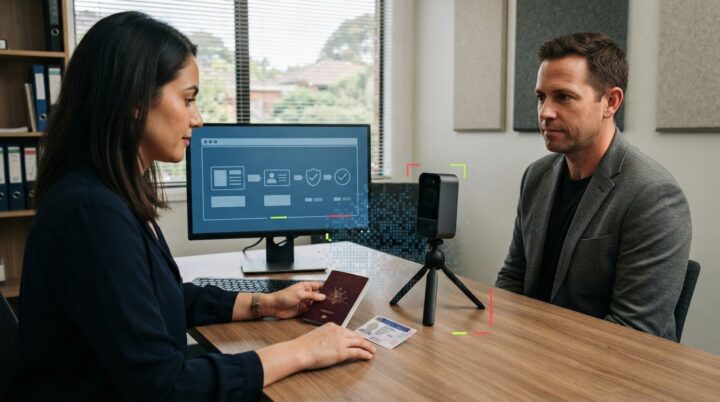
AML controls are strongest when customer due diligence sits with the teams making day-to-day customer decisions. The practical answer to what the three lines of defence in AML mean is a clear division of responsibility: operational teams identify and manage risk, compliance provides oversight and guidance, and internal audit independently assesses how well both are working.
It’s understandable to think AML responsibility rests mainly with the compliance function. In practice, the model works when management owns risk across the organisation and each line understands its role. Customer-facing staff and onboarding teams form the first line by gathering KYC information, applying controls and escalating concerns.
This article explains how the three lines support AML/CTF governance in Australia, where customer due diligence fits, and how operational responsibilities differ from compliance oversight and independent assurance. It also shows how the model clarifies accountability without separating compliance from everyday work.
Key Takeaways
- Separate operational ownership, compliance oversight and independent assurance to make AML/CTF responsibilities clearer.
- Keep risk management connected across the organisation; the three lines are distinct roles, not a sequence of hand-offs.
- Place customer due diligence within day-to-day operations, with clear controls for gathering information and escalating concerns.
- Use independent audit to assess whether risk management and controls are working effectively and where improvements are needed.
- Explore how integrated AML/CTF program management can support verification, ongoing monitoring and reporting.
What are the Three Lines of Defence?
The three lines of defence model divides AML/CTF work among operational teams, compliance and risk management, and independent audit. It helps Australian businesses clarify who manages customer and transaction risks, who oversees controls, and who provides assurance.
For businesses covered by AUSTRAC’s AML/CTF regime, obligations include managing money laundering and terrorism financing risks, applying relevant controls and escalating suspicious activity for reporting. Customer due diligence and transaction monitoring are practical parts of that risk management, supported by clear responsibilities across the organisation.
Oversight and separation of AML duties
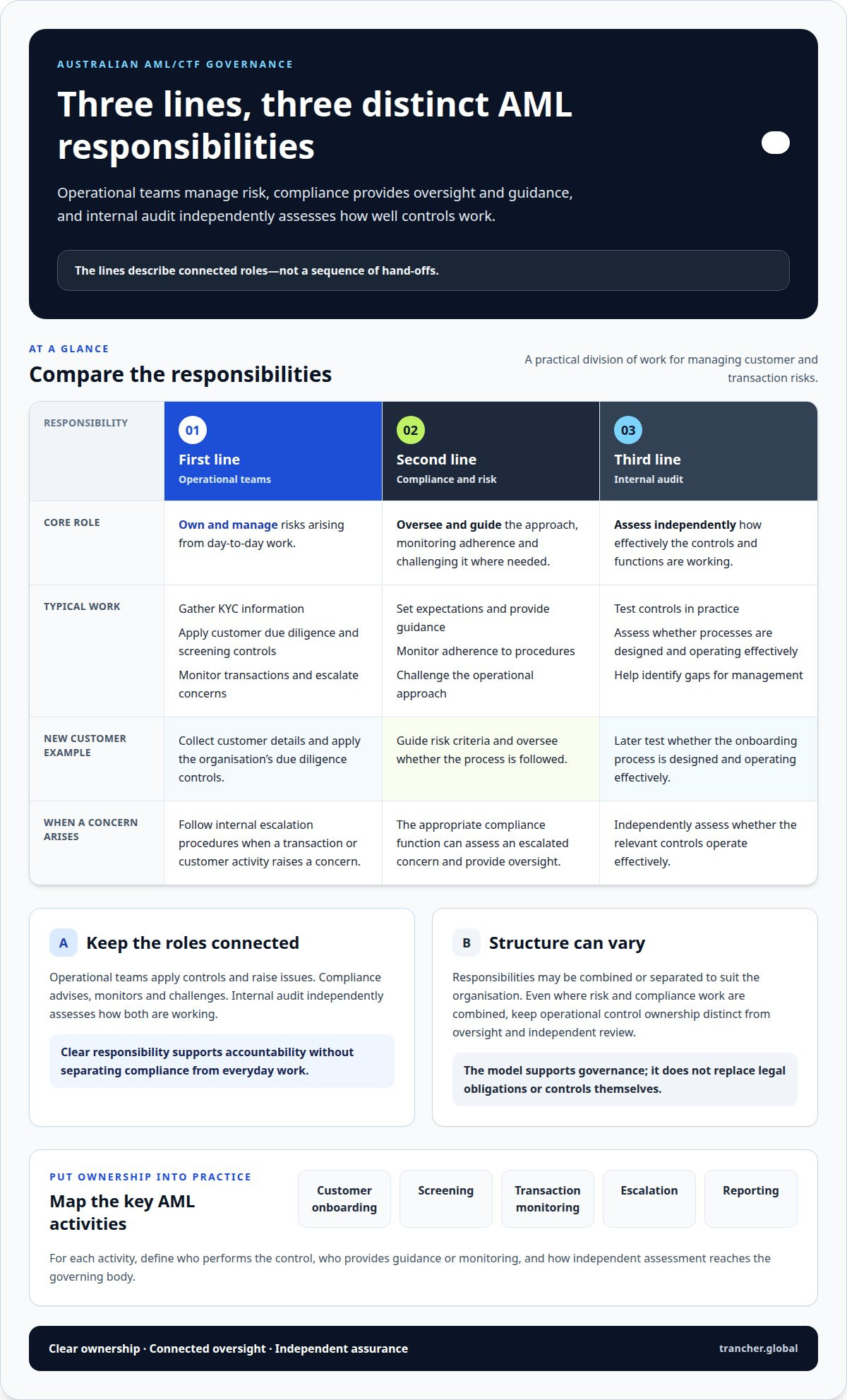
Oversight and segregation of duties mean separating operational risk ownership from compliance challenge and independent assurance. In the three lines model, the first line carries out controls, the second sets expectations and monitors adherence, and the third assesses both independently. This distinction helps senior management see whether controls are performed, reviewed and tested, rather than relying on one function to do everything.
Business-unit AML/CFT responsibilities
Business-unit responsibility means the teams delivering products or services identify and manage risks arising from their daily work. A customer-facing employee may collect KYC information, follow screening procedures and escalate an unusual transaction, while managers establish controls and address identified gaps. This matters because risk decisions happen in operational settings, not only within a central compliance function.
The three lines work through connected responsibilities, not a sequence of hand-offs. Operational teams apply controls and raise issues; compliance advises, monitors and challenges their approach; internal audit independently assesses whether both functions are effective. The IIA Three Lines Model treats these as distinct roles that can be combined or separated according to organisational structure.
AUSTRAC’s AML/CTF framework sets the regulatory context in which covered businesses manage financial crime risks. The three lines are a governance approach for allocating that work, not a replacement for legal obligations. Senior management remains responsible for effective risk management, while operational, compliance and assurance roles contribute through their distinct functions.
Consider a new customer onboarding example. The first line gathers customer details and applies the organisation’s due diligence controls; compliance provides guidance on risk criteria and can oversee adherence; audit can later test whether the process is designed and operating effectively. If a transaction raises a concern, the employee follows internal escalation procedures so the appropriate compliance function can assess it.
Three lines of defence model and governance
Strong governance connects AML risk ownership, compliance oversight and independent assurance. In Australia, the model helps organisations organise these roles around their AML/CTF risks and obligations.
Governance of the defence model
Governance is the way an organisation’s governing body, management and internal audit functions direct and oversee risk. The Audit Office describes the Three Lines Model through these structures and processes. For an Australian business, clear governance helps senior management establish who approves AML controls, who monitors them and who reports weaknesses. The lines describe roles, not departments or a sequence of hand-offs.
Responsibilities can be combined or separated, depending on the organisation’s structure. A smaller business, for example, may combine risk and compliance work, but should still distinguish operational control ownership from oversight and independent review. A reporting route to senior management gives material control issues visibility, while documented procedures show staff how concerns move between functions.
Effectiveness and limitations
The model works when each function has a clear remit, access to relevant information and a way to raise concerns. Compliance can monitor whether procedures reflect applicable regulations, while internal audit assesses how controls operate in practice. That assessment helps management identify gaps, assign corrective action and track whether changes address the issue.
The model is not a control in itself. Three named lines on an organisation chart cannot prevent missed customer information or overlooked transactions if staff do not follow procedures. A compliance review also does not replace the business unit’s responsibility to manage its own risks. The model supports accountability, but its effectiveness depends on the controls and decisions made within the organisation.
To implement the model, map key AML activities to accountable roles: customer onboarding, screening, transaction monitoring, escalation and reporting. Define which team performs each control, which function provides guidance or monitoring, and how independent assessment reaches the governing body. Document escalation routes and review them when products, customer activity or identified risks change.
Common weaknesses include unclear ownership, duplicated checks and gaps between operational teams and compliance. If a customer-facing team assumes compliance will resolve every alert, for example, an issue may remain unaddressed at the point of service. Independence can also be weakened when the function reviewing a control is responsible for operating it.
Regular monitoring can show whether responsibilities work as intended. Senior management can consider control exceptions, audit findings and overdue corrective actions together, rather than treating each as a separate issue. This gives a practical view of effectiveness and helps prioritise improvements against the organisation’s risk profile.
A connected AML/CTF program management framework can support consistent procedures, monitoring and oversight as responsibilities are put into practice.
Clear allocation of AML/CTF responsibilities
Clear allocation means assigning each AML/CTF activity to an accountable role, with defined oversight and reporting routes. In an Australian financial institution, the organisation remains responsible for its compliance arrangements; senior management provides direction, and an AML/CTF compliance officer oversees the system. Individual employees also have practical responsibilities when they onboard customers, handle transactions or identify suspicious activity.
Responsibility is shared, but it should not be blurred. The first line manages risks arising from business operations and follows controls. The second line, usually the compliance and risk functions, develops policies, advises teams and monitors adherence. The third line independently assesses whether the program and its controls work as intended. Clear role descriptions help staff act without assuming another team has taken ownership.
An AML/CTF compliance officer typically develops and oversees the AML/CTF system, prepares policies, conducts ongoing risk assessments and monitors compliance. The role also includes arranging communication and training, overseeing implementation, and reporting to relevant regulatory bodies. In a bank, the chief AML/CFT officer should monitor how the bank fulfils its AML/CFT duties, including through sample testing and reviewing exception reports.
That oversight does not transfer operational responsibility to the compliance officer. A customer-facing employee who notices a transaction inconsistent with the customer’s known activity, for example, should follow internal escalation procedures. Internal reports can be reviewed through the organisation’s established process to determine whether external reporting is appropriate. This separation helps operational staff raise concerns promptly while preserving a defined review and reporting process.
Senior management’s role is to establish accountability and ensure AML/CTF responsibilities are understood across the institution. A practical responsibility map can name the role accountable for each activity, the team performing it, the oversight function and the escalation route. For customer onboarding, this could distinguish staff collecting KYC information from compliance personnel setting screening expectations and managers resolving control gaps.
Financial institutions can make these responsibilities effective by connecting policies with everyday procedures. A written program should explain who assesses customer risk, who reviews exceptions, how staff escalate concerns and who oversees remediation. Training should reflect employees’ functions: frontline staff need to recognise and raise concerns, while compliance staff need to understand monitoring and reporting responsibilities.
Review the allocation when a business process changes or an internal assessment identifies unclear ownership. If transaction-monitoring alerts pass between operations and compliance without a named decision-maker, for instance, assign responsibility for review and escalation. This keeps the line of defence visible, supports consistent reporting and gives senior management a clearer view of unresolved AML/CTF risks.
First-line operational management and customer due diligence
First-line AML work happens where staff onboard customers, provide services and process transactions. Operational managers own risks arising from those activities, while employees apply the organisation’s controls in their daily work. An onboarding employee, for example, gathers customer information and follows the approved identity-check process. A manager sets expectations, supports staff decisions and addresses control failures. This places customer due diligence within normal operations, rather than treating it as a task only compliance performs.
Customer due diligence begins with collecting and checking relevant KYC information under the organisation’s procedures. Screening against sanctions lists and politically exposed person information can help staff identify customers requiring closer assessment. The first line must apply the business’s criteria consistently, record the checks performed and refer exceptions through its escalation route. If information is incomplete or inconsistent, employees should follow the applicable process rather than treating an unchecked field as a completed control.
Risk management continues after onboarding. First-line employees monitor customer transactions and activity for changes or patterns that may warrant review. The described model calls for transaction monitoring continuously or at least daily at branch level. Monitoring procedures should make clear what staff review, how they record a concern and where they send an alert. A change in customer behaviour, for example, can prompt further scrutiny under the organisation’s controls.
Employees also help identify and escalate suspicious activity. If a staff member suspects money laundering or terrorist financing, internal procedures should direct them to bring the suspicion to the compliance officer. The organisation’s reporting process then supports assessment and submission of a Suspicious Transaction Report to the authorities when required. Clear escalation instructions help staff raise concerns promptly without making decisions outside their role.
Training connects these steps to actual job responsibilities. Customer-facing staff need to understand how to collect KYC information, apply screening procedures and escalate concerns; transaction-monitoring analysts need to know how to review alerts and document outcomes. Managers reinforce these practices and address missed checks. This function-specific approach helps employees conduct controls consistently, while compliance guides the process and internal audit independently assesses its operation.
Effective first-line controls also depend on usable procedures and records. For a flagged transaction, the operational record should show what triggered review, what action staff took and whether they escalated the concern. Managers can use exceptions and recurring errors to identify where processes need adjustment. The first line remains responsible for operating controls; compliance oversight and independent audit provide additional challenge, not a substitute for day-to-day ownership.
What is the role of the third line of defence in AML?
The third line provides independent assurance on whether AML risk management and controls work effectively. Internal audit typically performs this role by assessing the first and second lines without designing or operating the controls under review. Its findings help senior management and the governing body understand how well the organisation identifies, manages and reports financial crime risks.
An AML audit can examine whether policies and procedures suit the organisation’s risk profile and are followed in practice. Auditors may, for example, test a sample of customer files to assess whether required due diligence was recorded, then compare transaction-monitoring alerts with documented decisions. They can also review staff training, compliance oversight and the quality of control records. The aim is to identify weaknesses and support corrective action, not take over operational or compliance responsibilities.
Independence matters. Internal audit should not make management decisions or take management actions concerning risk management. If auditors design a screening control and later assess its effectiveness, their assurance is less objective. A clear audit mandate, access to relevant records and a direct reporting route to the governing body help protect independence. The governing body oversees the internal audit function and receives its reports.
Audit planning should reflect the organisation’s AML risks. Banks should conduct AML/CFT audits periodically, with frequency based on risk. The scope and method should also suit the institution’s risk profile, and auditors need appropriate expertise. Depending on identified risks, a review might prioritise higher-risk customer onboarding, transaction monitoring, suspicious activity escalation or reporting processes.
A useful audit report makes findings actionable. It can describe the control tested, the evidence reviewed, the weakness identified and the corrective action required. If sample testing finds inconsistent records of customer screening, for instance, the report can identify the gap and recommend a clear remediation process. Management can then assign responsibility and track progress, while internal audit maintains its independent role.
Smaller or less complex organisations may outsource internal audit, while larger and more complex organisations often maintain an in-house function. Either approach needs a suitably independent review with relevant expertise and an audit scope aligned to the organisation’s risks. External auditors can assess AML policies and procedures when their scope addresses those risks and their experience is appropriate.
Independent AML audits do not guarantee that every suspicious transaction will be detected. They assess whether the framework and controls are adequate, relevant and effective, and identify areas for improvement. Audit-ready documentation supports clear evidence, consistent findings and follow-up on remediation.
Explore audit-ready AML documentation to support organised records for compliance oversight and independent review.
Trancher
Trancher helps Australian businesses put clear AML/CTF responsibilities into practice through end-to-end program management. Turn to Trancher when you need to connect customer due diligence, ongoing risk monitoring and reporting within a coordinated compliance approach. The platform supports operational teams in applying controls and helps maintain oversight and consistent records.
Support includes client verification, KYC/CDD and screening, ongoing client activity tracking, and regulatory and suspicious matter reporting. These capabilities can help bring day-to-day processes together with the wider AML/CTF program, so responsibilities are easier to manage across the organisation.
For guidance on applying the three-lines approach to your AML/CTF operations, contact Trancher.
Turn clear accountability into a stronger AML program
Understanding the three lines of defence in AML is a starting point; the next step is making responsibilities work consistently across your organisation. As your customer base, services or risk profile changes, revisit how your AML/CTF arrangements support staff decisions and keep processes aligned.
Trancher supports that work through End-to-End AML/CTF Program Management, Client Verification & Due Diligence (KYC/CDD + Screening), and Ongoing Risk Monitoring & Client Activity Tracking. These services connect customer checks and monitoring with the wider program, while keeping operational responsibilities in view.
Choose a practical next step that fits your organisation’s compliance needs. Contact Trancher about AML support to discuss how these capabilities may fit your approach. Clearer processes can help your teams work with greater confidence as your AML/CTF program develops.
Frequently Asked Questions
What are the Core Responsibilities of the Compliance Officers in the 3LOD Model?
Compliance officers coordinate the AML/CTF framework, maintain policies, assess risks and monitor adherence to procedures. They also arrange training, investigate internal suspicious activity reports and manage regulatory reporting responsibilities. If an employee escalates an unusual customer pattern, for example, the officer assesses the information under the organisation’s process and records the decision. This role supports consistent oversight, while operational teams remain responsible for their own controls.
What is the First Line of Defence?
The first line comprises operational roles closest to delivering an organisation’s products or services. These employees apply assigned controls as part of their regular work, rather than treating AML checks as a separate compliance task. During account opening, for example, a staff member follows the relevant identity-check process and raises unresolved discrepancies through the organisation’s escalation channel. Managers support consistent practice and address control issues within their teams.
What are the three lines of defence in AML?
The three lines are distinct roles for managing and overseeing AML risk: operational teams manage risk in daily work, compliance and risk functions provide oversight, and internal audit gives independent assurance. They connect through shared information and escalation rather than operating as isolated departments. An operational concern can inform compliance monitoring, for instance, while audit later assesses whether the organisation’s arrangements are working effectively.
What is the role of the first line of defence in AML?
The first line identifies and manages financial crime risks arising from customer relationships and everyday transactions. Staff follow internal AML/CTF procedures, notice activity that differs from expected customer behaviour and escalate concerns for assessment. An employee who sees a change in a customer’s transaction pattern, for example, can document the observation and use the organisation’s reporting route. Staff should raise concerns, not take on decisions assigned to compliance.
What is the role of the second line of defence in AML?
The second line sets AML risk standards, advises operational teams and monitors whether controls meet expectations. Compliance may examine emerging risks, assess adherence to internal policies or review a high-risk customer case. It can challenge a business decision and recommend where risk management needs greater attention. The function supports and oversees the business, while the operational team continues to run the customer-facing process.
What are common weaknesses in the AML three-lines-of-defence model?
Common weaknesses include unclear ownership, poor escalation between teams and reviews that lack independence. A control may also appear complete on paper while staff apply it inconsistently. If an alert has no named decision-maker, for example, it may sit unresolved between operations and compliance. Organisations can address these gaps by defining accountable roles, documenting escalation paths and tracking corrective actions through to completion.