
What if a lower-risk customer needs a proportionate process rather than the same checks as a higher-risk customer? If you’re asking what simplified due diligence is, it’s a risk-based form of customer due diligence that uses less extensive measures when money laundering and terrorism financing risks are low. It doesn’t remove the need to verify identity or complete required sanctions and politically exposed person checks.
It’s understandable to want a clear distinction between simplified due diligence, standard customer due diligence (CDD) and enhanced due diligence (EDD). The right approach depends on assessed risk, not a blanket rule for a customer group or account type. This article explains when simplified measures may apply in Australia, what they can change, and how ongoing monitoring and escalation fit into a proportionate process.
Key Takeaways
- Learn which customer and product characteristics may support a lower-intensity due diligence approach, and why risk must be assessed rather than assumed.
- Understand the conditions for simplified verification in Australia, including when it cannot be used.
- See how simplified, standard and enhanced due diligence differ in the scope of checks and ongoing scrutiny.
- Explore how proportionate checks can streamline work while maintaining appropriate monitoring and records.
- Find out how client verification, screening and ongoing risk monitoring can support a consistent due diligence process.
What is simplified due diligence (SDD)?
Simplified due diligence is a lower-intensity form of customer due diligence for customers assessed as low risk. It can reduce the scope of checks, but Australian businesses still need to establish customer identity and maintain appropriate monitoring.
Customer and product risk characteristics
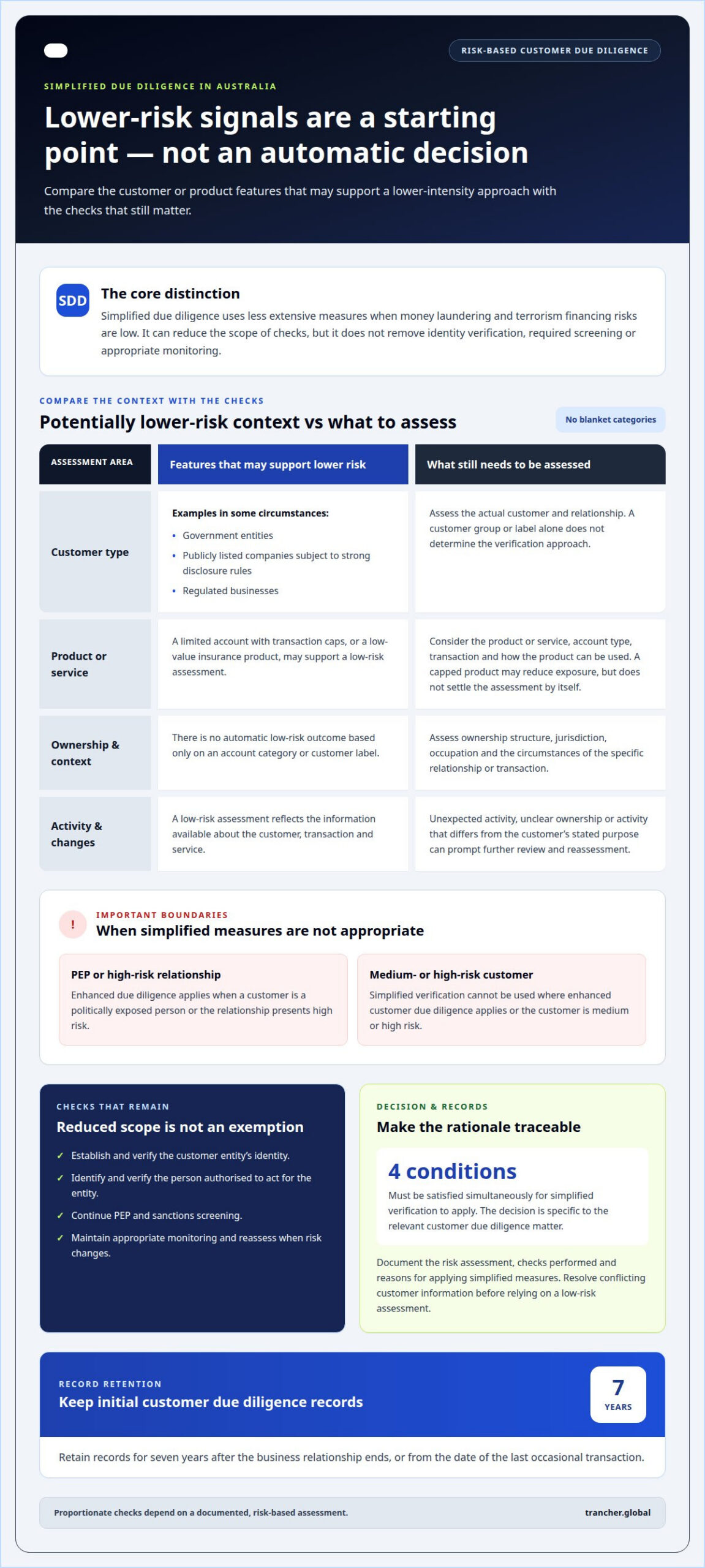
Customer and product characteristics can help determine whether reduced checks are proportionate. Government entities, publicly listed companies subject to strong disclosure rules, and regulated businesses may present lower risk in some circumstances. A limited account with transaction caps or a low-value insurance product may also support a low-risk assessment.
These examples aren’t automatic categories for SDD. Businesses need to assess the actual customer, transaction and service, including ownership, jurisdiction, account type and how the product can be used. A capped product may reduce exposure, but unexpected activity or unclear ownership can change the assessment.
Customer and representative identity
Identity checks for customers and their representatives establish who is receiving a designated service and who is acting on the customer’s behalf. Simplified verification may use less evidence for some checks, but it doesn’t remove the need to verify the customer entity’s identity.
Representatives and people receiving services for a customer remain relevant, too. For example, a business may apply proportionate measures to beneficial-owner checks while still identifying and verifying the person authorised to act for the entity. PEP and sanctions screening must also continue when simplified verification is used.
Before applying SDD, a business needs a risk assessment grounded in its business-wide risk assessment and risk appetite. It should consider the customer, jurisdiction, occupation, product or service, account type and ownership structure. The decision should relate to the specific relationship or transaction, not simply a customer label or account category.
Can simplified due diligence be used for politically exposed persons or high-risk customers? No. Enhanced due diligence applies when a customer is a politically exposed person or the relationship presents high risk, so simplified measures aren’t appropriate in those cases.
Risk can change after onboarding. Technology can help businesses compare new customer information and transaction activity with the recorded risk profile, flag inconsistencies and support timely reassessment. For instance, a transaction pattern that differs from the customer’s stated purpose can prompt further review and, where warranted, stronger due diligence.
When customer information conflicts, resolve the inconsistency before relying on a low-risk assessment. A mismatch between a representative’s details and the entity’s records, for example, may require further identity checks, updated information and a reassessment of the relationship’s risk.
What records must Australian businesses keep when using simplified due diligence? Keep initial customer due diligence records for seven years after the business relationship ends or from the date of the last occasional transaction. Document the risk assessment, checks performed and reasons for applying simplified measures, so the decision and any later reassessment can be understood.
Conditions for applying simplified verification
Simplified verification applies to specific customer due diligence matters, not as an exemption from the overall process. Australian businesses need a documented, risk-based reason before applying reduced measures.
Eligibility for simplified verification
Eligibility means the customer’s money laundering, terrorism financing and proliferation financing risks are low enough to support proportionate checks. A customer category or product label alone cannot determine the verification approach.
Australian simplified CDD guidance refers to section 31 of the Act and section 6-16 of the Rules. Simplified verification applies to three specific customer due diligence matters. The business must determine whether the relevant matter meets the criteria, using its risk assessment and the circumstances of the relationship.
Four conditions must be satisfied simultaneously for simplified verification to apply. It cannot be used where enhanced customer due diligence applies or the customer is medium or high risk. A low-risk assessment therefore needs support from relevant customer and service information, rather than an automatic rule for a customer group.
For example, a business might consider whether the customer’s ownership, location and intended service support a low-risk profile. If the information points to higher exposure, simplified measures shouldn’t be applied to that matter. Reassess when the relationship or available information changes.
Identity and beneficial ownership checks
Identity and beneficial ownership checks establish the customer’s identity, ownership and authority to act. Simplification may reduce the evidence gathered for eligible matters, but it doesn’t remove the need to identify the customer entity.
For example, a business may use fewer or less detailed identity documents when the risk assessment supports that approach. Electronic identity verification can help collect and assess customer information, but the method still needs to support a reasonable basis for the identity decision. Record what information was used and how it informed the outcome.
Beneficial-owner checks may be proportionate to the assessed risk. Simplified due diligence can involve identifying beneficial owners without further verification in appropriate cases, but this doesn’t remove identity checks for representatives or people receiving services for the customer. Resolve any mismatch between an entity’s records and its representative’s details before relying on the low-risk assessment.
Reduced verification also doesn’t mean abandoning ongoing review. If ownership information changes or transaction activity conflicts with the customer profile, reassess the risk and increase checks where appropriate. Clear records of the decision and its supporting information help maintain a consistent process. Structured identity verification workflows can support that consistency.
Differences between SDD, CDD and EDD
SDD, standard CDD and EDD are different levels of customer checks, matched to assessed risk. In Australia, the customer’s risk profile determines which approach is appropriate.
Standard CDD is the usual level of customer due diligence. It involves verifying identity and beneficial ownership, developing a customer risk profile, and monitoring activity and transactions. Simplified due diligence uses proportionate, less extensive measures for eligible low-risk cases. Enhanced due diligence adds checks and closer scrutiny when risk is higher.
- SDD: A low-risk assessment may support fewer or less detailed identity documents and proportionate beneficial-owner checks. Identity verification, relevant screening and ongoing monitoring still matter.
- Standard CDD: This covers the core identity, ownership, risk-profile and monitoring checks for a customer relationship.
- EDD: Additional checks and closer ongoing scrutiny apply in high-risk situations, including those involving a politically exposed person or a high-risk jurisdiction.
How does simplified due diligence differ from standard and enhanced customer due diligence? SDD reduces the scope of some checks for eligible low-risk cases. Standard CDD applies the core checks, while EDD increases scrutiny when risk factors call for closer examination.
The practical difference is not that SDD removes controls. For example, a business may collect less identity evidence for an eligible customer but still needs to establish identity and conduct relevant sanctions and politically exposed person screening. If a transaction or new information changes the risk profile, reassess and consider whether more extensive checks are needed.
Eligibility also differs between jurisdictions. New Zealand’s Anti-Money Laundering and Countering Financing of Terrorism Act 2009 defines 19 customer types eligible for SDD. In Canada, FINTRAC has issued seven types of entities that may qualify for a simplified identification method. These frameworks do not determine Australian eligibility.
For Australian businesses, the distinction is tied to the domestic risk-based approach. A category that qualifies for simplified treatment overseas does not automatically qualify here. The customer’s circumstances, ownership, service and transaction context still inform the local assessment.
Regulation (EU) 2024/1624 is part of the EU framework for clarifying how simplified due diligence applies across Member States. That framework illustrates why firms operating across borders need to distinguish local rules from their own Australian assessment.
Use the levels as a response to risk, not as fixed labels. A customer initially assessed as low risk may need standard or enhanced checks if new information, sanctions results or transaction activity changes the picture. Reassessment keeps the measures aligned with the risk presented.
Benefits of simplified due diligence
Simplified due diligence can make customer checks more proportionate when a documented risk assessment identifies a genuinely low-risk relationship. For an eligible customer, less extensive measures can reduce duplicated document collection and help staff focus on cases with stronger risk indicators.
The operational benefit is consistency. A business can define what information supports its decision, record why reduced checks are appropriate, and apply that approach to comparable cases. For example, a limited service with clear ownership and a straightforward purpose may need a different level of examination from a complex structure with unclear control.
Beneficial ownership identification can also be proportionate. Australian guidance identifies a beneficial owner as an individual who ultimately owns 25% or more of a customer, directly or indirectly. Identifying who owns or controls an entity helps the business understand its structure and decide whether reduced measures remain suitable.
Proportionate checks don’t mean ignoring owners. A business may tailor the depth of verification to the assessed risk while still identifying relevant beneficial owners and recording its reasoning. If ownership information is incomplete, inconsistent or difficult to understand, that uncertainty can undermine the low-risk rationale and prompt further checks.
There are risks if staff treat SDD as a shortcut rather than a risk-based decision. A blanket policy for a customer category can overlook unusual ownership, higher-risk jurisdictions or activity that doesn’t match the stated purpose. For instance, a previously straightforward relationship may warrant reassessment after an unexpected change in control or transaction pattern.
Controls help preserve the benefits. Record the risk assessment, identity information reviewed, beneficial ownership findings and reasons for selecting simplified measures. Link those records to ongoing monitoring, so changes in customer behaviour can trigger reassessment rather than leave the original decision untouched.
What are the penalties for incorrectly applying simplified due diligence in Australia? There isn’t one fixed penalty for every mistake. If reduced measures result in a failure to meet applicable AML/CTF obligations, the consequences depend on the breach and its circumstances.
That makes the quality of the decision as important as the efficiency gained. A clear record should show what facts supported the low-risk conclusion, which checks were completed, and what would prompt a review. For example, a new beneficial owner or inconsistent identity information can be a reason to reassess the customer’s profile.
Used this way, simplified due diligence supports efficient allocation of compliance effort without treating low risk as no risk. Staff can spend less time repeating checks that add little value in a well-supported case, while preserving a clear path to stronger measures when the customer’s circumstances change.
Meaning and features of simplified due diligence
Simplified due diligence is a risk-based way to scale customer checks for a low-risk business relationship. Its defining feature is proportionality: the nature of the customer, service and expected activity shapes the measures used. It changes the depth of appropriate checks, not the purpose of customer due diligence.
For example, a financial institution assessing a customer for a limited service may find that fewer identity documents are needed to support a low-risk decision. Publicly available information can help assess the customer, while relevant identity verification and screening remain part of the process. The institution records why the information supports its decision.
Policies give that decision a repeatable structure. They can describe which customer, ownership, jurisdiction and product factors staff should consider, and what information supports reduced checks. A policy should guide individual assessment, not create automatic approval for every customer in a named group. A publicly listed entity, for instance, still needs assessment in the context of its service and activity.
The approach also depends on the transaction and relationship purpose. A restricted account with clear limits may present a different risk from a service that allows complex transfers. Those features can inform the assessment, but a product label alone cannot establish low risk. The customer’s actual use and ownership structure remain relevant.
SDD is dynamic, not permanent. A financial institution can compare ongoing activity with the customer’s expected behaviour and recorded profile. For example, a change in ownership, an unusual transaction or new adverse information can prompt reassessment. If the revised assessment identifies higher risk, the institution adjusts its measures and may apply enhanced due diligence.
That’s why simplified policies need clear escalation points. Staff should know which inconsistencies require investigation, which changes trigger a fresh assessment, and how to record the rationale. If a customer’s stated purpose conflicts with transaction activity, review the difference rather than continue relying on the original low-risk decision.
The practical value lies in directing attention where it is most useful. A well-supported low-risk case can receive proportionate checks, while indicators of higher exposure receive closer examination. This balances operational efficiency with ongoing awareness, instead of treating every relationship identically or assuming a low-risk customer presents no risk.
Build a consistent approach to identity checks, screening and reassessment with customer due diligence support. Align each measure with the customer’s assessed risk, then keep the process responsive as information changes.
Trancher: Client Verification & Due Diligence (KYC/CDD + Screening)
Trancher’s platform helps Australian businesses manage client verification, due diligence and screening in a consistent workflow. It can support your team in assessing customer identity, applying appropriate checks and maintaining clear onboarding records.
For ongoing relationships, Ongoing Risk Monitoring & Client Activity Tracking helps keep customer activity aligned with the recorded risk profile. Trancher also supports End-to-End AML/CTF Program Management and Regulatory & Suspicious Matter Reporting, connecting due diligence with wider compliance processes.
If you’re reviewing how your business applies simplified measures, contact Trancher to discuss your client verification and due diligence needs.
Make risk-based due diligence part of your operating model
Understanding what simplified due diligence means is a useful starting point. The next step is to make risk decisions clear and repeatable across your organisation. When assessment criteria, escalation pathways and record keeping work together, teams can respond consistently as customer relationships evolve.
That approach also supports better operational decisions. Staff can recognise when a case fits established low-risk criteria, when information needs closer review, and when circumstances call for a different response. The result is a process designed to adapt, rather than rely on assumptions that may no longer fit.
Trancher can help connect customer verification, ongoing monitoring and broader AML/CTF program management within your compliance operations. If you’re considering how SDD fits your processes, contact Trancher to discuss SDD and identify a practical next step for your business.
With clear processes in place, your team can manage changing compliance needs with greater confidence and control.
Frequently Asked Questions
What are the steps involved in the SDD process?
Start by assessing the customer and service risk, then decide whether simplified measures fit the relevant due diligence matter. Collect and review suitable identity and ownership information, complete applicable screening, and record why the approach is proportionate. Set monitoring expectations against the customer’s intended activity. For example, if later transactions differ from the expected pattern, review the risk assessment and adjust the checks rather than relying on the original decision.
When can SDD apply?
SDD can apply when an individual assessment supports a low-risk conclusion and enhanced due diligence isn’t required. The decision should account for the customer, ownership, jurisdiction, service and expected transaction activity. A customer type or product category alone isn’t enough. For example, a business relationship with straightforward ownership may still need closer scrutiny if its intended use or later activity raises concerns.
Are there any risks associated with SDD?
Yes. The key risk is reducing checks without a sound, current assessment, which can leave important changes or inconsistencies undetected. A blanket policy for a customer group may miss exposure linked to ownership, location or transaction behaviour. For example, activity that no longer matches the customer’s stated purpose should prompt review. Clear records and defined escalation triggers help prevent a low-risk decision from becoming an unchecked assumption.
What are the benefits of SDD?
SDD can make eligible low-risk cases more efficient by limiting unnecessary checks and helping staff focus effort where risk indicators warrant closer attention. Clear criteria and recorded reasoning can also support more consistent decisions. For example, a well-documented assessment can show staff why a case received proportionate measures and what changes would require a fresh review.
What is the difference between SDD and EDD?
SDD uses proportionate measures for eligible low-risk cases, while EDD applies additional checks and closer scrutiny when higher-risk factors are present. A politically exposed person or a relationship involving a high-risk jurisdiction may require enhanced consideration. If new information changes a customer’s risk profile, reassess whether the existing approach remains suitable and increase the level of checking where the risk calls for it.
When can SDD be used?
SDD may be used during initial or ongoing customer due diligence when the assessed money laundering, terrorism financing or proliferation financing risk is low. It’s a decision about a specific relationship or matter, not a permanent status attached to a customer. For instance, a later ownership change or unusual transaction can alter the assessment. Review the customer’s circumstances and activity before continuing with simplified measures.
Which matters can be simplified?
In Australia, simplified verification applies to three specific customer due diligence matters under the relevant framework. It doesn’t simplify every part of a customer relationship or remove all verification and screening. The business needs to determine which matter is eligible and whether the required conditions are met. If enhanced due diligence applies, or the customer is medium or high risk, simplified verification isn’t appropriate.
What is simplified due diligence in Australia?
In Australia, simplified due diligence means applying reduced, risk-based measures to eligible customer due diligence matters where risk is low. The CDD changes under the Anti-Money Laundering and Counter-Terrorism Financing Amendment Act 2024 commenced on 31 March 2026. Simplified verification doesn’t remove customer identity requirements or applicable screening. The business must assess the case, document its decision and respond if risk changes.