The role of technology in AML compliance is to help businesses verify clients, monitor activity and identify patterns that warrant investigation. AI and machine-learning tools can analyse transaction data to flag unusual activity, while KYC and customer due diligence tools support identity checks and screening. Human oversight remains essential: technology informs decisions but does not replace them.
It’s understandable to expect automation to make compliance faster and more consistent, especially as data volumes grow. Its value depends on whether the tools address your business’s risks and fit the way your team works. This article explains how AI can support risk detection, how analytics and reporting improve visibility, and how KYC tools strengthen client checks. It also covers practical considerations for technology investment, including integration, staff training and ongoing review, so you can assess where technology can improve your AML processes.
Key Takeaways
- Use AI and machine learning to flag unusual activity, with human review guiding decisions about potential risks.
- Bring client and transaction information together to improve risk visibility and support clearer compliance reporting.
- Match automation to your business’s risk profile and data needs to make monitoring more manageable as activity grows.
- Use KYC and due diligence tools to support identity checks, screening and ongoing client risk assessment.
- Factor integration, staff training and ongoing review into technology decisions, and use compliance billing and ROI tracking to understand operational value.
Artificial intelligence and machine learning for risk detection
AI can help Australian businesses identify unusual activity across transactions, client behaviour and connected accounts. Its value depends on useful data, suitable detection methods and human review.
AI and Machine Learning for Suspicious Activity
AI and machine learning analyse transaction and client data to identify patterns that may indicate suspicious activity. Unlike a fixed checklist, a trained model can detect combinations of behaviours that appear unusual together. For example, a change in transaction frequency alongside transfers to unfamiliar destinations may warrant closer review.
This matters because financial crime can involve activity that looks ordinary when each transaction is considered alone. Machine learning can connect those signals and direct analysts to cases needing attention. The system identifies patterns; trained staff assess the context, decide what action is appropriate and record their reasoning.
Useful results depend on the information available to the model. Incomplete or inconsistent records can obscure relationships between transactions or clients. A practical approach is to review the data feeding the system, understand why alerts are generated and refine detection methods when business activity or risk patterns change.
Rule-Based and Machine-Learning Transaction Monitoring
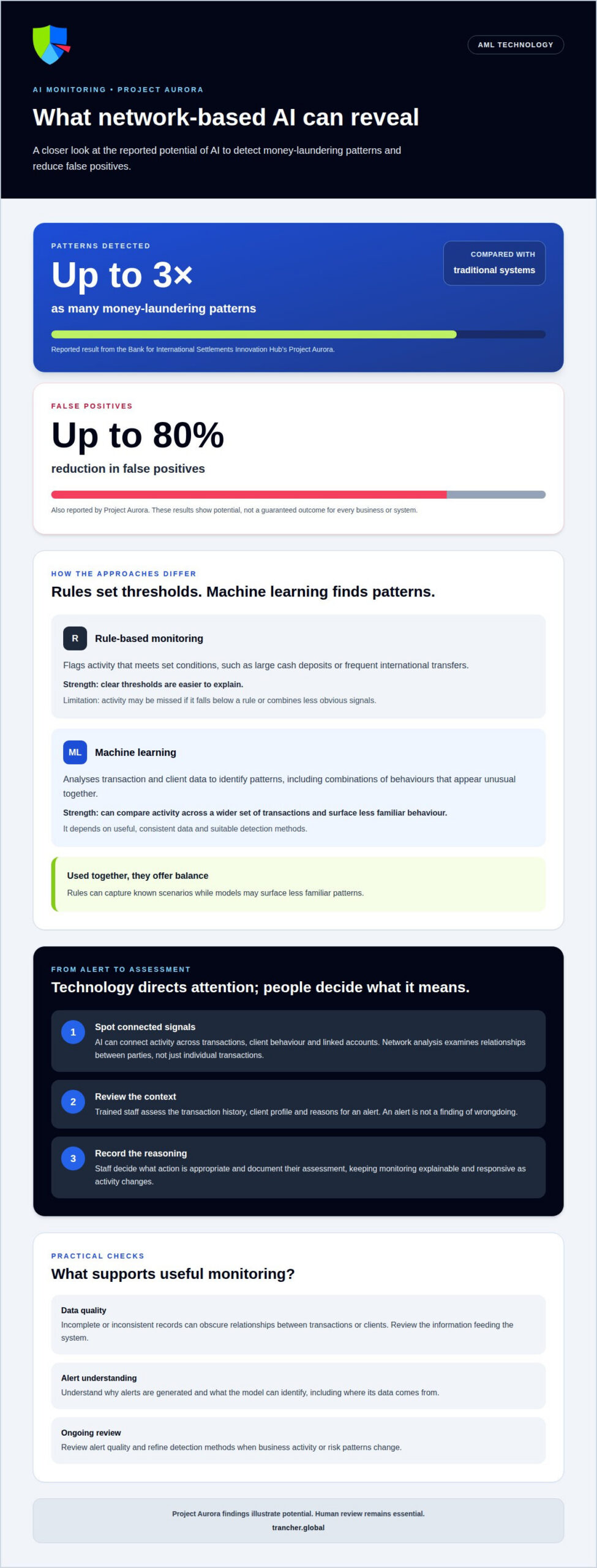
Rule-based monitoring flags transactions that meet set conditions, while machine learning identifies patterns in data. A rule might alert on large cash deposits or frequent international transfers. These clear thresholds are easier to explain, but may miss activity that falls below a rule or combines several less obvious signals.
Machine-learning models can add context by comparing activity with patterns across a wider set of transactions. Used together, the methods offer balance: rules capture known scenarios, while models can surface less familiar behaviour. For an institution, this can direct investigations towards patterns rather than relying on a single threshold.
Neither approach makes an alert a finding of wrongdoing. Teams need to review the transaction history, client profile and reasons for the alert before deciding what to do next. Combining automated flags with documented human assessment helps keep monitoring explainable and responsive as transaction behaviour changes.
AI for AML Monitoring and Detection
AI supports AML monitoring by analysing activity continuously and prioritising signals for review. The Bank for International Settlements Innovation Hub’s Project Aurora demonstrated that network-based AI models can detect up to three times as many money laundering patterns as traditional systems and reduce false positives by as much as 80%.
Network analysis is useful because it examines connections between parties, not just individual transactions. A series of transfers between linked accounts, for example, may reveal a pattern that isolated alerts would not show. Project Aurora’s results illustrate the potential of these methods, not a guaranteed outcome for every business or system.
Automation can help compliance teams manage large volumes of alerts, but people remain central to AML detection. Staff need to understand what a model can identify, where its data comes from and how to assess its alerts. Regular reviews of alert quality and documented decisions help keep monitoring aligned with operational risks.
Data analytics, visualisation and compliance reporting
Data analytics brings client and transaction information together, helping teams see emerging risks across their operations. For Australian reporting entities, AUSTRAC reporting obligations depend on the entity’s activities and applicable report type. Analytics can support detection, documentation and reporting workflows.
Suspicious matter reporting timelines depend on the applicable reporting category and when a suspicion is formed. A monitoring process should capture the relevant activity, assessment, decision and submission timestamps, helping staff manage reporting steps and maintain a clear audit trail.
Advanced Analytics and Predictive Tools
Advanced analytics examines combined datasets to identify trends, anomalies and changes that may indicate rising risk. Predictive tools use historical and current information to highlight possible risk escalation, helping teams focus attention before a pattern becomes more serious.
For example, a dashboard could show unusual changes in client activity alongside related transaction alerts. Analysts can review the underlying records, determine whether the pattern has a reasonable explanation and document their assessment. This supports informed decisions rather than treating a prediction as proof of suspicious activity.
Visualisation also helps managers assess control effectiveness across client groups, sectors or regions. Trends can reveal where alert volumes are rising, where reviews take longer or where procedures may need attention. The value comes from connecting those indicators to clear follow-up and recorded decisions.
Graph Analytics and Network Detection
Graph analytics maps relationships between clients, accounts, transactions and counterparties to reveal connections across a network. This can help detection teams find links that are difficult to see when records are reviewed individually.
For instance, a visual network may show several clients sending funds through the same intermediary before reaching a shared destination. That connection is a signal for further assessment, not a conclusion about intent. Analysts can trace the relevant records, consider legitimate explanations and record why the activity did or did not warrant escalation.
Clear visualisation makes complex relationships easier to interpret and explain. It can also help teams distinguish a direct transaction link from a broader association, improving case notes and supporting consistent reviews across investigators.
Real-Time Transaction Analytics
Real-time analytics assesses transaction and client activity as information arrives, allowing potential risks to surface promptly. A system might flag a sudden change in payment frequency or activity involving a new counterparty for review.
Timely alerts are useful only when they provide enough context for assessment. Showing the transaction, relevant client history and reason for the alert helps staff decide what to examine next. Teams should also record the review outcome so later decisions can draw on earlier assessments.
As transaction volumes change, dashboards can help supervisors monitor alert queues and spot delays. This supports operational oversight while keeping attention on suspicious activity and the evidence behind each alert.
Compliance Reporting and Requirements
Compliance reporting turns reviewed activity and decisions into organised records for regulatory processes. AUSTRAC reporting workflows should reflect the entity’s applicable obligations, with staff able to trace an alert from initial detection through assessment and submission.
For a suspicious matter, a useful record captures when the activity arose, what prompted concern, who assessed it and when the reporting decision was made. Reporting deadlines depend on the category, so workflows should make the applicable timing visible and track each required action. This helps teams manage deadlines without treating an automated alert as a reporting decision.
Analytics can also bring supporting transaction details and case notes into one review process, reducing gaps between detection and reporting. A structured audit trail helps explain the basis for decisions and supports consistent handling as circumstances evolve. Integrated AML reporting workflows can help organise monitoring and reporting activity.
Technology’s role in improving AML compliance efficiency, accuracy, scalability and monitoring
Automated monitoring can help teams process growing transaction volumes and focus reviews on relevant risks. For example, a system can group related activity, flag unusual changes and send cases to a review queue.
Automated Transaction Monitoring
Automated transaction monitoring applies configured rules and analytical methods to transaction data, flagging activity for assessment. It reduces repetitive manual screening and helps financial institutions handle larger volumes consistently.
A business can configure alerts around transaction patterns relevant to its risk profile, then route them to staff for review. Automation can also capture key information, such as the activity that triggered an alert and the resulting assessment. This creates a consistent review trail and helps teams see which cases need attention.
Automation still needs oversight. If transaction data is incomplete, alerts may be less useful or lack relevant context. Reviewing data inputs, alert reasons and case outcomes helps maintain accuracy as products, customers and activity patterns evolve.
Real-Time Monitoring and Risk Management
Real-time monitoring assesses activity as transaction information arrives, helping teams identify changes that may need prompt attention. A sudden shift in payment behaviour, for example, can be flagged for review rather than waiting for a scheduled manual check.
For risk management, monitoring is most useful when alerts connect to client context and clear follow-up processes. Staff can review the activity, assess its relevance and document the outcome. Supervisors can use dashboards to track alert queues and spot delays, supporting ongoing oversight as transaction volumes change.
Technology can scale this process by processing more activity without requiring every transaction to be examined manually. For organisations exploring how synthetic workforces and automated agents can support operational teams, specialists such as Navo assist with deploying practical AI agents. It supports timely decisions, while people remain responsible for interpreting signals and determining whether further action is appropriate.
Reducing False Positives While Preserving Accuracy
False positives are alerts that do not indicate meaningful suspicious activity; AML false-positive rates can reach 95%. A high volume can consume review time and draw attention away from potentially significant cases.
Technology can improve alert relevance by using more complete client and transaction data, applying contextual analysis and learning from recorded review outcomes. For example, a payment may be ordinary for one client but unusual compared with another client’s established activity. Context helps distinguish the two without simply suppressing alerts.
Teams should assess both alert quality and detection coverage when refining monitoring. If a rule is changed to reduce unnecessary alerts, reviewing subsequent cases can show whether it still surfaces relevant activity. This balances efficiency with accuracy and keeps human assessment in the process.
Technology Requirements for AML/CTF Reforms
For Australian businesses, technology requirements should be mapped to the AML/CTF obligations that apply to their activities. As AUSTRAC reforms affect applicable requirements, businesses need to identify which monitoring, record-keeping and reporting workflows require adjustment.
A practical assessment starts by mapping existing processes to the obligations relevant to the business, then identifying gaps in data capture, alert handling or reporting records. For example, if a workflow changes, the system should support updated review steps and preserve a clear record of decisions.
Technology does not determine whether a business meets its obligations. It can support consistent implementation through configurable controls, accessible records and staff workflows that reflect current processes. Regular reviews help keep systems aligned as business activities and applicable requirements evolve.
Customer due diligence and know-your-customer tools
KYC and customer due diligence tools help businesses establish who a customer is and assess relevant risks. Their design affects both screening quality and the customer’s onboarding experience.
KYC and Customer Onboarding
KYC tools support onboarding by collecting identity information and helping verify it against documents and other data. Some tools use biometric authentication, AI-driven document analysis and facial recognition to assess identity evidence.
For customers, a clear process can make it easier to provide information and understand why it is needed. For businesses, structured checks create consistent records and help staff identify missing or inconsistent details. For example, a document analysis tool may flag a name mismatch for review rather than letting an incomplete record go unnoticed.
Technology can make parts of verification more efficient, but smooth onboarding still depends on sensible data requests and clear communication. If a tool raises an issue, staff need a way to review the supporting information and resolve legitimate discrepancies. This balances operational efficiency with a fair customer experience.
Watchlist and Customer Screening
Screening tools compare customer information with sanctions lists, politically exposed persons databases and adverse media reports. The results can generate alerts for staff to assess, helping identify potential risk indicators during onboarding or later reviews.
A potential match is not, by itself, proof that a customer presents a risk. Names can be similar, records can be incomplete and context matters. Staff should assess identifying details and relevant information, document their decision and distinguish a genuine match from a false alert.
Screening may also support enhanced due diligence for higher-risk customers. Tools can help check public records and adverse media, bringing relevant information into a documented assessment. The depth of review should reflect the identified risk factors, rather than relying on a single alert or database result.
Screening quality depends on data coverage and how often information is refreshed. A system that captures different name forms, relevant identifiers and match rationale can make reviews more useful. Clear records also help staff understand why an alert was closed or escalated, supporting consistent decisions across the business.
Customer experience and compliance effort are connected. Repeated requests for the same information, unclear instructions or unresolved alerts can create unnecessary friction. A well-organised workflow can route incomplete applications for follow-up, direct potential matches for review and preserve the outcome with the customer record.
Privacy is another part of sound KYC design. Businesses should protect identity documents and screening records, restrict access to appropriate staff and handle information under applicable data protection requirements. For organisations operating across jurisdictions, those requirements may include the European Union’s General Data Protection Regulation (GDPR), where applicable.
Risk-based technology investment, training and vendor collaboration
Effective investment starts with the risks a business needs to manage, not the newest available tool. The role of technology in AML compliance is to support controls that fit real workflows, staff capability and emerging money laundering patterns.
Selecting AML Compliance Technology
Selecting AML technology means matching system capabilities to business risks, data and operational needs. This matters because a platform designed around the wrong priorities can add complexity without improving detection.
Start by identifying where existing processes need support, such as client screening, transaction monitoring or reporting records. Then assess whether each option can work with current systems, handle the required data and support your team’s review process. The Financial Action Task Force says technology and innovation can strengthen AML/CFT effectiveness when implemented through a risk-based approach.
Compare options against practical requirements. For example, a business with disconnected client and transaction records may prioritise integration, while one with rising alert volumes may focus on workflow automation. Consider platform costs alongside implementation needs, data management and staff training. This keeps investment tied to operational challenges rather than features that do not address the business’s risk profile.
Implementing AML Compliance Technology
Implementation means integrating a chosen tool into existing workflows, preparing data and training staff. A structured rollout matters because even a suitable platform depends on accurate inputs and consistent use.
Map the current process first, from information capture through review and record-keeping. Work with the technology provider to configure workflows around those steps, then test how representative cases move through the system. For instance, confirm that an alert reaches the right review queue and staff can record an assessment and its supporting rationale.
Training should explain both how the system works and the purpose of each control. Staff need to recognise what an alert indicates, review its context and document a decision. Ongoing guidance helps team members apply consistent methods, while feedback from daily work can reveal friction or unclear system prompts.
After launch, review whether the system supports the outcomes it was selected to improve. Examine alert patterns, data quality, workflow delays and user feedback. If money laundering methods or business activity change, adjust controls and training accordingly. The role of technology in AML compliance needs regular review so systems remain aligned with evolving risks, rather than treating implementation as a one-off task.
Vendor collaboration can help address integration issues and tailor workflows to business needs. Set clear priorities, share relevant process requirements and review how proposed changes affect staff tasks and records. Explore AML compliance support to map your priorities to practical technology workflows.
Trancher: Compliance Billing Support & Revenue/ROI Tracking
Trancher supports Australian businesses seeking clearer visibility into compliance billing and the operational value of their AML investment. Its compliance billing and revenue tracking tools help connect compliance activity with revenue and return-on-investment tracking, giving businesses a more informed view of their processes.
Trancher can be a useful next step when you’re assessing how technology fits your risk profile, workflows and growth plans. The platform supports end-to-end AML/CTF program management, client verification and due diligence (KYC/CDD and screening), and ongoing risk monitoring and client activity tracking. These capabilities connect compliance operations from client checks through ongoing monitoring.
For support managing AML processes and tracking compliance activity, contact Trancher.
Make your next AML technology decision count
The role of technology in AML compliance is not simply to automate tasks. It is to build a dependable operating capability that supports informed decisions as your business and its risks evolve. The next step is to identify where better-connected processes, clearer records or more consistent monitoring would make the greatest difference to your team.
Trancher supports end-to-end AML/CTF program management, client verification and due diligence (KYC/CDD and screening), and ongoing risk monitoring and client activity tracking. These capabilities help businesses connect AML processes and keep compliance activity visible.
Start a conversation about the needs and priorities of your AML program. Contact Trancher to discuss your AML needs.
A considered, risk-based approach can turn technology decisions into steady progress for your compliance operations.
Frequently Asked Questions
What Is AI In AML Compliance And How Does It Work?
AI in AML compliance uses algorithms to analyse information and identify activity that may need closer review. A system can compare transaction behaviour with client details and flag changes, such as a sudden shift in payment patterns. The alert helps staff focus their assessment; it does not establish that money laundering has occurred. Human judgement and documented decisions remain essential.
How does technology help detect suspicious transactions and money laundering in Australia?
Technology helps Australian businesses examine transaction activity alongside relevant client information, making patterns easier to identify. For example, a business can compare a client’s usual payment activity with an unexpected change and direct the case for assessment. Useful systems also help staff record why they investigated an alert and what they decided. That context supports consistent follow-up when similar activity appears later.
What are the roles of AI and machine learning in AML compliance, and what are their limitations?
AI can automate analysis and prioritise alerts, while machine learning can identify patterns across data that fixed rules may not capture. Results depend on the information and methods used. Incomplete data or biased historical patterns can affect which activity is flagged, and unfamiliar criminal methods may not resemble earlier examples. Staff should understand alert reasons, consider context and remain responsible for assessment.
How do transaction monitoring and customer risk-scoring systems work?
Transaction monitoring reviews activity against rules or analytical patterns, while risk-scoring systems use factors such as transaction behaviour, industry and geographic location to indicate relative client risk. A higher score can prompt closer review, but it is not a finding of wrongdoing. For example, a material change in a client’s activity may lead staff to reassess the profile and record why the risk view changed.
How does digital identity verification and KYC technology support AML compliance in Australia?
Digital identity tools can support KYC by analysing identity documents and using methods such as biometric authentication or facial recognition. They help businesses collect and assess identity information during onboarding, while screening tools check client details against relevant watchlists. If a document image is unclear or information conflicts, staff can send the case for further assessment instead of treating an automated result as conclusive.
What are the key risks of using automated AML systems, including bias, privacy, and cybersecurity?
Automated AML systems can produce skewed results if their data is incomplete or reflects biased historical decisions. They also process sensitive customer and transaction information, raising privacy and cybersecurity considerations. Engaging technical specialists like Insoft Services for cybersecurity consultancy and IT training can help organisations secure their broader systems and data environments. Limit access to appropriate staff, protect stored records and review how alerts are generated. For example, periodic checks of closed and escalated cases can help identify inconsistent outcomes or patterns that need attention.