
A risk-based approach to AML compliance means identifying money laundering and terrorist financing risks, then applying controls proportionate to those risks. In Australia, it helps businesses focus due diligence and monitoring on the customers, activities and exposure that warrant closer attention.
It’s reasonable to want clear rules for deciding when customers need additional checks and how often their activity should be reviewed. The aim isn’t to scrutinise everyone in the same way, but to make informed, documented decisions that reflect your business and its risks.
This article explains how to assess risk across customers, services, delivery channels and geographic exposure, then translate that assessment into proportionate due diligence and ongoing monitoring. It also covers how FATF recommendations inform the approach and how to keep risk profiles current when customer circumstances or activity change.
Key Takeaways
- Build your risk assessment around customers, products and services, delivery channels and geographic exposure.
- Section 26C is the legal reference for AML/CTF risk assessment obligations, according to the Australian Government, Federal Register of Legislation.
- Match customer due diligence to assessed risk, with more detailed checks for higher-risk relationships.
- Keep risk profiles current by responding to changes in customer circumstances, transactions and activity.
- Use ongoing monitoring to direct attention to unusual activity and emerging risks.
What are the main AML risk factors organisations should assess?
Australian AML/CTF risk assessment starts by identifying how customers, services, transactions and operating locations could expose a business to money laundering or terrorist financing. Section 26C of the Act is the legal reference for these risk assessment obligations, according to the Australian Government, Federal Register of Legislation.
Identifying and Scoring Risks
Risk identification lists potential threats; scoring compares their likelihood and potential impact. This helps explain why one customer type or transaction pattern needs stronger controls than another. For example, regular transactions involving a higher-risk jurisdiction may deserve more attention than activity consistent with a customer’s established profile.
Assess your business across its customers, products and services, delivery channels and geographic footprint. Consider transaction volumes and sizes, the number of customers already rated high risk, and jurisdictions where the business operates or has exposure. Internal audit findings and regulatory issues can also reveal weaknesses to address in a new assessment.
Estimate likelihood using relevant historical activity, industry trends and other evidence. Then assess possible consequences, including financial loss, reputational damage and regulatory penalties. A defined scoring method can combine likelihood and impact, supporting consistent decisions instead of relying on intuition alone.
Prioritising and Documenting Assessments
Prioritisation ranks identified risks so controls and resources focus on areas with the greatest potential impact. A medium-complexity business might compare likelihood and impact, while a low-complexity business could use impact alone to establish inherent risk. Choose a method that reflects your business’s nature, scale and complexity.
Document the factors considered, scoring logic, assigned rating, rationale and selected mitigation. Record who made the assessment and what evidence informed it, such as transaction patterns or internal audit findings. Clear risk thresholds help staff apply ratings consistently and explain why each control was chosen.
For suspicious matters and threshold transactions, Australian reporting workflows need to identify the report type and the event that triggers it. The applicable deadline depends on the classification and reporting requirement, so specify the deadline in each process before submission.
Inadequate risk-based AML/CTF compliance can expose a business to regulatory penalties, financial loss and reputational damage. The consequences depend on the nature and seriousness of the failure and its effects.
The 2024 reforms affect which businesses and activities fall within AML/CTF obligations. Expanded obligations take effect on the commencement dates that apply to the relevant provisions, so businesses should map their activities against those dates and adjust assessments and controls accordingly.
Link each material risk to a control that can mitigate it, such as closer review of unusual activity or stronger checks for higher-risk relationships. Reassess ratings when transaction patterns, products, ownership or geographic exposure change. This keeps documented controls aligned with your business’s current risk profile.
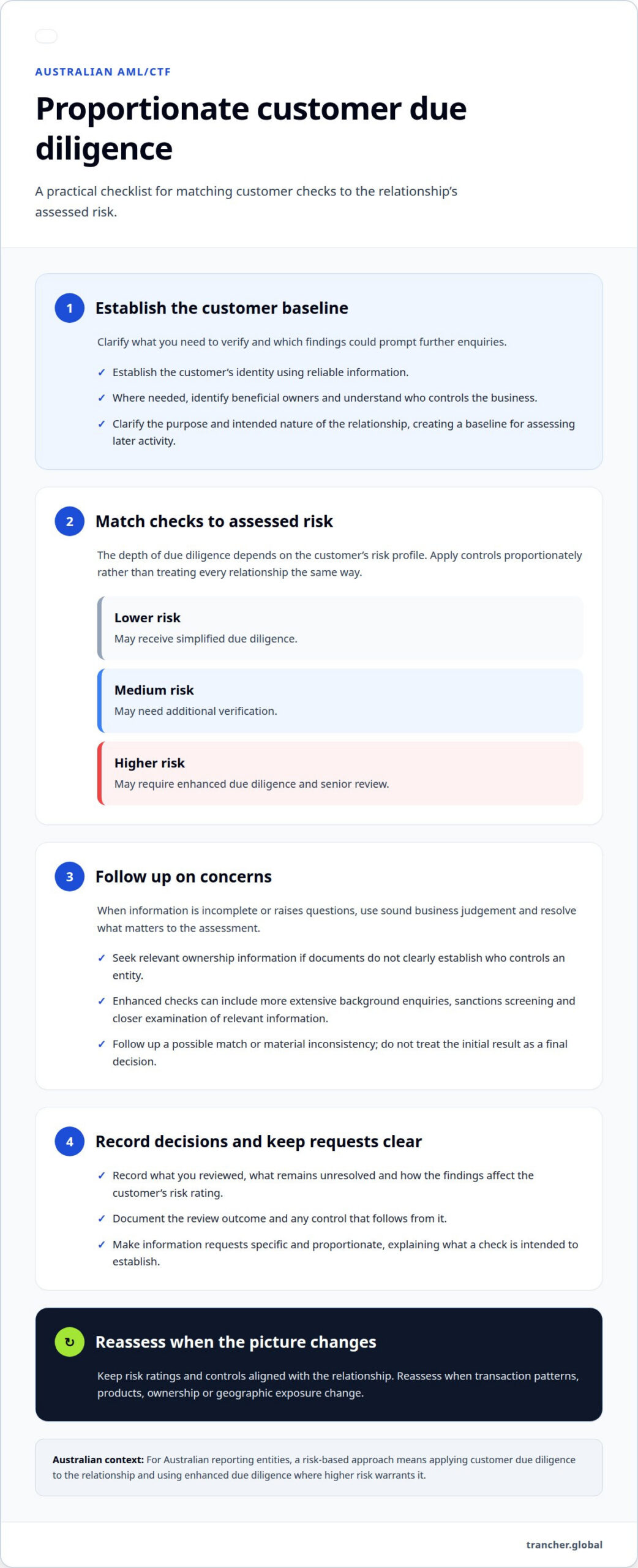
Proportionate customer due diligence
Customer due diligence involves deciding what information to obtain, how to assess it and what to do when it raises concerns. A clear process helps staff reach consistent outcomes while tailoring checks to the relationship’s assessed risk.
Customer and Business Risk Factors
This assessment turns a customer’s circumstances into a practical due diligence plan. Staff need to know what they are verifying and which findings would prompt further enquiries.
Begin by establishing the customer’s identity using reliable information. Where needed, identify beneficial owners and understand who controls the business. Clarify the purpose and intended nature of the relationship so later activity can be assessed against an informed baseline.
Use sound business judgement when information is incomplete or raises questions. For example, if documents don’t clearly establish who controls an entity, seek relevant ownership information before completing the assessment. Record what you reviewed, what remains unresolved and how those findings affect the customer’s risk rating.
Proportionate Due Diligence Controls
Proportionate controls set the depth of checks according to the customer’s assessed risk. For Australian reporting entities, a risk-based approach means applying customer due diligence to the relationship and using enhanced due diligence where higher risk warrants it.
A financial institution can assess a client’s risk profile before conducting customer due diligence. In practice, lower-risk customers may receive simplified due diligence, medium-risk customers may need additional verification, and higher-risk customers may require enhanced due diligence and senior review.
Enhanced checks can include more extensive background enquiries, sanctions screening and closer examination of relevant information. If a check produces a possible match or material inconsistency, staff should follow up appropriately rather than treating the initial result as a final decision. Document the review outcome and any resulting control.
Balancing Controls and Customer Experience
Customer experience improves when every information request has a clear purpose and follows a consistent process. Customers can respond more effectively when they understand what a check is intended to establish.
Make requests specific and proportionate. If a verification step needs clarification, explain what information is required and how it relates to the relationship, rather than sending a broad request without context. A staged process can address essential identity and ownership checks first, then pursue additional enquiries if the assessment indicates they are relevant.
Keep decisions and outstanding actions visible to the staff handling the file. Client verification and due diligence can support a structured workflow for KYC/CDD and screening, helping teams apply checks consistently while keeping each request tied to its purpose.
What is a risk-based approach to AML?
Ongoing monitoring tests whether AML controls continue to work as intended. It can help detect suspicious activity and show where control design or follow-up needs attention.
Ongoing Transaction Monitoring
Transaction monitoring compares activity with defined scenarios and generates alerts for review. A useful process gives each alert a clear path from initial assessment through investigation to a recorded outcome.
For example, an alert may identify activity that meets a transaction threshold. The reviewer can assess it alongside relevant customer information and document why it was escalated or closed. A clear record helps another staff member understand the decision without repeating the investigation.
Monitoring also needs quality oversight. Reviewing closed alerts can reveal whether staff apply investigation criteria consistently and whether recurring alert types receive appropriate attention.
Calibrating Monitoring to Risk
Calibrate monitoring by setting thresholds and alert priorities to reflect the risks your business intends to detect. This directs investigative effort towards alerts with stronger indicators, rather than treating every alert as equally urgent.
Connect thresholds to defined scenarios and the activity they are designed to identify. Alert outcomes can show whether a threshold is too broad or misses relevant patterns. Banks may conduct daily transaction monitoring, but each institution’s monitoring design and review process should reflect its operations and identified risks.
Prioritising alerts by risk score can help staff organise review queues. The score should support judgement, not replace consideration of the transaction and its context.
Updating Customer Risk Profiles
Monitoring findings should inform compliance decisions rather than remain isolated in an alert queue. This matters when an investigation reveals information that changes how existing controls should be applied.
For instance, repeated alerts with a consistent explanation may indicate that a scenario needs refinement. An unresolved alert, by contrast, may warrant escalation under the organisation’s procedures. Record the finding, decision-maker and rationale so future reviews can draw on the investigation instead of treating it as an isolated event.
Periodic reviews of monitoring outcomes can also reveal gaps in coverage. Document how those findings lead to changes in thresholds, alert handling or staff guidance.
Managing Residual Risk
Residual risk is the exposure that remains after controls are applied. Managing it means evaluating whether monitoring and other measures reduce exposure sufficiently for the business to make informed decisions.
A control may operate as designed yet leave some risk unresolved. For example, monitoring may generate an alert, but available information may not fully explain the activity. Record the remaining concern, its assessment and any further action selected.
Reviewing residual risk alongside alert outcomes helps distinguish effective controls from those needing adjustment. It also creates a reasoned record of how monitoring informs decisions about ongoing exposure.
FATF Recommendations and risk-based implementation
The FATF framework links risk assessment with controls for money laundering and terrorist financing. For Australian businesses, it offers a structured way to align measures with identified risk factors.
FATF’s Risk-Based Approach
The Financial Action Task Force defines a risk-based approach as identifying and understanding money laundering and terrorist financing risks, then applying mitigation measures in line with those risks. This matters because controls can be proportionate rather than uniform across every customer and activity.
In practice, this approach connects assessment to decisions. A business identifies relevant exposure, evaluates its significance and chooses measures to manage it. For example, a higher-risk customer relationship may call for closer scrutiny than lower-risk activity. Document why the controls differ to support consistent decisions across the organisation.
Implementing FATF Recommendations
Implementing the FATF Recommendations means translating the international framework into practical, risk-sensitive processes. This helps organisations direct compliance resources towards higher-risk customers and activities instead of spreading attention evenly.
A useful implementation links each identified risk to a control, an owner and a review process. For instance, a customer risk factor should inform relevant due diligence and monitoring measures. The organisation can then assess whether those measures address the risk and whether changing activity or other information calls for an update. Documenting these links makes the framework easier to apply consistently.
Implementation also needs to reflect the organisation’s circumstances. Its services, customers, transaction patterns and operating jurisdictions shape its exposure. A measure that suits one business may not address another’s risks effectively, so decisions should follow the organisation’s assessment rather than a generic checklist.
FATF Recommendation 1
FATF Recommendation 1 requires institutions to identify, assess and understand their risks, then apply controls proportionate to those risks. It matters because it makes risk assessment the basis for selecting and scaling AML/CFT measures.
For an Australian organisation, this principle should lead to specific operational choices. If identified risks relate to customer activity, controls can focus on appropriate due diligence and transaction monitoring. If they arise from a product or jurisdiction, consider how processes address that exposure. Give each decision a clear rationale.
The FATF Recommendations adopted in 2012 identify the risk-based approach as central to effective implementation. This places assessment and proportionate controls within the wider framework, rather than treating them as separate compliance tasks. Reviewing whether controls remain aligned with current risks helps maintain that connection as business activity changes.
Risk-based due diligence and monitoring
Due diligence establishes who a customer is and whether the relationship makes sense. Monitoring tests whether activity continues to fit that understanding. Together, these processes help Australian reporting entities identify changes linked to money laundering or terrorist financing and focus attention on relevant concerns.
Connect each customer assessment to the relationship’s actual features. Consider the customer’s industry, beneficial owners, operating jurisdictions, transaction types and volume, and any third parties involved. For example, a business customer with several layers of ownership may require enquiries to clarify who ultimately controls it. The resulting risk rating should guide the checks and monitoring applied.
Give geographic exposure specific attention. AUSTRAC expects businesses to assign a high-risk rating to countries on the FATF grey and blacklists. A customer’s connection to a listed country should inform the assessment and control decisions. Consider how that connection relates to the customer, transactions and business purpose, rather than treating country exposure as the only relevant factor.
Customer due diligence should establish identity using reliable information, identify beneficial owners where needed and build an understanding of the relationship’s purpose. Screening for sanctions, politically exposed persons and adverse media can add relevant context. If screening or other information raises a concern, further enquiries can clarify the customer’s circumstances before the organisation decides whether enhanced checks or escalation are appropriate.
Monitoring should reflect the customer’s risk profile and expected activity. A transaction may warrant attention because of its size, frequency, destination or inconsistency with the known relationship. For example, regular high-volume transfers to an unfamiliar jurisdiction may merit investigation if they differ from the customer’s established pattern. Monitoring systems can prioritise alerts by risk score, helping staff focus on activity with stronger indicators of concern.
When an alert is raised, assess the transaction against customer information, previous activity and the stated business purpose. Record the reason for escalation, the evidence reviewed and the outcome. If ownership, geography or transaction behaviour changes, reconsider whether the risk rating and controls remain suitable. Review higher-risk clients more frequently, and investigate escalated red flags rather than closing them without a clear rationale.
Bring due diligence and monitoring together in one repeatable process: establish the relationship, set relevant controls, assess activity and respond to meaningful changes. Strengthen ongoing risk monitoring with client activity tracking that connects observed behaviour to review decisions.
Trancher: Ongoing Risk Monitoring & Client Activity Tracking
Trancher helps Australian businesses manage ongoing AML/CTF monitoring and track client activity. Its Ongoing Risk Monitoring & Client Activity Tracking helps teams respond when customer activity changes, reviews become harder to coordinate or monitoring needs to work alongside existing due diligence processes.
Integrating ongoing monitoring into your compliance approach helps you assess activity against customer risk profiles and focus on changes that may need review. Trancher also provides Client Verification & Due Diligence (KYC/CDD + Screening) and End-to-End AML/CTF Program Management, connecting these activities within wider compliance operations.
To discuss how Trancher can support your AML/CTF monitoring and due diligence, contact Trancher.
Make your next compliance decision count
A risk-based approach to AML compliance is not a static document; it needs to keep pace with your business. As customers, services and transaction patterns evolve, build review points into your processes so emerging exposure prompts a considered response. This makes compliance part of day-to-day business operations, rather than an exercise revisited only when circumstances demand it.
Start by identifying where monitoring or due diligence creates the most operational friction, then decide what would help your team act consistently. Trancher connects the practical demands of AML/CTF management with workflows suited to your business. A conversation can clarify how that support fits your priorities and current processes.
Contact Trancher to discuss AML compliance and explore a practical way forward. With clear priorities and the right processes in place, your team can approach ongoing compliance with confidence.
Frequently Asked Questions
What exactly does “lower risk” mean?
“Lower risk” means the available information indicates comparatively lower exposure to money laundering or terrorist financing under your assessment method. It doesn’t mean zero risk or exemption from appropriate checks. For example, a customer with transparent ownership and activity consistent with their stated purpose may present lower risk than one with complex ownership and unexplained transactions. Document the factors behind the rating and reconsider it when circumstances change.
What are the benefits of an RBA in AML compliance?
A risk-based approach directs compliance effort towards customers, transactions and services with greater exposure. This can make reviews more focused and avoid applying the same scrutiny to every relationship. For example, staff can prioritise an alert involving an unexpected transaction pattern over routine activity that matches a customer’s profile. Documented decisions also help teams explain why particular checks or monitoring measures were selected.
What does a risk-based approach to AML compliance mean in Australia?
In Australia, it means assessing money laundering and terrorist financing risks relevant to your business, then applying controls in proportion to those risks. The assessment should reflect your customers, services, delivery channels and geographic exposure. For example, a business serving customers across several jurisdictions may consider how that footprint affects its customer checks and transaction monitoring. Section 26C of the Act is the legal reference for AML/CTF risk assessment obligations.
What are the key requirements of Australia’s Anti-Money Laundering and Counter-Terrorism Financing Act and Rules?
Requirements depend on whether a business provides a regulated designated service and which obligations apply. Australian AML/CTF compliance can involve an AML/CTF program, risk assessment, customer due diligence, ongoing monitoring, suspicious matter reporting, staff training and record keeping. The Act and Rules provide the relevant legal framework. Map your services against the applicable obligations, then ensure your processes address each requirement.
How should Australian businesses assess and document AML/CTF risks?
Identify exposure across customers, products and services, delivery channels and geographic operations. Assess each risk’s likelihood and potential impact, then record its rating, evidence, rationale and selected controls. For example, note why a transaction pattern is considered unusual and what review it prompted. Define consistent scoring logic and thresholds, and update the assessment when ownership, services, locations or customer activity changes.
What customer, product, service, delivery-channel and geographic risk factors should an AML/CTF risk assessment cover?
Consider the customer’s industry, beneficial ownership, transaction types and volume, and the relationship’s purpose. Assess how products and services could be used, whether a channel involves remote interaction or third-party checks, and which jurisdictions are connected to customers or activity. For example, a new service delivered online may change how identity information is obtained. Evaluate these factors together, since one feature alone may not represent the relationship’s overall risk.
When must Australian businesses conduct ongoing customer due diligence and transaction monitoring?
Businesses can consider ongoing due diligence and monitoring, adjusting review frequency to the customer’s assessed risk. Reassess when meaningful changes occur, such as new beneficial ownership, a new service, activity involving another jurisdiction or transactions inconsistent with the customer’s known profile. For example, an established customer starting unfamiliar cross-border transfers may prompt an earlier review. Set review triggers and monitoring thresholds that respond to the relationship’s risks.
How should AML/CTF controls be tailored to different customer risk ratings?
Align the depth of checks and monitoring with the customer’s rating and the reasons for it. Lower-risk customers may receive simplified due diligence where appropriate; medium-risk cases may need additional verification; higher-risk relationships may warrant enhanced checks and senior review. For example, complex ownership could prompt further enquiries about beneficial owners. Link each control to the specific concern and record why it suits that customer.