
Could a nominee appointment bring your accounting firm within AUSTRAC’s AML/CTF framework, even when it appears to be routine company administration? The key isn’t the word “nominee” on an engagement file. It’s the service your firm actually provides. Assessing nominee roles AML designated services means looking closely at the capacity involved, the work performed and the surrounding circumstances.
It’s understandable that the boundary can feel unclear. Nominee activities may sit alongside company, trust or administrative services, and each engagement needs to be assessed on its facts. Since Tranche 2 obligations commenced on 1 July 2026, accounting firms need a consistent way to identify relevant services and record their decisions.
This guide explains the nominee capacities to consider under Table 6, the engagement details and records that can help clarify scope, and practical steps for current AML/CTF operations. It also covers how structured activity tracking and integrated compliance workflows can support consistent reviews, clearer evidence and less duplicated administration.
Key Takeaways
- Assess nominee roles AML designated services by identifying the capacity and activities involved, then comparing them with the relevant Table 6 wording.
- Review nominee shareholder, nominee director and registered-office work alongside related entity creation or restructuring to distinguish the services being provided.
- Document each review consistently, including the engagement scope, client, relevant entities, activities considered and reasoning behind the decision.
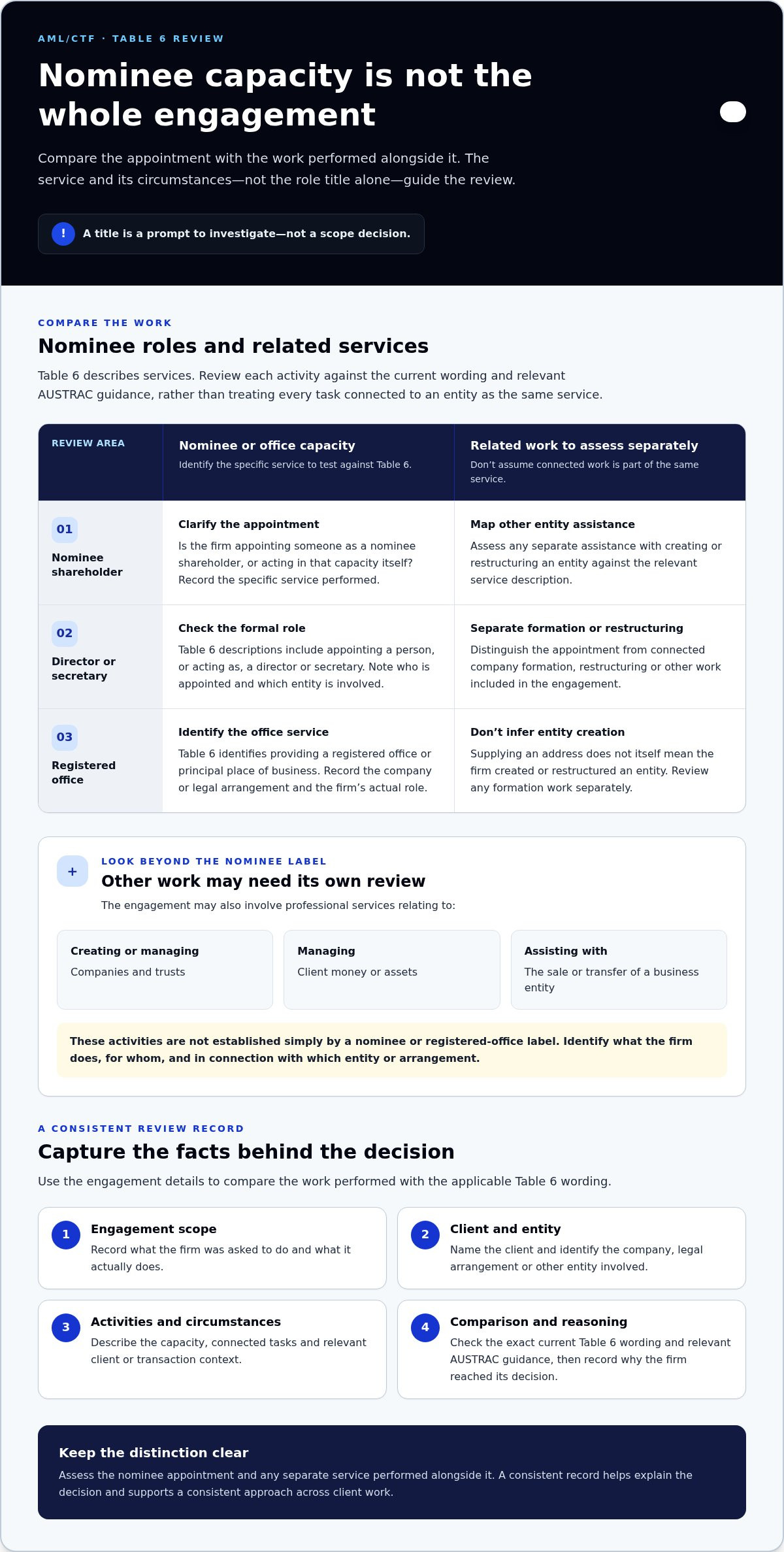
- Compare the nominee title with the actual work and its client and transaction context. A title is a prompt to investigate, not a scope decision.
- Trancher is more than software. It’s a complete AML compliance solution for accounting firms, with designated-service tracking, audit-ready evidence, role-based training modules, expert on-call support, dedicated onboarding and local support.
When can nominee roles be AML designated services for accountants?
A nominee role describes a capacity or appointment. It doesn’t, by itself, determine whether an engagement falls within the AML/CTF framework. For accounting firms, the question is whether the work performed matches a designated service in Table 6 of the relevant legislation. Table 6 specifies services, rather than bringing an entire profession into scope simply because it is accounting.
Start with the engagement itself. Record what the firm has been asked to do, what it actually does, who the client is, and which entity or arrangement is involved. General Anti-Money Laundering (AML) principles provide useful background, but they don’t replace checking the Australian service descriptions and current AUSTRAC guidance.
Why the nominee title alone is not the test
A role label can conceal important differences in the work. For example, a person described as a “nominee director” may be formally appointed to a company, while the firm’s wider engagement also involves setting up or restructuring an entity. Another engagement may use similar wording but involve a different capacity, client or scope.
Assess the service performed and its circumstances, not the title alone. Use the title as a prompt to investigate, not as a final classification. Compare the actual activities and engagement facts with the applicable Table 6 wording before recording a scope decision.
Which nominee capacities deserve closer review?
Pay particular attention to work involving nominee shareholders, company directors or secretaries, and related representative capacities. Table 6 descriptions include services such as appointing a person, or acting as, a director or secretary, as well as appointing or acting as a nominee shareholder. It also identifies providing a registered office or principal place of business for a company or legal arrangement. Check the exact current wording rather than relying on a summary.
- Nominee shareholder: establish whether the engagement involves appointing or acting in that capacity, and record the specific service performed.
- Nominee director or secretary: distinguish the formal appointment from connected company formation, restructuring or other work.
- Registered-office capacity: clarify whether the firm provides a registered office or principal place of business, and identify the relevant entity or arrangement.
These examples are review prompts, not automatic conclusions about every appointment or engagement. Compare the facts with the current Table 6 description and relevant AUSTRAC guidance. A clear record of that comparison helps the firm explain its decision and apply a consistent approach across client work.
Which nominee activities may intersect with Table 6 designated services?
For a practical review, separate the formal capacity from other work bundled into the engagement. Table 6 includes descriptions relating to acting in certain nominee capacities and providing a registered office or principal place of business. Other listed professional services may relate to creating or managing companies and trusts, managing client money or assets, or assisting with the sale or transfer of a business entity. Check the current wording before classifying a service. A broad label in a proposal may not show which activities the firm actually performs.
Assess the nominee appointment and any separate designated service performed alongside it. This helps avoid treating every task connected to an entity as part of the nominee role, or overlooking other work because the engagement is labelled “nominee services”.
Nominee shareholder and representative activities
Where a firm is asked to act for another person as a nominee shareholder, identify the precise appointment and what the firm does in that capacity. Is the firm itself acting as nominee shareholder, arranging an appointment for someone else, or providing separate assistance with an entity? These activities need to be mapped against the relevant Table 6 descriptions rather than treated as interchangeable versions of a role title.
Apply the same care to director, secretary and other representative appointments. Note who is appointed, which entity is involved, who the client is and what the firm undertakes. A person’s position in a company doesn’t, by itself, establish that every related task is the same designated service. Test each activity against the current AUSTRAC guidance and exact service wording.
Registered offices and entity-related work
Providing a registered office or principal place of business warrants a distinct review because Table 6 identifies that service separately. Record which company or legal arrangement the address relates to, and describe the firm’s actual role. Don’t assume that supplying an address means the firm has also created or restructured an entity. If the engagement includes formation or restructuring work, assess that work separately against the relevant description.
Apply the same distinction if an engagement also involves holding or managing client money or assets as a designated service, or assistance with a business sale or transfer. Those activities aren’t established simply by a nominee or registered-office label. Identify what the firm does, for whom, and in connection with which entity or transaction. Then compare those facts with the current Table 6 text. This gives the firm a clearer basis for consistent decisions without extending a service description beyond its terms.
Structured designated-service tracking can help accounting firms capture the capacity, related activities and assessment rationale together. Trancher is more than software: it’s a complete AML compliance solution for accounting firms, with designated-service tracking, integrated workflows and audit-ready evidence. The solution also includes role-based training modules, expert on-call support, dedicated onboarding and local support. Explore Trancher’s AML compliance solution to see how structured workflows can support consistent engagement reviews.
How do you distinguish a captured nominee service from related work?
A reliable review separates the role name from the work performed around it. For nominee roles AML designated services, consider the appointment, the firm’s activities, who receives the service, and the transaction or entity context. Then test each potentially relevant condition against the exact wording in current AUSTRAC guidance. The table below is a prompt for that assessment, not a determination that any example is captured or excluded.
| Role title | Activities and context to examine |
|---|---|
| Nominee shareholder | Is the firm acting in the nominee shareholder capacity, arranging an appointment, or also assisting with an entity transaction? Identify who requested the work, who receives it and the entity involved. |
| Nominee director or secretary | Distinguish the appointment from separate entity formation, restructuring or transaction assistance. Record the firm’s actual role and how the engagement relates to the body corporate or legal arrangement. |
| Registered-office arrangement | Clarify whether the firm provides an address as a registered office or principal place of business, and whether the scope also includes other entity-related activities. |
| Bookkeeping or administration | Describe the specific tasks, such as maintaining records or processing routine information, and check whether the same engagement also involves a separately described service or transaction-related work. |
Questions to ask about the engagement
Build the assessment from the engagement facts, rather than relying on one document or label. Establish who requested the appointment and who receives the service. Describe what the firm actually does, controls, arranges or assists with, and identify the relevant company or legal arrangement. Check the applicable geographical and business-context conditions in current AUSTRAC guidance. Record which conditions you considered and where the supporting facts came from.
Why adjacent tasks should be assessed separately
Bookkeeping, document handling or routine administration may sit beside a nominee appointment, but the task name alone doesn’t settle the AML/CTF assessment or establish a blanket exemption. Separate the appointment from any transaction planning or execution, asset-related work, or assistance with another activity described in Table 6. A combined engagement can involve distinct services, so assess each relevant activity and its circumstances on its own terms.
An appointment letter is useful evidence, but it may not describe all the work delivered. Compare it with the engagement scope, correspondence, instructions and activity records. If those sources differ, document the discrepancy and the basis for the firm’s assessment. This creates a traceable rationale that can be applied consistently without treating one fact as conclusive.
This section provides general educational information, not legal, financial or compliance advice. Use current legislation and AUSTRAC guidance to assess the specific facts of each engagement.
How should accounting firms review and document nominee engagements?
A repeatable review gives your team a clear record of how it assessed each nominee engagement. It doesn’t make a legal determination. Use the same sequence across client files: define the capacity, map the work, compare it with the current Table 6 wording, then record the reasoning and any points requiring further review.
A repeatable nominee-engagement review
Start with the appointment documents, then compare them with the actual scope of work. An appointment letter may describe a formal role without capturing the full assistance the firm provides. A consistent process can help:
- Identify the capacity. Record the proposed or actual appointment, the relevant client, and the company or legal arrangement involved.
- Map the activities. List each task separately, including arranging an appointment, dealing with entity documents or assisting with related work. Keep the description factual.
- Check the wording. Compare each potentially relevant activity with the current Table 6 descriptions and applicable AUSTRAC guidance. Note the material used and any unresolved interpretive questions.
- Record the decision. Document the assessment, reasons, review date and responsible internal reviewer. If new work is added, update the assessment rather than relying on an earlier scope description.
This process helps distinguish the engagement’s scope from assumptions based on a client or role label. It also gives the firm a consistent basis for reviewing similar work over time.
What supporting records can help show
Keep the engagement terms alongside evidence of what the firm actually did. Depending on the engagement, this may include appointment documents, client instructions, correspondence, entity records and notes of work completed. Link these materials to the review so a later reader can follow the path from the agreed scope to the activities considered and the decision recorded.
Where a potentially relevant designated service is identified, retain the rationale and supporting material in line with the firm’s record-keeping processes. The stated requirement is: “Maintain records for minimum of seven years.” Apply the relevant requirement to the records and organise files so they can be retrieved and understood.
Consistent designated-service tracking can help teams record review status, supporting evidence and changes in scope together. It supports operational oversight and clearer internal handovers, but doesn’t make the classification decision for the firm. For a practical framework for organising supporting material, use this guide to audit-ready compliance records.
Trancher is more than software: it’s a complete AML compliance solution for accounting firms, with designated-service tracking and integrated workflows. It includes role-based training modules, expert on-call support, dedicated onboarding and local support. Explore structured AML engagement tracking to support consistent reviews and organised evidence.
How can firms manage nominee-role AML readiness with a consistent system?
Once the firm has a repeatable way to assess nominee work, the next step is making that process visible across the wider AML/CTF operation. A shared workflow can help staff track designated services, review progress and organise supporting evidence in one place, rather than relying on separate notes and duplicated administration. It supports oversight, but doesn’t make a legal determination or replace the firm’s own responsibilities.
Bring nominee activity into the firm’s wider workflow
For each engagement, link the recorded service and review status to its supporting material. This gives authorised team members a clearer view of what has been assessed, what evidence is available and whether the engagement scope has changed. A consistent record can also help firms communicate compliance activity to clients more transparently and track the work associated with it.
Trancher is more than software. It’s a complete AML compliance solution for small and medium size accounting firms, supporting end-to-end program management through designated-service tracking, integrated workflows, audit-ready reporting and compliance evidence generation. Role-based training modules, expert on-call support, dedicated onboarding and local support help teams embed the system into their operations.
For a useful reference when mapping nominee work against relevant services, consult this Table 6 designated services guide. Use current AUSTRAC wording and guidance alongside your firm’s engagement records.
Prepare for current obligations and practical next steps
The milestone “Registering with AUSTRAC by 1 July 2026” has passed. That date was also the commencement date for Tranche 2 obligations. Firms reviewing their position now should use current AUSTRAC guidance to understand the enrolment requirements that apply to their circumstances, rather than treating the commencement date as the only relevant date.
Start with current nominee engagements. Identify services that may fall within the framework, review how the firm records its decisions, and look for gaps in evidence, workflow ownership or staff understanding. Then agree internally how changes to an engagement’s scope will be captured and who will review them. These steps help turn a one-off assessment into a process the team can use consistently.
Trancher’s stated 30-day compliance guarantee is expressed as “Be compliant in 30 days.” This product claim doesn’t replace assessing your firm’s obligations or applying current AUSTRAC guidance. Learn about Trancher’s AML compliance solution and how structured tracking and integrated workflows can support nominee-engagement reviews.
Make consistent reviews part of your next step
Nominee arrangements can change as client needs and engagement scopes evolve. Build a review point into your firm’s processes so changes prompt a fresh look at the activities involved and the records supporting your assessment. This keeps decisions connected to current work, rather than relying on an old role description or one-off review. A consistent approach to nominee roles AML designated services can also make internal handovers clearer and help your team apply its process with greater confidence.
Consider how your firm can bring those reviews into its wider AML/CTF operations. Trancher is a complete AML compliance solution for accounting firms, with designated-service tracking and integrated workflows to support consistent activity records. Explore Trancher’s complete AML compliance solution for accounting firms and take a steady next step towards more organised compliance operations.
Frequently Asked Questions
Can a nominee director role be an AML designated service?
A nominee director title alone doesn’t determine whether the service is designated. Compare the firm’s actual work and engagement context with the current Table 6 wording, including any conditions that apply. For example, note whether the firm is appointed as director or performs separate entity work under the same engagement. Use AUSTRAC’s current professional designated services guidance as the reference for your review. This is general information, not legal advice.
Does acting as a nominee shareholder automatically bring an accounting firm into AUSTRAC’s AML/CTF regime?
No. The label alone isn’t a final scope decision, though acting as a nominee shareholder warrants review. Assess what the firm provides, who receives the service and the surrounding circumstances. For example, distinguish acting in that capacity from separately arranging entity work. Compare the facts with the applicable Table 6 description and current AUSTRAC guidance before reaching a firm-level assessment.
Is providing a registered office a designated service under Table 6?
AUSTRAC’s professional services guidance identifies providing a registered office address or principal place of business among the services to examine. Check the exact current wording and any relevant conditions, then assess what the firm actually provides. For example, record whether the engagement covers the address alone or also includes entity formation or transaction assistance. Consider those additional tasks separately rather than assuming they share the same scope.
Who is the client when an accountant acts in a nominee capacity?
The answer can depend on the engagement and service being provided. Review who instructed the firm, who receives the service, whose interests the firm acts for and which entity or arrangement is involved. For example, the party signing an engagement letter may not, by that fact alone, resolve every client-identity question. Apply the relevant concepts in current AUSTRAC guidance. This FAQ doesn’t make a determination for a particular engagement.
Can a nominee appointment be outside scope if the firm only performs administrative tasks?
Don’t assume an activity is outside scope simply because it appears administrative. Clarify what the staff member actually does, such as preparing documents, submitting information or arranging an appointment, and assess those tasks in context against the relevant Table 6 description. Keep a concise record of the facts and reasoning, especially if duties change during the engagement. This general information isn’t a substitute for legal advice.
What records should an accounting firm keep when reviewing nominee engagements?
Keep the engagement terms, capacity involved, a clear account of activities, relevant client and entity details, and the basis for the scope assessment. For example, preserve instructions or correspondence that explain why the firm undertook particular tasks, and link them to the review record. Where the stated record-keeping requirement applies, use the exact wording: “Maintain records for minimum of seven years.” This list doesn’t replace the firm’s full record-keeping obligations.