
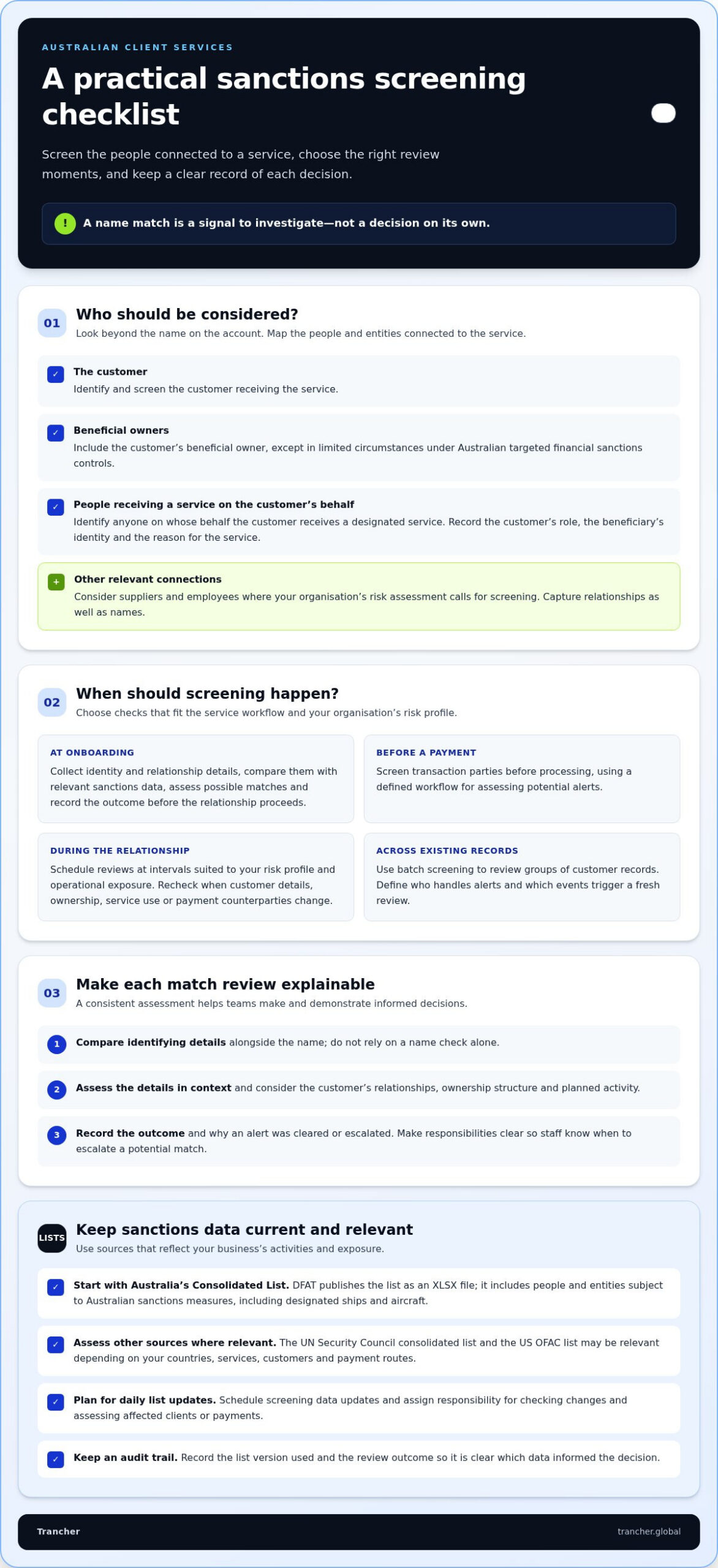
A name match is a signal to investigate, not a decision on its own. A sanctions screening checklist helps client service teams compare customer names and other identifying details with relevant sanctions lists, then assess and document potential matches. In Australia, targeted financial sanctions controls must cover the customer, the customer’s beneficial owner except in limited circumstances, and anyone on whose behalf the customer receives a designated service.
Sanctions screening can be difficult to operationalise: names vary, alerts can be false positives, and teams need a clear record of how decisions were made. A practical, risk-based process makes assessments more consistent. This article explains sanctions screening in Australian client services, how to assess name matches, what to record for an audit trail, and how to adapt screening to risk throughout the customer relationship.
Key Takeaways
- Use Australia’s Consolidated List as part of a screening approach tailored to the customers, services and transactions your business handles.
- Assess potential name matches using additional identifiers, and document why an alert was cleared or escalated.
- Build screening into onboarding and ongoing reviews, including when sanctions lists or customer information change.
- Keep a clear audit trail of screening activity and decisions so your process can be demonstrated and reviewed.
- Apply a risk-based approach to prioritise higher-risk cases and align controls with your business’s exposure.
What Is Sanctions Screening?
Sanctions screening compares customer, entity and transaction details with sanctions lists to identify restricted parties before services are provided or payments proceed. Australian businesses need to consider the sanctions regimes relevant to their activities and exposure.
According to Australia’s Department of Foreign Affairs and Trade (DFAT), dealing with a person or entity on the Consolidated List is a serious criminal offence, carrying up to 10 years’ imprisonment for individuals. If you suspect an asset is owned or controlled by a designated person or entity, freeze it, inform the Australian Sanctions Office and notify the Australian Federal Police as soon as possible.
Australian Consolidated List coverage
Australia’s Consolidated List brings together people and entities subject to Australian sanctions measures, helping businesses identify restricted parties before providing services or processing transactions. It can include individuals, organisations and jurisdictions, as well as designated ships and aircraft. In a client service workflow, compare relevant customer and transaction details with the list rather than relying on a name check alone.
A potential match calls for careful assessment, not an automatic conclusion. Review names and identifying details in context, and remember that suspected dealings involving a designated person’s or entity’s assets trigger specific action. For example, a payment involving a possible designated party should be held for assessment under the business’s process, with any suspected controlled asset handled in line with Australian sanctions requirements.
Sanctions list sources and updates
Governments and international organisations publish sanctions lists, each reflecting its own measures and designations. DFAT publishes Australia’s Consolidated List, while the United Nations Security Council consolidated list is another major source. The US Office of Foreign Assets Control (OFAC) list may also be relevant where a business’s activities or exposure bring that regime into scope.
Global coverage does not mean every list applies to every business. Consider the countries, services, customers and payment routes involved, then identify relevant domestic and international regimes. Lists can differ, so do not assume one consolidated data source replaces every applicable sanctions list.
DFAT provides the Australian Sanctions Consolidated List as an XLSX file. Retrieve the current file and compare its entries with the records used in screening. Sanctions lists are updated daily, so schedule updates to screening data and make a defined review step part of the workflow. A sanctions screening checklist can assign responsibility for checking updates and assessing affected clients or payments.
When a list update changes a designation, review relevant customer and transaction records against the new information. Record the list version and review outcome so staff can see which data informed the decision. This anchors domestic screening to Australia’s Consolidated List while allowing the business to account for relevant global sanctions exposure.
Screening persons receiving a designated service on a customer’s behalf
An Australian sanctions screening checklist should identify who receives each service, screen relevant parties at onboarding, and schedule reviews during the relationship. Australian targeted financial sanctions controls cover the customer, their beneficial owner except in limited circumstances, and anyone on whose behalf the customer receives a designated service.
Who and what to screen
Map the people and entities connected with a service, not just the person named on the account. Include customers, beneficial owners, people represented by customers, suppliers and employees where the organisation’s risk assessment calls for screening. This broader view can reveal relevant connections a customer-only check may miss.
For example, if a company arranges a payment or service for another individual, identify and assess that person as part of the workflow. Record the customer’s role, the beneficiary’s identity and the reason for the service. International ownership or an intermediary can obscure who benefits, so capture relationships alongside names.
Screening schedules and triggers
Choose screening methods that fit the workflow. Customer screening supports onboarding and periodic reviews; payment screening checks transaction parties; batch screening reviews groups of existing records. Event-triggered screening starts when relevant information changes, such as a new beneficial owner, revised customer details or a new service request.
Set review schedules according to the organisation’s risk profile and operational exposure rather than relying on a single check. For example, a payment workflow can screen parties before processing, while batch reviews can identify changes across existing customer records. Define who handles alerts and which events trigger a fresh review. Apply the schedule consistently across teams.
Onboarding and ongoing monitoring
At onboarding, collect identity and relationship details for the customer, beneficial owners and anyone receiving a service on the customer’s behalf. Compare those details with relevant sanctions data, assess possible matches and record the outcome before the relationship proceeds. A customer’s international links, ownership structure and planned activity can inform the review.
During the relationship, screen again at defined intervals and when a trigger occurs. Review changes to customer details, ownership, service use or payment counterparties. Include suppliers and employees where the business’s controls require it. Make responsibilities clear, so client-facing staff know when to escalate a potential match instead of treating the original onboarding check as permanent clearance.
- Identify the customer and relevant connected parties.
- Screen at onboarding and assess any alerts.
- Set review intervals and event triggers.
- Rescreen affected records after a relevant change.
- Record decisions and escalate unresolved matches.
Travel-related services, for example, may involve a customer arranging a booking for another person. The workflow should capture who receives the service and who pays, then screen the relevant parties at the appropriate stages. Client Verification & Due Diligence can support screening within a structured client process.
AI-assisted name matching and false-positive reduction
Automated matching can flag possible links between client records and sanctions data, including names written in different forms. In Australia, compare tools by how they handle name variations, supporting identifiers, alert review and audit records. Software flags candidates for investigation; a reviewer assesses the evidence before making a decision.
When comparing Australian screening software, consider features such as fuzzy logic, alias handling, phonetic matching and transliteration. Costs depend on screening volumes, data coverage, integrations and implementation requirements, with pricing provided after a quote request.
Name matching across languages
Multilingual matching compares a customer’s recorded name with alternative spellings, aliases and transliterations on a sanctions list. This matters when a name moves between writing systems or appears differently in foreign records. A single exact-text comparison can miss a relevant candidate.
For example, a customer’s passport may use a Latin spelling while a sanctions entry uses another script or transliteration. Matching tools can use phonetic methods and aliases to flag variations. Include available identifiers, such as date of birth and nationality, so reviewers can distinguish a possible match from someone with a similar name.
Data quality affects screening results. Capture names as recorded in identity documents, preserve alternative spellings, and compare each available version with relevant sanctions lists. Keep original data alongside any standardised form so the reviewer can see what the system compared and why an alert appeared.
Assessing potential matches
A potential match is an alert to investigate, not proof that a customer is designated. Compare the customer’s date of birth, nationality and other identifiers with the sanctions entry. Gather additional information where available, then assess whether the combined details support a true match or a false positive.
For example, if a name resembles an entry but the listed date of birth differs, record the discrepancy and consider other identifiers before clearing the alert. If details align or remain unresolved, follow the organisation’s escalation policy. Do not dismiss an alert based on name similarity alone, particularly where transactions or access to financial services are involved.
Assign a reviewer, record the evidence considered and document the decision. A clear rationale helps another staff member understand why an alert was cleared, escalated or held for further review. If the assessment indicates a possible sanctions breach, escalate through the appropriate regulatory and internal reporting process.
Screening technology and software options
Screening systems can compare customer, entity and transaction data with sanctions lists, then present potential matches for compliance staff to investigate. Useful capabilities include fuzzy logic for spelling variations, alias and phonetic matching, transliteration, and fields for comparing identifiers. AI-assisted matching can help prioritise alerts, but it should not replace human assessment.
Compare options against the organisation’s languages, customer data, payment workflows and security controls. Check how the system presents match evidence, supports escalation, and records decisions. These features help teams manage alerts consistently and explain how a regulatory decision was reached.
Costs vary with screening volume, list coverage, workflow integrations and implementation needs. Compare these factors alongside matching quality and the staff effort required to investigate alerts. A system that produces more alerts without useful identifiers may increase manual review rather than reduce it.
Screening documentation and audit trails
A reliable screening record shows what the business checked, which data sources it used and what action followed. Capture the customer or transaction screened, the sanctions-list version, matching details, reviewer and decision. These records let another staff member trace the reasoning without relying on memory or informal notes.
For each alert, record the identifiers compared, such as name, date of birth, nationality or identification number. Note whether the details matched, differed or required further investigation. If a reviewer clears an alert, document the reason; if they escalate it, record who took over and what action followed. A brief conclusion without supporting evidence is difficult to reconstruct.
Use timestamped records to show when screening occurred and when a decision was made. A useful audit report can show the original search, the list data used, the alert status and any later changes. For example, if an updated sanctions list triggers a rescreen, preserve the new result alongside the earlier record. This creates a traceable history of screening and monitoring.
Retention matters too. A practical recommendation is to retain sanctions-related records for 5-7 years. Keep records organised by customer, transaction or alert, with access limited to staff who need them. If a case involves several countries or data sources, record which sources informed the assessment and how the reviewer resolved conflicting details.
Test the screening process as well as the records it creates. Run sample names with spelling variations through the matching workflow, then check whether expected alerts appear and staff can document their decisions. Review results during internal audits to identify gaps, such as missing timestamps, unclear escalation notes or records that do not show which list was searched.
Training helps staff apply the process consistently. Teach compliance and client-facing teams to recognise new sanctions and red flags, record matching evidence and escalate unresolved alerts. Use a scenario involving a similar name or changed customer detail, then check that staff record the evidence and action taken. Refresh training when the organisation changes its screening process.
- Screening evidence: retain the search details, list version and customer or transaction screened.
- Decision trail: record the reviewer, timestamp, rationale and action taken.
- Quality checks: test matching, audit records and address identified gaps.
- Staff readiness: train teams on sanctions updates, red flags and escalation steps.
When a confirmed match indicates a possible breach, retain the assessment and any required reporting records. AUSTRAC may be relevant to reporting obligations, depending on the circumstances. A consistent record of the evidence, decision and follow-up action helps the organisation explain its conduct and show how it handled the alert.
Risk-based sanctions screening
Risk-based screening directs attention to customers, ownership structures, services or transactions with greater sanctions exposure. Key risks include opaque ownership, missed list updates and treating an initial match as a final decision.
Applying a risk-based approach
A risk-based approach tailors screening coverage and alert thresholds to the business’s activities and exposure. It helps teams prioritise parties or transactions that need prompt assessment while keeping routine reviews consistent.
Start by considering the products and services offered, countries involved, payment routes and customer ownership. For example, a complex structure with unclear beneficial ownership is a higher-risk red flag. Apply due diligence that reflects these factors, and assess whether relevant domestic or international sanctions regimes cover the activity.
Australian AML/CTF policies must explain how the business will prevent assets being made available to, or for the benefit of, a person designated for targeted financial sanctions. They must also provide for checking whether covered persons become designated during the business relationship. Risk assessment therefore continues after onboarding; it does not end when a customer first passes screening.
Set review triggers for changes to customer details, ownership, transactions or sanctions lists. Use enhanced due diligence for higher-risk cases, including source-of-funds and source-of-wealth information where appropriate. Politically exposed person and adverse media checks can add context about other risks, but they do not replace sanctions-list checks.
Screening risks and common mistakes
Common mistakes include screening only the account holder, relying on outdated list data and clearing similar-name alerts without checking other identifiers. Each can obscure a connection to a designated person or entity.
Another risk is applying the same threshold to every customer and transaction. A payment involving an opaque ownership chain may warrant closer assessment than a straightforward transaction. Prioritise cases using documented risk factors, then record why a match was cleared, escalated or held for further review.
According to Australia’s Department of Foreign Affairs and Trade, dealing with a person or entity on the Consolidated List is a serious criminal offence, carrying up to 10 years’ imprisonment for individuals. Treat a possible match as an alert to assess, not proof of a breach; unresolved concerns need prompt escalation through the organisation’s process.
Keep the approach practical: identify relevant parties, account for changes, and align review intensity with exposure. Strengthen ongoing risk monitoring by embedding review triggers and escalation responsibilities into client workflows.
Trancher: End-to-End AML/CTF Program Management
Trancher helps Australian accounting firms connect sanctions screening with wider AML/CTF program management. Its end-to-end client verification, screening and risk assessment support onboarding, while ongoing risk monitoring and client activity tracking help teams manage reviews throughout the relationship.
This can be a practical next step when screening responsibilities, alert handling and ongoing reviews need a more consistent workflow. Trancher also supports regulatory and suspicious matter reporting, bringing related compliance activities into a coordinated process. The right starting point depends on where your client service workflow needs more structure, whether in initial verification, ongoing monitoring or reporting.
Contact Trancher to discuss how its AML/CTF program management could support your sanctions screening workflow.
Make screening part of how your service works
Treat sanctions screening as a workflow design decision, not a task separate from client service. Map where identity details enter, where reviews are needed, and who can pause or escalate a case. A sanctions screening checklist is most useful when it guides these hand-offs in day-to-day operations.
Start with one client journey. Identify decision points, assign clear ownership, and make sure staff can record why they took action. Then refine the process as your services, customer base or risk exposure changes. This keeps controls connected to real work rather than relying on a static procedure.
Trancher supports Australian businesses with AML/CTF program management, client verification and due diligence, and ongoing risk monitoring. If you’re ready to strengthen your workflow, contact Trancher about sanctions screening. A practical, well-owned process can help your team work with greater clarity and confidence.
Frequently Asked Questions
What is a Sanctions List?
A sanctions list identifies people, businesses, organisations or places subject to restrictions imposed by a government or international body. Depending on the measure, restrictions can affect trade, financial services or transactions. For example, a business may compare a customer’s details with an applicable list before providing a service. Lists may use different identifiers and spellings, so a name resemblance is a prompt for review, not confirmation of a match.
What is the Consolidated List?
Australia’s Consolidated List brings together people and entities designated under Australian sanctions measures. The Department of Foreign Affairs and Trade publishes the list, including as an XLSX file. A practical approach is to compare relevant customer or counterparty details with the list, then retain the version used in the screening record. The list is Australia-specific, so businesses with international exposure may also need to consider other relevant sanctions lists.
Who imposes sanctions?
Governments and international organisations impose sanctions. Australia applies its own measures, while the United Nations Security Council can impose measures through its decisions. Other governments also maintain national regimes and lists. Which measures matter depends on the parties, services and transactions involved. For example, an Australian business handling a cross-border payment may need to assess relevant Australian measures alongside other regimes connected to the transaction.
Who is subject to financial sanctions?
Financial sanctions can apply to designated individuals, businesses, organisations, countries or regimes, and may also identify ships or aircraft. Restrictions depend on the relevant measure and can prohibit transactions or financial services involving a designated target. Assess the parties to a transaction and any relevant ownership or control links. A similar name alone does not establish that a person or entity is designated.
What is sanctions screening and who must conduct it in Australia?
Sanctions screening compares information about customers, other relevant parties or transactions with applicable sanctions lists. Australian targeted financial sanctions controls cover the customer, the customer’s beneficial owner except in limited circumstances, and anyone on whose behalf the customer receives a designated service. Required controls depend on the business and service involved. Identify which obligations apply to your activities and reflect them in the screening process.
Which Australian sanctions laws and regulations govern sanctions screening?
Australia’s framework includes the Autonomous Sanctions Act 2011 and the Autonomous Sanctions Regulations 2011. Targeted financial sanctions provisions are also referenced in section 28(2)(e) and section 30 of the Anti-Money Laundering and Counter-Terrorism Financing Act 2006, and section 5-3 of the Rules. These instruments address related sanctions and AML/CTF obligations. A screening process should reflect the measures relevant to the business’s activities, rather than treating every list or provision as interchangeable.
How should businesses screen customers, beneficial owners, directors, suppliers and transactions?
Build a reliable record for each party, then compare available identifiers with relevant sanctions lists. For a company customer, distinguish the entity from its beneficial owners and directors, and record their roles. Screen suppliers where they are relevant to the business’s risk controls, and assess transaction parties before processing. If details raise an alert, compare other identifiers and document the reasoning. This helps staff distinguish a similar name from a credible potential match.
How often should sanctions screening be repeated, and what events should trigger rescreening?
Screen at onboarding and repeat checks periodically according to the organisation’s risk-based schedule. Rescreen when a relevant sanctions list is updated, customer information changes, or a new event alters the relationship or transaction risk. Examples include a change in beneficial ownership or a new payment counterparty. Document the trigger and outcome so the business can explain why it reviewed a party and what information informed its decision.