
A client-money account alone doesn’t determine AML/CTF status. Under item 3 of Table 6, receiving, holding, controlling or managing another person’s money or property can be a designated service in specified circumstances. The key is what the business does with the funds and how that activity relates to a transaction.
It’s understandable that the boundary can seem unclear: recording a client transaction isn’t the same as taking control of their money, and simply operating a trust account doesn’t automatically make every service designated. This article explains when holding client money may be a designated service in Australia, what exceptions may apply, and which record-keeping obligations are relevant.
You’ll see how the rules may affect legal and accounting work, why the purpose and handling of funds matter, and how transaction records and customer due diligence fit in. This gives you a clearer basis for assessing your services and organising compliance responsibilities.
Key Takeaways
- Assess what your practice actually does with client funds or property, not simply whether it operates a trust account.
- Transaction-related decisions about payments or transfers can affect whether handling client money is a designated service.
- Map your services against the relevant rules and consider how exceptions apply to your practice as a whole.
- Build record-keeping into your compliance processes; Australian practices must retain relevant AML/CTF records for seven years.
- AUSTRAC requires an SMR within 3 business days in any other case, when the suspicion does not relate to terrorism financing or information protected by legal professional privilege.
Receiving, holding, controlling or managing client funds and property
For Australian businesses, item 3 of Table 6 covers receiving, holding, controlling or managing another person’s money or property in specified circumstances. Whether holding client money is a designated service depends on the activity and its connection to a transaction, not simply on whether an account exists.
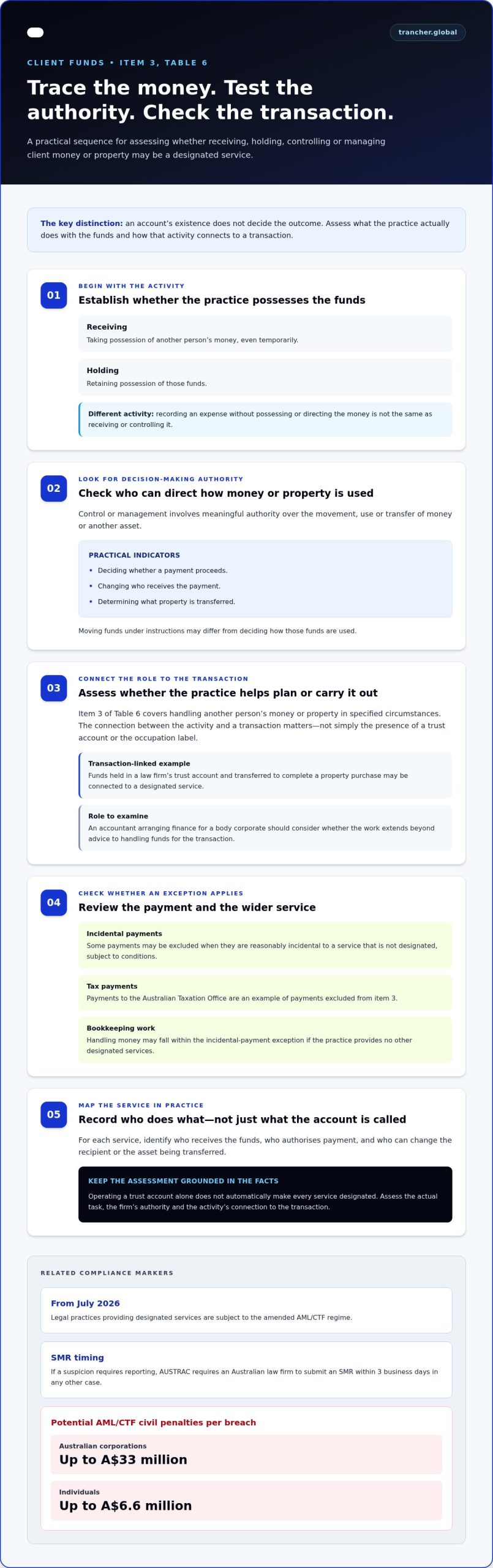
Misusing client money can have serious legal and professional consequences. For AML/CTF non-compliance, Australian corporations can face civil penalties of up to A$33 million per breach, and individuals up to A$6.6 million per breach.
Receiving and holding client funds
Receiving client funds means taking possession of money belonging to someone else, even temporarily. Holding those funds means retaining possession. The distinction matters because using a trust account for a transaction may involve holding client money as part of a designated service, while ordinary bookkeeping entries alone don’t mean the practice has taken control of client property.
For example, an accounting practice that receives a client’s money into its own account and pays the client’s expenses may be receiving and controlling those funds. By contrast, recording an expense without possessing or directing the money is a different activity. Assess what the practice actually does, not just how staff describe the task.
Controlling client property for transactions
Controlling or managing property means having meaningful authority over how money or another asset is transferred or used. This matters because whether holding client money is a designated service may depend on whether the firm helps plan or carry out a transaction, rather than simply documenting the client’s decisions.
A practical indicator is whether the firm decides if a payment proceeds, changes its recipient, or determines what property is transferred. For instance, directing settlement funds through a trust account as part of a property transaction may involve control, not just administration.
Item 3 covers receiving, holding, controlling or managing another person’s money or other property in specified circumstances. This property can include money, accounts, securities, virtual assets or other assets. A business’s role matters: moving funds under instructions may differ from deciding how those funds are used.
Consider a partner arranging a debt financing transaction. If the firm handles funds or assets to help carry it out, assess whether holding client money may be a designated service. The occupation label, such as “bookkeeping” or “legal work”, doesn’t settle the question. Focus on the actual task, the firm’s authority and its connection to the transaction.
Some payments may be excluded when reasonably incidental to a service that is not designated, subject to conditions. Tax payments to the Australian Taxation Office are an example of payments excluded from item 3. A bookkeeping practice’s handling of money may also fall within the incidental-payment exception if it provides no other designated services.
From July 2026, legal practices providing designated services are subject to the amended AML/CTF regime. Assess the service and how funds are handled, including whether decisions affect a payment or transfer. If a suspicion requires reporting, AUSTRAC requires an Australian law firm to submit an SMR within 3 business days in any other case.
When holding or managing client money is a designated service
Item 3 of Table 6 focuses on the activity performed, not simply the presence of a trust account. For legal and accounting practices, the connection between handling money and a transaction is central to the assessment.
Managing money in transactions
Managing money in a transaction means handling or directing client funds as part of carrying it out. A firm that decides whether a payment proceeds, or materially changes who gets paid, may be exercising control rather than providing clerical support.
For example, funds held in a law firm’s trust account and transferred to complete a real estate purchase may be connected to a designated service. An accountant arranging finance for a body corporate should also consider whether their role extends beyond advice to handling funds for the transaction.
Managing client money and property
Managing client money or property involves taking responsibility for its movement, use or transfer, rather than merely recording it. The arrangement matters because item 3 concerns receiving, holding, controlling or managing another person’s money or property in specified circumstances.
Map each service to the actions staff perform: who receives the funds, who authorises payment, and who can change the recipient or the asset being transferred. A partner who only explains a transaction’s financial implications has a different role from one who directs funds to complete it.
This distinction also helps clarify the purpose of the work. Advising on a possible transaction isn’t the same as helping plan or carry it out. For instance, tax advice about a possible company sale differs from managing money during an actual sale, although the facts and timing affect the assessment.
Managing client trust accounts
Managing a client trust account means administering funds held for clients, but operating the account alone is generally not a designated service. It matters whether the firm also performs a transaction-related activity covered by Table 6.
Compare routine account administration with using a trust account to move funds as part of a transaction. Letting a client use the account as a de facto bank account may also raise an item 3 issue. The account’s label does not settle whether the firm is providing a designated service.
Section 6(5C)(b) may exempt a practice whose only designated service is holding trust money for payments reasonably incidental to a non-designated service. The exception is assessed across the practice, so another designated service, such as conveyancing, can affect its application. A bookkeeping practice’s incidental handling of funds may qualify only where it provides no other designated services.
Keep the assessment tied to actual duties and service lines. This supports clear guidance for staff and helps identify activities that could expose the practice to money laundering or terrorism financing risks. A structured AML/CTF compliance workflow can help organise client checks, monitoring and reporting processes.
Record-keeping requirements
For Australian law firms, AML/CTF records must be retained for at least 7 years from the relevant record-keeping date. Australian practices must maintain transaction and customer due diligence records for seven years. These requirements make it important to connect the record to the designated service, the client and the transaction it supports.
A transaction file might involve a real estate purchase, financing arrangement or company restructuring. Organise the records so a reviewer can follow what the practice did, why funds moved and which customer checks related to the work. A clear link between the file and the transaction is more useful than a folder of disconnected documents.
Organise records around the service
Start by identifying each designated service the practice provides, then link its records to the relevant client and transaction. For example, a file involving a legal arrangement can connect customer due diligence material with the transaction documents. This structure helps staff distinguish regulated work from routine accounting entries.
Customer due diligence records should be retrievable alongside the related transaction records. If a practice assists with a company sale, staff should be able to find the relevant client file and transaction information without relying on one employee’s memory. Use consistent file names and access controls that suit the practice’s procedures.
Record-keeping does more than preserve documents. It helps the practice explain its actions and decisions if AUSTRAC reviews its compliance. For a payment involving a counterparty, for instance, a coherent record should let the practice trace the activity to the relevant service and client. Records should reflect what happened, not just provide an after-the-fact summary detached from the underlying file.
Make retention workable in daily operations
Assign responsibility for filing and retrieval, and use the same process across teams. A file checklist can help confirm that transaction and customer due diligence records are stored together. For a restructuring matter, staff can record the service type and link supporting material to the matter file.
Retention controls also need to account for the seven-year period. Set a clear retention start point based on the relevant record-keeping date, and keep applicable records accessible throughout that period. When the practice provides a designated service, don’t treat ordinary bookkeeping records as a substitute for AML/CTF records.
Consistent record-keeping helps staff identify gaps while a matter is active. If a file shows that funds were received but doesn’t clearly connect them to the transaction, staff can address the documentation promptly. A defined process also supports handovers, so another team member can understand the matter without reconstructing each step.
Build record retention into the practice’s written AML/CTF procedures. Specify how transaction and customer due diligence records are stored, who can retrieve them, and how each record is linked to the service provided. These practical controls help maintain audit-ready records without confusing general accounting files with evidence of regulated activity.
Receiving and holding client money
Receiving client money means taking possession of another person’s funds; holding it means retaining possession. For an Australian practice, the key question is how this activity connects to a designated service, not simply whether money enters an account.
Consider a corporate client arranging finance for an entity. If the practice receives funds and retains them pending a transaction step, document their purpose, who owns them and what authority the practice has. These details help distinguish transaction-related handling from ordinary accounting work that records payments without taking possession or control.
The same distinction applies when staff process a payment. Recording an invoice or entering a bookkeeping transaction doesn’t, by itself, mean the practice has received client property. Receiving funds into an account and then paying a supplier is different: the practice has taken possession and made a transfer. Assess the activity together with its connection to a designated service.
For legal services, item 3 of Table 6 covers receiving, holding, controlling or managing another person’s money or property in specified circumstances. A firm handling funds to help plan or execute a transaction should assess the whole role, including whether staff decide when funds move. The amount received alone does not establish whether the activity is designated.
Accounting practices should map each service line against the relevant definitions and qualifications. A practice that receives money to pay a client’s expenses performs a different function from one that records those expenses after payment. Whether an accounting service is designated also depends on geographical-link requirements and applicable exemptions. Assess the actual work rather than relying on a service label.
A trust account is not automatically a designated service simply because the practice operates it. The activity surrounding the account matters. A trust account used to hold or transfer money as part of a transaction requires a different assessment from account administration alone. Likewise, a client using a trust account as a de facto bank account can raise an item 3 issue.
Some payments may be excluded. Under paragraph 6(5C)(b), payments reasonably incidental to a non-designated service may qualify for an exception, provided the business offers no designated services other than item 3. Tax payments to the Australian Taxation Office are an example of payments excluded from item 3. The exception’s conditions matter across the practice, not just for one payment.
From 1 July 2026, specified professional services with the required geographical link to Australia can be designated services. Before a practice receives or retains funds, record the service purpose, the client, the transaction and the staff member’s authority. That assessment gives the practice a clearer basis for identifying designated activity and applying relevant AML/CTF processes.
The designated-services model under the AML/CTF regime
Australia’s AML/CTF regime defines the services that can bring a business within its scope. For legal practitioners, section 6(5B) of the Anti-Money Laundering and Counter-Terrorism Financing Act 2006 sets out nine professional services, commonly called Table 6 designated services. The rules for holding client money as a designated service turn on the activity performed and its circumstances.
What customer due diligence applies when a practice holds client money? Legal practitioners providing a designated service must identify and verify clients and beneficial owners before providing it. They must also have a risk-based AML/CTF program that assesses money laundering and terrorism financing risks.
The model focuses on what a business does, rather than its occupation or branding. A legal practice is not automatically regulated because it is a law firm, and a service can be covered even if it is not the practice’s main activity. Table 6 services must be provided in carrying on a business, but may also be provided pro bono.
For legal practitioners, the nine services include:
- Assisting a client to buy, sell or transfer real estate.
- Assisting with buying, selling or transferring an entity or legal arrangement.
- Receiving, holding, controlling or managing another person’s money or property in specified circumstances.
- Assisting with equity or debt financing transactions.
- Selling or transferring a shelf company.
- Assisting with creating or restructuring an entity or legal arrangement.
- Acting, or arranging for someone to act, as a director, trustee or partner.
- Acting, or arranging for someone to act, as a nominee shareholder.
- Providing an entity with a registered office or principal place of business address.
These categories can overlap in one matter. For example, assisting with a company transfer and arranging a nominee shareholder role may involve separate designated services. According to AUSTRAC, guidance on assisting with transaction planning or execution applies to items 1-4 and 6. Assess the actual work and connected activities instead of relying on a broad matter label.
For an accountant, mapping services can clarify where AML/CTF obligations may arise. Pure advice about a possible transaction differs from help with planning or carrying out an actual transaction. The same practical assessment applies to holding client money as a designated service: identify the service, the work performed and its connection to the transaction.
Once a business provides a designated service, AML/CTF obligations apply to that activity. Customer due diligence is one part of the framework; the risk-based program must also reflect the business’s services and risks. A legal practice should identify which staff perform each service and how client and beneficial-owner verification fits in before work begins.
Use a service map to connect each designated service with client checks and risk controls. For structured client verification and due diligence, align verification steps with the services your practice provides.
Trancher: End-to-End AML/CTF Program Management
Trancher helps Australian accounting firms turn designated-service assessments into workable AML/CTF processes. If your practice handles client funds or supports transactions, Trancher’s end-to-end AML/CTF program management brings key compliance activities together.
Support includes Client Verification & Due Diligence (KYC/CDD + Screening), Ongoing Risk Monitoring & Client Activity Tracking, and Regulatory & Suspicious Matter Reporting. These capabilities help organise customer checks, monitor activity and manage reporting as part of your compliance operations.
Consider Trancher when you’re turning your service assessment into consistent processes for staff, clients and records. The system helps make ongoing obligations easier to manage while keeping attention on the work your practice performs.
Visit trancher.global to learn more or contact Trancher to discuss your AML/CTF needs.
Make your next compliance decision deliberate
Your next step is to turn the service assessment into a clear operational decision. Consider how your team’s work may change as transactions, client instructions and internal responsibilities evolve. A documented approach can help staff recognise when their role shifts from recording activity to handling or directing client property.
A sound assessment of holding client money as a designated service connects the work performed with the controls your practice uses. This gives your team a practical reference for consistent decisions, clear handovers and ongoing review as services change.
Trancher can help you consider how AML/CTF processes fit your practice’s operations. Contact Trancher to discuss your obligations and explore a suitable next step for your compliance approach.
With a thoughtful process in place, your team can approach its responsibilities with greater clarity and confidence.
Frequently Asked Questions
Anti-money laundering: what is a “Designated Service” for accountants, and what isn’t?
A designated service is an activity listed in Australia’s AML/CTF legislation, assessed by what the accounting practice actually does. Examples include assisting with a transaction to transfer real estate or a body corporate, creating an entity, arranging specified roles, or providing a registered office. Pure advisory work, tax return preparation, audit and bookkeeping are generally unlikely to be designated services. The practice’s service mix and the details of each engagement matter.
Is holding client money a designated service under the AML/CTF Act?
It can be: whether holding client money is a designated service depends on the circumstances and its connection to the work. For instance, receiving funds into a practice account and paying a client’s expenses may involve receiving and controlling their money. Operating a trust account alone is generally not enough. A bookkeeping practice’s incidental handling of funds may fall within an exception if it provides no other designated services.
What records and reporting must businesses keep for client money in Australia?
Relevant AML/CTF transaction and customer due diligence records must be kept for seven years. Reporting can include suspicious matter reports, threshold transaction reports and annual compliance reporting, depending on the activity and entity. SMR deadlines vary: terrorism financing suspicions have a shorter deadline, while other cases have different timeframes. AUSTRAC states that an Australian law firm must submit an SMR within 3 business days in any other case.
How should a business set up and reconcile a client money trust account?
Use a client-by-client ledger to record each receipt, payment, date, reference and authorisation. For each reconciliation, compare the ledger’s opening balance, receipts and payments with the account statement, then investigate unmatched items and document how they were resolved. Keep supporting transaction records together for retrieval. Follow the professional trust-accounting requirements that apply to your practice, as AML/CTF record-keeping doesn’t replace those separate duties.