
A name on a company register may not reveal who ultimately owns or controls a customer. In Australia, beneficial ownership CDD means identifying and verifying relevant customer and beneficial-owner information as part of initial customer due diligence; the initial requirements are set out in sections 28 and 136-141 of the Act.
CDD can become challenging when a legal structure spans multiple entities or ownership and control are divided. The practical task is to identify the relevant people, understand how they own or control the customer, and keep a clear record that supports a consistent risk assessment.
This guide explains who qualifies as a beneficial owner, what institutions collect and record, and when they re-verify that information. It also outlines how the EU AML Regulation approaches customer and beneficial-owner checks, including its general application from 10 July 2027. You’ll see how to distinguish Australian requirements from EU rules and build a more reliable approach to ongoing due diligence.
Key Takeaways
- Look beyond the immediate customer to understand who ultimately owns or controls the entity, including through indirect structures.
- Revisit ownership information when new facts call its reliability into question, and keep the customer’s confirmation and your decision-making record together.
- Keep initial CDD records for 7 years following the end of the business relationship or after the date of the last occasional transaction.
- Separate Australian obligations from overseas rules: the EU AML Regulation generally applies from 10 July 2027.
- Build ownership checks into a consistent process for collecting information, assessing risk and maintaining clear records.
When institutions must re-verify beneficial ownership
Australian initial CDD requirements appear in sections 28 and 136-141 of the Act. Re-verification depends on the customer relationship, the information available and any facts that challenge its reliability.
Triggers for Re-verifying Ownership
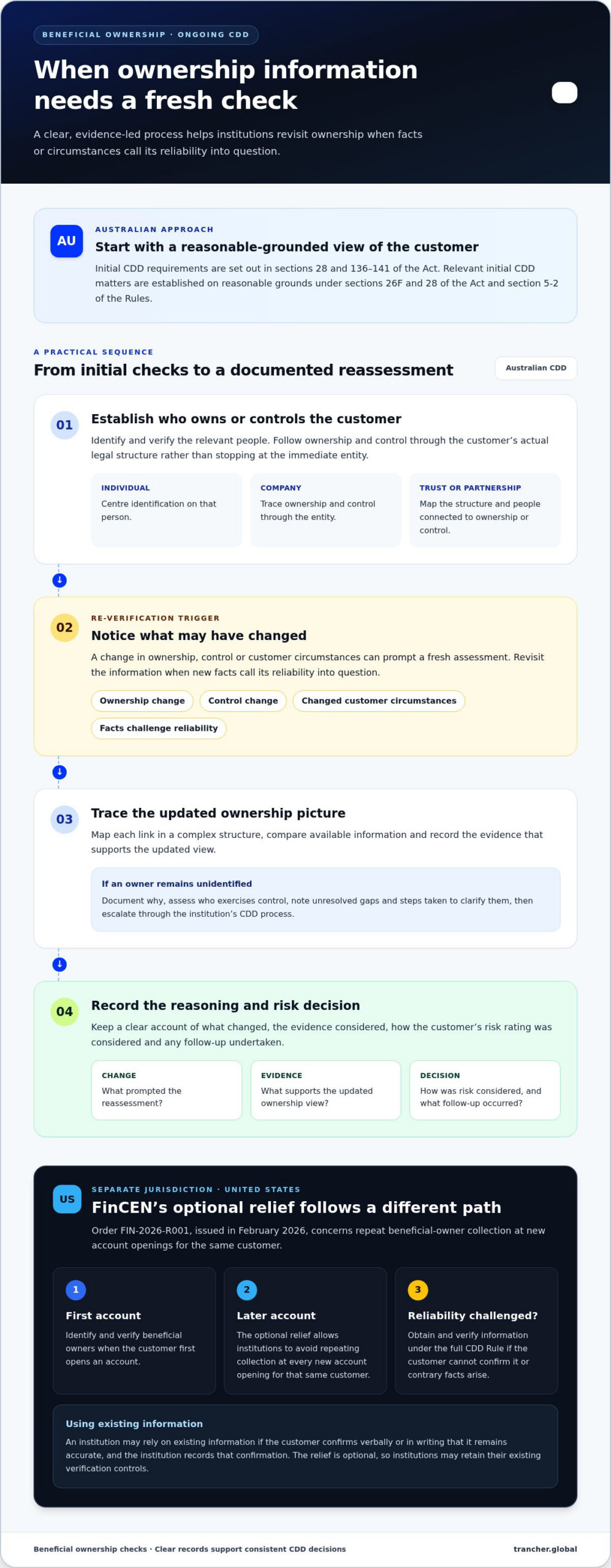
Re-verification means repeating identification and checks when ownership information may no longer be reliable. A change in ownership, control or customer circumstances can prompt a fresh assessment. Under the Australian approach, institutions establish relevant initial CDD matters on reasonable grounds, as set out in sections 26F and 28 of the Act and section 5-2 of the Rules. Record what changed, what evidence supports the updated ownership picture, and how the customer’s risk rating was considered.
Verification Requirements and Relief
CDD identification and verification checks establish who the customer is and who ultimately owns or controls a legal entity. In the United States, FinCEN order FIN-2026-R001, issued in February 2026, allows institutions to avoid repeating beneficial-owner collection at every new account opening for the same customer. They must identify and verify owners when the customer first opens an account, then revisit the information if known facts reasonably call its reliability into question.
For ongoing US due diligence, an institution may rely on existing information if the customer confirms verbally or in writing that it remains accurate and the institution records that confirmation. If the customer cannot confirm it, or contrary facts arise, the institution must obtain and verify the information under the full CDD Rule requirements. This relief is optional, so US institutions may retain their existing verification controls.
Different Customer Structures
In Australia, the customer’s legal structure shapes which people and ownership links need attention. For an individual, customer identification centres on that person; for a company, the assessment follows ownership and control through the entity. For a trust or partnership, map the relevant structure and the people connected to its ownership or control, then document the basis for identifying them. The Act’s section 28 and Part 6 of the Rules address initial CDD for different customer types.
These distinctions matter because a company register may not reveal indirect ownership, while trusts and partnerships can involve different relationships. The objective is consistent: establish the relevant CDD matters on reasonable grounds and retain a clear account of how the structure was assessed.
Complex Structures and Unidentified Owners
A complex structure requires tracing ownership and control through each entity until the people behind it can be assessed. Map each link, compare the available information, and record any unresolved gaps and steps taken to clarify them. If you cannot identify a beneficial owner, document why, assess who exercises control, and escalate the issue through the institution’s CDD process rather than treating the search as complete.
Inadequate checks can leave an institution unable to support its customer identification, risk rating or ongoing monitoring decisions. They can also create regulatory and record-keeping exposure. The specific penalty depends on the circumstances. A reliable file should show the information considered, the reasoning applied and any follow-up undertaken.
Who counts as a beneficial owner?
A beneficial owner is an individual who ultimately owns or controls an entity, directly or indirectly. Identifying that person helps institutions understand who sits behind a customer and assess the relationship under applicable CDD requirements.
Meaning of Beneficial Ownership
In Australian customer due diligence, the task is to establish the relevant ownership and control of the customer, then identify and verify the individuals involved. For a company, that can mean tracing ownership through other entities rather than stopping at the first shareholder. The information an institution needs to establish may vary with the customer and its structure.
Ownership and control are not always the same. Someone may hold an interest through an intermediary, while another person directs decisions without appearing as a direct owner. For example, if Company A owns shares in Company B, trace the ownership chain to understand which individuals ultimately hold or exercise control. A customer certification can provide information about the structure, but the institution still needs a sound basis for its assessment.
Apply Australian requirements to the customer’s actual structure. Don’t assume a definition used in another jurisdiction automatically determines who counts in an Australian CDD assessment. Document how the institution identified the relevant people and understood their connection to the entity.
Ownership Thresholds
An ownership threshold is a percentage used in some rules to identify people whose shareholding makes them beneficial owners. The threshold depends on the jurisdiction and the rule being applied, so don’t treat an overseas figure as an Australian standard.
For comparison, the US banking beneficial-ownership rule uses a 25% ownership threshold. The US FinCEN CDD Rule also includes one individual with significant responsibility to control, manage or direct the legal entity. Separately, Article 52 of the EU AML Regulation treats direct or indirect ownership of 25% or more of shares, voting rights or another ownership interest as beneficial ownership. These are jurisdiction-specific examples, not interchangeable Australian tests.
For an Australian customer, assess ownership alongside control and customer type under the applicable Act and Rules. A shareholding percentage may help explain an ownership chain, but it does not capture every way a person may influence an entity. Record how the institution reached its conclusion, including the ownership links considered and any relevant control factors.
Clear, consistent checks make those decisions easier to evidence across customer files. Where ownership information needs to be collected and assessed systematically, client verification and due diligence can support a structured CDD process.
Beneficial ownership certification and records
Australian businesses must keep initial CDD records for 7 years following the end of the business relationship or after the date of the last occasional transaction. Those records should let someone understand what ownership information was collected, how it was assessed and what decisions followed.
For beneficial ownership CDD, document the customer’s ownership structure, the individuals identified and the evidence supporting the assessment. A certification can record information provided by the customer or an authorised representative, but the file should also show how the business assessed it. This creates a clear trail from customer-provided details to the resulting CDD decision.
A useful record connects each person to the legal entity customer. Note whether the person is a direct owner, sits behind an intermediate company or exercises control another way. Record the documents or information considered, the assessment date and any inconsistency requiring follow-up. Don’t store a conclusion without the reasoning behind it.
Ongoing monitoring adds context to the initial assessment. If a customer reports a change in ownership, document what changed, when the business became aware and how the updated information affected the customer’s risk rating. If activity raises concerns about possible money laundering, preserve the relevant review and decision records in line with the applicable reporting process.
For a foreign entity, retain the available ownership information and a concise explanation of how the structure was understood. If documents use different names or describe different ownership links, record the discrepancy and steps taken to resolve it. Reviewers should be able to distinguish verified details from customer statements and unresolved questions.
What record-keeping requirements apply to beneficial ownership checks in Australia? Initial CDD records must be kept for 7 years following the end of the business relationship or after the date of the last occasional transaction. Keep the records organised so the ownership assessment and its supporting material can be retrieved together.
For comparison, US financial institutions must retain beneficial ownership records for five years. That US period is separate from Australia’s initial CDD retention requirement, so legal entity customers operating across borders may need distinct record-keeping controls for each applicable jurisdiction.
A practical file brings the evidence and decision together: customer certification, ownership documents, the ownership map, verification notes and the risk assessment rationale. Use consistent naming and filing so staff can find the record during an ongoing review. Clear documentation helps the business monitor changes without relying on memory or scattered correspondence.
Beneficial ownership information collected by financial institutions
Customer due diligence gathers information that helps an institution understand the customer and the people behind an entity. In Australia, requirements for collecting and verifying KYC information refer to sections 28 and 41 of the Act and section 6-10 of the Rules.
Information for AML Programmes
Within an AML programme, ownership information helps an institution understand a customer’s structure and risk. For a company owned through another company, record each entity in the chain and how it connects to the customer. This gives staff a practical basis for customer due diligence and risk assessment, ongoing monitoring and decisions about activity that appears suspicious or may relate to money laundering.
Keep customer statements distinct from information assessed independently. For example, identify an ownership document as evidence, then note how its details compare with the customer’s explanation. A structured record also helps staff see which ownership details inform the customer profile, rather than treating every document as equally relevant.
Details Required About Owners
The information required depends on the jurisdiction and the applicable CDD process. For Australian KYC collection and verification, sections 28 and 41 of the Act and section 6-10 of the Rules are relevant. In practical file design, connect each identified individual to the customer, describe the ownership or control link, and record what information supports that assessment.
Distinguish a direct shareholder from an individual whose interest runs through an intermediate entity. Capture the evidence considered and any material differences between documents and customer-provided details. This helps an institution explain how it understood the structure, rather than keeping a list of names without context.
Account opening is when financial institutions gather customer and ownership information for CDD. That information should present the legal entity and its relevant owners as a connected profile. In the United States, FinCEN’s CDD Rule requires covered financial institutions to identify and verify customers’ identities, understand the nature and purpose of customer relationships, and develop customer risk profiles. Those US requirements should not replace Australian requirements.
Company applicant information is a separate concept from beneficial-owner information. Under the US Corporate Transparency Act, reporting companies formed on or after January 1, 2024, were subject to company applicant information requirements. That distinction matters: an applicant involved in forming a company is not automatically the person who ultimately owns or controls it.
For CTA reports, beneficial owners may provide one of four specified forms of identification, together with an image of the identification document. This is a US reporting requirement, not an Australian CDD field list. Australian institutions should organise collected information around applicable Australian requirements and the customer’s structure, keeping the ownership map, supporting material and assessment linked in the file.
What is beneficial ownership under Australian AML/CTF customer due diligence rules?
In Australian AML/CTF customer due diligence, beneficial ownership analysis looks beyond the named customer to the individuals connected with its ownership or control. The practical aim is to understand who stands behind a customer, rather than treating a company name as the complete picture. Initial CDD requirements are set out in sections 28 and 136-141 of the Act.
There isn’t one ownership percentage in the available Australian requirements that determines every beneficial-owner assessment. Instead, the business must establish relevant initial CDD matters on reasonable grounds, as set out in sections 26F and 28 of the Act and section 5-2 of the Rules. This makes the customer’s structure and the evidence available central to the assessment.
For a company, consider the ownership chain and the individuals connected to it. If another company holds shares, trace the relationship through that entity and record how the assessment reached the individuals behind the structure. For a trust or partnership, assess the customer according to its structure and relevant relationships. Initial CDD guidance for different customer types refers to section 28 of the Act and Part 6 of the Rules.
Collection and verification are related, but distinct, parts of the process. Sections 28 and 41 of the Act and section 6-10 of the Rules are relevant to collecting and verifying KYC information. In practice, keep the customer’s details, ownership information and supporting material connected, so the file shows how the institution formed its view. A register entry may help explain a company’s structure, but should be considered alongside other relevant information.
The rules also recognise different CDD circumstances. Simplified CDD requirements refer to section 31 of the Act and section 6-16 of the Rules. Nested services relationships are addressed in section 6-25 of the Rules. These references show why a single ownership checklist may not suit every customer or relationship. Apply the relevant requirements to the customer type and circumstances, and document the reasoning behind the assessment.
For a clear operational approach, align ownership checks with customer verification and ongoing review. A useful file records the structure considered, the individuals identified, the basis for the conclusion and any unresolved issues. Strengthen your customer due diligence process by connecting verification and monitoring records to the customer assessment.
Trancher: End-to-End AML/CTF Program Management
Trancher provides end-to-end AML/CTF programme management to help Australian businesses organise customer due diligence and ongoing compliance work. Client verification and due diligence support KYC/CDD and screening, while ongoing risk monitoring helps businesses track client activity.
Turn to Trancher when ownership checks need to sit within a consistent programme, from verifying customer information to monitoring changes and managing relevant reporting. Support for regulatory and suspicious matter reporting also helps keep connected compliance activities organised.
For support with your AML/CTF processes, contact Trancher or visit trancher.global.
Make ownership checks part of a stronger compliance process
A well-designed beneficial ownership CDD process makes understanding customer risk a practical part of business, rather than a separate administrative task. The next step is to connect ownership assessments with the wider AML/CTF programme, keeping customer information, review decisions and changing risk aligned as relationships develop.
Trancher offers End-to-End AML/CTF Program Management, Client Verification & Due Diligence (KYC/CDD + Screening), and Ongoing Risk Monitoring & Client Activity Tracking. These capabilities support a consistent process, from initial checks to ongoing reviews of customer activity.
Identify where your current process creates extra work, such as repeated data entry, disconnected records or ownership changes that are difficult to track. A connected workflow can help teams follow procedures consistently and maintain useful records for review.
Contact Trancher about CDD to discuss a more organised approach to customer due diligence. With clear processes and the right operational support, your team can move forward with confidence.
Frequently Asked Questions
What Is Customer Due Diligence (CDD)?
Customer due diligence is the process of understanding who a customer is and assessing the risks of the relationship. In practice, an Australian business gathers customer information, verifies identity and considers the relationship’s purpose. For a company customer, the assessment also considers its ownership and control structure. The resulting information helps staff apply appropriate checks and make decisions using a consistent customer profile.
What is a UBO?
A UBO, or ultimate beneficial owner, is the individual who ultimately owns or controls a customer, even if another person or company appears in the direct ownership chain. For example, someone may hold an interest through a holding company rather than in their own name. The term highlights why an entity’s immediate shareholder may not be the end of the enquiry: the relevant individual may sit further along the structure.
Why is the 25 percent threshold used?
A 25% threshold provides a defined ownership point in some regimes, helping institutions identify individuals whose shareholding may be relevant to a CDD assessment. It is not a universal rule: the US banking beneficial-ownership rule uses 25%, and Article 52 of the EU AML Regulation also specifies 25% or more. A percentage alone may not reveal who exercises control, so assess the applicable jurisdiction’s rules and the full ownership picture.
How must Australian reporting entities identify and verify a customer’s beneficial owners?
Australian reporting entities must establish relevant initial CDD matters on reasonable grounds, using the customer’s structure and available information. For a company, trace ownership through intermediate entities and assess how individuals may own or control it. Compare customer-provided details with relevant supporting material, resolve inconsistencies where possible, and keep a record of the reasoning. Australian initial CDD requirements include sections 26F and 28 of the Act and section 5-2 of the Rules.
What ownership or control threshold defines a beneficial owner in Australia?
Do not treat 25% as a universal Australian beneficial-owner threshold. The Australian initial CDD framework requires relevant matters to be established on reasonable grounds, so consider the customer’s ownership structure and how individuals exercise control. A percentage can help describe an ownership interest, but it may not explain indirect interests or decision-making authority. Record why the people identified are relevant to the particular customer and assessment.
What information and documents are required for beneficial ownership CDD in Australia?
Gather enough information to understand the customer’s ownership and control, then retain material that supports the assessment. Depending on the customer, this may include an ownership chart, company or trust documents, customer-provided details and identity information for relevant individuals. Note the source of each detail and how it connects to the customer. If documents conflict, record the discrepancy and how staff considered it rather than leaving unexplained differences in the file.
When must beneficial ownership checks be completed and updated under Australian AML/CTF rules?
Complete beneficial-owner checks during the initial CDD assessment, then revisit the information when a change or inconsistency affects the ownership picture. A newly disclosed shareholder or changed control arrangement, for example, may require reassessment. Follow-up timing and scope depend on the customer information and risk assessment. Keep the basis for each update with the customer record so later reviews can follow the decision history.