
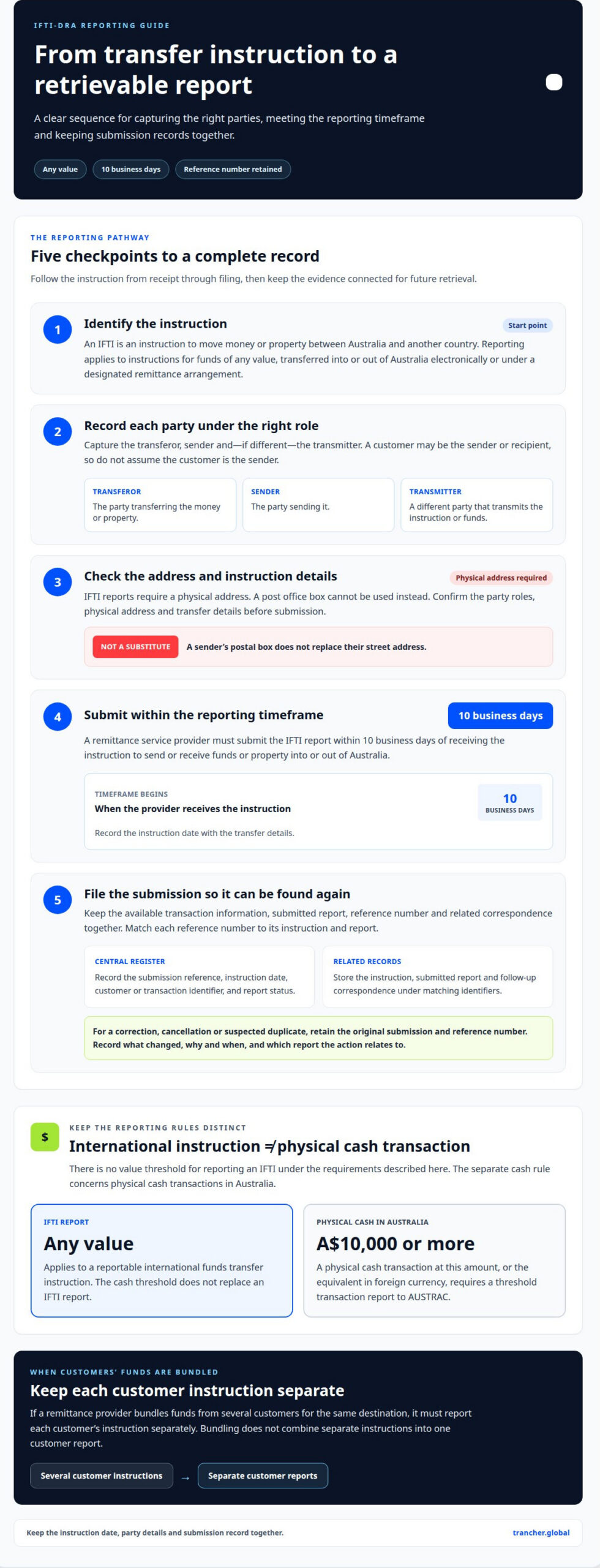
An IFTI-DRA report must identify the transferor, the sender and, if different, the transmitter. It must include a physical address, not a post office box. For IFTI reporting to AUSTRAC, getting these core details right is essential to preparing a complete report.
It’s understandable to focus on the information each submission requires and how to retrieve it later. This reference covers key report details, practical ways to store submitted reports and reference numbers, and how automation can help identify transfers and flag missing data. It provides a clearer path from transfer instruction to report, with records organised for timely retrieval.
Key Takeaways
- Build IFTI-DRA reports around the transferor, sender and, where different, transmitter, and include a physical address rather than a post office box.
- Keep submitted reports and their reference numbers organised together so you can retrieve records and respond to information requests efficiently.
- Use automation to identify potentially reportable transfers, prepopulate available details and flag missing information for review.
- Distinguish international transfer instructions from physical cash movements; AUSTRAC requires a threshold transaction report for physical cash transactions of A$10,000 or more, or the equivalent in foreign currency.
- Clarify which transfer activities and business types fall within reporting requirements, then align your processes with the obligations that apply to your operations.
Information required in IFTI-DRA reports
An international funds transfer instruction, or IFTI, is an instruction to move money or property between Australia and another country. An IFTI-DRA report records an instruction handled under a designated remittance arrangement. For each report, capture the transferor, sender and, if different, transmitter. These roles identify the parties involved in arranging and sending the transfer.
A transferor is the party transferring the money or property. The sender is the party sending it, while the transmitter is a different party that transmits the instruction or funds. A customer may be the sender or the recipient. Record each party’s details under the correct role, rather than assuming the customer is the sender.
IFTI reports require physical addresses; a post office box cannot be used instead. Check the address field before submission and enter the person’s or entity’s physical address. For example, a sender’s postal box does not replace their street address. A completeness check should also confirm that the transferor, sender and any separate transmitter are identified.
IFTI reports and suspicious matter reports serve different purposes. An IFTI report concerns an international transfer instruction, while a suspicious matter report concerns grounds to suspect a person or transaction is linked to crime, or that someone is not who they claim to be. “International funds transfer report” is often used broadly to mean an IFTI report, rather than a separate report type.
Reporting entities must report instructions for funds of any value transferred into or out of Australia, electronically or under a designated remittance arrangement. The customer may be the sender or recipient. If a remittance provider bundles funds from several customers for the same destination, it must report each customer’s instruction separately. Bundling does not combine separate instructions into one customer report.
For an IFTI, a remittance service provider must submit the report within 10 business days of receiving an instruction to send or receive funds or property into or out of Australia. The period starts when the provider receives the instruction, so record that date with the transfer details. Existing reporting entities continue IFTI reporting until their IVTS reporting transition date.
There is no value threshold for reporting an IFTI under the current requirements described here. A separate cash-reporting rule applies: in Australia, a transaction involving physical cash of AUD 10,000 or more, or the equivalent value in foreign currency, requires a threshold transaction report to AUSTRAC. That cash threshold does not replace an IFTI report for an international instruction.
A body corporate that fails to submit an IFTI report may face a penalty of up to 100,000 penalty units. AUSTRAC may also take enforcement action, including seeking a penalty, for reporting failures or other non-compliance. An organisation should therefore keep the instruction date, party details and submission record together.
Reporting entities submit IFTI reports through an AUSTRAC Online account. Reports can be entered manually, which AUSTRAC identifies as the best method when submitting few reports. Before submitting, check the party roles, physical address and instruction details. Afterwards, retain the report and its reference number so you can retrieve the filing if AUSTRAC requests further information.
Storing submitted reports and reference numbers
An IFTI record is the saved evidence of the instruction, report and submission outcome. Organise records so staff can promptly retrieve requested information and link each report to its reference number.
Records for submitted reports
IFTI reporting records document the instruction, report and submission details. Keep available transaction information, the submitted report, its reference number and any related correspondence together. A useful record also identifies the relevant customer and transfer, helping staff trace the submission without relying on memory. AUSTRAC may request further information about an IFTI report, so organise files for timely retrieval.
Reference numbers and record matching
A reference number identifies a submitted report. Record it alongside the corresponding instruction and report, rather than in a separate, unlinked list. For example, an index can match the customer or transaction reference to the AUSTRAC submission number and submission date. Use consistent labels so another staff member can locate the correct report if the original submitter is unavailable.
Corrected, cancelled and duplicate reports
A corrected report changes information in an earlier submission; a duplicate repeats a submission already made. When documenting a correction, cancellation or suspected duplicate, keep the original submission and its reference number. Record what changed, why and when, and which report the action relates to. Use AUSTRAC Online’s available process for the relevant action, and retain any resulting confirmation with the related records.
Building a retrieval process
A retrieval process is a repeatable method for locating a report and its supporting records. Start with a central register that records the submission reference, instruction date, customer or transaction identifier, and report status. Store the report and related documents under matching identifiers. For example, searching a transaction reference should lead staff to the instruction record, submitted report and follow-up correspondence.
Access, review and consistent storage
Consistent storage means using the same naming and filing approach across reports. Assign responsibility for updating the register after submission, and periodically check for missing references or mismatched files. Restrict access to staff who need records for compliance work, and use your organisation’s approved storage controls. These steps support reliable retrieval and reduce the risk of confusing one customer’s report with another.
For a more structured approach to audit-ready documentation and record keeping, connect each report to its supporting compliance records and review trail.
Remittance service providers need record-keeping practices that let them provide requested information promptly. Make retrieval straightforward, including for staff who did not prepare the original submission. Keep filing conventions clear and consistent, and ensure the register points to supporting material rather than merely noting that it exists. When records are updated, check that the related report and reference remain connected and that the register shows the current status. Routine checks can help staff respond efficiently to requests and reduce the chance of overlooking relevant instructions, reports or correspondence.
Prepopulating reports and identifying missing data
Prepopulation transfers existing customer and transaction details into report fields before submission. It can reduce repeated data entry, but source records still need to be checked. Match each international transfer instruction to its customer and transaction record, then map verified details to the corresponding report fields. Keep the original source available for review.
Field mapping connects a data source to the matching report field. For an IFTI-DRA report, map details for the transferor, sender and, where different, transmitter. Treat these roles separately, even when one person has more than one role. A review screen can show each role alongside its source record, making incorrect assignments easier to spot.
Validation checks that required information is present and usable before submission. For example, flag a blank physical address or one entered only as a post office box. A missing-data alert should identify the specific field and linked transfer, rather than simply mark the report incomplete. Staff can then correct the source record or resolve the gap before preparing the report.
Source checking compares prefilled values with the records they came from. Confirm names, addresses and party roles against the relevant customer and transfer information. Avoid guessing to fill a blank field or copying details from a similar customer. If records conflict, pause the report for review and record which source informed the final entry.
Duplicate detection checks for repeated records or submissions relating to the same instruction. Before creating another report, compare available identifiers such as the customer, transaction and instruction details. This matters when funds from several customers are bundled for the same destination: each customer’s instruction requires its own IFTI report. A matching destination alone is not a reason to merge separate customer instructions.
A review queue lists reports awaiting human attention because information is missing, inconsistent or unusual. Sort alerts by issue, such as an absent transmitter or address mismatch. Assign each item to a staff member, record the resolution, then rerun the checks. This creates a clear path from detected gap to corrected report data.
Keep automation within a controlled reporting workflow. A person should review populated fields and resolve alerts before submission through AUSTRAC Online. Record any manual change and its source so later reviewers can understand why a value differs from the original record. This makes the process more traceable, but does not replace checking the underlying transfer information.
What is an IFTI under AUSTRAC rules?
An international funds transfer instruction, or IFTI, is an instruction to transfer money or property between Australia and another country. It may relate to funds sent from or received into Australia. For example, a customer may instruct a remittance provider to send money overseas or arrange to receive funds from another country.
An IFTI-E is an international funds transfer instruction carried out or passed on electronically. Under the current IFTI regime, IFTI-E reports apply to electronic funds transfers sent to or received from another country by financial institutions. The focus is the instruction and its cross-border movement, not whether the customer physically handles cash.
An IFTI-DRA is an international funds transfer instruction involving a designated remittance arrangement. It can arise when an entity accepts a customer’s instruction under that arrangement. The customer may be the sender or recipient, so identify their role in the particular transfer. A sender’s instruction to transfer funds overseas and a recipient’s arrangement to collect funds in Australia illustrate different customer roles.
The applicable reporting category depends on how the instruction is handled and the entity involved. Current IFTI-DRA reports apply to transfers of money or property by businesses that are not financial institutions, including remittance service providers and casinos. Current IFTI-E reports concern electronic transfers by financial institutions. These categories distinguish the reporting context without changing the instruction’s cross-border nature.
The current IFTI reporting provisions are provisions of the AML/CTF Act as in force immediately before 31 March 2026. Part 3, Division 4 (sections 45 and 46) of that Act continues to apply until an entity’s IVTS reporting transition date. For existing reporting entities, IFTI reporting continues until AUSTRAC provides regulatory clarity on IVTS reporting requirements and timelines.
IVTS means international value transfer services under Australia’s replacement reporting regime. The AML/CTF Amendment Act 2024 introduces the IVTS reporting regime to replace IFTI reporting. IVTS covers transfers of value that can include money, virtual assets or property. Its scope can include a business accepting an international value-transfer instruction on behalf of a payer in Australia, or making value from an international transfer available to a payee in Australia.
Virtual asset service providers can fall within the IVTS regime when they exchange, transfer, safeguard or administer virtual assets and handle international value transfers. The distinction depends on the service and cross-border transfer activity, not simply on whether a business uses digital assets. Map each service to the relevant instruction and reporting transition date to understand which regime applies to the entity.
Who must report international funds transfer instructions to AUSTRAC?
Responsibility mapping is an internal record showing which business function handles each relevant service. List the transfer-related services your organisation performs, then assign an accountable team or role to each. This gives staff a practical route for escalating unusual instructions, process changes and questions about reporting ownership.
A service inventory describes the activities and channels a business uses. Record how customers initiate instructions, which teams process them and where transaction information is captured. Compare the inventory with current procedures to reveal gaps, such as a transfer pathway handled by operations but missing from compliance review.
Business structure can affect how teams coordinate responsibilities. Document which entity or business unit performs each relevant activity, who oversees its process and where its records are kept. If several teams support one service, identify the hand-off points. This helps trace a reporting decision through the organisation without confusing operational ownership with customer-facing responsibilities.
Channel mapping records the different ways an instruction can enter or move through a business. For example, compare instructions received through a digital workflow with those handled by staff. The aim is to identify where relevant information originates and who can resolve a discrepancy. Keep the map current when a product, customer journey or internal process changes.
Responsibility controls help staff recognise when an activity needs compliance attention. Set up a practical escalation path that records the issue, the team notified and the decision made. Keep it aligned with internal reporting procedures so frontline staff know where to direct a query instead of making an unsupported assumption about the correct classification.
Review operational changes before revised processes become routine. A new payment route, customer segment or service arrangement can affect how instructions are handled. Record the change, identify affected teams and check whether existing procedures still describe the activity accurately. This gives compliance and operations a shared basis for assessing reporting responsibilities.
For IFTI reporting to AUSTRAC, a clear responsibility map helps connect service design with internal oversight. Review it alongside your client activity and compliance workflows, using workflow tools for compliance activity where they support consistent coordination.
Under Australia’s new IVTS regime, businesses will be required to submit reports to AUSTRAC within ten business days of the transfer instruction being sent or received. Build this timing into the responsibility map: identify which team tracks when an instruction is sent or received, coordinates the report and confirms submission. Review hand-offs that could leave ownership unclear, and record escalation and completion so the process can be followed internally.
In Australia, everyone, including reporting entities, must report cross-border movements of physical currency. Keep this obligation visible when assigning responsibilities. A transfer-instruction workflow alone does not identify who handles reporting of physical currency movements. Give staff a route for raising questions and directing them to the relevant internal process. Revisit ownership when channels or business arrangements change, so staff know who is responsible for each activity and where to escalate uncertainty.
Trancher: End-to-End AML/CTF Program Management
Trancher helps Australian businesses organise AML/CTF compliance, from client checks to reporting workflows. For teams handling cross-border transfers, its end-to-end program management platform can connect customer due diligence, ongoing activity monitoring and regulatory reporting.
Client Verification & Due Diligence (KYC/CDD + Screening) supports consistent client checks, while Ongoing Risk Monitoring & Client Activity Tracking helps review activity over time. Regulatory & Suspicious Matter Reporting supports reporting processes, bringing these activities into a coordinated compliance approach.
Consider Trancher when reporting responsibilities, customer records and activity reviews need a more structured workflow. Contact Trancher to discuss your compliance needs, or visit trancher.global.
Make your reporting workflow ready for what’s next
IFTI reporting to AUSTRAC is an opportunity to build a connected compliance process, not just complete a submission. When reviewing your workflow, consider how customer information, transfer activity and reporting decisions move between teams. Clear ownership and consistent records can make the process easier to manage as obligations evolve.
Trancher provides end-to-end AML/CTF program management, including client verification and due diligence, ongoing risk monitoring and client activity tracking. These capabilities help bring related compliance activities into a coordinated workflow.
Take the next step at a pace that suits your organisation. Contact Trancher to discuss IFTI reporting and consider how your current processes can support confident, well-organised compliance.
Frequently Asked Questions
What information must an IFTI report include?
An IFTI report generally needs to identify the parties involved in the transfer and include a physical address. Depending on the report type, it may also include transaction dates, amount and currency, an instruction identification code, information the payer gave the payee, and information one financial institution gave another. Before submitting an electronic transfer report, for example, match transaction and instruction details to the relevant parties and transfer records.