
Effective client due diligence starts before a designated service is provided. From 1 July 2026, Tranche 2 AML/CTF obligations apply to certain services provided by Australian legal professionals, so a practical Tranche 2 AML checklist for lawyers needs to connect the work being performed with the client, beneficial owners and risk involved.
It’s understandable to want a clear process: client checks involve more than collecting identity documents, particularly when companies or trusts make ownership harder to trace. The goal is to understand who the client is, who benefits from the arrangement and whether the relationship or transaction raises concerns.
This guide explains how to identify services that may trigger obligations, conduct customer due diligence and review companies, beneficial ownership and trusts. It also covers behaviour that may warrant closer attention, so you can organise checks and monitoring into a practical workflow for your firm.
Key Takeaways
- Map the legal services your firm provides to identify which may trigger Tranche 2 AML/CTF obligations.
- Build client due diligence around identity, beneficial ownership and the purpose of the service, not just document collection.
- Review company and trust structures to understand who ultimately owns, controls or benefits from them.
- Set a clear internal escalation process so concerning behaviour can be assessed and suspicious matters reported within applicable timeframes.
- Use a consistent approach to verification, screening and ongoing monitoring to make client checks more manageable.
What are the common red flags that law firms should watch for in client behaviour?
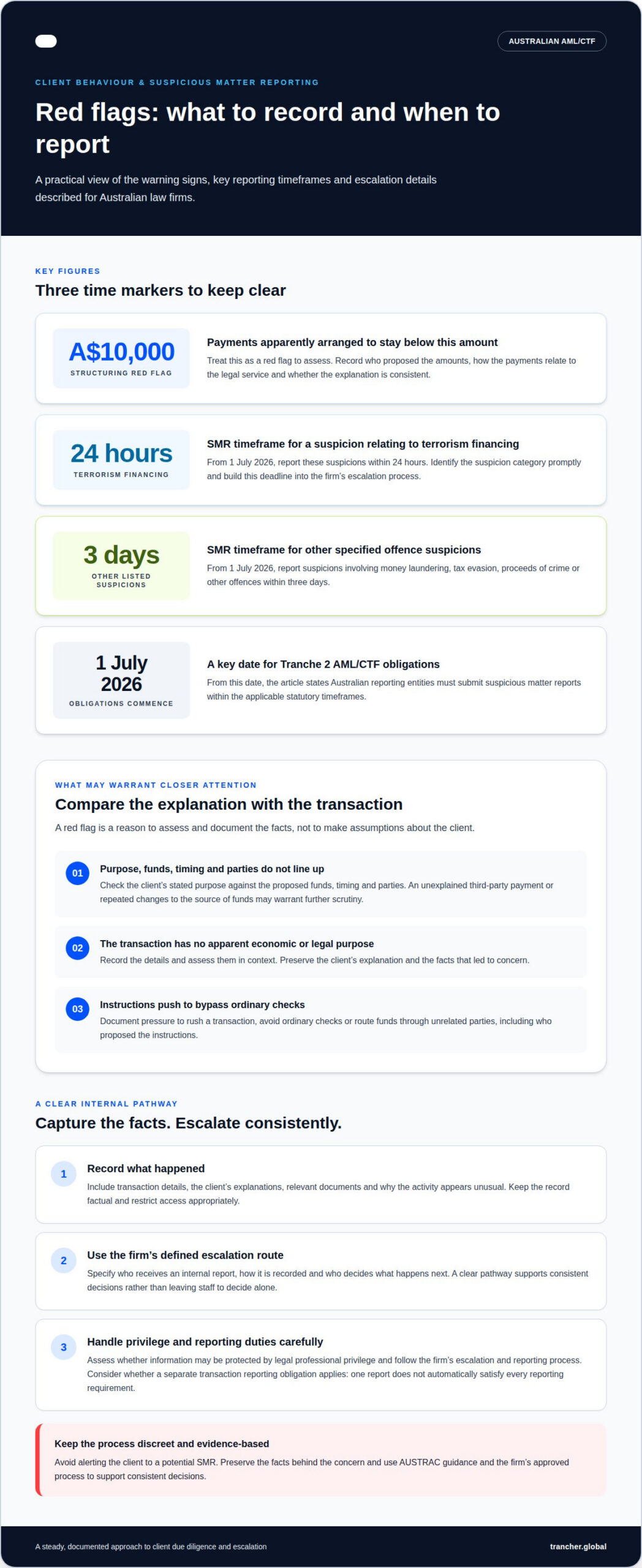
Watch for unexplained transaction structures, inconsistent client explanations and activity that lacks an apparent economic or legal purpose. From 1 July 2026, Australian reporting entities must submit suspicious matter reports (SMRs) within statutory timeframes, so record concerns and escalate them promptly.
Legal professional privilege and confidentiality require careful handling alongside AML/CTF reporting. Assess whether information may be privileged and follow the firm’s escalation and reporting process.
- Look for behaviour that conflicts with the transaction. Compare the client’s stated purpose with the proposed funds, timing and parties. A client who cannot explain why a third party is paying, for example, or repeatedly changes the source of funds may warrant further scrutiny. A transaction with no apparent economic or legal purpose is a red flag to assess, not a reason to make assumptions about the client.
- Record possible structuring and unusual instructions. Treat transactions apparently arranged to stay below A$10,000 as a red flag. Note who proposed the amounts, how the payments relate to the legal service and whether the explanation is consistent. Also document pressure to rush a transaction, avoid ordinary checks or route funds through unrelated parties. Context matters: preserve the facts that led to concern.
- Escalate concerns through a defined internal pathway. Specify who receives an internal report, how it is recorded and who decides what happens next. Include the transaction details, the client’s explanations, relevant documents and the reasons the activity appears unusual. Keep the record factual, restrict access appropriately and avoid alerting the client to a potential SMR. A clear pathway helps staff respond consistently rather than making decisions alone.
- Apply the correct SMR deadline. From 1 July 2026, report suspicions relating to terrorism financing within 24 hours. Suspicions involving money laundering, tax evasion, proceeds of crime or other offences must be reported within three days. Handle information that may be protected by legal professional privilege carefully when considering an SMR. Build these distinct deadlines into the escalation process and identify the suspicion category promptly.
- Separate suspicious activity reporting from other reporting duties. Australian law firms must report certain transactions and suspicious activity to AUSTRAC. Record the activity, assess whether an SMR is required and consider any separate transaction reporting obligation that applies. Use AUSTRAC guidance and your firm’s approved process to support consistent decisions. One report does not automatically satisfy every reporting requirement.
Understanding which legal services trigger Tranche 2 obligations
From 1 July 2026, Australian AML/CTF obligations apply to certain services provided by lawyers, conveyancers and legal services businesses. A Tranche 2 AML checklist for lawyers can help firms assess each service and the role they perform, rather than relying on a broad label such as “legal advice”.
- Map the work your practice performs. List each service and describe the actions involved in a typical matter. Note whether the firm advises on, arranges, manages or carries out a client transaction. The service name alone may not establish whether it is designated. For example, document the work involved in a conveyancing matter separately from general property advice, or contrast transactional arrangements with brand protection and intellectual property legal services like those provided by Trademark Doctor. Compare the actual activity with the designated service descriptions in the AML/CTF framework.
- Assess the matter before accepting the engagement. Identify the client, requested outcome and your firm’s role. Distinguish advice about a transaction from participating in its implementation or management. Record the reasons for your assessment and the information considered, so another practitioner can follow the decision. A Tranche 2 AML checklist for lawyers should make this service-by-service assessment easy to apply consistently across new matters.
- Review appointments involving companies and trusts. Lawyers and firms acting as nominee directors, shareholders or trustees face AML/CTF responsibilities and risks associated with designated services. Record who gives instructions, exercises control and benefits from the arrangement. Identify the firm’s precise role, including whether it holds an appointment or acts on a specific instruction. Reassess the position if the role or arrangement changes.
- Link service coverage to the firm’s risk assessment. Consider how your practice’s services, clients, delivery methods and transactions could expose it to money laundering or terrorism financing risks. Work involving trust arrangements, for example, may require procedures for understanding control and purpose. Australian law firms providing designated services must conduct ML/TF risk assessments and maintain a tailored AML/CTF program.
- Document the decision and controls. Set out who determines whether a service is designated, what they record and when they revisit the assessment. The Anti-Money Laundering and Counter-Terrorism Financing Act 2006 (Cth), listed by the Australian Government Federal Register of Legislation, governs Australia’s AML/CTF obligations for law firms. Use a documented process to support consistent decisions, staff training and record keeping. Strengthen your AML/CTF risk controls with a structured approach.
How Should Law Firms Conduct Customer Due Diligence (CCD) Effectively?
Before providing a designated service, identify and verify each individual client and beneficial owner. Understand the client’s risk, keep AML/CTF records for at least seven years from 1 July 2026, appoint a compliance officer, train staff and meet the applicable independent-evaluation date.
-
Verify customer identity
Verify the customer’s identity before providing a designated service, using information and documents appropriate to the risk. Check that the details align with the person’s stated purpose and role in the matter. If information conflicts or is incomplete, resolve the discrepancy through your firm’s due diligence process before proceeding. Record what you checked, how you verified the identity and any remaining concerns.
-
Establish beneficial ownership
Identify the beneficial owners behind each company, trust or other client structure. Trace ownership and control through relevant entities rather than stopping at the immediate client or an intermediary. For a trust, establish who controls or benefits from the arrangement and how the proposed service relates to its purpose. Record the information you relied on, any uncertainty and the risk assessment supporting your decision.
-
Maintain due diligence records
Keep records that show the customer due diligence performed, the evidence considered, the risk assessment and decisions made. AML/CTF records must be retained for at least seven years from 1 July 2026. Track the independent-evaluation due date against the last two AUSTRAC account-number digits: deadlines are 30 June 2029 when both are odd, 31 December 2029 when the second-last is odd and the last even, 30 June 2030 when both are even, or 31 December 2030 when the second-last is even and the last odd.
-
Conduct ongoing customer due diligence
Monitor the client relationship and transaction activity after onboarding. Reassess due diligence when the client’s risk profile changes, ownership or control shifts, or activity no longer matches the known purpose. Apply enhanced due diligence to high-risk clients, including Politically Exposed Persons, and transactions with no apparent economic or legal purpose. Your AML/CTF program should define staff responsibilities, escalation steps and the compliance officer’s oversight.
Client identity verification and KYC
- Start customer due diligence at the right point. From commencement of Tranche 2 obligations, Australian businesses providing designated services must apply initial customer due diligence to every new customer. Build this step into the matter-opening workflow, before the firm provides the relevant service. Record whether the work is a designated service, when the checks began and which staff member is responsible. This makes the start of verification clear for each new client.
- Collect information that identifies the client. For an individual, capture identifying details and the purpose of the legal engagement. For a company, record its legal name, structure and the person authorised to give instructions. If a company director contacts the firm, for example, distinguish the director’s identity from the company’s. An email address or introduction alone is not proof: document the evidence and verification steps.
- Match verification to the risk assessment. Consider the client, service, transaction and any relevant ownership structure together. A straightforward instruction from an individual may present different factors from a company acting through several intermediaries. If details conflict, pause the verification workflow, identify the discrepancy and seek an explanation through your firm’s process. Record how the issue affects the assessment instead of relying on an informal note or assumption.
- Keep the client profile current. Treat KYC as an ongoing process, not a one-off matter-opening task. Update client information when ownership, control, instructions or transaction activity changes. A new representative or a change in the stated purpose, for example, may mean you need to revisit the assessment. Give staff a clear process for recording updates, identifying suspicious activity and escalating concerns to the right person.
- Connect verification with reporting and records. Keep identity information, verification evidence, risk assessments and decisions together in the client file. Reporting entities need a process that enables staff to retrieve relevant information when reviewing activity or assessing a suspicious matter. Assign responsibility for checking that records are complete, and note when each step occurred. A consistent file structure helps the compliance officer review decisions across matters and spot gaps in the firm’s workflow.
Corporate structures and trusts
Map how each entity or trust relates to the legal service you provide. Reviewing the structure clearly helps identify control, purpose and activity that may affect your firm’s money laundering and terrorism financing risk assessment.
- Build a structure map. List each company, trust and intermediary involved, then show how they connect. For a corporate group, note parent entities, subsidiaries and each entity’s role in the proposed transaction. For a trust, identify the parties and the documents describing their roles. A visual map can reveal extra layers or unexplained links that may be difficult to spot in separate file notes.
- Understand who directs and benefits from the arrangement. Review relevant company and trust documents alongside the instructions you receive. Identify who can make decisions, who acts for the structure and who benefits from the service. For example, compare a trustee’s instructions with the trust deed and the stated purpose of the matter. Record gaps or inconsistencies for follow-up rather than treating the named client as the only relevant party.
- Test the purpose and movement of funds. Relate the transaction to the client’s stated objective and the roles shown in the structure map. If a company pays funds for a trust matter, establish the stated connection and reason. Consider whether the arrangement has an apparent economic or legal purpose. Unexplained third-party payments, complex routing or changing explanations may warrant closer assessment of financial crime risks.
- Apply controls that match the assessed risk. Consider how the structure, service and transaction could expose your practice to money laundering or terrorism financing. Australian law firms providing designated services must conduct ML/TF risk assessments and maintain a tailored AML/CTF program. Set procedures for resolving unclear ownership, documenting the reason for the structure and escalating concerns. Scrutinise complex arrangements in proportion to their assessed risk.
- Keep the structure review current. Update the file when a new entity, trustee, controller or payment party becomes involved. Keep the structure map, supporting documents, explanations and decisions together so the firm can trace how its assessment developed. Clear records also help staff apply procedures consistently across related matters.
Strengthen your entity and trust due diligence with a consistent review process.
Trancher
Trancher helps Australian law firms organise AML/CTF compliance across client checks, risk monitoring and reporting. Consider Trancher when your practice needs a consistent way to manage verification, screening, client activity and suspicious matter reporting within its broader AML/CTF program.
End-to-end program management brings these activities together, while ongoing monitoring helps firms respond when a client’s profile or activity changes. Practical workflows and clearer records help your team manage its obligations alongside legal work.
Contact Trancher to discuss support for your firm’s AML/CTF processes.
Make your AML process part of everyday practice
Turn your checklist into a working process with clear ownership, consistent records and a practical way to manage exceptions. Start by deciding how client checks fit into matter opening, how updates reach the right people and how your firm will keep its approach aligned as its services evolve.
Use the Tranche 2 AML checklist for lawyers as a starting point for that operational design, not as a document that sits apart from daily work. A well-integrated process can help staff apply requirements consistently while keeping decisions visible to the people responsible for compliance.
Trancher supports firms with End-to-End AML/CTF Program Management, Client Verification & Due Diligence (KYC/CDD + Screening), and Ongoing Risk Monitoring & Client Activity Tracking.
Contact Trancher to discuss your AML needs and take a considered next step towards a more organised compliance process.
Frequently Asked Questions
What Are the Key AML/CTF Obligations for Law Firms Under Tranche 2 Reforms?
Law firms providing designated services must enrol with AUSTRAC, assess money laundering and terrorism financing risks, and maintain a tailored AML/CTF program. Obligations also include customer due diligence, ongoing monitoring, reporting suspicious matters, appointing a compliance officer, training staff and keeping records. For example, a firm should connect its client-onboarding steps with its risk controls and escalation procedures. The Australian Government Federal Register of Legislation identifies the Anti-Money Laundering and Counter-Terrorism Financing Act 2006 (Cth) as the governing Act.
What will compliance look like for my law firm?
Compliance means building AML/CTF controls into regular matter workflows, rather than treating them as a separate annual exercise. For a new conveyancing instruction, for example, staff can assess whether the service is designated, complete relevant client checks and retain decisions in the matter record. The compliance officer oversees the program, while staff follow its procedures and raise concerns through the internal escalation pathway.
When do legal professionals have to comply?
Legal professionals providing designated services must meet the Tranche 2 obligations from 1 July 2026. Firms should use this commencement date to assess their services, prepare their program and establish operational processes before regulated work begins. For example, map matter-opening, client verification and escalation workflows to the services the practice provides. The date applies to the new AML/CTF obligations for legal professionals, not simply to a firm’s decision to update its policies.
Who is impacted?
Tranche 2 affects Australian legal practices and practitioners when they provide services captured as designated services. The reforms also extend to certain work performed by conveyancers and other professional service providers. A practice’s size or title alone does not determine its obligations; the relevant consideration is the service being provided. For instance, assess a lawyer’s role in a client’s company or trust arrangement, rather than assuming every legal instruction receives identical treatment.
When does Australia’s Tranche 2 AML/CTF regime commence for lawyers?
Australia’s Tranche 2 AML/CTF obligations for legal professionals commence on 1 July 2026. That is the date to use when determining when the new requirements apply to covered legal services. It is distinct from preparation milestones, such as building a program or training staff. A firm should align its commencement planning with the services it provides, so its controls are ready for relevant work from the start date.
Which legal services and law firms are covered by Tranche 2 AML/CTF obligations in Australia?
Coverage depends on whether the legal work falls within a designated service under Australia’s AML/CTF framework. Certain services commonly provided by lawyers, conveyancers and legal services businesses are covered. Firms should assess each service and their role, including work involving nominee director, shareholder or trustee appointments. A law practice may need to assess different matter types separately rather than assume the same rules apply to every client engagement.
What beneficial ownership, politically exposed person, and sanctions screening checks are required?
For a designated service, identify and verify individual clients and beneficial owners, then assess their risk before providing the service. Apply enhanced due diligence to high-risk clients, including Politically Exposed Persons. Screening can help identify politically exposed persons and sanctions-related concerns, but results need to be assessed in the context of the client and matter. For a company or trust, look beyond the immediate client to understand who ultimately owns, controls or benefits from the arrangement.
What AML/CTF risk assessment and risk-based program must a law firm maintain?
A firm providing designated services must conduct a money laundering and terrorism financing risk assessment and maintain a tailored AML/CTF program. The assessment should reflect the firm’s services, client types, delivery methods and transaction risks, then inform practical controls. A practice handling trust arrangements, for example, may need procedures for understanding ownership and control. The program should also define staff responsibilities, the compliance officer’s role, training, record-keeping and how concerns are escalated.