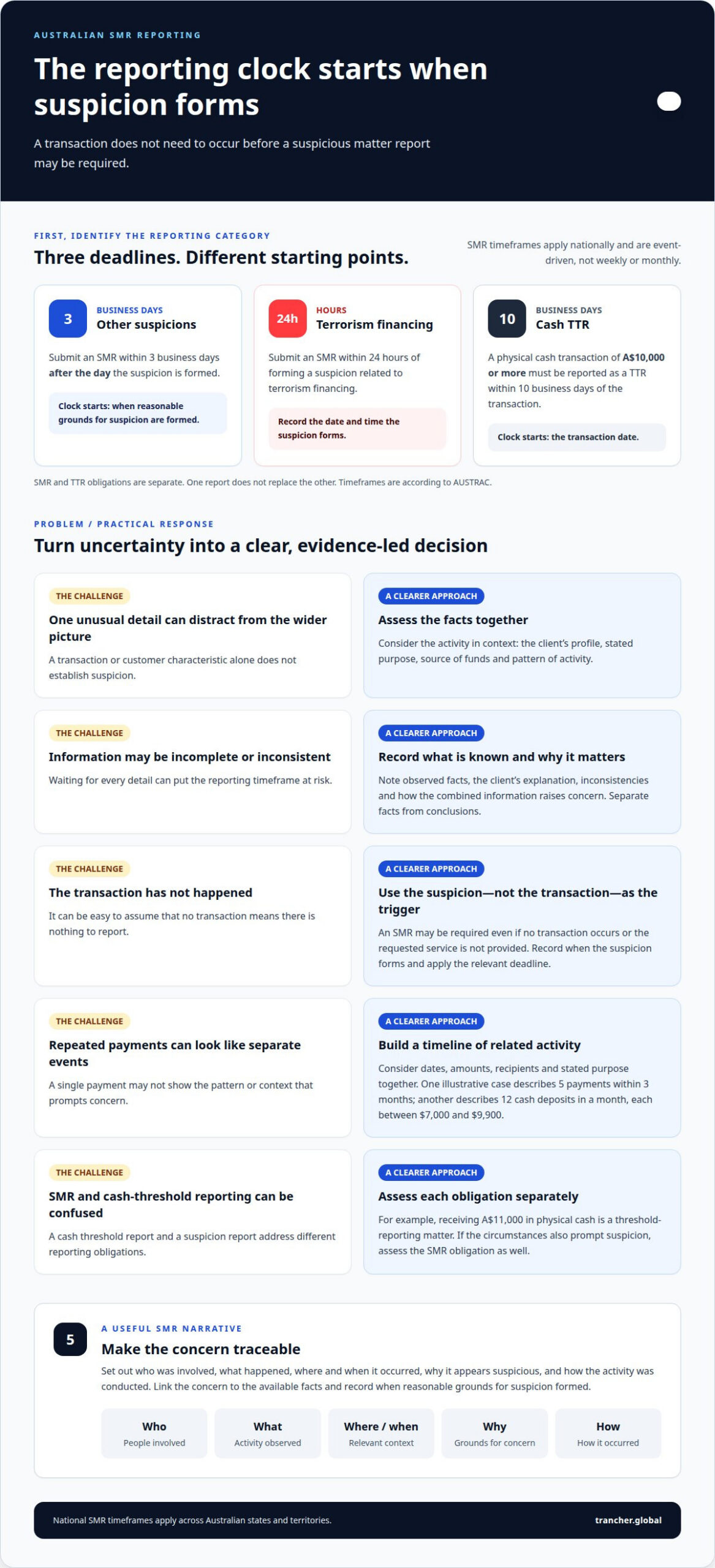
A suspicious matter report (SMR) can be required even when no transaction takes place. Under Australia’s SMR reporting guidelines, reporting entities generally have 3 business days after forming a suspicion to lodge a report; if the suspicion relates to terrorism financing, the deadline is 24 hours, according to AUSTRAC. The reporting clock starts when the suspicion is formed, not when a transaction occurs.
Recognising when unusual activity gives rise to reasonable grounds for suspicion can be challenging, particularly when information is incomplete. Assess what you know, record why it raises concern and act within the applicable timeframe. Clear procedures, reliable records and practical staff training help teams report consistently and respond with confidence.
Key Takeaways
- Assess the facts together to decide whether activity gives rise to reasonable grounds for suspicion, rather than relying on a single unusual detail.
- Start the reporting clock when the suspicion is formed, not when the transaction takes place.
- For other suspicions, Australian reporting entities must submit an SMR within 3 business days after the day they form the suspicion, according to the Australian Transaction Reports and Analysis Centre (AUSTRAC).
- For a suspicion related to terrorism financing, the deadline is 24 hours after forming the suspicion, according to the Australian Transaction Reports and Analysis Centre (AUSTRAC).
- A suspicion may require an SMR even when no transaction occurs or the requested service is not provided; clear records and staff training help support a consistent response.
What are the reporting timeframes?
SMR reporting timeframes apply nationally, so deadlines do not vary between Australian states and territories. Reports are event-driven, not submitted on a weekly or monthly schedule; the relevant deadline depends on the type of suspicion.
-
Check the applicable SMR deadlines
Start by recording the date the suspicion formed, then identify its type. Australian reporting entities must submit an SMR for other suspicions within 3 business days after the day they form the suspicion, according to the Australian Transaction Reports and Analysis Centre (AUSTRAC). The deadline runs from forming the suspicion, not from the transaction date. Avoid waiting for every detail before starting the reporting process.
-
Check state and territory differences
Apply the Australian SMR timeframe wherever the reporting entity operates. These obligations sit within the national AML/CTF reporting framework, so moving between states or territories does not create a different deadline. Identify the reporting obligation that applies to the activity rather than assuming location changes the timeframe.
- Separate an SMR from a Threshold Transaction Report (TTR). A physical cash transaction of A$10,000 or more in Australia must be reported as a TTR, according to the Australian Transaction Reports and Analysis Centre (AUSTRAC). The TTR deadline is within 10 business days of the transaction. For example, receiving A$11,000 in physical cash is a threshold-reporting matter, even if the circumstances also prompt a separate suspicion assessment.
- Identify whether a suspicion relates to terrorism financing. That category has a shorter deadline: Australian reporting entities must submit an SMR within 24 hours of forming a suspicion related to terrorism financing, according to the Australian Transaction Reports and Analysis Centre (AUSTRAC). Treat the time the suspicion forms as the starting point. Record that date and time clearly so the reporting timeline is traceable.
- Build the report around the facts that explain the concern. Include who was involved, what happened, where and when it occurred, why it appears suspicious, and how the activity was conducted. Record when suspicion formed on reasonable grounds. A clear account links the unusual activity to its context and shows how the reporting decision was reached.
- Use the deadline to plan the reporting steps, not to delay escalation. Record the suspicion, identify the relevant reporting category, gather available information and submit within the applicable period. If a transaction also meets the cash threshold, assess the TTR obligation separately from the SMR. The reports address different obligations, and one does not replace the other.
What counts as “reasonable grounds” for suspicion?
Assess the client’s activity in context, not as an isolated event. Australian rules address the grounds for suspicion in sections 5-12(a)-(b) of the Rules.
Identify suspicion triggers
Look for activity that may indicate an attempt to avoid reporting, conceal a source of funds or disguise the purpose of a transaction. For example, repeated payments below $10,000 may warrant assessment when they appear designed to avoid threshold reporting obligations. An unusual transaction alone does not settle the question; consider its pattern and the client’s circumstances before deciding whether grounds exist.
Assess reasonable grounds
Compare the activity with the information available about the client, including the stated purpose and source of funds. A reasonable-grounds suspicion should rest on identifiable facts, not a hunch or an unsupported assumption. The Rules’ sections 5-12(a)-(b) provide the relevant reference for assessing grounds. Record what was observed and why the combined facts appear suspicious.
- Build a timeline of relevant events. An illustrative case describes a client making 5 payments within 3 months. Consider the dates, amounts, recipients and stated purpose together. The sequence may provide useful context that a single payment cannot. Note which facts are known, which are inconsistent, and how each fact contributes to the concern.
- Compare the activity with the client’s profile and explanation. For example, repeated deposits may warrant closer assessment if their pattern does not fit the client’s stated circumstances. Record the explanation and the specific facts that do not align. A customer characteristic, business type or unusual transaction alone does not establish suspicion.
- Assess whether payment patterns suggest deliberate structuring. One illustrative bank case describes 12 cash deposits in a month, each between $7,000 and $9,900. The relevant consideration is the overall pattern and whether it suggests splitting payments to avoid reporting obligations, not merely that each deposit sits below $10,000.
- Set out the grounds in a clear narrative. Describe what happened, when it happened, who was involved and what made the activity suspicious. Explain any concern about the source of funds where the available facts support it. Separate observed facts from conclusions, linking each conclusion to specific evidence or a recorded explanation.
- Review the narrative before lodging the suspicious matter report. Check that another reader can follow the sequence, understand the client’s explanation and see why the facts raised concern. Remove unsupported claims and distinguish uncertainty from established information. A concise, evidence-led account clarifies the grounds without overstating what the activity shows.
What is a suspicious matter report?
A suspicious matter report (SMR) records a reporting entity’s suspicion and the facts behind it. Australia’s SMR reporting guidelines require a clear connection between the concern and its supporting facts. Under Australia’s AML/CTF Act 2006, a suspicion can trigger reporting regardless of transaction amount, including when it arises from an inquiry and no service follows.
- Separate the reporting decision from the transaction outcome. An SMR may be required even if the entity declines the requested service or no transaction takes place. For example, the circumstances, proposed activity or information provided during a prospective client’s inquiry may raise suspicion. Under Australia’s SMR reporting guidelines, a cancelled payment or declined service does not, by itself, resolve the concern.
- Create an internal decision record as soon as staff identify a concern. Capture the activity, relevant payments, people involved, dates, information reviewed and explanation provided. Record when reasonable grounds formed and why the known facts supported suspicion. A clear chronology shows how the decision developed, rather than presenting a conclusion without context.
- Make the report specific and easy to follow. Australian SMRs should explain who was involved, what happened, where and when it occurred, why it appears suspicious, and how the activity was conducted. Separate observed facts from interpretations. If a real estate matter involves a proposed transaction that does not proceed, accurately describe the known steps and circumstances.
- Retain the SMR and related documentation for 7 years. Keep the submitted report with supporting records, the assessment, relevant client information and the decision trail. Use a consistent file structure so authorised staff can locate the original concern and its supporting material. Preserve enough context to explain both the report and the actions taken afterwards.
- Manage post-lodgement activity through documented controls. Lodging an SMR does not by itself require the reporting entity to stop a transaction. Record any subsequent decision and the circumstances behind it, while protecting report information. Telling a client directly or indirectly that an SMR has been or will be filed may constitute a criminal offence under the AML/CTF Act 2006.
- Train staff to recognise, escalate and document potentially suspicious activity. Use practical scenarios involving unusual payments, inconsistent client explanations and inquiries that do not lead to a service. Staff should know how to raise concerns through the entity’s reporting process and record relevant facts. Refresher training can reinforce consistent handling as procedures and risks change. For staff reviewing educational webinars and regulatory updates on YouTube, slothtube.net provides an efficient way to generate video summaries and written transcripts.
When Australian reporting entities must lodge an SMR
Australian reporting entities must lodge when they form the relevant suspicion, even if no transaction proceeds. AUSTRAC oversees AML/CTF suspicious matter reporting. ASIC has separate suspicious activity reporting expectations for certain market participants.
The reporting obligation applies to reporting entities under Australia’s AML/CTF framework. Late, incomplete or inaccurate reporting can have regulatory consequences; the response depends on the nature and circumstances of the breach.
- Start the reporting process as soon as reasonable grounds for suspicion form. Australian reporting entities must submit an SMR within 24 hours of forming a suspicion related to terrorism financing, according to the Australian Transaction Reports and Analysis Centre (AUSTRAC). For other suspicions, the applicable deadline is 3 business days after the day the suspicion forms. Record the formation time and relevant category promptly.
- A completed transaction is not a condition of reporting. An SMR may be required when suspicion arises from an inquiry, even if the service is declined or no transaction takes place. For example, concerns arising during a proposed service may need reporting before funds change hands. Base the decision on the suspicion and circumstances, not on whether the transaction was completed.
- Prepare the information needed to explain the matter. Set out who was involved, what activity occurred, where and when it happened, why it raised suspicion, and how it was conducted. Include the date the entity formed suspicion on reasonable grounds. Clear details help AUSTRAC understand the activity and assess the information provided.
- Use AUSTRAC Online for lodgement where the applicable process requires it. Australian real estate agents must submit suspicious matter reports through AUSTRAC Online. Follow the relevant process, enter available facts accurately and retain the submission record. Do not delay lodgement to pursue details that would not change the grounds already formed.
- Use AUSTRAC’s suspicious matter reporting guidance and reference guide to help prepare the report. These resources explain reporting expectations and support clear, useful reporting. The guidance is general information, and specific circumstances can affect how a requirement applies. Keep the report factual, distinguish observations from conclusions and avoid unsupported assumptions.
- Keep reporting channels and responsibilities clear within the entity. Staff should know how to escalate a concern, who assesses it, and how the decision and lodgement are recorded. For market participants, ASIC expects suspicious activity reports through its Regulatory Portal; this is distinct from an SMR to AUSTRAC. Where separate obligations apply, one report does not replace another.
SMR compliance frameworks and staff training
Australia’s SMR framework is governed by the AML/CTF Act 2006 and AML/CTF Rules 2025. AUSTRAC guidance explains the regulator’s interpretation, while Australian courts ultimately interpret the laws.
- Map the reporting process to the relevant laws. Document how staff identify and escalate concerns, assess reasonable grounds and prepare an SMR. Include clear decision points for activity that may involve money laundering or proceeds of crime. Align procedures with the entity’s services, client types and exposure instead of relying on a generic checklist.
- Assign a role to each stage. Specify who receives an internal alert, who assesses the client’s circumstances and who submits the report. Set out a route for urgent escalation where suspicion relates to terrorism financing. A defined handover helps ensure concerns are not left in an inbox or lost between teams.
- Connect due diligence with ongoing review. Give staff a way to compare new payments or instructions with the client’s stated purpose and known activity. For example, assess a sudden change in transaction behaviour against the client profile and available source-of-funds information. Staff should record the facts prompting escalation, rather than labelling a client suspicious without supporting reasons.
- Train staff using realistic scenarios involving unusual payment patterns, unclear business purposes and activity that may involve criminal proceeds. Ask staff to identify what they observed, what remains uncertain and which internal channel to use. Effective training helps personnel recognise potentially suspicious transactions and orders, then pass relevant information to the appropriate decision-maker.
- Tailor procedures for changes in coverage. Since 1 July 2026, the AML/CTF Act 2006 has covered real estate agents, buyer’s agents and certain property developers. A Tranche 2 business should connect its procedures to the services it provides, then train relevant staff on the reporting pathway and the records needed to support decisions.
- Test whether the framework works in practice. Use a scenario such as a staff member noticing payments inconsistent with a client’s stated purpose. Check whether the concern reaches the right person, the decision is documented and reporting deadlines are visible. Record any gaps and update guidance so teams can apply the process consistently.
- Use AUSTRAC’s updated suspicious matter reporting guidance to strengthen report quality, accuracy and timeliness. Then align staff instructions with the entity’s actual escalation process. Explore SMR compliance support to help structure reporting workflows and staff guidance.
Businesses can consult AUSTRAC’s updated suspicious matter reporting guidance for the regulator’s interpretation of the framework.
Trancher: Regulatory & Suspicious Matter Reporting
Trancher supports Australian businesses with regulatory and suspicious matter reporting as part of a structured AML/CTF compliance approach. Turn to the platform when you need clearer reporting workflows, connected client information and consistent decision records. End-to-End AML/CTF Program Management brings reporting processes together with Client Verification & Due Diligence (KYC/CDD + Screening) and Ongoing Risk Monitoring & Client Activity Tracking. These features help teams organise relevant information to assess activity and prepare reports, while grounding decisions in the facts and applicable obligations.
To strengthen your SMR processes, contact Trancher to discuss your compliance needs.
Make reporting readiness part of daily operations
Strong reporting practice starts before a concern arises. Clear ownership, accessible procedures and consistent staff guidance make escalation part of routine operations, rather than an improvised response under pressure. Use Australia’s SMR reporting guidelines to shape processes that fit your business, and keep them aligned with how your team verifies clients, monitors activity and records decisions.
A practical next step is to identify where information or handovers could break down. A concern may pass through several people before it reaches the person responsible for assessment and lodgement. Well-defined workflows help teams act on relevant information while maintaining a clear record of decisions.
Trancher can support businesses seeking to strengthen their AML/CTF program and reporting processes. Contact Trancher about SMR compliance to discuss a practical next step for your organisation.
With clear processes in place, your team can handle its responsibilities more confidently and consistently.
Frequently Asked Questions
How Do You Lodge an SMR with AUSTRAC?
Submit the SMR using the reporting process and form applicable to your entity. Australian real estate agents lodge through AUSTRAC Online. Before submitting, organise the event timeline, people involved, activity and grounds for suspicion, including when suspicion formed. Keep the report and supporting decision record together. If a real estate agent forms a new suspicion about a previously reported client, a fresh SMR is required, referencing the earlier report.
How long do agents have to submit an SMR?
For a suspicion unrelated to terrorism financing, Australian reporting entities must submit an SMR within 3 business days after the day they form the suspicion, according to the Australian Transaction Reports and Analysis Centre (AUSTRAC). If the suspicion relates to terrorism financing, the deadline is 24 hours. These periods apply to the reporting entity’s suspicion, not simply the date an agent first noticed unusual activity.
What Are the 6 Essential Elements of an SMR?
A useful SMR narrative answers six core questions: who was involved, what happened, where it happened, when it occurred, why it appeared suspicious, and how the activity was conducted. Explain the relationship between the people involved and the relevant payments, then link the sequence to the concern. Keep the account factual, distinguish observations from explanations and make the reasons for suspicion clear.
What Are the SMR Deadlines?
For other suspicions, the deadline is 3 business days after the day suspicion forms; for terrorism-financing suspicions, it is 24 hours. A report claiming information protected by legal professional privilege generally has up to 5 business days after forming the suspicion. These are event-based deadlines, not routine monthly reporting dates. The relevant starting point is when the entity forms the suspicion, rather than when the transaction occurs.
What Happens After You Lodge an SMR?
Keep the submitted report with its supporting records and decision history. Reporting entities must retain an SMR and related documentation for 7 years. Lodging a report does not, by itself, require the entity to stop a transaction, so record any subsequent decision and its rationale. Protect report information in internal communications: telling a client directly or indirectly that an SMR has been or will be filed may constitute a criminal offence.
What does SMR mean in Australian reporting guidelines?
SMR stands for suspicious matter report. A reporting entity submits one when it forms a relevant suspicion under Australia’s AML/CTF framework. Suspicion can arise from a proposed service or inquiry, even if no transaction takes place. The report records the concerning activity and the facts behind the entity’s decision, distinguishing a documented assessment from an unexplained alert or assumption.
What information must be included in an Australian SMR report?
Explain who was involved, what occurred, where and when it happened, why it raised suspicion, and how the activity was carried out. Include the date the entity formed suspicion on reasonable grounds. For example, if payments appear inconsistent with a client’s stated purpose, describe the sequence and relevant explanation. Distinguish facts from conclusions and include available information that makes the circumstances understandable.
How do you submit an SMR report in Australia, and which forms or portals are used?
Use the applicable AUSTRAC SMR form and lodgement process; Australian real estate agents submit through AUSTRAC Online. Entities enrolled after 30 March 2026 must use the new SMR form from 1 July 2026. Entities enrolled with AUSTRAC on 30 March 2026 can transition to that form at any time from 1 July 2026 to 30 March 2029. Ensure the form reflects the matter and suspicion date accurately.