
Could routine accounting support become a designated service simply because it relates to a property or business sale? Under Australia’s Tranche 2 AML/CTF framework, the work your firm performs matters more than the transaction label. To assess when assisting on property or business sales AML may apply, distinguish general accounting work from assistance that could fall within a designated service.
A property sale and a business sale can involve different steps, and the same client may also receive routine tax or bookkeeping support. Tranche 2 commenced on 1 July 2026, but not all accounting work is captured. Assess the services provided in each engagement rather than assuming every sale, or every task connected to one, triggers the same obligations.
This article explains the distinction between assistance with property transactions and business or entity transactions, and the engagement details that may affect your assessment. It also sets out what to document and where to check current AUSTRAC guidance, so your firm can make a clearer, evidence-based scope decision.
Key Takeaways
- For assisting on property or business sales AML, focus on the service your firm performs, not simply the fact that a sale is taking place.
- Compare property sale work with business or entity sale work by examining the transaction subject, your firm’s role and the purpose of the assistance.
- Separate transaction-focused support from routine accounting tasks that are merely connected to the client or sale.
- Assess each engagement in a consistent sequence: identify the transaction, describe the service, assess your role and record your reasoning.
- Where work is in scope, organise the relevant processes, records and staff readiness, using current AUSTRAC guidance to inform your approach.
Assisting with property or business sales: what does the AML/CTF question mean?
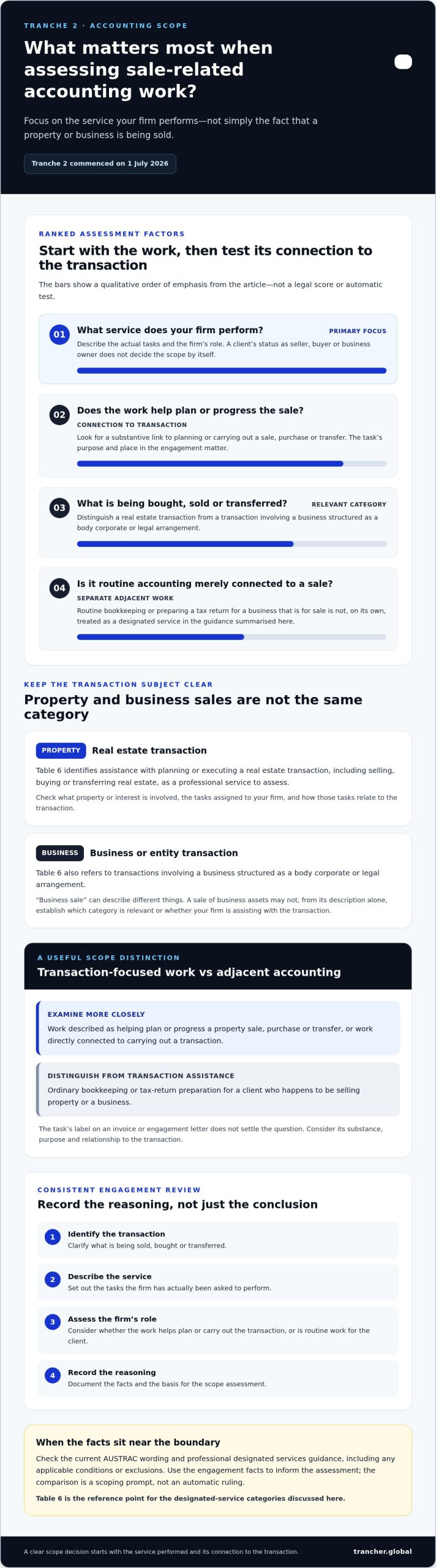
Start with the service the accounting firm provides. A client’s role as a seller, buyer or business owner doesn’t, by itself, establish whether the firm is providing a designated service. Under Australia’s Tranche 2 framework, Table 6 sets out professional services that may be relevant, including assistance with transactions involving real estate and businesses structured as a body corporate or legal arrangement.
The practical question is: what is being bought, sold or transferred, and what is the firm doing in connection with it? A firm may work for a client selling an asset without helping carry out the sale. In contrast, work described in everyday terms as accounting support may warrant closer assessment if it is directed at planning or executing a transaction. The wider concepts behind Anti-money laundering provide useful background, but the designated-service categories and current AUSTRAC guidance are the relevant references for assessing the firm’s work.
What does ‘assisting’ mean in this context?
In plain language, assistance suggests a substantive connection between the firm’s work and progressing a transaction. Ask whether the work helps the client plan or carry out the sale, purchase or transfer, or whether it is simply performed for a client who happens to be involved in one. Keeping that distinction in view helps focus the assessment on the engagement, not the client’s status.
For example, routine bookkeeping or preparing a tax return for a business that is for sale is not, on its own, treated as a designated service under the guidance summarised for this article. Work specifically connected to enabling a sale may raise a different question. The label on an invoice or engagement letter won’t settle the issue. Consider the work’s purpose, substance and relationship to the transaction. If the facts are near the boundary, review the current AUSTRAC wording and guidance before reaching a conclusion.
Why property and business sales need separate consideration
Table 6 distinguishes real estate transactions from transactions involving a business that is a body corporate or legal arrangement. These categories concern different transaction subjects, so assess the firm’s work against the relevant category rather than grouping it under a broad label such as “sale support”.
Everyday language can obscure the transaction structure. A “business sale” might mean the sale of a business as a body corporate or legal arrangement, or the transfer of other business assets. The description alone may not establish which category is relevant or whether the firm’s role amounts to assistance. The sections below compare the transaction subject and the nature of the accounting work in each case.
This article is educational only. It isn’t legal, financial or compliance advice. Use it to frame an initial scope assessment, then refer to current AUSTRAC guidance and the facts of the particular engagement.
Property sale assistance: when might accounting work relate to a real estate transaction?
Table 6 identifies assistance with the planning or execution of a real estate transaction, including selling, buying or transferring real estate, as a professional service to assess under Australia’s AML/CTF framework. For an accounting firm, the key is to describe the work precisely. A client’s involvement in a property sale doesn’t, by itself, tell you whether your service falls within this category.
Start with the transaction: what real estate, or interest in it, is involved, and is the engagement connected to a sale, purchase or transfer? Then examine your firm’s role. Work directed towards planning or progressing the transaction raises a different scope question from routine work for a client who happens to be selling property. Check Table 6’s wording and any applicable conditions or exclusions against AUSTRAC’s current professional designated services guidance before reaching a conclusion.
Property transaction facts to examine
Read the engagement in context, not just by its label. Identify the property transaction, the tasks assigned to your firm and how those tasks relate to planning or carrying it out. The client’s occupation, ownership status or description of the work as “accounting support” isn’t a substitute for examining the service itself.
The parent guide, Designated Services Table 6: A Practical Guide to Items 1-9, provides broader context for the professional-services categories. For the property category, verify the current AUSTRAC wording, including any conditions or exclusions relevant to the transaction and engagement.
How to distinguish transaction assistance from adjacent accounting work
Use the comparison below as a scoping prompt, not an automatic ruling. The same task may need closer examination depending on its purpose and place in the engagement.
| Scope question | Transaction-focused work to examine | Adjacent work to distinguish |
|---|---|---|
| What is the work for? | Tasks described as helping plan or progress a property sale, purchase or transfer. | Routine bookkeeping or tax-return preparation for a client who is also selling property. |
| How does the firm contribute? | The engagement connects the firm’s work directly to steps in the transaction. | The work concerns the client’s ordinary accounting needs, without an evident transaction-planning or execution role. |
| What evidence clarifies the scope? | Engagement terms, instructions and work records showing the purpose and scope of the tasks. | Records showing the work is separate from the property transaction. |
These examples help frame the question, but they don’t decide it. A routine service can’t be classified solely by its name, and a connection to a sale doesn’t automatically mean all related work is captured. If the firm’s contribution or the transaction structure is unclear, record the facts and compare them with current AUSTRAC guidance before treating the work as in or out of scope. This careful distinction is central to assessing assisting on property or business sales AML.
Once the scope is understood, consistent workflows can help organise the associated compliance activity. Explore AML compliance workflows as an operational support option for small and medium size accounting firms.
Business sale assistance: how does it compare with property sale work?
A business sale can involve more than the transfer of premises or other property. Table 6 separately identifies assistance with selling, buying or transferring a body corporate or legal arrangement. This requires a different scope assessment from a real estate transaction: first establish what is being transacted, then examine what the accounting firm does in relation to it.
The phrase “business sale” is not precise enough on its own. The transaction may involve an entity or legal arrangement, or it may concern other business interests. Don’t infer the relevant category from the client’s description alone. Review the engagement documents and transaction information, then compare the facts with current AUSTRAC guidance and the relevant Table 6 wording.
When the transaction involves a company or legal arrangement
The structure matters because a transfer involving a body corporate or legal arrangement is distinct from a transaction involving real estate itself. For example, a company may own property, but the proposed transaction could concern the company or arrangement rather than a direct sale of the property. These are prompts to identify what is being transferred, not conclusions about the applicable category.
Where the work also involves establishing or changing an entity structure, related questions may arise beyond the sale category. The guide Company and Trust Formation as an AUSTRAC Designated Service: When Does It Apply? addresses that adjacent issue.
Questions that clarify an accountant’s role
Before deciding how the work should be treated, record the engagement in neutral, factual terms. Compare the transaction with property sale work by focusing on three points:
- Transaction subject: Is the engagement about real estate, or the sale, purchase or transfer of a body corporate or legal arrangement?
- Firm’s role: Is the firm providing background accounting work, or does its work contribute to planning or executing the transaction?
- Purpose and timing: What did the client ask the firm to do, and how does that task connect to the proposed transaction?
For instance, distinguish routine accounting work for a company that is being sold from work the firm is specifically asked to perform to help progress the transaction. The client’s sale may explain why a task arose, but that connection alone doesn’t settle the scope question. Describe the service and its purpose, then assess the facts against AUSTRAC’s current guidance.
Use examples as issue-spotting prompts, not automatic rules. A business may have a complex structure, and an accountant’s involvement may change during an engagement. If the transaction subject or the firm’s contribution is unclear, document what is known, identify the uncertainty and check the exact category and any relevant qualifications in current official guidance. This measured approach helps firms distinguish assisting on property or business sales AML questions from routine work without treating every sale-related service as captured.
A practical way to assess property and business sale engagements
A consistent file review turns a broad question about sale-related work into a clearer, evidence-based assessment. Use the same sequence for property and business engagements, while recording the facts that distinguish each transaction. This initial scope assessment is separate from any AML/CTF program, customer due diligence or other obligations that may apply if the firm provides a designated service.
Four checks for an engagement file
- Identify the transaction. Record whether the matter concerns real estate or the sale, purchase or transfer of a body corporate or legal arrangement. Describe the property, entity or arrangement involved, using the terminology in current AUSTRAC guidance.
- Describe the actual service. Set out the tasks the firm has been asked to perform in practical terms. Avoid relying only on broad labels such as “business advice” or “accounting support”, which may not explain the work’s connection to a transaction.
- Assess the firm’s role and purpose. Note whether the work is background accounting for a client involved in a sale, or whether it helps plan or execute the transaction. Record the instructions received and when the firm became involved.
- Document the reasoning. Identify the AUSTRAC source and wording reviewed, the facts considered and the basis for the preliminary scope assessment. If interpretation remains uncertain, record the issue and escalate it through the firm’s appropriate governance process.
Scope depends on the service performed and the facts of the transaction, not simply on the client’s involvement in a sale.
Keep the comparison useful without overreaching
For both transaction types, ask what is being transferred, what the firm has been asked to do and how that work relates to planning or execution. Then make the distinctions explicit in the file. For example, a property file should identify the real estate transaction being considered; a business-sale file should clarify whether the matter concerns a body corporate or legal arrangement. Similar client circumstances don’t necessarily mean the engagements have the same scope.
Use the file review as a practical aid, not as a replacement for the legislation or AUSTRAC’s current professional designated services guidance. Check the exact definitions, conditions and any applicable exclusions against the latest official material. If the facts change, such as when the firm takes on additional transaction-related tasks, revisit and update the assessment rather than relying on an earlier conclusion.
This separation matters operationally. First decide whether the service may be in scope, then establish what requirements apply to the firm and engagement. A preliminary assessment doesn’t, by itself, determine the customer due diligence steps or the contents of an AML/CTF program. Where nominee involvement forms part of the work, assess that role separately against relevant guidance on nominee services.
Once a firm has identified work requiring AML/CTF processes, organised workflows can help support client verification, records and ongoing compliance activity. Explore AML/CTF workflow support for small and medium size accounting firms.
Prepare your accounting firm to manage identified AML/CTF work
Once your firm has identified work that may fall within a designated service, turn the assessment into clear internal processes. Set out who reviews the engagement, how the firm records its reasoning and what happens if the work or transaction changes. This creates a consistent path from initial scoping to any AML/CTF processes that apply, without assuming every sale-related engagement is captured.
Turn identified work into a consistent firm workflow
Organised processes connect program control with practical tasks such as client verification, risk monitoring, reporting and compliance activity tracking. Assign clear responsibilities, keep relevant records together and make sure staff know how to raise a changed or uncertain engagement for review. These measures support consistent operations; they don’t determine whether a service is in scope or replace checking the legislation and current AUSTRAC guidance.
For relevant records, use the required wording: “Maintain records for minimum of seven years.” Keep the engagement assessment, information relied on and subsequent compliance activity organised so the firm can retrieve and review them. Broader program planning should also draw on current official material, including AUSTRAC guidance on program requirements.
Keep the timeline precise. Tranche 2 commenced on 1 July 2026, and the enrolment deadline for businesses providing designated services was 29 July 2026. The phrase “Registering with AUSTRAC by 1 July 2026” should not be presented as the enrolment deadline. Check AUSTRAC’s current information for timing or status questions relevant to your firm.
Where Trancher fits in the preparation process
Trancher is more than software. It’s a complete AML compliance solution for small and medium size accounting firms. Integrated workflows support program control, client verification, risk monitoring, reporting and compliance activity tracking. The offering also includes role-based training modules, expert on-call support, dedicated onboarding and local support. These resources help organise firm processes while leaving professional judgement and internal responsibilities with the firm.
Trancher offers a “30-day compliance guarantee” and the promise “Be compliant in 30 days.” The platform supports your firm’s operational processes, but it doesn’t determine whether a particular engagement is captured. Scope assessments still need to reflect the transaction facts, the service performed and current authoritative guidance.
For firms ready to bring identified work into a more consistent operational process, Trancher’s integrated workflows, training and support can help organise preparation. A structured approach can make responsibilities clearer and records easier to manage.
Make transaction scoping part of your firm’s readiness
Use your engagement review as a foundation for repeatable processes. As your firm’s services evolve, set a clear point to revisit the scope assessment when client instructions or transaction details change. This keeps professional judgement connected to current AUSTRAC guidance and gives staff a practical way to raise questions early.
For small and medium size accounting firms, an organised compliance process can support smoother operations as well as regulatory readiness. If you’re assessing how to manage the work that follows an in-scope decision, Trancher offers a complimentary 3-month trial. “No cost. No obligation.” Limited places available. The trial includes full platform access, dedicated onboarding and local support, and an “ROI report at the end of your trial.”
Explore Trancher’s complete AML compliance solution for accounting firms, including its 30-day compliance guarantee, role-based training modules and expert on-call support. Take the next step towards managing assisting on property or business sales AML assessments within your firm’s broader processes. With a considered approach and practical operational support, your team can move forward with greater clarity and confidence.
Frequently Asked Questions
Does every accountant involved in a property sale provide a designated service?
No. An accountant’s involvement with a seller or buyer doesn’t automatically mean the firm provides a designated service. The relevant question is what work the accountant performs and how it relates to the transaction. For example, preparing a client’s usual accounts while they sell an investment property differs from being engaged to help progress the sale. Assess the actual instructions and tasks against current AUSTRAC guidance rather than relying on the client’s involvement alone.
Can an accounting firm be assisting with a business sale without acting as the buyer’s or seller’s agent?
Yes. Acting as an agent isn’t the only fact to consider. An accountant could be asked to perform work that helps plan or execute a transaction without representing either party as an agent. Equally, providing accounting services to a client who is selling a business doesn’t automatically mean the firm is assisting with the sale. Describe the accountant’s specific tasks and purpose, then assess them against the relevant Table 6 category and current AUSTRAC guidance.
Is selling a company treated the same as selling the property owned by that company?
Not necessarily. A company’s ownership of real estate doesn’t make a company sale identical to a direct property sale. The transaction documents and instructions may show whether the subject is the real estate or a body corporate or legal arrangement. That distinction can affect which Table 6 category needs examination. For an assisting on property or business sales AML assessment, record what is being transferred and don’t treat the company’s assets as proof of the transaction type.
What is the difference between a body corporate and a legal arrangement in this context?
Table 6 uses these terms to identify a category of transaction separate from real estate. A body corporate generally refers to an incorporated entity, while a legal arrangement may involve a structure such as a trust. The precise meaning and application depend on the legislation and transaction facts. If the documents use different terminology or the structure is unclear, note that uncertainty and consult the current statutory wording and AUSTRAC guidance.
Do court-ordered property or business transfers fall within the same designated-service rules?
A court order doesn’t, by itself, establish whether an accountant’s work is captured or excluded. The assessment still needs to consider the transaction, the service performed and any conditions or exclusions in the applicable rules. For a court-directed transfer, retain the order and related instructions, identify what interest or entity is changing hands, and check the current Table 6 wording and AUSTRAC guidance. Don’t assume a court process changes the result without verifying the relevant provisions.
How should an accounting firm document a borderline property or business sale engagement?
Keep a concise record of the client’s instructions, transaction documents reviewed, work assigned and the firm’s connection to the proposed transfer. Note the AUSTRAC guidance or legislative wording consulted, the preliminary reasoning, any unresolved issue and who reviewed or escalated it internally. If the engagement changes, update the record. This creates a traceable basis for the firm’s assessment without presenting an internal note as a substitute for authoritative interpretation.
Where can accounting firms check the current wording for professional designated services?
Use AUSTRAC’s current professional designated services guidance and check the relevant provisions of the Anti-Money Laundering and Counter-Terrorism Financing Act 2006, including Table 6 and any applicable qualifications. Read the wording that applies to the specific service rather than relying solely on summaries or industry examples. If the facts raise an unresolved interpretation issue, follow the firm’s governance process and seek appropriate professional guidance before settling the assessment.