In Australia, documenting source of wealth means explaining how a customer accumulated their wealth and assets, then assessing the evidence in proportion to their money laundering and terrorism financing risk. AUSTRAC says the review should cover the customer’s wealth and assets, including the economic, business or commercial activities behind them. If a customer won’t provide documents, assess what you can establish, whether closer monitoring or further action is appropriate, and record the reasons for your decision.
A refusal can leave a compliance team with a difficult judgement: you need enough information to understand the customer’s wealth, but evidence may be incomplete or unavailable. Don’t treat every refusal alike. Consider the customer’s circumstances, the activity involved and whether the information gathered is consistent with what you know about them.
This article explains how to assess source-of-wealth risk, gather useful customer information and document common sources, including employment, business income, business sales, investments and gifts. It also outlines what to do when evidence is missing, so your assessment, decisions and next steps are clear and properly recorded.
Key Takeaways
- Match the depth of source-of-wealth checks to the customer’s risk, and look more closely when their activity does not fit the information provided.
- For business income or a sale, connect financial records and transaction documents to show how the wealth was generated and received.
- Choose evidence that fits the source, such as payslips for employment income or sale agreements and business records for business proceeds.
- Build a clear picture of the customer’s overall wealth, including the original capital behind investment returns, not just the latest account balance.
- When documents are incomplete, record what you could establish and use the remaining risk indicators to guide monitoring and next steps.
Risk-based approaches to establishing source of funds and wealth
Source of funds explains where money for a particular transaction came from and how the customer obtained it. Source of wealth looks more broadly at how the customer accumulated their assets. An account balance may show that money arrived, but not how the customer created their wealth. Assess both questions in light of the customer’s circumstances and the activity involved.
Australian businesses should tailor checks to the customer’s specific money laundering and terrorism financing risks. The level of detail should be proportionate to the risk: a straightforward salary payment may call for different evidence from a complex business sale or unexplained transfer. Record why the evidence fits the customer’s profile, or identify what remains unresolved.
AUSTRAC guidance refers to section 26F of the Act and section 5-2 of the Rules for source-of-funds and source-of-wealth policies. For verification, it refers to sections 26F and 28 of the Act and section 5-2 of the Rules. These references help frame policy and verification processes. They don’t replace an assessment of the individual customer and transaction.
Look more closely when risk indicators suggest a mismatch or heightened exposure. Examples include a politically exposed person, a transaction involving a party established in a high-risk country, or activity inconsistent with what the business knows about the customer. An unusually complex or large transaction, or one without an apparent economic or legal purpose, may also warrant scrutiny. Consider whether money, property or other assets may be linked to criminal activity.
- Compare: Check whether the customer’s stated wealth explains the transaction’s size and purpose.
- Trace: Connect the funds to the event or activity that generated them.
- Resolve: Identify gaps, contradictions or unexplained changes in the account.
- Record: Document the evidence reviewed, remaining concerns and reasons for the next step.
For a politically exposed person, a more detailed review can examine each material source of wealth and its supporting evidence. If the customer’s activity does not align with the information collected, seek clearer evidence and reassess the risk. Where wealth comes from several sources, assess each material source rather than relying on a general statement.
If the business cannot establish source of funds or wealth, consider whether submitting a suspicious matter report is appropriate. If you decide to continue providing designated services, document why. Review money laundering and terrorism financing risk more frequently, and monitor transactions and behaviour more closely. Clear records make the reasoning behind a risk-based decision easier to follow.
Business sale and business income documentation
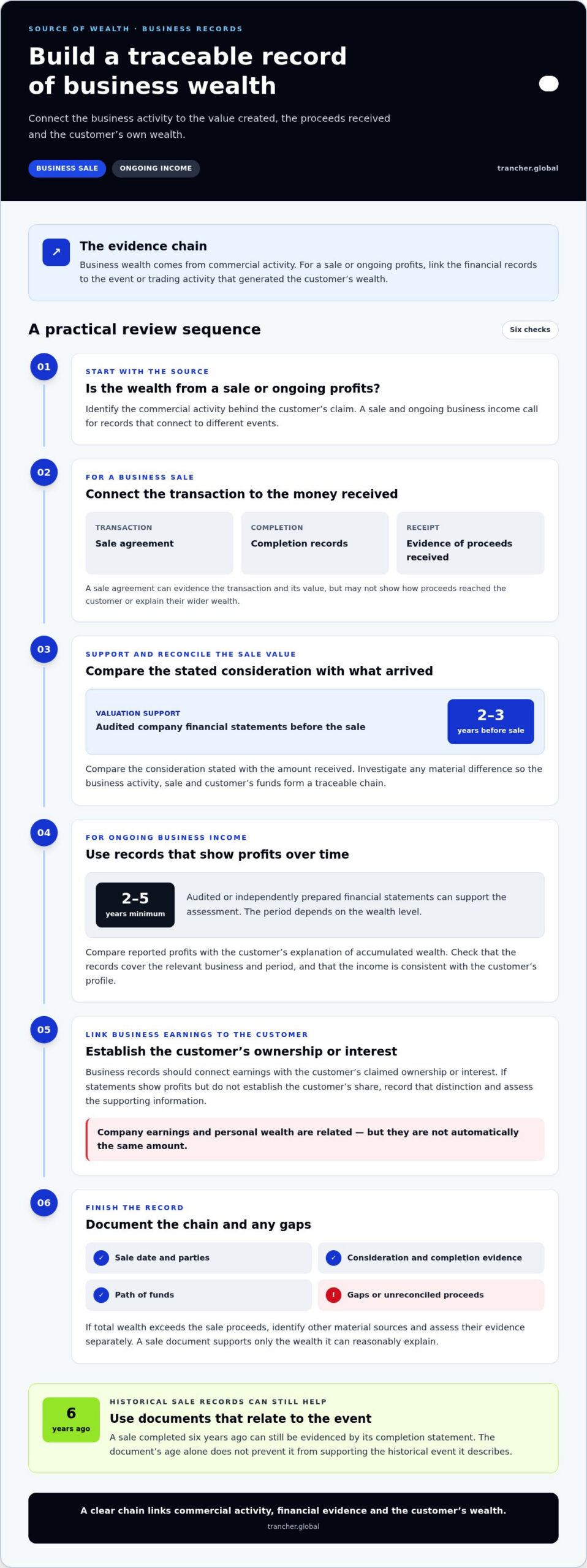
Business wealth comes from income accumulated through commercial activity. For a sale or ongoing profits, connect the financial records to the event or trading activity that generated the customer’s wealth.
Business sale records
A business sale record can evidence the transaction, its value and the proceeds received. A sale agreement alone may not show how the proceeds reached the customer or explain their wider wealth.
For a sale, review the sale agreement alongside completion records and evidence of receipt. Audited company financial statements covering the 2-3 years before the sale can support the business valuation. Compare the stated consideration with the amount received, and investigate any material difference. This helps establish a traceable connection between the business activity, the transaction and the customer’s funds.
A sale completed six years ago can still be evidenced by its completion statement. Documents should relate to the historical event they describe; their age alone does not prevent them from supporting the account. If the customer’s total wealth exceeds the sale proceeds, identify other material sources and assess their evidence separately. A sale document supports only the wealth it can reasonably explain.
Keep a concise record of the sale date, parties, consideration, completion evidence and path of funds. Note gaps, such as proceeds that cannot be reconciled with the stated amount. This creates a clear evidential chain rather than relying on a broad description of the sale.
Business income records
Business income records show profits generated through ongoing commercial activity. They matter because a single payment or account balance may not demonstrate how income accumulated over time.
For ongoing profits, audited or independently prepared financial statements covering a minimum of 2-5 years can support the assessment, depending on the wealth level. Compare reported profits with the customer’s explanation of accumulated wealth. Then consider whether the records cover the relevant business and period, and whether the income is consistent with the customer’s profile.
Use business records to connect earnings with the customer’s claimed ownership or interest in the business. If financial statements show profits but don’t establish the customer’s share, record that distinction and assess the supporting information. Company earnings and personal wealth are related, but they are not automatically the same amount.
Document which records were reviewed, what period they cover and how they support the stated source. If the evidence leaves a gap between reported profits and the customer’s accumulated wealth, note the gap and its effect on the assessment. Consistent audit-ready record keeping helps preserve the reasoning alongside the supporting documents.
Common sources of wealth and supporting documents
A customer’s wealth may come from several sources, while the funds for a particular transaction may have a narrower origin. Keep those explanations separate: identify the wealth-building activity, then connect the transaction funds to their immediate source. For example, investment income may build wealth over time, while a bank statement shows a transfer used for a particular payment. Documenting source of wealth therefore means more than recording one transaction.
The Commonwealth Bank of Australia form lists employment, investments, business activity, asset sales, family gifts, real estate, superannuation or pensions, government benefits, compensation and windfalls as possible sources of wealth. These categories can structure customer questions, but a category alone doesn’t explain how wealth accumulated. Ask what happened, when it happened and how the resulting funds or assets reached the customer.
- Salary and wages: Payslips can support employment income, while bank statements may show salary deposits.
- Business income: Business financial records can explain earnings generated through commercial activity.
- Dividends and investment income: Investment statements can show returns, while records of the initial capital help explain their origin.
- Property or personal asset sales: A sale agreement can evidence the transaction, and account records can help trace the proceeds.
- Family support or gifts: Record who provided the funds, their relationship to the customer, and whether repayment is expected.
- Superannuation, pensions or government benefits: Relevant account or payment records can support the stated source.
- Compensation or windfalls: Documents describing the event and resulting payment can explain how the funds arose.
Immediate funding sources for a transaction might include wages, business income, dividends, investment income, or proceeds from real estate or personal property sales. Match the evidence to the source: a payslip may explain salary, but not proceeds from an asset sale. A bank statement confirming receipt supports the evidence, but doesn’t by itself show how the wealth was created.
For a family gift transferred within Australia, the Commonwealth Bank of Australia form defines family support or a gift as financial support from family in Australia that doesn’t have to be repaid. Record the giver’s identity, relationship, reason for the transfer and any available supporting documents. A transfer record shows that money moved; information about the giver and gift explains the context.
Build a source-to-evidence record for each material category. Note the customer’s explanation, the documents reviewed and how each document supports the claimed source. Keep sources distinct when documenting wealth across categories. If a customer lists investments and property, for example, don’t treat one account statement as evidence for both. This gives a clearer financial picture and shows where further questions may be needed.
What information should a source-of-wealth statement include?
A useful statement explains how the customer accumulated their wealth, rather than naming only the funds used for one transaction. AUSTRAC says it should cover the customer’s wealth and assets, including the economic, business or commercial activities behind them. Set out the customer’s explanation clearly, then connect each material source to supporting evidence.
Structure the statement so a reviewer can follow the account from origin to current position. Include the customer’s explanation of each source, the relevant events or activities, and how they contributed to the customer’s wealth. For example, a statement naming business ownership should explain how the business generated income and how that income accrued to the customer.
- Sources identified: List material sources such as employment, business activity, investments, asset sales, gifts or superannuation.
- How wealth arose: Describe the relevant activity or event, such as earning wages or selling a business.
- Customer’s connection: Explain their role, ownership or entitlement to the income or proceeds.
- Evidence reviewed: Identify the records that support each source and what they demonstrate.
- Unexplained elements: Record any gap between the customer’s account and the evidence reviewed.
- Assessment outcome: Summarise how the evidence fits the customer’s overall financial position.
Trace investment wealth back to its original capital. Investment returns may grow substantially, but the statement should explain how the funds used for the initial investment were obtained. Then connect the original capital to later returns through relevant investment records. Without that link, evidence of current investment value may not explain how the customer first acquired the wealth.
Make each evidential link specific. A bank statement can confirm receipt of money, but doesn’t explain how the wealth was created. Pair it with records of the event or activity that generated the funds. For a property sale, for instance, sale documents explain the transaction, while account records show the proceeds arriving.
Use documents that relate to the events they describe. For historical wealth events, contemporaneous records can provide context about the customer’s circumstances at the time. There is no universal recency requirement for source-of-wealth documents, so assess relevance against the event and the claim.
Finish with a concise assessment, not just a document inventory. State what the evidence supports, how the sources fit together and what remains unclear. If a customer claims wealth from business income and investments, distinguish those sources and show how each contributes. This gives reviewers a coherent account they can understand and reassess as the customer’s information changes.
Employment income and executive remuneration
Employment evidence should explain both current earnings and, where relevant, wealth accumulated over time. Payslips typically cover 3-12 months for standard employment income. A customer whose assets reflect years of earnings may need a longer evidence trail. Distinguish income received recently from the wealth built through earlier employment.
For ongoing employment or business income, recent documentation typically covers the last 2-5 years. Use the period that best explains the customer’s claimed wealth and current financial position. For example, recent payslips can support current salary, while tax returns may help show earnings across a longer period.
Executive remuneration can involve several components or change over time. Ask the customer to explain how each material component contributed to their wealth. Match the explanation to relevant records, then compare amounts and timing across documents. If a role change or altered remuneration affects the account, note how it fits the evidence.
Assess records as a connected account, not as isolated documents. A payslip may show earnings for a pay period, while a bank statement shows a corresponding deposit. A tax return can provide a broader view of reported income. Together, these records can help establish whether employment earnings are consistent with the customer’s stated accumulation of wealth.
- Confirm the employment context: Record the employer, role and period relevant to the customer’s explanation.
- Identify the income evidence: Note whether payslips, tax returns or bank statements support the stated earnings.
- Compare the records: Check whether dates, amounts and payment patterns align across documents.
- Explain accumulated wealth: Record how earnings over time relate to the customer’s assets and stated financial position.
For example, a customer may describe building wealth through a long-term executive career but provide only recent payslips. Those records can support current income without explaining earlier accumulation. Identify the period the documents cover, then assess whether further relevant records or customer information are needed to make the history understandable.
Keep the assessment proportionate to the customer’s risk and the purpose of the review. If an executive’s income records don’t align with the stated wealth, document the difference and consider what further evidence would clarify it. A structured client verification and due diligence process can help teams capture the explanation, evidence and assessment consistently.
Finally, record what each document establishes and what it cannot establish alone. A tax return supports reported income, for example, but doesn’t automatically explain every asset accumulated from that income. Notes on the evidence period, income sources and remaining questions make the employment history easier to review later.
Trancher: End-to-End AML/CTF Program Management
Trancher helps Australian businesses connect client due diligence, risk monitoring and AML/CTF program management. When source-of-wealth evidence needs to sit within a consistent compliance process, Client Verification & Due Diligence (KYC/CDD + Screening) supports customer checks, while Ongoing Risk Monitoring & Client Activity Tracking helps businesses review customer activity over time.
Trancher also supports Regulatory & Suspicious Matter Reporting, helping businesses manage related reporting processes within their wider AML/CTF program. These workflows can help teams collect customer information, record assessments and respond to changing risk indicators.
Contact Trancher to discuss how its AML/CTF program management platform can support your compliance processes.
Make your process work consistently
Make documenting source of wealth a clear, repeatable part of customer due diligence. Set out how staff capture explanations, connect evidence to risk assessments and record decisions. Consistent workflows help teams apply their judgement clearly as customer circumstances and activity evolve.
Trancher’s End-to-End AML/CTF Program Management, Client Verification & Due Diligence (KYC/CDD + Screening), and Ongoing Risk Monitoring & Client Activity Tracking can help businesses manage customer checks and ongoing compliance processes in a joined-up way.
Take the next step by discussing how your current processes could better support your AML/CTF obligations. Contact Trancher to discuss AML and explore an approach that fits your operations. A clear, well-maintained process can help your team work with greater confidence.
Frequently Asked Questions
What if a client refuses to provide source of wealth documentation?
Record the refusal, the explanation given and the evidence already reviewed. Then assess whether you can still understand the customer’s wealth and activity. If you can’t establish source of funds or wealth, consider whether submitting a suspicious matter report is appropriate. If you decide to continue providing the designated service, document why. Review customer risk more frequently and monitor transactions and behaviour more closely while the concern remains unresolved.
Can cryptocurrency be accepted as a source of wealth?
Cryptocurrency can be assessed as a claimed source of wealth, but the customer’s explanation needs evidence that makes the origin and accumulation understandable. Consider records showing how the assets were acquired, held and transferred, and whether the account fits the customer’s profile. A wallet balance or transaction screenshot may show current holdings, but not how the customer obtained the assets or funded their acquisition.
Source of wealth vs source of funds: what’s the difference?
Source of funds concerns the origin of money used for a particular transaction and how the customer obtained it. Source of wealth concerns how the customer accumulated their overall assets. For example, employment savings may form part of a customer’s wealth, while a transfer from those savings funds one transaction. Keep the explanations distinct so evidence for the payment isn’t mistaken for evidence of the customer’s wider financial history.
When is source of wealth verification triggered?
Verification is especially relevant when the customer’s risk is elevated or their activity conflicts with information already collected. Triggers may include a politically exposed person, a transaction involving a party established in a high-risk country, or an unusually complex or large transaction. An apparent lack of economic or legal purpose, or concerns that assets may come from criminal activity, can also call for closer assessment.
Which entities need to request source of wealth?
Australian businesses subject to AML/CTF obligations should consider source of wealth as part of a risk-based customer assessment. The question is whether understanding the customer’s wealth is needed to assess the relationship or activity, not whether every customer must provide identical documents. For example, if a transaction conflicts with the customer’s profile, the business may need more information to understand the customer’s financial circumstances.
What does source of wealth mean in Australian AML/CTF checks?
Source of wealth means the activities and events through which a customer accumulated their wealth and assets. AUSTRAC describes a source-of-wealth statement as explaining where the customer’s wealth and assets come from, including economic, business or commercial activities. In practice, a statement might explain employment earnings, business ownership or an asset sale, then connect those claims to relevant evidence and the customer’s overall financial position.
When must Australian banks and financial institutions verify a customer’s source of wealth?
Guide verification by the customer’s specific money laundering and terrorism financing risks, rather than applying it identically to everyone. Closer scrutiny may be appropriate when activity conflicts with information held, a customer or beneficial owner is politically exposed, or a transaction involves a high-risk-country party. An unusually complex or large transaction without an apparent economic or legal purpose can also warrant further examination.
What documents can prove source of wealth in Australia?
Useful records depend on the source of wealth. Employment may be supported by payslips or tax returns, business income by financial statements, and an asset sale by a sale agreement and completion records. Bank statements can help trace receipt, but don’t explain wealth creation on their own. For historical events, use records made at the time. Certified copies can generally be used when originals are impractical, if certified by an appropriate regulated professional.