
Which accounting engagements bring a firm within Australia’s AML/CTF regime? The answer depends on the service provided, not simply the firm’s professional title. Designated services Table 6 sets out nine service categories, and obligations have applied since 1 July 2026 to firms providing those services.
It’s understandable that the boundary can feel unclear. Routine professional work may sit close to assistance with a transaction, so broad assumptions can lead to inconsistent assessments across a firm. Reviewing the work performed in each engagement makes the distinction easier to manage.
This guide explains the scope and structure of Table 6, outlines what its nine items cover and shows how to assess engagements that may warrant closer review. You’ll also learn how to record the service provided and the reasoning behind your assessment, creating a consistent basis for designated-service tracking and compliance workflows.
Key Takeaways
- Assess the work performed in each engagement, rather than relying on a client or service-line label, to identify where Table 6 may be relevant.
- Use the nine items in designated services Table 6 to guide closer review of transaction assistance, entity services, roles and business addresses.
- Consider how the engagement activity connects with the transaction, then record the evidence and reasoning behind your assessment.
- Apply a consistent workflow across the firm so similar engagements are assessed and documented reliably.
- Connect service mapping with designated-service tracking, client workflows and record keeping as part of broader AML/CTF operational readiness.
What are designated services under Table 6, and who can be captured?
Table 6 is the professional-services table in the Australian AML/CTF framework. It appears in subsection 6(5B) of the Anti-Money Laundering and Counter-Terrorism Financing Act 2006, as amended. It identifies specified services that may bring a provider within the regime when the relevant legal conditions are met. For accounting firms, the practical question is not simply “What kind of firm are we?” but “What are we doing in this engagement, for whom, and in what circumstances?”
That distinction matters because the same firm may provide routine accounting support in one engagement and assist with a transaction in another. The client receiving the service, the business providing it and any relevant Australian geographical link are all part of the assessment. These concepts have specific legal meanings, so use the Act and current AUSTRAC guidance to determine how they apply to the facts. A service label alone cannot settle the question.
The regime concerns specified activities in an AML/CTF context, including activities that may be misused to facilitate money laundering. Start your assessment with the work actually performed. Don’t assume that all accounting activity is captured, or that ordinary professional work is automatically outside scope.
Why the service matters more than the firm’s professional label
Different service lines can involve different tasks, transaction connections and scope considerations. Preparing routine accounts, for example, is not the same activity as helping a client plan or carry out a transaction that may correspond to a Table 6 service. This contrast is a prompt to examine the engagement, not a conclusion that either activity is always included or excluded.
Review the engagement letter, instructions, deliverables and actions taken. Did the firm provide general financial information, or take steps connected with a listed transaction, entity or role? Record the facts that explain the distinction. This makes assessments more consistent across teams, particularly where a broad service description covers materially different work.
What Table 6 covers at a glance
The nine items provide a map for reviewing an engagement. Broadly, they cover transaction support involving property, financing or other arrangements; handling or transferring property; and services involving the creation, restructuring or transfer of entities, along with specified roles and business-address arrangements. The following sections examine the items in more detail.
Use this grouping to direct your review, not as a substitute for the statutory wording. The precise description, qualifications and any applicable conditions matter. Don’t rely on a short summary alone when the engagement involves several activities or parties.
For a sound scope assessment, consider the service description alongside the parties involved and the circumstances in which the service is provided. Check the current legislation and AUSTRAC guidance against those facts, and keep the reasoning clear enough for another reviewer to follow.
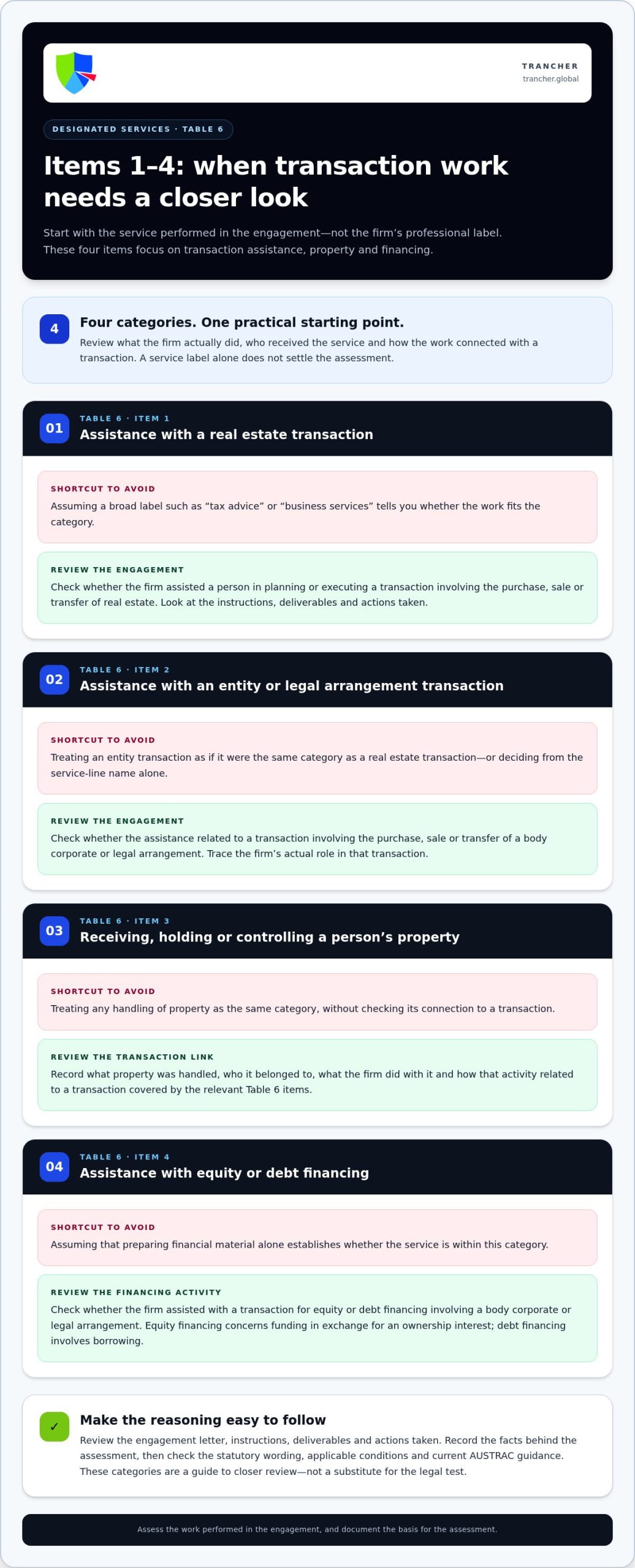
Table 6 items 1-4: transactions, property and financing explained
The first four items focus on services connected with transactions, property and financing. For an accounting firm, the practical distinction is between providing general professional input and taking part in an activity described by the legislation. The engagement documents, instructions and actual deliverables help show the firm’s role.
Items 1 and 2: helping with property or entity transactions
Item 1 concerns assisting a person in planning or executing a transaction involving the purchase, sale or transfer of real estate. Item 2 concerns assistance with a transaction involving the purchase, sale or transfer of a body corporate or legal arrangement. The categories are distinct: one centres on real estate, while the other concerns an entity or arrangement. In each case, assess the service against the Act’s wording and applicable conditions.
Consider what “assistance” involved in practice. Preparing general accounts or explaining financial information doesn’t, by itself, establish that the firm assisted with a listed transaction. A role that includes helping structure, organise or carry out a client’s property or entity transaction may warrant closer review. Don’t classify the work solely from a broad label such as “tax advice” or “business services”; trace it to the specific transaction and the firm’s actions.
Items 3 and 4: client property and financing activity
Item 3 addresses receiving, holding or controlling a person’s property in connection with a transaction covered by the relevant Table 6 items. The transaction link is important. Record what property was handled, who it belonged to, what the firm did with it and how that activity related to the transaction. Handling property for another purpose isn’t automatically the same category.
Item 4 relates to assistance with a transaction for equity or debt financing involving a body corporate or legal arrangement. At a high level, equity financing concerns funding in exchange for an ownership interest, while debt financing involves borrowing. Use those descriptions to orient your review, not to extend the legal category beyond the statutory test.
Hypothetical: A client asks an accounting firm to help organise funding as part of a proposed company acquisition. The firm prepares financial material and also assists with steps to arrange the financing. That combination could make item 4 relevant for assessment, but it isn’t a definitive classification. Document the instructions, deliverables, transaction connection and the firm’s role, then compare those facts with the current legislative wording and AUSTRAC guidance.
A practical record should distinguish advice provided from actions taken, identify the parties and property or entity involved, and explain why the activity may or may not fit an item. Structured workflows help keep these assessments and supporting records organised. Trancher provides operational support for designated-service tracking and AML/CTF workflows through accounting firm compliance workflows.
Table 6 items 5-9: entity services, roles and business addresses
The final five items focus on entity-related services, specified roles and address arrangements. Their descriptions can sound similar in a general engagement summary, but each points to a distinct activity. For a reliable review, compare the work performed with the relevant item rather than relying on labels such as “company administration” or “business set-up”.
Items 5 and 6: shelf companies, creation and restructuring
Item 5 concerns selling or transferring a shelf company. Item 6 concerns creating or restructuring a body corporate or legal arrangement. The distinction is the service provided: a shelf-company transfer involves an existing company, while creation or restructuring relates to establishing or changing an entity or arrangement. Check the statutory definitions and conditions when applying either category.
For example, an engagement to assist with establishing a new company may raise an item 6 question, while an instruction to transfer an already-existing shelf company may point towards item 5. These examples prompt closer assessment, not automatic classifications. An engagement letter may describe the intended service, but the actual work, including the steps taken and deliverables provided, gives the assessment its substance.
Items 7-9: acting for clients, nominee roles and addresses
The remaining items concern acting, or arranging for another person to act, in specified capacities, and providing specified addresses. The Act identifies particular relationships and services. Don’t assume that every company officer, representative or address service falls within these categories; compare the precise role and arrangement with the current wording.
At a high level, the categories cover:
- Item 7: acting, or arranging for another person to act, as a director or secretary of a body corporate, a partner in a partnership, or in a similar position for a legal arrangement.
- Item 8: acting, or arranging for another person to act, as a trustee of an express trust or in a similar position for another kind of legal arrangement.
- Item 9: providing a registered office, business address, correspondence address or administrative address for a body corporate or legal arrangement.
These descriptions are a practical guide to the item structure, not a replacement for the legal test. For a role-based engagement, record who is acting, the capacity involved, who arranged the role and the entity or arrangement concerned. For an address service, distinguish the service actually provided from ordinary correspondence or administrative work, then test it against item 9’s wording and any relevant conditions.
When assessing designated services Table 6, keep the supporting facts alongside the conclusion. A structured workflow can help organise service mapping, designated-service tracking and related records. Trancher supports AML/CTF operational workflows for Australian accounting firms through designated-service tracking workflows.
How to assess an accounting engagement against designated services Table 6
A consistent scope review starts with the engagement itself, not the client’s industry or the firm’s service-line name. Use the steps below to compare the actual work with Table 6, check relevant conditions and keep a clear record of the decision. If the facts or legal interpretation are uncertain, flag that uncertainty rather than treating an initial view as a final classification.
- Describe the work performed. Review the engagement letter, instructions, deliverables and actions taken. Write a plain-language summary of what the firm did, who it did it for and whether the work changed as the engagement progressed. Avoid relying on broad labels such as “business advisory” without examining the tasks involved.
- Identify a possible Table 6 item. Compare the work with the closest statutory service description. Note why the item may be relevant, and check whether another item could also apply if the engagement involved several activities. Treat the match as a question for assessment, not an automatic finding.
- Trace the transaction connection. Establish whether the work related to a transaction, property, entity, financing activity, role or address service described in the relevant item. Record the specific steps the firm took and how they related to that activity. General discussion and active assistance can be different, so examine the evidence before drawing a conclusion.
- Check the relevant conditions. Use the current Act and AUSTRAC guidance to assess the customer, the business providing the service, any Australian geographical link and item-specific qualifications. Don’t assume these conditions are met simply because a service resembles an item summary. Record the source and wording used for the assessment.
- Document and route the decision. Capture the facts, possible item, reasoning, outcome, reviewer and date. Note any limits in the evidence or unresolved interpretation, then send uncertain cases through the firm’s established governance process for review.
Separate routine work from transaction-related assistance
Compare the engagement’s scope, deliverables and actions with the wording of the possible designated service. For example, preparing routine financial information and helping organise steps in a client’s transaction are different fact patterns, but neither should be classified from a shorthand description alone. Where an assessment also raises questions about customer checks, use the firm’s process alongside customer due diligence guidance for accountants, including PEP and sanctions screening.
Create a repeatable record of the scope decision
Use the same record fields across teams so similar engagements can be compared consistently. Include the service summary, relevant Table 6 item, transaction connection, evidence considered, reasoning and outcome. If interpretation remains uncertain, record the issue and the governance review path rather than concealing the ambiguity. This supports audit-ready compliance records and makes later reassessment more manageable.
Make the review repeatable by connecting engagement assessments with designated-service tracking and supporting records. Explore Trancher’s AML/CTF workflows for operational support designed for Australian accounting firms.
From Table 6 assessment to Tranche 2 operational readiness
Identifying a potentially relevant Table 6 service is an important starting point, not a complete AML/CTF program. The assessment needs to connect with the firm’s operating processes: how services are tracked, how client workflows are managed, who reviews changes and where decisions are recorded. Linking these elements helps turn an engagement-level judgement into a consistent firm-wide approach.
For broader preparation, use this AML program checklist for Australian firms alongside your assessment of designated services. It can help frame the wider operational work without treating service mapping alone as proof that every compliance element is in place.
Turn service mapping into a firm-wide process
Assign responsibility for maintaining the firm’s service inventory and reviewing changes to engagement work. If a service changes in scope, it may need a fresh assessment, so give teams a clear way to flag new instructions, deliverables or transaction-related tasks. Keep the process proportionate: its depth should reflect the firm’s assessed activities and obligations.
Connect each scope decision to relevant operational workflows, rather than leaving it in a standalone file. Depending on the firm’s assessed obligations, linked processes may include:
- client verification and due diligence;
- risk assessment and ongoing monitoring;
- record keeping, review and governance; and
- staff guidance on identifying changes in engagement scope.
These processes should work together, but they serve different purposes. A Table 6 assessment helps clarify the nature of a service; related workflows support the firm’s broader AML/CTF operations. Keep the connection visible in your records so reviewers can see how the initial scope decision informs subsequent steps.
Use structured tools to support consistent implementation
Consistent implementation is easier when service mapping, designated-service tracking and supporting records sit within an organised workflow. Trancher is an operational platform designed for Australian accounting firms, supporting AML/CTF workflows across designated-service tracking, client verification, risk assessment, monitoring, reporting, record keeping and staff guidance. Dedicated onboarding and Australian support are also available.
A structured process helps teams apply the firm’s approach consistently, while keeping responsibility for decisions and governance clear within the firm. The platform supports operational workflows; it doesn’t replace the firm’s assessment of its activities or the need to consider applicable requirements.
If you’re looking to organise designated-service tracking alongside broader AML/CTF workflows, explore Trancher’s platform and see how it could support your firm’s processes.
Make your next scope decision easier
Make service-scope review part of how your firm manages change. New instructions, revised deliverables or a shift in the firm’s role can all prompt a fresh engagement assessment. A consistent process helps staff raise those changes early and gives reviewers a clear basis for deciding whether further assessment is needed.
Use the designated services Table 6 assessment as one input to a broader operational approach, with clear ownership for reviews and records that explain decisions. Over time, this can help your firm respond to changing work consistently, rather than relying on individual recollection or informal handovers.
Trancher supports Australian accounting firms with AML compliance workflows and designated-service tracking, alongside dedicated onboarding and Australian support. Explore Trancher’s AML compliance platform to see how it could support your firm’s operational approach.
Clear processes make complex obligations more manageable. Start a conversation with Trancher about organising designated-service tracking and building a well-documented AML/CTF workflow for your firm.
Frequently Asked Questions
Is every Australian accounting firm automatically captured by Table 6?
No. A firm’s professional label alone doesn’t determine whether it is captured. Review the services it actually provides, the engagement context and the conditions that apply to the relevant item. For example, a firm offering several types of work shouldn’t treat its entire client base as in scope based on one service description. Before reaching a conclusion about reporting-entity status, check the current statutory wording and geographical-link test.
Can a firm provide accounting services without providing a Table 6 designated service?
Possibly, but the service name alone won’t establish that. Compare the engagement’s instructions, work performed and deliverables with the relevant Table 6 wording, including any transaction connection. For instance, a broad “business advisory” label could describe different activities across clients. If the facts don’t clearly resolve the classification, document what remains uncertain and obtain appropriate independent legal advice rather than relying on a familiar service label.
Does a transaction have to be completed for a Table 6 service to be relevant?
Not necessarily. Some categories concern assistance with planning or execution, so completion may not be the deciding factor. If a proposed transaction is paused or abandoned, preserve the engagement records showing what assistance was actually provided and at what stage. The answer depends on the specific Table 6 item and circumstances, so check the current Act and AUSTRAC guidance before recording a final scope decision.
Does Table 6 cover services provided to companies and trusts as well as individuals?
It can refer to different customers and entity types, depending on the service description. Some items refer to a body corporate or legal arrangement, while others use wording about a person’s property or a customer. For an engagement involving a company or trust, identify the relevant parties and the capacity in which the firm acts. Then check the applicable statutory definitions instead of applying one item’s terminology across the table.
What if one client engagement appears to involve more than one Table 6 item?
Assess the distinct activities separately rather than selecting a single label for the whole engagement. For example, an engagement might include entity-related work and a separate financing activity. Record the facts relevant to each possible item, such as instructions, deliverables and the firm’s role, then check each item’s conditions. This gives reviewers a clearer basis for deciding whether multiple designated services may be involved.
What should a firm do if the Table 6 classification is uncertain?
Keep the engagement documents and write down which facts make the classification uncertain. Compare those facts with the current statutory wording and AUSTRAC guidance, then use the firm’s governance process to review the question. A workflow can help organise evidence and decisions, but it isn’t a legal determination. If the interpretation could materially affect the firm’s obligations, seek appropriate independent legal advice before settling the assessment.