
What if the same client request looks like routine administration in one engagement, but formation assistance in another? Under Australia’s AML/CTF regime, the answer depends on the work your firm performs, not simply whether a company or trust is involved. That distinction sits at the heart of the company trust formation designated service question.
It’s understandable that the boundary can feel unclear. Preparing tax returns or providing general bookkeeping doesn’t, on its own, make an engagement a designated service. Helping create, structure or manage a company or trust may raise different questions, depending on the specific activities involved. A consistent assessment starts with the work itself, rather than the service label.
This article explains how company and trust formation activities may fall within Table 6, what distinguishes formation assistance from routine accounting work, and which facts to review in a client engagement. It also points to authoritative AUSTRAC guidance and outlines how to translate your assessment into practical internal processes. A structured approach helps your team make more consistent decisions and organise its compliance workflows with greater confidence.
Key Takeaways
- Assess the activity performed for the client, not just your firm’s professional title or the fact that a company or trust is involved.
- Understand how the company trust formation designated service may apply, while recognising that companies and trusts are distinct legal structures.
- Separate potential formation assistance from routine accounting tasks by examining the work carried out in each engagement.
- Use a consistent review process: define the service, map the tasks, check current AUSTRAC guidance and document your reasoning.
- If an engagement is captured, identify the operational preparation that may follow and review the relevant program, due diligence and reporting requirements.
What makes company or trust formation a designated service under Table 6?
An accountant’s professional title doesn’t, by itself, determine whether AML/CTF obligations apply. The focus is the specific service provided to a customer. This section looks at company and trust formation under the relevant Table 6 wording, rather than every service an accounting practice may provide.
A concise way to describe the formation-related concept is: assisting a customer to create or restructure a body corporate or legal arrangement. That summary reflects the key activity-based distinction in Table 6. Whether a particular engagement falls within the designated-service rules depends on its facts and the current legal wording, not just the label on an invoice or proposal.
What does Table 6 mean by forming a company or trust?
A company is a body corporate: broadly, a legal entity distinct from the people who own or manage it. Table 6’s body-corporate wording is therefore relevant when a service involves creating or restructuring a company. A trust is different. It is a legal arrangement in which a trustee holds or manages property for beneficiaries, rather than a company in its own right. The legal-arrangement wording is relevant to trust formation or restructuring.
The distinction matters because these terms describe different legal structures, even though both may feature in a client’s formation work. AUSTRAC is Australia’s AML/CTF regulator and financial intelligence unit; its role is outlined by the Australian Transaction Reports and Analysis Centre (AUSTRAC). For the applicable service wording and its interpretation, use AUSTRAC’s current primary-source guidance and the legislation. A general summary may not resolve a question about a specific activity.
Why the work matters more than the accountant’s title
The regime is activity-based. An accountant isn’t automatically captured simply because they advise a company, prepare its accounts or work with a trust. Equally, calling a task “administration” doesn’t settle the question if the work involves helping create or restructure a body corporate or legal arrangement.
Consider two engagements. In one, a firm prepares year-end accounts for an established company. In another, it helps a customer plan and carry out the creation of a company or trust. These descriptions point to different activities, but they aren’t enough on their own to determine the firm’s position. Review what the firm actually does, for whom, and how its tasks relate to creating or restructuring the entity or arrangement.
Use examples as prompts for assessment, not automatic answers. The phrase company trust formation designated service helps frame the issue, but a service label can’t replace a review of the engagement facts against current Table 6 wording. This distinction gives firms a practical starting point for consistent assessment without assuming that every incorporation, trust-related task or accounting engagement has the same result.
Company formation vs trust formation: what is similar and what differs?
Table 6 uses different legal-form terms for companies and trusts. A company is considered in the context of a body corporate, while a trust is considered in the context of a legal arrangement. These terms aren’t interchangeable. The common thread is the service performed for the customer, so compare the structure involved with the firm’s actual role in establishing or restructuring it.
The legal form tells you which Table 6 wording to examine; the assistance provided determines whether the activity-based scope test may be met. Use the comparison below to focus an engagement review, then check the current wording against the facts.
| Company formation | Trust formation | Questions to assess |
|---|---|---|
| Consider the body-corporate wording where the work relates to creating or restructuring a company. | Consider the legal-arrangement wording where the work relates to creating or restructuring a trust. | What structure is involved, and what does the firm do in relation to its creation or restructuring? |
| Planning, coordinating or carrying out formation-related tasks may be relevant, depending on the engagement. | Assistance to establish or restructure the arrangement may be relevant, depending on the engagement. | Does the firm shape or carry out the formation, or provide a separate service once the structure exists? |
| Registration documents may form part of a wider engagement, but paperwork alone doesn’t settle the scope question. | Trust documents may form part of a wider engagement, but their presence alone doesn’t settle the scope question. | What tasks were requested, completed and delivered, and how do they relate to formation? |
Company formation: identify the work performed
For a company engagement, compare the work with Table 6’s current wording about creating or restructuring a body corporate. For example, a client might ask an accounting firm to help plan a new company, coordinate steps towards its establishment and prepare or lodge registration material. Record the tasks the firm actually undertakes. Don’t treat registration or paperwork as a definitive test on its own.
Trust formation: apply the same careful service-based lens
For a trust, examine the legal-arrangement wording and the firm’s role in establishing or restructuring that arrangement. Keep this work distinct from later accounting tasks. Preparing tax information, bookkeeping or providing other advice about an existing trust doesn’t automatically amount to formation assistance. The engagement facts and current Table 6 wording remain central.
In practice, note the client’s request, the structure involved, the agreed scope and the work delivered. This makes the comparison useful without assuming companies and trusts are legally identical or that every related engagement has the same outcome. Assess the company trust formation designated service question against the relevant wording and facts, and refer complex or uncertain interpretations to authoritative AUSTRAC guidance.
Once a firm has assessed its exposure, integrated workflows can help organise related compliance activity. Trancher is a complete AML compliance solution for accounting firms, combining operational workflows with role-based training modules and expert on-call support. Explore AML compliance workflows for accounting firms.
Formation assistance or routine accounting: where does the distinction sit?
A client’s company or trust may feature in many accounting engagements, but that doesn’t make every task formation assistance. Preparing a tax return or providing general bookkeeping, by itself, isn’t a designated service. The assessment may differ if the work involves creating or restructuring an entity or arrangement, or other activities captured by the relevant Table 6 wording.
Assess the particular service and its context against current official guidance; don’t classify an engagement by its label or the client’s structure alone. One client relationship can include both formation-related work and separate ongoing accounting services. Treating the whole relationship as one undifferentiated task can obscure what the firm actually does.
Questions that help separate formation work from ongoing accounting
Start with the purpose of the engagement. Is the firm being asked to help create or restructure a company or trust, or to provide accounting services for an existing structure? Then map the work performed, the customer receiving it and the relevant engagement or workstream. Compare the written scope with what staff deliver, including any additional tasks that arise during the relationship.
- Does the request concern establishing or restructuring an entity or arrangement?
- Which tasks does the firm perform, and for whom?
- Are formation-related tasks distinct from bookkeeping, tax preparation or other ongoing work?
- Has the actual work expanded beyond the original engagement description?
For example, a firm might prepare accounts for an established company and separately assist its owner with steps to establish another entity. Examine those activities separately rather than assuming routine accounting work determines the status of the formation-related work, or vice versa.
Why engagement labels can be an unreliable shortcut
Broad descriptions such as “business support” or “trust services” may cover different tasks. A website service description or invoice category can help explain what a firm offers, but may not show what happened in a particular client engagement. The scope letter, correspondence, file notes and completed work can provide a clearer picture of the service delivered.
Keep the reasoning practical. Record the activity reviewed, the relevant Table 6 wording, the facts considered and why the firm reached its internal classification. If the work changes, revisit the assessment. If an interpretation remains uncertain, consult current AUSTRAC guidance and seek appropriate professional advice rather than treating an example as a definitive ruling.
The company trust formation designated service question isn’t answered by a single task name. It calls for a clear view of the engagement’s purpose, the firm’s role and the work performed. Consistent records help explain the firm’s approach and identify when a new or expanded client request needs a fresh assessment.
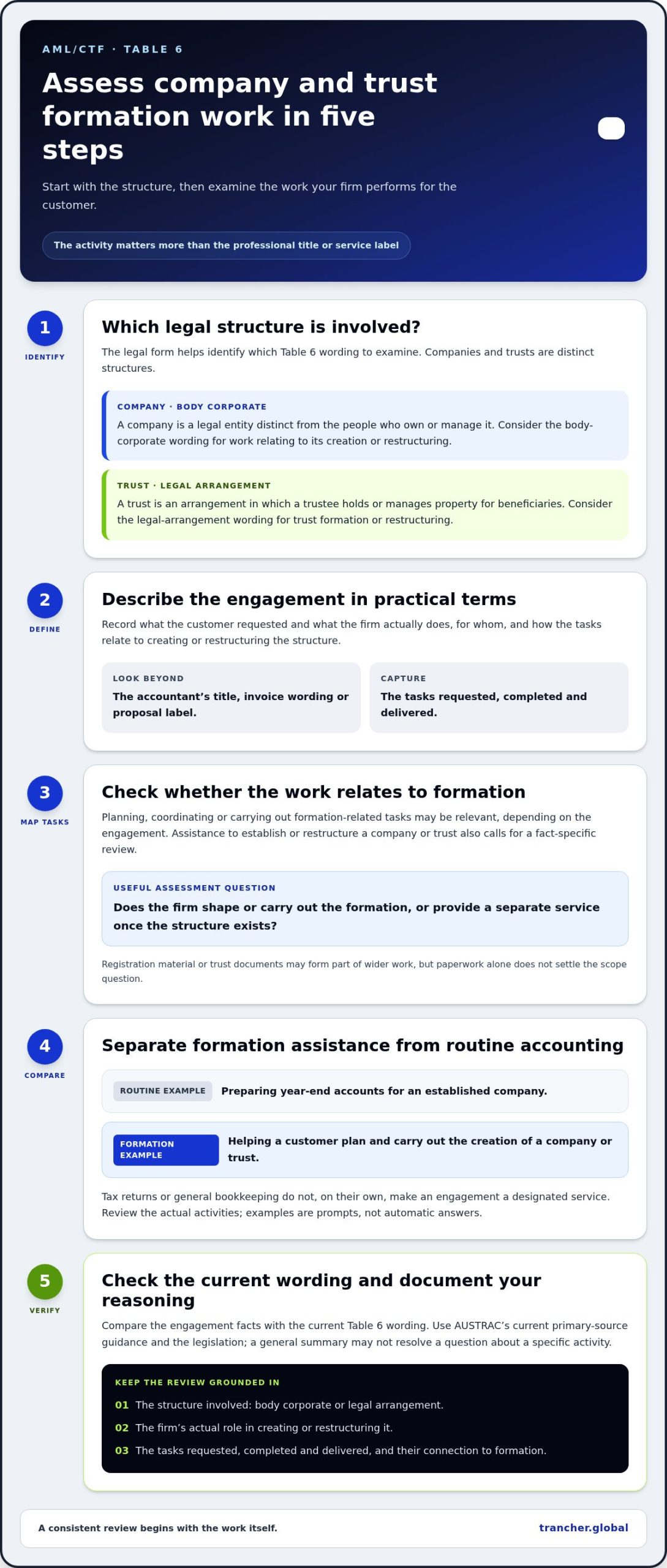
How can an accounting firm assess a company or trust formation engagement?
A consistent review helps turn a broad service description into a clear record of the work involved. It won’t replace professional judgement or determine a legal position by itself, but it can help your team identify the relevant questions, consult current AUSTRAC guidance and record its internal reasoning.
Use this four-step process for a new engagement or when an existing client request expands into formation-related work:
- Define the service. Record what the client has asked the firm to achieve. Is the request about establishing or restructuring a company or trust, or about accounting work for an existing structure?
- Map the tasks. Note the work requested and performed, who performs it, who receives it and how each task relates to the client’s intended outcome. Separate formation-related tasks from other services in the engagement record.
- Check the official wording. Compare the facts with the relevant current Table 6 wording and AUSTRAC’s primary-source guidance. Record assumptions, interpretive questions and details that remain unclear.
- Record the rationale. Document the wording considered, the engagement facts and the basis for the firm’s internal classification. Keep the note with the engagement materials so the reasoning can be reviewed if the work changes.
Map the engagement before drawing a conclusion
Imagine a client initially asks for help with routine accounts, then asks the firm to assist with steps to establish a trust. The original request and the later work raise different questions. Record when the scope changed, what the firm agreed to do and what it actually delivered. That timeline helps distinguish separate activities instead of relying on a single engagement label.
Keep the assessment tied to evidence. The engagement letter, client instructions, correspondence and work records can help show the scope and the firm’s role. If key facts are missing, record what needs clarification internally before reaching a view. Don’t treat an example or checklist as an automatic answer to a particular engagement.
Make the assessment repeatable across the firm
Use consistent terms in intake forms and service records, so staff describe the work itself rather than relying on broad labels such as “business support”. Under the firm’s governance arrangements, assign responsibility for reviewing uncertain cases and deciding when they need escalation. If a question remains unresolved, refer it through the firm’s established process for appropriate professional or legal review.
Revisit the assessment if the client’s instructions, the firm’s tasks or relevant AUSTRAC guidance changes. A shared review process can support more consistent decisions while keeping responsibility with the firm and its professional judgement.
Once you’ve assessed your firm’s exposure, explore Trancher’s AML compliance workflows. Trancher is a complete AML compliance solution for accounting firms, with integrated workflows, role-based training modules and expert on-call support to help organise compliance activity.
If formation work is captured, what should the firm prepare next?
Once your firm has assessed its exposure, move from classification to organised preparation. A designated service can bring AML/CTF obligations, so use the scope decision to identify the program processes, people and records that may need attention. Keep the detailed requirements grounded in current AUSTRAC guidance and your firm’s circumstances.
Tranche 2 obligations commenced on 1 July 2026. The AUSTRAC registration deadline was 1 July 2026, so firms should treat registration as a current compliance matter. The relevant requirement is: “Maintain records for minimum of seven years.”
Turn the scope decision into organised operational preparation
Map the assessment to the areas your firm needs to address. These may include AML/CTF program workflows, client verification and due diligence, risk monitoring, reporting and compliance activity tracking. For detailed requirements, consult AUSTRAC’s current primary-source material and the relevant AML program checklist and CDD and KYC requirements guides.
Good documentation helps make the process traceable. Keep the engagement assessment and its rationale alongside the relevant compliance records. Audit-ready documentation and organised activity tracking can support oversight, while the firm remains responsible for its own decisions and internal obligations.
Where Trancher fits after the firm understands its scope
After establishing which services may be in scope, an accounting firm can consider how to organise the related work consistently. Trancher is a complete AML compliance solution for accounting firms, not simply software. It brings together workflows for client verification, risk assessment, monitoring, reporting and compliance activity tracking, with audit-ready documentation and AUSTRAC-aligned workflows.
The solution also includes role-based training modules, expert on-call support, dedicated onboarding and local support. These resources help firms organise responsibilities and processes without replacing professional judgement or the firm’s internal responsibilities. Trancher offers a 30-day compliance guarantee, with the promise: Be compliant in 30 days. This is not legal advice or a promise of a particular regulatory outcome.
For firms assessing a company trust formation designated service, the practical next step is to connect the scope decision with clear workflows, records and staff guidance. Explore how Trancher can support AML compliance operations within your accounting firm.
Make engagement reviews part of everyday practice
A scope decision is most useful when it continues to inform how your firm handles new instructions. As client relationships develop, work can shift or expand, so build a habit of revisiting the assessment when the service changes. That keeps your internal view connected to the work being delivered, rather than relying on an old engagement description.
Use the company trust formation designated service assessment as a practical prompt for clear ownership. Ensure staff know where to record a change in scope, how to raise an uncertainty and who reviews it. Over time, that discipline can support more consistent decisions and help your team respond thoughtfully as client needs evolve.
For accounting firms ready to organise AML/CTF activity around their assessed obligations, Trancher brings integrated workflows together with role-based training modules, expert on-call support, dedicated onboarding and local support. This complete AML compliance solution can support your firm’s operational readiness.
Explore Trancher’s complete AML compliance solution for accounting firms and start a complimentary 3-month trial. No cost. No obligation. You’ll receive an ROI report at the end of your trial. Limited places available.
Frequently Asked Questions
Is every company or trust formation engagement a designated service?
No. A company’s or trust’s involvement doesn’t, on its own, determine whether the work is a designated service. For example, an established trust might appear in a client’s tax records without the firm assisting with its creation. Review the actual service against current Table 6 wording and AUSTRAC guidance, then keep a concise note of the facts considered and the basis for the firm’s assessment.
What is the difference between company formation and trust formation for Table 6?
Table 6 relates company formation to wording about a body corporate, while trust formation is considered under legal-arrangement wording. These terms point to different kinds of structures, so don’t assume the same tasks or conclusion apply to both. For a specific file, identify the structure involved, then check current AUSTRAC material for the precise wording relevant to the service the firm provides.
Can routine tax or bookkeeping work become a designated service because a client has a trust?
Not simply because the client has a trust. Preparing accounts for an established trust is different in nature from assisting with steps to create or restructure that arrangement. If a client adds new work during an accounting engagement, record that request separately and assess what the firm is being asked to do. This helps distinguish routine accounting from possible formation-related activity without relying on a broad service label.
How should an accounting firm review a company formation engagement?
Start with the client’s instructions and intended outcome, then set out the firm’s specific tasks, including any coordination or documentation work. Compare that record with the relevant Table 6 wording and current AUSTRAC guidance. Keep the assessment with the engagement file so another reviewer can understand the reasoning later. This practical review framework supports internal consistency, but it isn’t legal or compliance advice and doesn’t determine the firm’s legal position.
Does helping a client register a company automatically mean the firm is providing a designated service?
Not automatically. The word “register” doesn’t describe the full scope of an engagement. One firm may be asked to handle a limited administrative task, while another may be involved in broader planning or execution connected with establishing a company. Document what the client requested and what the firm undertook, then compare those facts with current official guidance. An evidence-based review is more useful than deciding from a task name alone.
What does AUSTRAC mean by a legal arrangement in this context?
Table 6 uses legal-arrangement wording for relevant designated services, and trusts are a key structure to consider in formation work. Avoid extending the term beyond the meaning given in current authoritative material. If a client’s arrangement is unfamiliar or its classification is unclear, note the issue and consult AUSTRAC’s current guidance for the applicable wording before recording the firm’s view.
What should a firm do if it is unsure whether its formation work is captured?
Set out the engagement facts before deciding: the client’s request, the structure involved, the tasks performed and how those tasks relate to creating or restructuring it. Compare that information with current AUSTRAC guidance and document any unresolved point. Then use the firm’s established escalation process, such as referring the question to the person responsible for reviewing scope assessments or obtaining appropriate professional advice.