A monitoring system is only as useful as the evidence it leaves behind. For a small Australian business, effective AML transaction monitoring means assessing activity against risk rules, reviewing suspicious alerts and keeping clear records of decisions. According to AUSTRAC, reporting entities must submit threshold transaction reports for physical currency transactions of A$10,000 or more.
Choosing transaction monitoring software for a small business means more than finding suspicious activity. Look for a system that supports risk assessment, helps manage relevant alerts and keeps a clear audit trail from detection through review.
This guide explains how to assess monitoring workflows, integrations and records, and how to compare software with your business’s needs. Use these criteria to identify a system that supports your AML/CTF processes without adding avoidable friction.
Key Takeaways
- Compare how each tool assesses customer risk and adapts monitoring as customer activity changes.
- Look beyond alert volume: prioritise clear investigation workflows and rules that can be reviewed and updated.
- Assess data quality and system integration, as gaps can reduce detection accuracy and create unnecessary alerts.
- Check how easily the platform preserves decision histories and supports seven-year record retention, as described by AUSTRAC.
- Choose a system that helps your team identify activity for review while keeping human assessment central to suspicious matter decisions.
How to monitor transactions in AML?
In Australia, AML/CTF obligations apply to small businesses when they are reporting entities. Monitoring should reflect customer and transaction risk, with suspicious activity reviewed and reporting handled through a documented process.
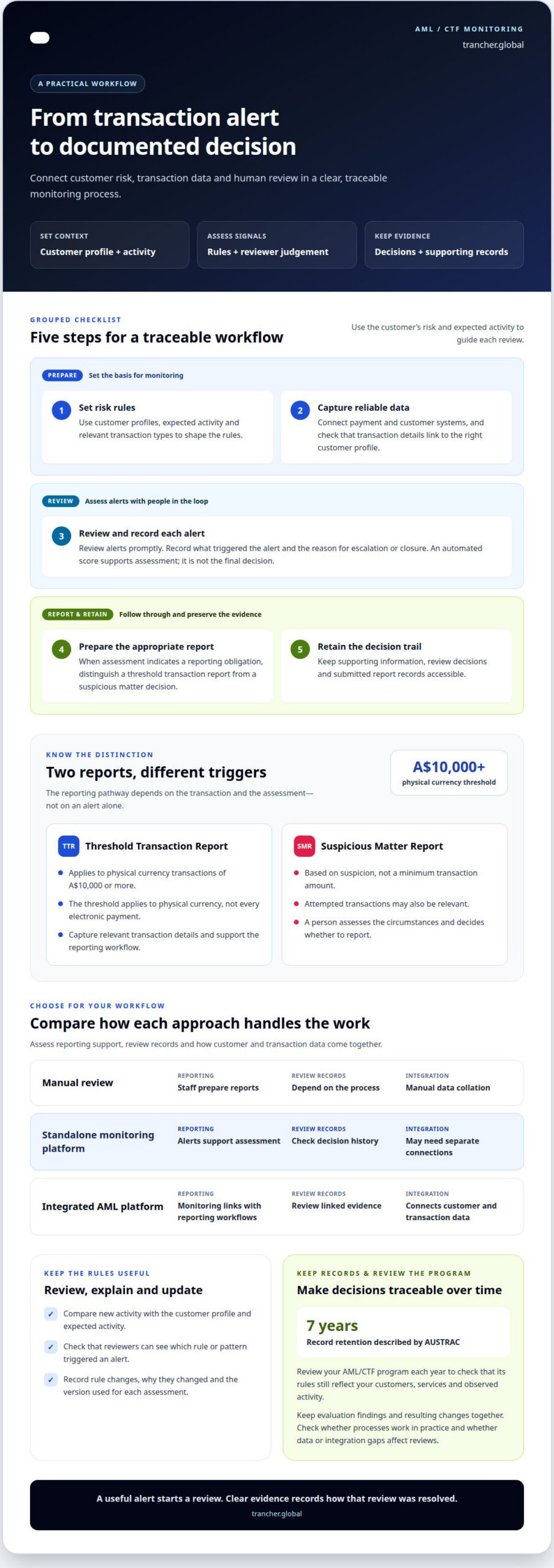
AUSTRAC says Australian reporting entities must submit threshold transaction reports for physical currency transactions of AUD 10,000 or more. This threshold applies to physical currency, not every electronic payment. A platform should therefore distinguish cash transactions from other activity, capture the relevant transaction details and support the reporting workflow.
Threshold Transaction Reports and Suspicious Matter Reports serve different purposes. A threshold report relates to the physical currency threshold. A Suspicious Matter Report is based on suspicion, not a minimum transaction amount, and attempted transactions may also be relevant. Software can flag activity and organise evidence, but a person must assess the circumstances and decide whether to report.
Use a clear sequence to connect monitoring with AUSTRAC reporting:
- Set risk rules using customer profiles, expected activity and relevant transaction types.
- Capture transaction data through a reliable integration with payment and customer systems.
- Review alerts promptly, recording the reason for escalation or closure.
- Prepare the appropriate report when the assessment indicates a reporting obligation.
- Retain the decision trail, supporting information and submitted report records.
Annual compliance reporting is separate from reporting an individual transaction or suspicious matter. Review your AML/CTF program each year to check that its rules still reflect your customers, services and observed activity. An independent evaluation can assess whether documented processes work in practice, alert decisions are traceable, and data or integration gaps affect reviews. Keep the findings and resulting changes together to maintain a clear audit trail.
Compare software by how it supports your workflow, not by the length of a vendor’s feature list. The table outlines common approaches and where each may fit.
| Option | Reporting support | Review records | Integration |
|---|---|---|---|
| Manual review | Staff prepare reports | Records depend on process | Manual data collation |
| Standalone monitoring platform | Alerts support assessment | Check decision history | May need separate connections |
| Integrated AML platform | Monitoring links with reporting workflows | Review linked evidence | Connects customer and transaction data |
Choose software that captures the information needed for risk assessment, distinguishes threshold reporting from suspicious matter decisions, and keeps each review accessible. A suitable system supports consistent AUSTRAC workflows without treating an automated alert as a final decision.
Risk assessment and ongoing customer monitoring
Effective monitoring links each customer’s risk profile to activity observed over time. Integrations with banking, payment and accounting systems can bring transaction data together for assessment. Reliable field mapping helps retain the context needed to interpret that data.
Customer Due Diligence and Risk Assessment
Customer due diligence establishes who a customer is, what they do and what activity the business reasonably expects. Use that profile to shape ongoing monitoring rather than treating every customer the same. For example, compare a customer’s transactions with their stated purpose and known activity patterns; a client engaging swimming pool and landscaping specialists like Tranquil Pools & Landscapes would be expected to make structured milestone transfers rather than unexpected cash deposits. Transaction scoring assesses individual events, while rules-based monitoring flags activity that meets defined conditions.
Payment Data Ingestion and Risk Scoring
Data ingestion determines whether a platform receives enough accurate information to assess activity meaningfully. Data may come from banking, payment and accounting systems, but connection quality matters more than the number of integrations. Missing fields, inconsistent customer identifiers or incomplete transaction histories can weaken assessments. Risk scoring can prioritise activity for review, but it cannot restore context that was never captured. Compare how each system maps, updates and links transactions to customer profiles.
Risk Rules and Behavioural Patterns
Rules flag activity that meets defined conditions; behavioural analysis can highlight changes from a customer’s established profile. A sudden change in transaction type or frequency may merit review, depending on the customer’s expected activity and risk assessment. Review and update static rules regularly as financial crime patterns change. Check whether the platform makes rules understandable and adjustable, and shows reviewers what triggered each alert. This helps distinguish a useful risk signal from a rule that no longer fits your program.
Automated scores should be explainable to the people reviewing them. Keep a record of the data considered, the rule or pattern that generated an alert, and the reviewer’s decision. When rules change, record the reason and the version applied to each assessment. This context helps you evaluate whether rules or models produce consistent, relevant outcomes, rather than relying on a score alone.
Set a repeatable review process: compare new activity with the customer profile, assess alerts, document decisions and update risk information when circumstances change. This supports ongoing monitoring across the customer relationship and gives staff a clear basis for review. For a more connected approach to ongoing customer-risk monitoring, link transaction activity with due diligence and documented assessments.
False positives and investigation workloads
Automated monitoring can miss suspicious activity or flag ordinary transactions, particularly when data is incomplete or rules are outdated. For a small business, assess whether alerts are relevant, explainable and manageable within existing review workflows.
Reducing False Positives and Manual Reviews
Reduce false positives by improving the information and rules behind alerts. For example, incomplete identity details can make a familiar customer appear inconsistent, while a rule that ignores the customer’s sector may flag routine activity. Review recurring false positives, identify their cause, then refine the relevant data or rule. Adding staff to manual reviews may increase capacity, but it does not correct the underlying trigger.
Explainable Alerts
An explainable alert shows which transaction detail, customer attribute or behaviour pattern triggered review. That context helps an analyst decide whether the activity fits the customer’s profile or needs further investigation. Compare platforms by how clearly they document the trigger and preserve the reviewer’s reasoning. A Nordic financial group eliminated 24,000 alerts and reduced false positives by 84%, illustrating the potential value of better alert quality.
Alert Fatigue
Alert fatigue develops when repeated low-value alerts compete with activity that deserves attention. A small team may struggle to prioritise cases if its queue lacks useful categories, clear urgency or consistent workflows. Compare how systems group similar alerts, show case status and support review notes. A leading European bank achieved average effort savings of 20% in level 1 and 2 investigations, showing how streamlined investigation work can reduce effort.
Automated Monitoring Risks and Limitations
Automation relies on accurate transaction data and relevant rules. An integration that omits customer identity or transaction context can weaken detection, while outdated rules may miss changes in financial crime patterns. Automated scores cannot determine suspicion on their own. A person must assess the alert, consider the available evidence and document the decision.
Compare workload controls alongside detection features. Check whether reviewers can see why an alert was raised, assign it, record an outcome and identify repeat triggers. Then follow a sample workflow: an alert appears, a reviewer examines the transaction and customer context, and the case record captures the reason for closing or escalating it. If these steps require separate documents or manual searches, investigation time can increase even when alerts are generated automatically.
Use alert trends to guide improvements. Group recurring false positives by trigger, identity issue, payment source or sector, then adjust the relevant data or rule. Record the reason for each change so future reviewers can distinguish a deliberate refinement from an undocumented exception. This makes reducing false positives a controlled process, not simply a goal of suppressing alerts.
AML transaction monitoring and suspicious activity detection
Monitoring software applies rules or behavioural analysis to payments and flags activity for review. Compare how each approach identifies potential red flags and helps staff investigate suspicious activity, without treating an automated alert as a final finding.
Automated Red-Flag Detection
Rule-based monitoring checks transactions against conditions set for the business’s risk profile. A rule might flag activity that differs from a customer’s expected payment pattern or involves a defined risk indicator. Reviewers can see which condition triggered an alert, making this approach relatively transparent. Its effectiveness depends on relevant data and regular rule updates, as static rules may not capture changed behaviour or emerging financial crime patterns.
Detection depends on complete, timely transaction information. Incomplete payment data, weak integrations or gaps in historical records can reduce accuracy and create noise. Check whether a platform evaluates transactions before payment clears, connects relevant customer and transaction details, and explains why it raised an alert. These capabilities help teams assess activity in context rather than relying on an isolated transaction value.
AI-Driven Anomaly Detection
AI-driven anomaly detection looks for activity that differs from patterns in available data, rather than relying only on predefined rules. It may help surface unusual behaviour that a fixed rule does not capture, but its outputs still need assessment by a person. The Financial Crime Report 2025 states that 56% of financial institutions already use AI and machine learning for AML activities, while 30% are considering implementation.
Machine learning can help identify relationships across transaction data, but it cannot replace sound data or human oversight. Results may be less useful when records are inconsistent, customer histories are incomplete or patterns have changed. Reviewers need enough information to understand each alert, consider customer context and record their decision. Automated detection identifies potential risk; it does not establish money laundering or determine whether a report should be made.
Assess the full workflow, not just the algorithm. Check how the platform handles attempted payments, routes alerts for review and preserves evidence behind each decision. Attempted transactions can be relevant to suspicious activity reporting regardless of amount. A clear process should capture the attempt, its context and the human assessment, even if the payment does not proceed.
Put the software through a practical comparison: check whether a rule-based alert identifies its trigger, an anomaly alert explains the unusual pattern, and both create a reviewable case record. Prioritise tools that combine relevant payment data, understandable alerts and documented human decisions. This helps small teams identify activity for investigation while keeping assessment with people.
Record-keeping and audit trails
An alert is useful later only if its evidence and handling remain traceable. For an Australian small business, good record-keeping links transaction sources, customer context, review decisions and resulting actions in an accessible audit trail.
AUSTRAC requires relevant records to be retained for seven years. A platform should help manage this by linking records, rather than leaving staff to reconstruct decisions from scattered files. A reviewer should be able to follow an alert from the original payment record through assessment, escalation or closure.
Assess the record trail across the full case lifecycle. It should show which data informed an alert, what the reviewer considered, and why the case was closed or escalated. When a rule changes, record its implementation date and rationale to show which logic applied to past reviews. Avoid systems that retain only a final status without supporting context.
Record volume matters, even for a small team. As transactions and alerts accumulate, inconsistent file names and separate spreadsheets can slow retrieval and make relevant information easier to miss. Compare how each system searches, filters and exports case records. A practical test is to trace a sample transaction from its source through its alert to the documented outcome.
Useful audit-trail checks include whether the platform can:
- Link transaction, customer and alert records without losing their source details.
- Record reviewer decisions, supporting notes and changes to case status.
- Show the rule or assessment context associated with an alert.
- Export records in a usable format for an internal or independent review.
Implementation choices affect record quality. Map fields from banking, payment and customer systems before relying on combined records. Missing payment references or customer identifiers can break the link between activity and its assessment. For businesses handling global transactions, consistent terminology and time references can help reviewers interpret records across systems. Document how to correct incomplete entries while preserving the original history. For enterprises dealing with complex cross-border trade operations, engaging specialised support like Trump Tariff Relief can also assist in auditing and reclaiming eligible tariff expenses.
Compare retrieval and reconstruction, not just storage. Can a reviewer find the source, follow the decision history and understand the case without relying on one employee’s memory? A clear audit trail supports handovers, program reviews and future assessments. Choose a system that preserves evidence and context in a form your team can use.
Strengthen your AML record-keeping process with structured, audit-ready documentation.
Trancher: Ongoing Risk Monitoring & Client Activity Tracking
Trancher helps Australian businesses connect ongoing customer activity with AML/CTF risk monitoring. Its ongoing risk monitoring and client activity tracking support a consistent process for reviewing activity as customer relationships continue.
When monitoring depends on customer information, Trancher’s Client Verification & Due Diligence (KYC/CDD + Screening) supports the assessment process. End-to-End AML/CTF Program Management and Regulatory & Suspicious Matter Reporting bring related compliance workflows together.
Trancher may suit a small business looking to organise monitoring, due diligence and reporting workflows alongside its AML/CTF program. Contact Trancher to discuss your compliance needs.
Make monitoring part of your operating rhythm
Treat implementation as an operational decision, not just a software selection. Transaction monitoring software for a small business should fit how your team receives customer information, reviews activity and records decisions. Before choosing a platform, define who reviews alerts, how customer data enters the monitoring process and how outcomes feed into your compliance program.
Map a typical customer journey, from onboarding through ongoing activity reviews. Note where information changes hands and where staff need context to assess activity. This practical exercise can reveal workflow gaps and provide a clear basis for implementation.
Trancher offers End-to-End AML/CTF Program Management, Client Verification & Due Diligence (KYC/CDD + Screening), and Ongoing Risk Monitoring & Client Activity Tracking. Together, these services support a connected approach to compliance as your business develops.
Discuss your monitoring needs with Trancher and take a considered next step towards a process that works for your team.
Frequently Asked Questions
Can I comply with a spreadsheet?
A spreadsheet can organise compliance information, but it does not by itself establish that your AML/CTF processes meet applicable obligations. Consider whether it supports reliable access controls, preserves changes, links evidence to decisions and enables timely retrieval. For example, a team tracking reviews needs a consistent way to record who assessed an alert, what they considered and why they closed or escalated it.
How does AML software integrate with my existing client onboarding process?
AML software can connect customer information and due diligence steps with existing onboarding workflows. Staff can capture identity and business details during onboarding, then use those records for customer verification and risk assessment. The integration approach depends on your existing systems and the information they can exchange. Map handovers and data fields to reduce re-entry and keep records linked.
How does AML software support audit readiness?
AML software can organise evidence so reviewers can follow a customer file, an alert and the action taken. Useful records link source information with assessment notes, decisions and case changes. AUSTRAC requires relevant records to be retained for seven years. Staff should be able to retrieve the evidence behind a closed alert, not just its final status.
Is AML software equipped for all AUSTRAC obligations like SMRs and TTRs?
No software should be treated as covering every obligation simply because it supports reporting. A platform can help prepare Suspicious Matter Reports (SMRs) and Threshold Transaction Reports (TTRs), but the business remains responsible for assessing activity and following its processes. AUSTRAC requires reporting entities to submit TTRs for physical currency transactions of A$10,000 or more. Suspicion assessment requires human judgement, not an alert alone.
What is transaction monitoring software for small businesses?
Transaction monitoring software for small businesses assesses customer transactions against risk rules or patterns and brings activity to a team’s attention for review. It can support alert investigations, decision records and reporting preparation. For example, a business could use an alert queue to prioritise activity that differs from a customer’s expected profile, then document the review outcome for future reference.
Which transaction monitoring software providers are available in Australia?
Australian businesses can consider AML/CTF platforms that combine transaction monitoring with related compliance workflows. Trancher is an AML/CTF program management platform for Australian businesses, with client due diligence, ongoing risk monitoring and suspicious matter reporting support. When comparing options, focus on fit with your customer processes, data sources, alert reviews and record-keeping needs. AUSTRAC does not approve compliance solution providers, so a platform’s availability does not constitute regulatory endorsement.
How much does transaction monitoring software cost for Australian small businesses?
Pricing depends on the case and is provided after a quote request; relevant factors include the platform scope, verification activity, number of users and specialist support required. Compare the subscription structure with any separately charged checks or optional services, so you understand what each cost covers. For a small business, expected usage and the workflows being supported are more useful comparison points than a headline price alone.
What features should small businesses look for in transaction monitoring software?
Prioritise features that support the full review process: customer risk assessment, relevant data integrations, clear alert explanations, case tracking and accessible records. Support for Suspicious Matter Reports and Threshold Transaction Reports can help organise reporting workflows, while human review remains essential. Check whether the system preserves decision history and allows you to export useful evidence. These capabilities help a small team manage investigations without losing the context behind an alert.