
A civil penalty is not necessarily one fine for one compliance failure. Under the AML/CTF Act, each contravention of a civil penalty provision may be dealt with separately. Understanding AUSTRAC civil penalties therefore means looking beyond the headline maximum to the conduct behind each alleged breach.
For contraventions on or after 1 July 2026, the maximum civil penalty for a company is A$36.4 million per contravention. AUSTRAC can apply to the Federal Court for a civil penalty order, but the maximum is not an automatic fine: the Court determines whether a contravention occurred and what penalty to impose.
It is understandable to focus first on the potential financial impact. A practical starting point is to identify which obligations apply and where gaps in enrolment, customer due diligence, reporting or record-keeping could lead to enforcement.
This article explains how civil penalties work, what can trigger AUSTRAC action and how maximum amounts are calculated. It also outlines practical compliance steps, from maintaining a fit-for-purpose AML/CTF program to keeping records and reporting on time.
Key Takeaways
- Match the applicable penalty-unit value to the date of the alleged contravention; from 1 July 2026, one unit is A$364.
- Build compliance around practical controls: keep required records, review the AML/CTF program and meet reporting deadlines.
- Understand how separate contraventions and individual involvement can affect the scope of enforcement action.
- Distinguish the maximum civil penalties for companies and individuals from the penalty a court may ultimately order.
- Explore how structured program management, due diligence, risk monitoring and reporting support consistent AML/CTF compliance.
How do AML/CTF penalties work in Australia?
AUSTRAC regulates compliance with Australia’s AML/CTF laws and can apply to the Federal Court for civil penalty orders. Penalties are expressed in penalty units, whose dollar value depends on when the alleged contravention occurred.
Penalty units and monetary values
A penalty unit is a statutory measure used to calculate the maximum monetary penalty for a contravention. The number of units alone does not show the potential financial exposure: the applicable dollar value must also be applied.
The monetary value of a penalty unit can vary over time, so check the applicable rate for the relevant contravention. Under section 175 of the AML/CTF Act, the maximum civil penalty for a body corporate is 100,000 penalty units per contravention. At that rate, the maximum is A$36.4 million for each contravention.
The maximum is not an automatic fine. AUSTRAC applies to the Federal Court for an order, and the Court decides whether a contravention occurred and what penalty, if any, to impose within the statutory limit.
Values based on conduct dates
The applicable penalty-unit value is tied to the date of the conduct, not simply the date proceedings begin. This distinction matters if an alleged failure spans different periods or involves earlier reporting.
For conduct from 7 November 2024 to 30 June 2026, a unit is A$330. Earlier values were A$313 from 1 July 2023 to 6 November 2024, and A$275 from 1 January 2023 to 30 June 2023.
For conduct from 1 July 2020 to 31 December 2022, a unit is A$222. It was A$210 from 1 July 2017 to 30 June 2020, A$180 from 31 July 2015 to 30 June 2017, and A$170 from 28 December 2012 to 30 July 2015. Before 27 December 2012, it was A$110. Match the alleged conduct date to its rate before calculating exposure.
AUSTRAC civil penalty orders
A civil penalty order is made by the Federal Court and requires payment to the Commonwealth after AUSTRAC applies for it. This differs from an infringement notice issued by AUSTRAC: a court application puts the alleged contravention before the Court.
Each contravention of a civil penalty provision may be the subject of a separate order. The Court considers whether the relevant provision was contravened, while the number of contraventions and the applicable statutory maximum shape potential exposure. AUSTRAC may also seek an injunction as an enforcement action.
The Court determines the penalty, rather than simply applying the maximum number of units. For individual liability, section 175 sets a maximum of 20,000 penalty units per contravention from 1 July 2026.
Review, settlement and case outcomes
Because the Federal Court makes a civil penalty order, a challenge to that decision follows court appeal procedures, rather than an AUSTRAC review of its own order. The Court considers the proven contravention and relevant statutory limit when determining the outcome.
Proceedings can also involve an agreed position. In Westpac’s case, AUSTRAC and the bank filed an agreed statement of facts on 24 September 2020, including a proposed A$1.3 billion penalty. The Federal Court ordered Westpac to pay A$1.3 billion on 21 October 2020 after finding breaches on more than 19 million occasions.
Other outcomes show the range of penalties: the Federal Court ordered Tabcorp to pay A$45 million on 16 March 2017, and Crown Melbourne and Crown Perth to pay A$450 million on 11 July 2023. These cases demonstrate why understanding AUSTRAC civil penalties requires looking at the conduct and findings, not just the maximum.
AML/CTF compliance steps to reduce penalty risk
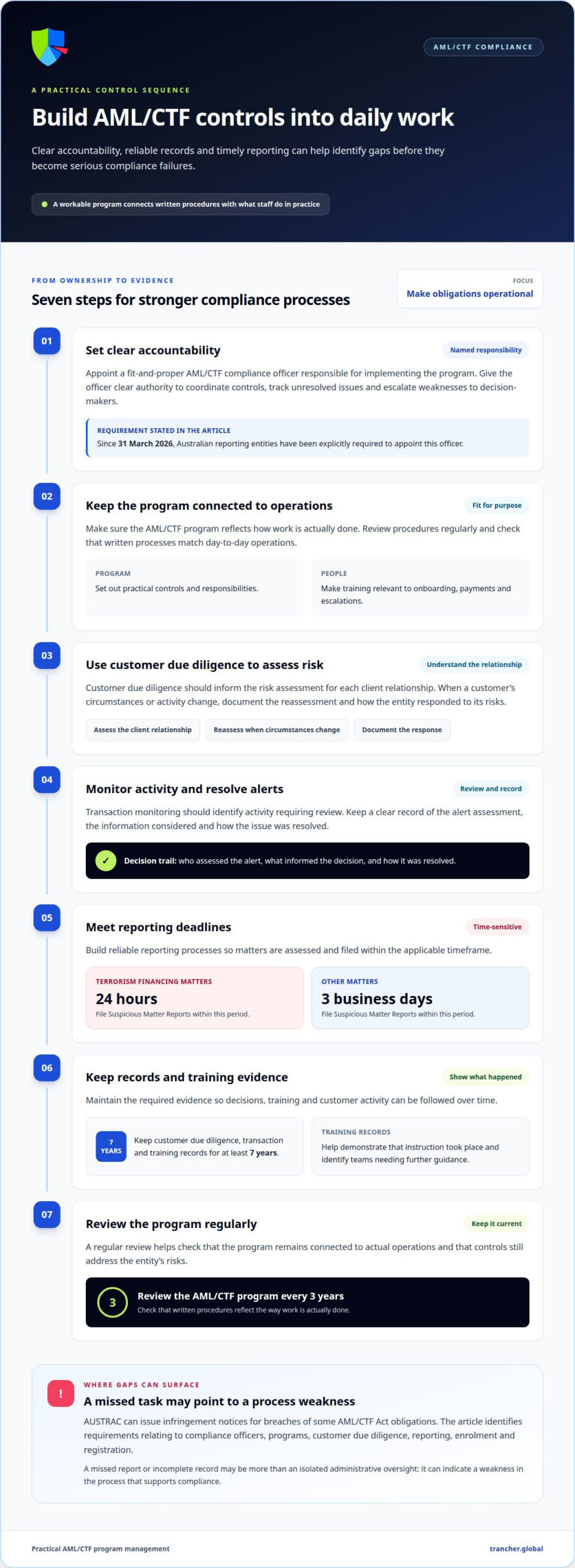
Penalty exposure is easier to manage when obligations are built into daily work. A current AML/CTF program, clear staff responsibilities and reliable reporting processes can help identify gaps before they become serious compliance failures.
Start with accountability. Since 31 March 2026, Australian reporting entities have been explicitly required to appoint a fit-and-proper AML/CTF compliance officer responsible for implementing the program. Give that officer clear authority to coordinate controls, track unresolved issues and escalate weaknesses to decision-makers.
Keep the program connected to actual operations. Customer due diligence should inform the risk assessment for each client relationship, while transaction monitoring should identify activity requiring review. When a customer’s circumstances or activity change, documenting a reassessment helps show how the entity responded to its risks.
- Maintain customer due diligence, transaction and training records for at least 7 years.
- Review the AML/CTF program every 3 years.
- File Suspicious Matter Reports within 24 hours for terrorism financing matters, and within 3 business days for other matters.
- Record who assessed an alert, what information informed the decision and how the issue was resolved.
These controls matter because AUSTRAC can issue infringement notices for breaches of some AML/CTF Act obligations. These include requirements relating to compliance officers, programs, customer due diligence, reporting, enrolment and registration. A missed report or incomplete record may point to a process weakness, not just an isolated administrative oversight.
Make training practical. Staff handling onboarding, payments or escalations need to understand how the program applies to their work. Training records help demonstrate that instruction took place and identify teams needing further guidance. Review procedures regularly to check that written processes match how work is actually done.
For 2026-27, AUSTRAC expects newly regulated businesses to be enrolled, have an AML/CTF program and compliance officer, train staff, and be ready to report suspicious matters. Preparation should therefore bring enrolment, role allocation, staff training and reporting workflows together, rather than treating them as separate launch tasks.
When a control fails, document the issue, its impact and the corrective action. Assign follow-up responsibility and update the relevant procedure or training where needed. This creates a clear record of how the entity addressed weaknesses and strengthened its compliance practices.
For firms building these controls into daily operations, end-to-end AML/CTF program management can bring program processes into a more coordinated workflow.
What triggers AUSTRAC enforcement action?
AUSTRAC enforcement can follow failures to meet AML/CTF obligations, including requirements for reporting, enrolment and customer due diligence. Each contravention of a civil penalty provision may be considered separately, so the nature and recurrence of a failure matter.
Obligations that can trigger a penalty
A contravention occurs when a reporting entity fails to meet an applicable AML/CTF requirement. Obligations that may lead to infringement notices include maintaining a compliance officer and program, completing customer due diligence, reporting, enrolment and registration.
Reporting failures offer a practical example. AUSTRAC alleged that Castra Licensee Pty Ltd and Princeton Securities (NSW) Pty Ltd did not submit annual compliance reports for the 2023 calendar year. In September 2024, infringement notices were issued to 16 Australian businesses over missed compliance reports. Castra and Princeton did not pay their notices, prompting AUSTRAC to commence Federal Court action.
A missed obligation may prompt more than a notice. AUSTRAC can seek civil penalty orders or injunctions, issue a written remedial direction, or require an external audit where it has reasonable grounds to suspect non-compliance. AUSTRAC guidance can explain expected practice, while courts determine whether legal provisions were contravened.
Individual liability for involvement
Individual exposure must be distinguished from a civil penalty against a business. Under Australia’s AML/CTF framework, individuals may face criminal exposure, while civil proceedings can have consequences for a body corporate. A person’s role in decisions, reporting and escalation may therefore matter when authorities assess conduct.
Some failures also involve separate criminal offences. Section 41 makes failing to file a Suspicious Matter Report when reasonable grounds for suspicion exist an offence. Tipping off can carry up to 120 penalty units and 2 years’ imprisonment. Structuring transactions to avoid reporting thresholds can carry up to 5 years’ imprisonment.
These outcomes are distinct from civil penalty orders. They illustrate why staff guidance, escalation pathways and reliable decision records matter. Clear records can help explain who handled a concern, what information informed the response and whether it was escalated within the organisation.
Repeated and transaction-based contraventions
Repeated conduct can increase exposure because each contravention of a civil penalty provision may be the subject of a separate order. A recurring control failure may therefore raise questions about multiple instances, rather than one isolated lapse.
A conveyancing practice handling 100 matters per year could face 100 separate contraventions if it processed each matter without enrolment after that date. The example illustrates why enrolment status and transaction records need close operational oversight.
Look for patterns, not just individual errors. Repeated missed reports, unresolved alerts or gaps in client checks can signal that a process needs attention. A documented response, supported by staff guidance and accurate records, helps show how the entity addressed the underlying issue.
Maximum civil penalties under the AML/CTF Act
Section 175 sets maximum civil penalties for each contravention of specified AML/CTF provisions. The applicable maximum depends on whether the respondent is a company or an individual.
Maximum civil penalty limits
A maximum is the statutory ceiling for a civil penalty order, not an automatic amount payable after every breach. AUSTRAC must apply to the Federal Court, which decides whether a contravention occurred and whether to order a penalty.
For contraventions on or after 1 July 2026, section 175 sets a maximum of 100,000 penalty units per contravention for a body corporate. At A$364 per unit, that is A$36.4 million for each contravention. Separate contraventions may create separate potential limits.
The applicable rate depends on the conduct date. For example, the A$364 unit value applies from 1 July 2026, while earlier conduct may use an earlier rate. A reporting entity assessing exposure should distinguish the alleged conduct period from the date AUSTRAC starts proceedings.
Not every AML/CTF breach uses the section 175 maximum. Under section 6, providing a designated service without AUSTRAC enrolment carries a maximum civil penalty of 10,000 penalty units per contravention. The provision involved therefore matters as much as the respondent’s status.
Penalties for companies and individuals
Section 175 sets a lower maximum for an individual than for a body corporate. For contraventions on or after 1 July 2026, the individual maximum is 20,000 penalty units per contravention, compared with 100,000 units for a body corporate.
At A$364 per unit, the individual maximum is A$7.28 million per contravention. The company maximum is A$36.4 million per contravention. These figures are statutory ceilings, not predictions of what the Federal Court will order in a particular proceeding.
Separate infringement notices use different unit amounts. A company notice is generally 60 penalty units, stated as A$21,840 at the current rate described for that notice. An individual notice is generally 12 penalty units, stated as A$4,368. An infringement notice is distinct from a court-ordered civil penalty.
For a practical assessment, identify the legal provision, date of conduct, type of respondent and number of alleged contraventions. Then distinguish an infringement notice from potential Federal Court proceedings. This helps a reporting entity understand the relevant statutory ceiling without treating the maximum as an inevitable outcome.
AML/CTF Act civil penalty provisions
The provisions matter because they define which AML/CTF duties can lead to enforcement and what consequences may follow. The reporting obligations relevant to the proceedings are under Australia’s Anti-Money Laundering and Counter-Terrorism Financing Act 2006, according to the Federal Register of Legislation.
The framework includes civil penalty provisions and separate criminal offences. A civil penalty order is sought through the Federal Court, while criminal exposure concerns offences under the Act. Keeping these pathways distinct helps reporting entities understand the difference between an alleged breach, a court application and a criminal prosecution.
Section 175 sets the maximum civil penalty for a body corporate at 100,000 penalty units per contravention for conduct on or after 1 July 2026. For an individual, the maximum is 20,000 penalty units per contravention. The applicable dollar amount depends on the penalty-unit value for the conduct date.
Other provisions address particular conduct. Under section 6, providing a designated service without AUSTRAC enrolment carries a maximum civil penalty of 10,000 penalty units per contravention. Section 142 concerns structuring transactions to avoid reporting thresholds, which can attract up to 300 penalty units and up to 5 years’ imprisonment. The relevant provision shapes the type of exposure.
AUSTRAC has several enforcement options. It can issue infringement notices, require enforceable undertakings, apply to the Federal Court for civil penalty orders, refer matters for criminal prosecution, and cancel or suspend reporting entity status. It may also issue a written remedial direction or require an external audit where the relevant grounds apply.
Case outcomes show how provisions operate in practice. On 11 July 2023, the Federal Court ordered Crown Melbourne and Crown Perth to pay A$450 million. On 7 June 2024, SkyCity Adelaide Pty Ltd was ordered to pay A$67 million for AML/CTF Act breaches. These are court outcomes, not automatic amounts attached to every contravention.
AUSTRAC must commence Australian civil penalty proceedings within 6 years of the contravention. That limit makes the timing and records of alleged conduct important when assessing a matter. A clear record of reporting decisions, customer checks and corrective action can help establish what occurred and when.
For a reporting entity, the practical takeaway is to map each obligation to its governing provision, evidence and escalation process. This makes it easier to identify whether a concern involves a civil penalty provision, an infringement notice or possible criminal exposure. Strengthen your AML/CTF compliance processes with structured reporting and monitoring support.
Trancher
Trancher helps Australian reporting entities organise AML/CTF obligations through an end-to-end program that connects compliance processes. The platform supports client verification and due diligence, ongoing risk monitoring, and regulatory and suspicious matter reporting.
Consider this support when compliance responsibilities are spread across teams, customer checks are difficult to track, or reporting workflows need greater consistency. Coordinated processes can make obligations easier to manage and help keep records aligned with day-to-day activity. Trancher supports operational compliance; it does not provide legal representation or outsourced AML officer services.
If you want to strengthen how your firm manages AML/CTF compliance, contact Trancher to discuss your needs.
Build compliance into the way your firm works
Use understanding AUSTRAC civil penalties as a prompt to consider how regulatory responsibilities fit into your firm’s daily decisions. The next step is not simply to respond when a concern arises. Make compliance part of how people work, how decisions are recorded and how emerging issues reach the right person.
This operational perspective can help leaders identify where processes rely too heavily on individual memory, where responsibilities need clearer ownership and where teams need practical support. It also helps position regulatory readiness as part of sound business management, rather than a task addressed only during an audit or enforcement action.
Trancher supports Australian businesses with AML/CTF program management, client verification and due diligence, and ongoing risk monitoring. If you’re considering how these capabilities could fit your firm’s compliance approach, contact Trancher to discuss compliance.
Steady, well-integrated practices can help your team approach its obligations with greater clarity and confidence.
Frequently Asked Questions
Does the AML/CTF Act contain criminal offences?
Yes. The Act contains criminal offences as well as civil penalty provisions, and the two pathways have different consequences. For example, section 41 makes failing to submit a Suspicious Matter Report when reasonable grounds for suspicion exist an offence. Tipping off and structuring transactions to avoid reporting thresholds are also criminal matters. A civil penalty proceeding, by contrast, concerns a court order for a contravention of a civil penalty provision.
How do penalties multiply per breach?
Potential exposure can increase when conduct amounts to multiple contraventions, because each contravention of a civil penalty provision may be dealt with separately. For instance, transactions processed without required enrolment may each be treated as separate contraventions. The actual number depends on the alleged conduct and the provision involved, not simply the number of internal errors recorded. The Federal Court decides whether contraventions occurred and whether to order a penalty.
Are directors and officers personally liable?
A company’s civil penalty and an individual’s exposure are separate questions. The AML/CTF framework recognises criminal exposure for individuals, while civil proceedings can have consequences for a body corporate. A director’s or officer’s position alone does not determine liability; the relevant conduct and applicable provision matter. If an investigation concerns an individual, identify the alleged actions and whether the matter is civil or criminal.
Are board directors personally exposed?
Board membership alone does not establish whether a director faces personal exposure. Individual exposure depends on the conduct under examination and the legal provision relied on, while the company may face separate civil consequences. For example, board records showing how an AML/CTF issue was escalated can help clarify what decisions were made and by whom. Consider personal exposure separately from the organisation’s potential civil penalty.
Can a small business be fined by AUSTRAC?
Yes. The AML/CTF Act applies to reporting entities in Australia, including single-venue community clubs, so a business’s size alone does not remove its obligations. AUSTRAC can issue infringement notices for breaches of some requirements and apply to the Federal Court for civil penalty orders. The key questions are whether the business provides a designated service and whether it has met the obligations that apply.
Can directors and partners be personally affected?
Yes, individuals can face consequences separate from a business’s civil exposure, including criminal exposure under applicable AML/CTF offences. This does not mean every director or partner is automatically liable when a business fails to comply. Conduct, role and the applicable provision matter. A practical first step is to preserve relevant decision records and distinguish allegations against the entity from any concerning an individual.
Which Australian laws govern AUSTRAC civil penalties?
The principal law is the Anti-Money Laundering and Counter-Terrorism Financing Act 2006, which establishes reporting obligations and civil penalty provisions. The Crimes Act 1914 sets the dollar value of a penalty unit, which is updated periodically. AML/CTF Rules and regulations also form part of the framework. AUSTRAC explains its interpretation, while Australian courts ultimately interpret the law and decide whether a provision has been contravened.
How are AUSTRAC civil penalty amounts calculated for companies and individuals?
Calculate the statutory maximum by multiplying the penalty units for the relevant provision by the unit value applicable to the conduct date. For contraventions on or after 1 July 2026, section 175 sets maximums of 100,000 units for a body corporate and 20,000 for an individual per contravention. At A$364 per unit, those ceilings are A$36.4 million and A$7.28 million respectively. A maximum is not the automatic court-ordered amount.