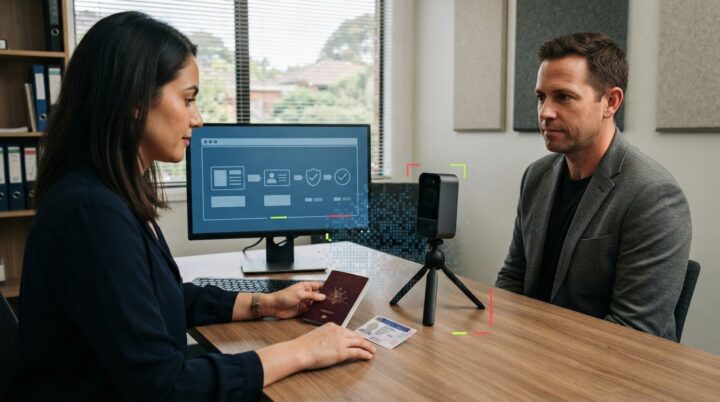
Seven years is the general retention period for many AML/CTF records, but the start date depends on the record type. If you’re asking what records you need for AML compliance, the key categories include customer due diligence, transaction details, and evidence of your compliance program and decisions.
Keeping documents for the right length of time is only part of the obligation. Records should show how you identified customers, assessed risk, and handled relevant transactions, while remaining secure and retrievable when needed. Full copies of identity documents are not generally required for AML/CTF record-keeping.
This guide explains which customer, transaction, governance, and compliance officer records to retain, and how retention periods work in Australia. It also explains why the start date varies by record type, what to know about identity document copies, and how organised records support clear, consistent compliance.
Key Takeaways
- Many AML/CTF records must be retained for seven years, but the period starts from different events depending on the record type.
- Customer due diligence records should show how identity was verified and how client risk was assessed, rather than relying only on stored identity documents.
- Transaction records need enough detail to reconstruct the transaction, including its nature, purpose and the parties involved.
- Keep governance records that demonstrate how your AML/CTF program is maintained, reviewed and supported by staff training.
- Secure, well-organised records should be accessible when required and protected from unauthorised access, loss or tampering.
What Are AML Record Keeping Obligations in Australia?
Australian reporting entities must keep records that demonstrate compliance with their AML/CTF obligations. Under section 116(1) of the Anti-Money Laundering and Counter-Terrorism Funding Act 2006, this includes records reasonably necessary to demonstrate compliance with Part 1A of the Act.
Secure and accessible record systems
Secure electronic record-keeping means storing AML/CTF documents so authorised staff can retrieve them when needed. Records may be electronic or paper, but they must remain appropriate, accessible, and protected from unauthorised access, loss, or tampering. Password protection, encryption, and restricted permissions can help safeguard digital files. Keep records in English or in a format that can be readily translated into English, so they can be understood when required by AUSTRAC.
Record-keeping responsibilities
Record-keeping responsibilities should assign ownership for maintaining, reviewing, and securely storing each category of AML/CTF documentation. A business policy should identify which records it retains, the storage systems and formats, retention periods, and the role responsible for each task. Reporting entities must be able to show they took reasonable steps to meet obligations under the AML/CTF Act and Rules. A designated service provider is a reporting entity for that service, so its CTF program should support that evidence.
Assign a named role or team to manage the record system, then train other staff to use it. Records held by the AML/CTF Compliance Officer can also evidence governance and oversight. Clear ownership helps prevent gaps when customer information changes or staff responsibilities shift.
Common record-keeping failures
Common failures include incomplete files, inconsistent naming, missing updates, and records that cannot be retrieved promptly. A file showing a customer’s original risk rating, for example, may not explain a later change or the reason for a service decision. Missing training records or outdated AML/CTF Program versions can also weaken evidence of how the business manages money laundering and terrorism financing risks.
A reporting entity that cannot produce relevant records may struggle to demonstrate reasonable steps to comply with the AML/CTF Act and Rules. In practice, a record gap makes it harder to show that evidence reflects actual decisions and processes. Simply keeping a folder of documents is not enough.
Suspicious matter and tipping-off records
Suspicious matter records should show how the business assessed an issue and why it decided to submit, or not submit, a Suspicious Matter Report. Keep the assessment and decision rationale with relevant customer or transaction information, along with records of any report made. These details help explain how the reporting entity handled the concern and support consistent decisions.
Tipping-off controls should be reflected in policies and staff guidance for handling sensitive reporting information. AML/CTF reporting entities need clear privacy policies and collection notices explaining how personal information is handled, unless providing a notice would breach statutory tipping-off restrictions. Limit access to suspicious matter reports to authorised personnel.
Customer due diligence and identity verification records
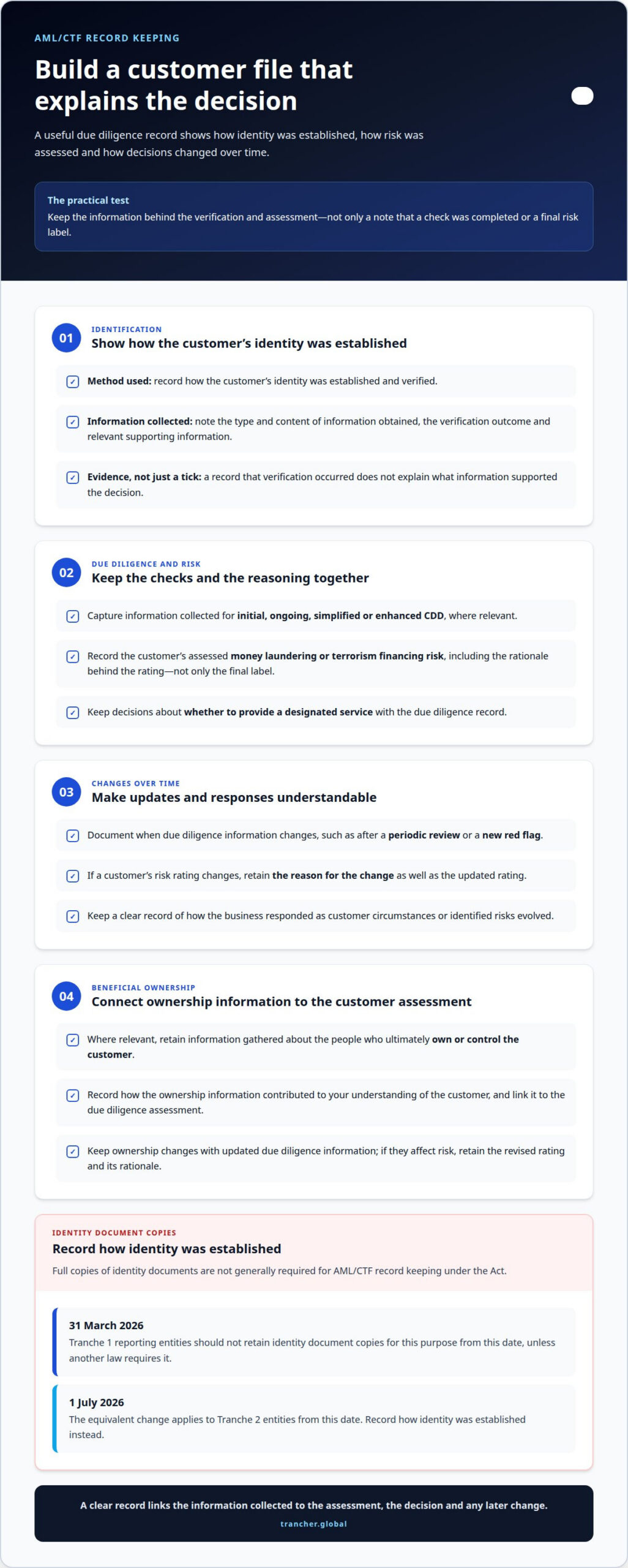
Customer due diligence records should explain how a reporting entity identified each customer and assessed associated money laundering and terrorism financing risks. They should preserve the information behind the verification, not merely indicate that a check occurred.
Customer identification and verification data
Identification and verification records describe the method used to establish a customer’s identity and the information obtained. Keep details of the type and content of information collected, alongside the verification outcome and relevant supporting information. This gives the file substance: a note that verification was completed does not explain what information supported the decision.
Copies of full identity documents are not generally required for AML/CTF record-keeping under the Act. From 31 March 2026, Tranche 1 reporting entities should not retain those copies for this purpose unless another law requires it; the equivalent change applies to Tranche 2 entities from 1 July 2026. Record how identity was established instead.
Customer due diligence records
Customer due diligence records show the checks and assessments applied throughout the customer relationship. They should capture information collected for initial, ongoing, simplified, or enhanced CDD, where relevant, and the customer’s assessed money laundering or terrorism financing risk. Retain the rationale behind the risk rating, not just the final label.
Keep a clear record when due diligence information changes. For example, document a periodic review, a new red flag, or the reason for changing a customer’s risk rating. Record decisions about whether to provide a designated service as well. These details explain how the reporting entity responded as customer circumstances or identified risks evolved.
Beneficial ownership records
Beneficial ownership records capture information gathered about the people who ultimately own or control a customer, where relevant to customer identification and verification. Retain the ownership information obtained and how it contributed to the entity’s understanding of the customer. Link this information to the customer’s due diligence assessment.
Keep changes in beneficial ownership with the customer’s updated due diligence information. If ownership details affect the customer’s risk assessment, retain the revised rating and its rationale. This creates a useful history, rather than a snapshot that cannot explain how the entity’s understanding changed.
Customer due diligence retention
Australian businesses should retain customer due diligence records for at least 7 years from the date the business relationship ends. For an occasional transaction, the 7-year period begins when the transaction is complete. The event that starts the retention period therefore depends on whether the customer had an ongoing relationship.
Apply the relevant start date consistently to verification information, due diligence findings, and recorded assessment decisions. Keep records secure and retrievable throughout the applicable period, while limiting personal information collected to what is reasonably necessary for AML/CTF obligations and organisational functions. A complete, dated customer file helps show what information supported the entity’s decisions.
Record retention periods
Seven years is a common AML/CTF retention period, but the start date depends on the record. Separate retention rules apply to transaction documents, program records, and third-party CDD assessments.
Transaction record retention
Transaction record retention means keeping the records required to document a transaction for the applicable period. For general transaction records, a reporting entity must retain each record for 7 years from the day it was created. Customer-provided transaction documents, such as signed agreements or order forms, must be kept for 7 years from the day they were received.
The transaction’s completion date is also relevant: businesses should keep transaction records for at least 7 years from the date the transaction was completed. These periods can have different starting points, so a process that records creation, receipt and completion dates helps avoid treating every file as if its retention clock began together. Section 107(1) of the AML/CTF Act addresses transaction record obligations.
Seven-year record retention
Seven years is not a single, universal countdown from the day a file is opened. AML/CTF program records must be kept until 7 years after they are no longer relevant to demonstrating compliance. For a third-party CDD assessment, the 7-year period begins when the assessment record is prepared. The applicable event depends on the record type and its purpose.
Other records have their own triggers. A record of a credit reporting body verification request must be kept for at least 7 years after the request. If the entity provides designated services to that individual during the initial retention period, it must retain the record until there has been a continuous 7-year period without providing services. For occasional-transaction CDD, the 7-year period begins when the transaction is complete.
These differences matter when retention processes cover customer files, reporting records, and program documentation. A reliable schedule links each record category to its trigger date, rather than applying one deletion date to an entire customer account. For example, a received order form and a transaction record created later may have separate start dates, even if both relate to the same transaction.
Keep records for the full applicable period and ensure they remain retrievable throughout. Records supporting AML/CTF processes may need to show how the entity addressed money laundering and terrorism financing risks. When a record supports more than one obligation, its retention should reflect the latest applicable period. A documented schedule helps staff apply the correct period consistently and avoid premature deletion or indefinite storage.
Transaction records and reconstructing client transactions
Reporting entities should keep transaction records that support review of their activities. Records must allow reconstruction of individual transactions involving designated services, including relevant funds transfer instructions and threshold transaction reporting records. Where the threshold transaction reporting obligation applies, relevant cash transactions of A$10,000 or more must be reported to AUSTRAC.
Reconstruction means a reviewer can follow a transaction using its recorded details and supporting documents. For a client transaction, the file should show its nature, purpose, and parties. A customer-provided signed contract, agreement, or order form can add context. Customer identification and due diligence information may also help explain the parties and service.
General transaction records can capture key details such as:
- The transaction’s date and time, amount, and currency.
- Relevant virtual asset or property details, where applicable.
- Customer and recipient information, transaction type and unique identifier.
- The payment method and customer-provided transaction documents.
These details should connect clearly to the relevant designated service. For example, a record showing an amount and payment method needs enough context to identify the transaction and its parties. A unique identifier can distinguish it from other activity in the customer’s file. Consistent links between transaction details and supporting documents make reconstruction more practical.
Funds transfer records require attention where the entity has applicable international funds transfer instruction reporting obligations. Keep records of IFTIs reported to AUSTRAC when those obligations apply. Associate the reporting record with the relevant transaction information, so the entity can identify the activity without relying on staff recollection. For organisations managing cross-border operations or international transactions involving hubs such as the UAE, working with specialists like Account Dubai helps ensure commercial bookkeeping, audit documentation, and tax records remain fully aligned.
Threshold transaction reporting also depends on whether the obligation applies to the entity and transaction. Relevant cash transactions of A$10,000 or more must be reported to AUSTRAC where the threshold transaction reporting obligation applies. Keep transaction information connected to the reporting record, so the reported activity can be identified and understood.
Language matters for access and interpretation. AML/CTF records should be in English or a format that can be readily translated into English. If a customer document is in another language, retain it so it can be clearly translated and retrieved alongside its transaction record. This helps staff and AUSTRAC interpret the evidence consistently, including the transaction’s parties, purpose, and supporting documents.
A well-structured transaction file brings together the record, customer documents, and applicable reporting information. This helps show how a designated service related to the transaction and supports review of the associated risk assessment and due diligence. Accurate, accessible records give the entity a clear account of the activity it handled.
AML/CTF Compliance Officer records
Records about an AML/CTF Compliance Officer help show how a reporting entity oversees its obligations. They should document the officer’s skills, knowledge, integrity, and suitability before and during their engagement. This evidence connects governance arrangements to the regulated services the business provides and its money laundering risks.
Keep a clear record of the suitability assessment made before engagement, then document relevant reviews during the officer’s engagement. Address each required attribute in the assessment, rather than recording only a name or appointment date. For example, the file should show how the entity considered the officer’s knowledge and integrity, as well as their skills and overall suitability.
The officer’s records sit within broader AML/CTF governance documentation. Keep the AML/CTF Program and its updates, staff training records, annual compliance reports, and independent evaluation reports. Together, these records help show how policies and processes support the entity’s CTF obligations and address risks associated with its designated services.
Reporting to the governing body also needs supporting evidence. AML/CTF program records must demonstrate annual or more frequent compliance reports to the governing body, at least once every 12 months. Retain the reporting record alongside the relevant compliance material, so the timing and substance of the communication can be understood during an internal review.
Reporting responsibilities extend beyond internal governance. Australian reporting entities must submit an Annual Compliance Report to AUSTRAC each year. Keep the report and its supporting records together, including evidence that policies ensure reported information is complete, accurate, and unaltered. This connects the officer’s oversight work with the entity’s external reporting processes.
Staff training records show how AML/CTF policies operate in practice. They should document training delivered and help demonstrate how staff are guided in their responsibilities. For example, review a training record alongside the relevant program update to show how a change was communicated within the business.
Well-organised governance records make it easier to follow decisions across the compliance framework. An officer’s suitability assessment, program updates, training records, and reports each serve a different purpose. Keeping them distinct but retrievable supports effective review. When a policy changes, link the update to relevant governance and training records, rather than scattering evidence across unrelated files.
For support organising AML/CTF governance documentation and record keeping, explore audit-ready compliance support.
Trancher: Audit-Ready Documentation & Record Keeping
Trancher provides Audit-Ready Documentation & Record Keeping to help Australian businesses organise AML/CTF evidence and maintain accessible records. It is a practical way to manage customer due diligence, transaction records, and program documentation consistently.
Trancher’s End-to-End AML/CTF Program Management and Client Verification & Due Diligence (KYC/CDD + Screening) support connected compliance processes, from customer checks to record-keeping. Compliance Billing Support & Revenue/ROI Tracking can also help where billing oversight is part of your operational needs.
For support aligning your record-keeping processes with your AML/CTF obligations, contact Trancher.
Make record keeping part of stronger operations
Understanding what records you need for AML compliance is a starting point. Next, make record-keeping work consistently across your business. Clear ownership, dependable processes, and useful records can support sound decisions as customer relationships and risk profiles change. Treat the system as an operational capability, not simply an archive.
Trancher supports this work through End-to-End AML/CTF Program Management, Client Verification & Due Diligence (KYC/CDD + Screening), and Ongoing Risk Monitoring & Client Activity Tracking. These offerings connect customer checks and changing risk information with wider compliance processes that rely on accurate records.
Consider where your current processes create friction, such as handovers, scattered evidence or updates that are difficult to track. A focused discussion can help identify a practical path towards more consistent AML/CTF operations. Contact Trancher to discuss AML compliance and take the next step with confidence.
Frequently Asked Questions
How long must AML documentation be kept?
Many AML/CTF records must be retained for seven years, with the start date depending on the record category. For example, a transaction document’s retention period may begin when it is received, while a program record’s period relates to how long it remains relevant to demonstrating compliance. A retention schedule should track each record type and its applicable trigger, rather than assign one deletion date to every file.
How should an AML provider store your documentation securely and accessibly?
Store documentation in a format authorised personnel can retrieve, with safeguards against unauthorised access, loss, or tampering. For digital files, encryption, password protection, and restricted permissions are practical controls; paper files should be kept in locked or restricted-access areas. Secure backups can support recovery. Even when an external provider stores records, the reporting entity remains responsible for ensuring its AML documentation is accurate, complete, and retrievable.
What businesses need to keep AML documentation?
Australian businesses providing a designated service under the AML/CTF regime must keep relevant AML documentation for that service. The obligation applies to reporting entities, including businesses in sectors brought within the regime through Tranche 2 reforms. A business’s status depends on the services it provides, not simply its size or trading name. Its records should relate to its customer relationships, transactions and compliance processes.
What documentation is required to stay AML compliant?
For a business asking what records it needs for AML compliance, documentation should evidence its program and how it operates. Depending on its activities, this may include program versions, customer due diligence outcomes, transaction information, staff training records, compliance reports, and suspicious matter decision records. For example, keeping a program update with training evidence can show how a policy change was communicated and put into practice.
Who Needs to Meet These Obligations?
Reporting entities providing designated services in Australia must meet applicable AML/CTF obligations. This includes established reporting entities and businesses entering the regime because their sector is covered by the reforms. For example, a professional services business may be affected when its work falls within a designated service. The service provided is central to determining whether obligations apply, so businesses should identify which activities bring them within the regime.
Who is responsible for maintaining AML documentation?
The reporting entity remains responsible for maintaining accurate, complete, and retrievable AML documentation, even when it uses an external provider. Assign a role or team to maintain, review, and securely store records, and train staff to follow the process. For example, a designated record owner can oversee file access and retention schedules, while the AML/CTF Compliance Officer supports oversight of the compliance framework.
What customer identification and verification records must Australian reporting entities keep?
Keep records showing how the customer was identified and what information supported verification. The file should identify the type and content of information collected, relevant verification details and, where applicable, beneficial ownership information. Full identification document copies are not generally required for AML/CTF record-keeping. From 31 March 2026 for Tranche 1 entities, and 1 July 2026 for Tranche 2 entities, such copies should not be retained for this purpose unless another law requires them.
What records must be kept for customer due diligence, beneficial ownership and politically exposed persons?
Understanding what records you need for AML compliance includes retaining customer due diligence information, assessment decisions, and relevant beneficial ownership details. Where politically exposed person screening forms part of the entity’s due diligence process, retain the screening outcome and resulting assessment so the decision can be understood later. Keep updated results connected to the customer file and review history, so material changes can be followed over time.