A small firm’s AML/CTF program should reflect its actual risks, not simply copy a generic document. In Australia, entities that provide designated services must have an AML/CTF program. An AML compliance program template offers a starting structure for recording risk assessment, customer due diligence, reporting, policies and governance, with senior manager approval.
A clear, practical approach can help meet these obligations without unnecessary administration. Adapt the framework to your business so its controls reflect the services you provide, the customers you serve and the risks you manage. This guide explains the main components of an AML/CTF program, including how firm-level risk assessment differs from customer due diligence, what reporting procedures should cover, and how policies, staff training, record keeping and governance fit together. It also shows how to use a template as a foundation and make the resulting program workable in day-to-day operations.
Key Takeaways
- Build the program around your business’s assessed money laundering, terrorism financing and proliferation financing risks; firm-level assessment is distinct from customer due diligence.
- Set out how customer identity and risk are assessed, when enhanced due diligence is used, and how customer information is kept current.
- Document reporting procedures: cash transactions over A$10,000 and international funds transfer instructions must be reported to AUSTRAC within 10 business days; suspicious matter reporting deadlines depend on the type of concern.
- Make policies practical to follow, obtain senior manager approval, and establish how controls, staff training and reviews are governed.
- Use templates as a starting point, then adapt them to your services and retain compliance-related records for at least seven years, according to AUSTRAC.
Customer due diligence, KYC and enhanced due diligence
For a free starting point, use Australian AML/CTF guidance to locate a suitable program framework. Customise it to your designated services, customers, delivery channels, risk profile and customer due diligence procedures.
Customer due diligence (CDD) is the process of identifying customers and assessing their money laundering and terrorism financing risks. Know Your Customer (KYC) procedures record who the customer is, what they intend to do and whether their activity fits the business relationship. Customer due diligence can help businesses understand customers before providing services.
A useful template separates firm-level risk assessment from checks on individual customers. For each customer, record the identity information collected, how it was verified, the service sought and the resulting risk profile. A routine service may present a different risk from one involving complex ownership structures or unusual transaction patterns. Explain how staff identify those differences and what action to take.
Set out a clear workflow for each customer relationship:
- Identify: collect the details needed to establish the customer’s identity and understand the proposed service.
- Verify: document the checks completed and any unresolved identity or ownership questions.
- Assess: record relevant risk factors, such as customer type, service, geography and transaction behaviour.
- Respond: define when ordinary checks are insufficient and enhanced due diligence (EDD) is required.
Enhanced due diligence (EDD) procedures should explain how staff respond to higher-risk customers, rather than simply label a file “high risk”. Specify what additional information to gather, who reviews the assessment and how the decision is recorded. For example, a complex ownership structure may prompt closer examination of beneficial owners and the reason for the requested service. Link evidence to the risk decision and proportionate controls.
Three practical tools can support this work. A ML/TF Risk Register and KYC Tool helps structure customer identification, risk scoring and due diligence records. A High-Risk Customer and ECDD Register helps track elevated-risk relationships and enhanced checks. A Firm Risk Assessment template records business-wide risks, keeping entity-level analysis distinct from each customer’s profile.
Customise each tool to match your business’s services, customer types and operating channels. Assign responsibility for completing, reviewing and updating customer records, then explain how changes in activity trigger reassessment. Keep the steps practical: staff should be able to follow them consistently and show why a customer received a particular risk rating. A template becomes operational when its fields, approval points and escalation steps match actual workflows.
Firm-level money laundering, terrorism financing and proliferation financing risk assessment
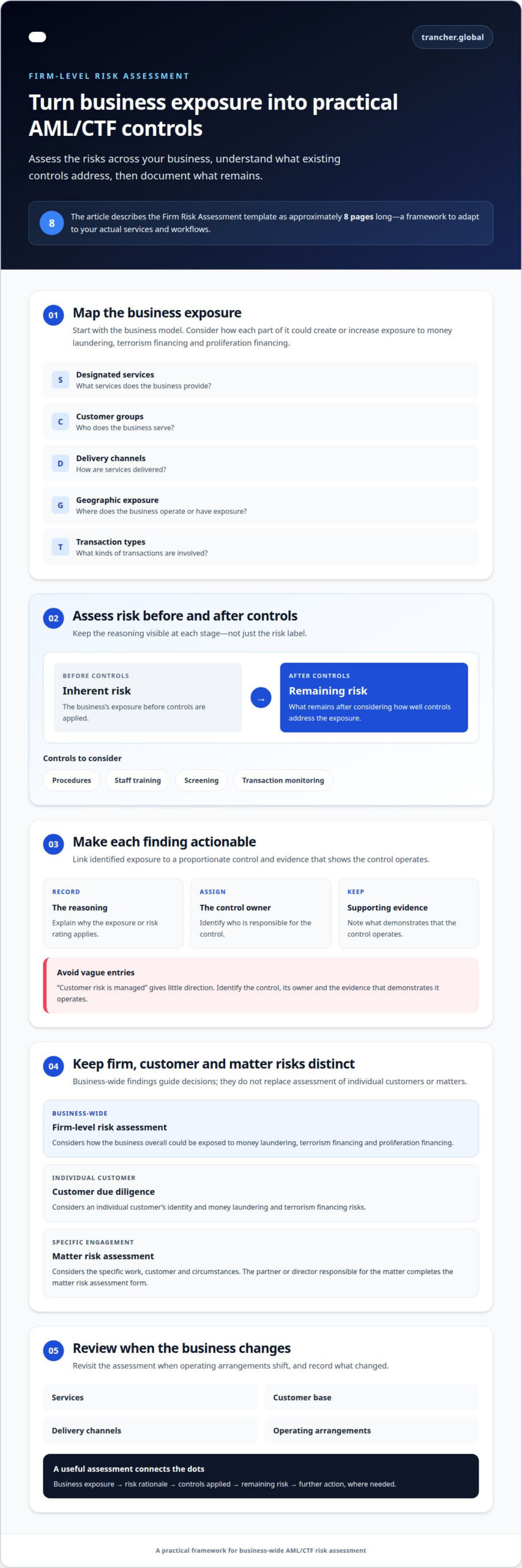
An Australian AML/CTF program must reflect the reporting entity’s assessed risks. The firm-level risk assessment examines how the business could be exposed to money laundering, terrorism financing and proliferation financing. It is distinct from customer due diligence: one assesses the business overall, while the other considers individual customers.
Start by mapping the business model. List its designated services, customer groups, delivery channels, geographic exposure and transaction types. Then consider how each feature could create or increase risk. For example, a service involving complex ownership arrangements may need different controls from a straightforward, face-to-face service. Record the reasoning, not just a risk label.
A practical assessment distinguishes inherent risk from the effect of existing controls. Inherent risk describes exposure before controls are applied. Controls may include procedures, staff training, screening and transaction monitoring. Assess whether these measures address the identified exposure, then document the remaining risk and any further action. Controls should be proportionate to the business’s assessed risks.
Use the Firm Risk Assessment template to organise this business-wide analysis. This template is approximately 8 pages long and provides a framework for documenting risk factors, ratings and controls. Adapt its prompts to the firm’s actual services and workflows. A generic entry such as “customer risk is managed” offers little direction; identify the control, its owner and the evidence that demonstrates it operates.
Business-level findings should guide, not replace, matter-level decisions. A matter risk assessment considers the specific work, customer and circumstances involved. The partner or director responsible for the matter completes the matter risk assessment form. For example, a customer’s usual service may present a different risk if a new matter involves an unfamiliar transaction pattern or complicated ownership.
Link each matter assessment to a practical response. Record the relevant risk factors, rationale for the rating, controls applied and any escalation decision. If the facts change, reassess the matter and document what changed. This creates a traceable link between the firm’s overall risk picture and decisions on individual engagements.
Review the assessment when the business changes its services, customer base, delivery channels or operating arrangements. A new service, for instance, may alter exposure and make existing controls insufficient. Assign responsibility for maintaining the document, recording changes and communicating revised controls to relevant staff. This makes the risk assessment an operational reference, rather than a file completed once and left untouched.
For firms building these processes into day-to-day operations, structured risk assessment support can help connect identified risks with monitoring and client activity procedures.
Suspicious Matter Report and Threshold Transaction Report procedures
Reporting procedures need to turn employee observations into timely, documented decisions. Procedures should explain how staff identify cash transactions that may require reporting and escalate them for review. International funds transfer instructions must also be reported to AUSTRAC within 10 business days. Suspicious Matter Reports (SMRs) have different deadlines: report within 24 hours for terrorism-related issues and within 3 days for other crimes.
Training must be regular and sustained; AUSTRAC does not specify a training cadence. Australian accounting practices must train relevant staff before they provide designated services and annually thereafter. AML/CTF programs must be independently reviewed at least every three years. Reporting entities must notify AUSTRAC within 14 days of appointing an AML/CTF compliance officer.
Establish a clear internal pathway for concerns, even when staff are unsure whether activity is suspicious. Employees should record the facts, preserve relevant transaction details and promptly escalate concerns through the documented channel. The responsible reviewer can assess the available information, decide whether an SMR is required and record the decision and its rationale. Procedures should also address confidentiality and access to reporting records.
Transaction monitoring supports this process by identifying activity that may need review. Define how staff recognise activity that differs from the customer’s known profile, who investigates alerts and how findings are recorded. Section 30 of the AML/CTF Act 2006 is cited in connection with transaction monitoring. A practical procedure links monitoring results to escalation, assessment and any required report.
Use the SMR & TTR Policy template, approximately 7 pages long, to document reporting responsibilities and workflows. The Suspicious Matter Report Content Requirements Guide, version 1.1 dated 10 June 2026, helps organise information for an SMR. The AML/CTF Compliance Officer Obligations and Procedures tool, version 1.0 dated 11 Jan. 2026, supports clear role and process documentation. These tools need to reflect the firm’s actual reporting pathway.
A usable procedure should specify the trigger, responsible role, evidence to retain, decision record and submission deadline. For example, a cash transaction that crosses the reporting threshold should move promptly to the designated reviewer, with the relevant transaction details captured. An employee identifying possible terrorism-related activity should escalate it immediately, so the applicable 24-hour timeframe can be managed. Keep reporting records organised so the decision trail is clear.
Set out how staff receive guidance and practise applying the process. The Staff Training Policy template is approximately 6 pages long and includes a table specifying 10 AML/CTF training topics. Tailor those topics to the employee’s role, including how to recognise concerns and whom to notify. Clear responsibilities help staff act consistently, while a documented review process helps identify gaps in reporting controls.
AML/CTF program policies, controls and governance
An Australian AML/CTF program must be documented and approved by a senior manager. Both Part A and Part B require formal senior manager approval. The documents should connect assessed risks with practical controls, including customer due diligence, reporting procedures, staff responsibilities and record keeping. A policy package is useful only when its directions match how the business operates.
What must an AML/CTF compliance program include in Australia? It needs documented, risk-based policies and controls, governance arrangements, and clear processes for customer checks, monitoring, reporting and staff responsibilities. Part A and Part B require formal approval by a senior manager.
Build policies around operational decisions. State who performs each control, what evidence they retain and how exceptions are escalated. For example, a procedure can explain who reviews an unresolved identity issue and how the decision is documented. Policies should also set expectations for employees, including how breaches of internal procedures are reported and addressed. Describe any disciplinary approach clearly, apply it consistently and align it with the organisation’s governance arrangements.
A useful policy package brings related documents together without blurring their purpose. The AML/CTF Policies document, version 6.0, sets out policy requirements. The AML/CTF Program, Part A template, approximately 8 pages long, supports the program’s foundation. The AML/CTF Program, Part B template, approximately 9 pages long, supports the operational procedures. Adapt each document to the business’s services, risk assessment and workflows.
Use the AML/CTF Program Review and Update Register, version 1.0 dated 11 Jan. 2026, to record review activity and changes. A policy review is recommended at least annually and when relevant circumstances change. Record what prompted the review, which documents changed, who approved updates and how revised guidance reached affected staff. A new service or altered customer profile, for example, may require controls to be reconsidered.
What are the penalties and common compliance risks for failing to meet AUSTRAC requirements? Penalties depend on the breach and its circumstances, so a generic template cannot establish a single applicable outcome. Common control risks include incomplete records, unclear responsibilities, outdated procedures, missing approvals and policies that staff cannot apply consistently.
The FATF Recommendations provide an international standard relevant to AML policy development. Use them as a reference point, while ensuring Australian policies address the business’s assessed risks and operational procedures. Clear document ownership, senior manager approval and recorded reviews make governance traceable. These steps can also help identify gaps before staff rely on outdated guidance or inconsistent controls.
AML compliance program template for small firms
A small firm needs a program that is proportionate to its assessed risks, not a stack of unused documents. An AML compliance program template can provide a structure, but it must reflect the firm’s designated services, customer types, delivery channels and day-to-day processes. Entities providing designated services to customers must have an AML/CTF Program.
Assign an owner to each obligation. Map key procedures to the people who perform them, the evidence they create and the records they retain. For example, a small practice might document who reviews customer information, who escalates concerns and who maintains reporting records. Clear ownership makes responsibilities workable even when staff hold several roles.
Templates can be adapted across sectors, but their content should match the firm’s actual operations. An accounting practice and a business providing another designated service may have different customers, transaction patterns and exposure. Replace irrelevant prompts with specific procedures, then ensure each control has an owner and a way to record its use. A template is a starting framework, not a substitute for assessing the firm’s risks.
Several tools can help organise implementation:
- AML/CTF Implementation Plan Template for Tranche 1 Reporting Entities Only: helps structure implementation tasks and track how program elements are put into practice.
- AUSTRAC Enrolment Form: version 1.1 dated 10 June 2026, supports preparation of enrolment information.
- AML/CTF Glossary: version 2.1 dated 4 Aug. 2026, provides a consistent reference for terminology used across program documents.
Use these tools selectively. The implementation plan is specifically for Tranche 1 Reporting Entities Only, so its scope matters. A glossary can help staff interpret terms consistently, while enrolment documentation serves a different administrative purpose. Keep the core program focused on obligations and controls relevant to the business, rather than adding documents that do not support its procedures.
Record keeping needs a practical method. According to AUSTRAC, Australian AML/CTF programs must retain compliance-related records for at least seven years. Establish how records are named, stored, accessed and linked to decisions. For instance, a customer review record should let someone follow the assessment, action taken and any escalation without searching across unrelated files.
Finally, establish how the program stays current. Assign responsibility for recording operational changes, updating relevant documents and sharing revised guidance with affected staff. A new service or a change in customer activity can prompt a fresh review of related controls. To turn a documented framework into manageable processes, put your AML/CTF program into practice.
Trancher: End-to-End AML/CTF Program Management
Trancher provides End-to-End AML/CTF Program Management for Australian businesses seeking practical support to put compliance processes into operation. Its offering includes client verification and due diligence with screening, ongoing risk monitoring and client activity tracking, and compliance billing support with revenue and ROI tracking.
Consider Trancher when you need customer checks, ongoing monitoring and program administration to work together in your business workflows. The platform brings these activities into a connected process, with risk scoring, built-in guidance and an evidence trail to support record keeping. Trancher supports compliance activities; your business remains responsible for its governance and decisions.
To discuss how Trancher’s AML/CTF platform can support your processes, contact Trancher.
Turn your framework into a working practice
Treat an AML compliance program template as the start of an operating rhythm, not a finished file. Make compliance responsibilities part of ordinary business workflows so staff can apply procedures consistently as services and customer activity evolve.
Consider how information moves from initial verification to ongoing review, and how changes in activity inform risk decisions. Trancher provides end-to-end AML/CTF program management, client verification and due diligence with screening, and ongoing risk monitoring and client activity tracking. These platform features support connected processes for customer checks and ongoing compliance activity.
Choose a practical next step that suits your firm’s current priorities. If you’re ready to discuss support for your AML/CTF processes, contact Trancher about AML compliance. A clear, workable approach can help your team move forward with confidence.
Frequently Asked Questions
What is an AML/CTF program?
An AML/CTF program is a documented framework for managing a reporting entity’s money laundering and terrorism financing risks. It sets out the controls, roles and procedures that support compliance with Australia’s AML/CTF obligations. In practice, it should guide everyday decisions, such as accepting a customer, reviewing unusual activity or escalating a concern, rather than sit unused as a policy document.
What are the latest Australian AML/CTF laws and AUSTRAC requirements for reporting entities?
Australia’s AML/CTF framework is established under the Anti-Money Laundering and Counter-Terrorism Financing Act 2006, administered by AUSTRAC. Reporting entities must maintain an AML/CTF Program and address applicable customer due diligence, monitoring, reporting, training and record-keeping obligations. Requirements depend on the designated services provided. For example, a business should map each service to the controls and reporting procedures its program needs, then keep those documents aligned with its operations.
How do you tailor an AML/CTF program to a business’s services, customers and risk profile?
Tailor the program by connecting each designated service to the customers who use it, how it is delivered and the risks those features create. A firm serving individuals through in-person appointments may need different procedures from one handling entities through remote channels. Document why each control fits the exposure, who applies it and what evidence they retain. Revisit the mapping when services, customers or operating methods change.
What customer identification and verification procedures should an Australian AML/CTF program cover?
Procedures should explain what identifying information staff collect, how identity is verified, how ownership is understood and where evidence is recorded. For a company or trust, address relevant people connected to the entity, such as beneficial owners and directors. The checks performed should reflect the people and ownership structure relevant to the entity. Set out how staff handle missing details or information that conflicts with the customer’s stated circumstances.
What are Australia’s customer due diligence and ongoing monitoring requirements?
Customer due diligence and ongoing monitoring can help businesses manage risks associated with their services. Monitoring helps identify changes that may affect a customer’s risk profile, such as activity inconsistent with the stated purpose of a relationship. Define what triggers a review, who assesses the change and how the outcome is documented. Updated customer circumstances should inform the next risk decision and any additional checks.
How should an Australian business assess and document money laundering and terrorism financing risks?
Assess exposure across the business’s services, customers, delivery channels and transaction patterns, then record the reasoning behind each risk conclusion. For example, a new service involving more complex ownership may change the firm’s exposure and call for different controls. Keep evidence of the factors considered, existing safeguards, decisions and assigned actions. This gives reviewers a clear trail from identified risk to selected control, rather than an unexplained rating.
What are the steps to implement and maintain an AML/CTF compliance program in Australia?
Begin by mapping designated services and assessing business risks. Then document procedures, assign responsibilities, obtain senior manager approval and prepare staff to apply the controls. Establish record storage and review processes, and track changes that could affect the program. According to AUSTRAC, compliance-related records must be retained for at least seven years. An AML compliance program template can organise this work, but its content should reflect the firm’s actual operations.