

Compliance shouldn’t be a drain on your firm’s profitability. Many professionals are treating the July 2026 Tranche 2 rollout as an unavoidable tax on their time, yet this transition offers a unique opportunity to modernise your internal systems. With approximately 90,000 new entities entering the regulatory fold, the fear of AUSTRAC penalties and the weight of manual KYC processes are very real concerns for accountants and lawyers alike.
It’s completely natural to feel overwhelmed by these administrative requirements. You’ve worked hard to build your practice, and the last thing you need is a complex regulatory burden that feels like a non-billable overhead. However, implementing the right AML CTF compliance software Australia offers can transform this obligation into a strategic advantage for your business.
In this guide, we’ll show you how to evaluate and select a software partner that doesn’t just satisfy AUSTRAC but also streamlines your onboarding. You’ll discover how to achieve full readiness before the deadline, automate your due diligence, and implement a system that allows you to recover compliance costs from your clients. Let’s look at how you can turn these new requirements into a seamless, profitable part of your professional service.
Key Takeaways
- Move beyond manual spreadsheets to purpose-built AML CTF compliance software Australia to ensure your practice meets AUSTRAC’s 2026 Tranche 2 standards without the administrative headache.
- Identify the essential technical features, such as integrated KYC/CDD and automated reporting, that protect your firm so you don’t frustrate your clients during onboarding.
- Quantify the return on investment by comparing the high cost of senior partner manual oversight against the efficiency of an automated, audit-ready workflow.
- Learn how to transform compliance from a non-billable overhead into a profit centre by making AML activities a recoverable professional expense.
- Discover a structured 30-day path to full regulatory readiness, supported by local experts who guide you through your first AUSTRAC reporting cycle with confidence.
Navigating the Tranche 2 Landscape: Why Australian Firms are Moving to AML Software
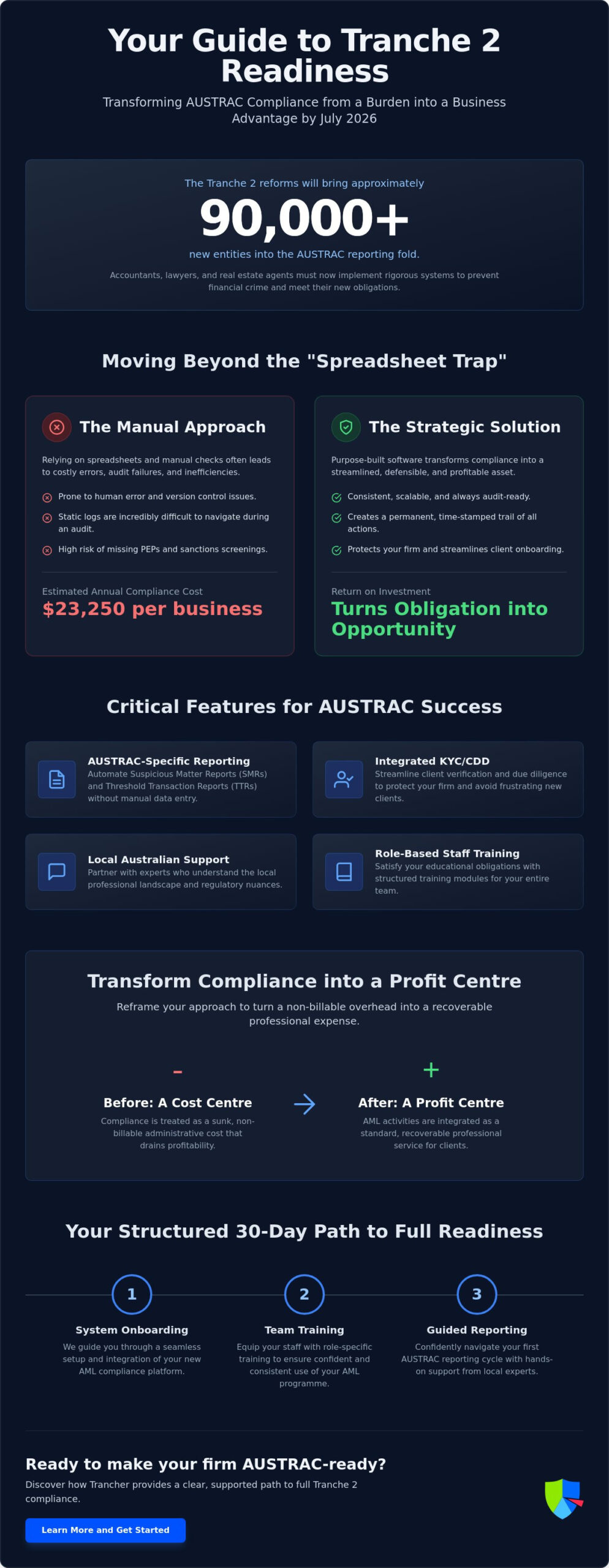
The regulatory environment for professional services in Australia is undergoing its most significant shift in decades. By July 2026, the Tranche 2 reforms will officially bring approximately 90,000 to 100,000 new entities into the AUSTRAC reporting fold. This change means that for the first time, many accountants, lawyers, and real estate agents must implement rigorous systems to detect and prevent financial crime. In this new climate, AML CTF compliance software Australia has evolved from a luxury into a foundational requirement for any practice providing designated services.
Adopting an end-to-end platform is no longer just about ticking a box; it’s about creating a defensible, systematised approach to risk. Unlike fragmented point solutions that only handle one part of the process, a comprehensive platform integrates your AML/CTF programme management, client verification, and reporting into a single workflow. This transition from “best effort” manual checks to a robust digital framework ensures that your compliance is consistent, scalable, and, most importantly, ready for AUSTRAC oversight.
The July 2026 Deadline: What Changes for Accountants?
From 1 July 2026, firms providing designated services, such as assisting with the creation of companies or managing client funds, must be fully compliant. This requires more than just an awareness of the rules. You’ll need a formal AML/CTF programme, a designated compliance officer, and a system for reporting suspicious matters. The risks of falling behind are significant, with AUSTRAC empowered to issue enforceable undertakings or substantial financial penalties for systemic failures. Implementing dedicated software is the most reliable way to satisfy the “reasonable steps” requirement, proving to regulators that your firm has taken its obligations seriously from day one.
The Limitations of Manual Compliance
Many firms initially consider using spreadsheets to manage their obligations, but this often leads to the “spreadsheet trap.” Manual logs are static, prone to version control issues, and incredibly difficult to navigate during an independent audit. When you consider that the Australian Government estimates manual compliance costs at roughly $23,250 per business annually, the financial argument for automation becomes clear. Human error is also a major factor in PEPs (Politically Exposed Persons) and sanctions screening, where a missed name can lead to severe regulatory breaches. Automated record-keeping is the only way to remain audit-ready because it creates a permanent, time-stamped trail of every due diligence action your team takes.
Critical Features: What Your Practice Needs from an AML/CTF Compliance Solution
Selecting the right AML CTF compliance software Australia requires a focus on local regulatory alignment rather than generic global features. Your software must be built to handle AUSTRAC-specific reporting schemas, particularly for Suspicious Matter Reports (SMRs) and Threshold Transaction Reports (TTRs). If a platform isn’t designed with these exact data fields in mind, your team will find themselves manually re-entering data into the AUSTRAC portal, defeating the purpose of automation. A truly effective solution acts as a bridge, ensuring that every piece of information collected during onboarding flows seamlessly into the required regulatory formats.
Beyond technical reporting, your practice needs a partner that understands the Australian professional landscape. This means prioritising platforms that offer local support and role-based staff training. Under the Tranche 2 reforms, you’re required to ensure your team is sufficiently educated on money laundering risks. As highlighted in the Law Council of Australia’s submission, the practical burden on smaller firms is a significant concern. Having a software partner that provides structured training modules helps you satisfy these educational obligations while maintaining a high standard of professional care.
Automated Client Verification & Due Diligence
Digital identity verification is no longer a “nice to have” feature; it’s the backbone of a modern practice. By using the Document Verification Service (DVS), software can verify Australian passports, driver licences, and Medicare cards in seconds. This creates a frictionless experience for your clients, who can complete their identity checks from home without needing to visit your office with physical documents. However, verification is only the first step. You must also ensure that PEPs (Politically Exposed Persons) and sanctions screening are ongoing. Sticking to a one-off check at the start of a relationship leaves you vulnerable to risk changes over time. Following the latest CDD and KYC requirements Australia ensures your firm remains protected against evolving threats throughout the entire client lifecycle.
Audit-Ready Documentation & Record Keeping
In the event of an AUSTRAC inspection, your ability to produce records quickly is your best defence. Australia’s “seven-year rule” dictates that you must retain records of all compliance activities, including your reasoning for certain risk ratings, for at least seven years after the service is provided. Manual filing systems often fail this test. Leading software solutions solve this by creating a permanent, time-stamped audit trail for every decision made. A centralised dashboard provides a “whole-of-firm” view, allowing partners to see exactly which clients are verified and where potential gaps exist. This level of transparency makes the independent audit process much smoother and less stressful. If you’re ready to move away from fragmented systems, exploring comprehensive AML management can help you centralise these critical records today.
The Cost of Inaction: Evaluating the ROI of Automation
Viewing compliance as a mere administrative tax is a missed opportunity for firm growth. While the initial focus is often on the subscription price of AML CTF compliance software Australia, the true cost of inaction is far higher. A senior partner spending their morning on manual KYC isn’t just an inefficient use of talent; it’s a direct drain on the firm’s bottom line. When you weigh a partner’s hourly rate against the cost of an automated check, the financial choice becomes clear. By implementing a digital framework, you’re not just buying a tool. You’re reclaiming your most valuable asset: time.
The AUSTRAC announcement on Tranche 2 makes it clear that the regulator expects a sophisticated level of oversight. For many, this sounds like a financial burden. However, using compliance ROI tracking software allows you to turn these regulatory obligations into billable assets. This ensures that every check performed contributes to the firm’s financial health rather than eroding it through unrecovered costs. There’s also the “hidden cost” of onboarding friction to consider. If your manual process is slow and invasive, you risk losing client interest before the engagement even begins.
Time Savings and Operational Efficiency
Manual risk assessments for a complex trust or SMSF can easily take between 2 and 4 hours of focused work. This involves cross-referencing documents, checking screening databases, and documenting the rationale for every risk rating. Automated platforms reduce this entire process to a matter of minutes through guided prompts and instant data retrieval. This “set and forget” approach to ongoing monitoring means you don’t have to manually re-screen long-term clients every year. The system handles the heavy lifting, allowing your team to focus on high-value advisory work.
Protecting the Firm’s Reputation and Licence
Beyond the immediate operational savings, automation serves as a critical insurance policy for your professional standing. AUSTRAC has the power to publicly name firms that fail to meet their obligations, a move that can be devastating for a local accounting or legal practice. With penalties for severe or systemic breaches potentially exceeding $20 million, the risk of a “best efforts” manual approach is simply too high. High-net-worth clients increasingly view robust compliance as a “quality mark.” They choose firms that demonstrate they take security and professional standards seriously, turning your readiness into a competitive advantage.
To further bolster this competitive edge, ensuring your firm’s online reputation is proactively managed by experts like Digital Junction helps project a consistent image of professionalism and reliability to potential clients.
Transforming Compliance into a Profit Centre: A New Framework for 2026
Viewing the 2026 regulatory changes as a cost centre is a perspective that limits your firm’s potential. While the administrative requirements are non-negotiable, the way you integrate them into your business model is entirely within your control. The most successful Australian practices are already moving away from the “compliance as a tax” mindset. Instead, they’re using the data and processes required by AUSTRAC to deepen client relationships and uncover new, high-value advisory work. Adopting advanced AML CTF compliance software Australia provides the digital infrastructure to make this transition seamless and professional.
By positioning your firm as a strategic compliance partner, you change the narrative from “ticking boxes” to “protecting assets.” Your clients value security and professional integrity. When you explain that your robust onboarding process is designed to protect their identity and financial standing, compliance becomes a shared value rather than a hurdle. This approach allows you to introduce a new framework where regulatory activities are recognised as a premium professional service.
Recoverable Compliance Activities
One of the most effective ways to offset the cost of Tranche 2 is through a transparent “Compliance Billing” model. Trancher tracks the time and evidence associated with every client verification, allowing you to treat these activities as a recoverable professional expense or a standard disbursement. This shift from a cost centre to a billable service ensures your firm’s margins remain protected. Comprehensive ROI reports provide the objective data partners need to justify software spend to the board, proving that compliance can be a revenue-neutral or even profitable department. When you communicate these fees with transparency, highlighting the advanced technology used to secure client data, most clients accept them as a standard part of modern professional engagement.
Unlocking Advisory Revenue
Beyond billing for the checks themselves, the enhanced due diligence process acts as a powerful business intelligence tool. A deep KYC (Know Your Customer) process often reveals complex business structures, outdated trust deeds, or international interests that require professional intervention. For example, if an investigation into a “suspicious matter” flags a lack of transparency in a client’s current structure, this creates a natural opening for a protective advisory piece on restructuring. You can also package “AML Readiness” as a standalone service for your own corporate clients who may be struggling with their own Tranche 2 obligations. This turns your internal expertise into a marketable asset that provides genuine value to your business network.
If you are ready to see how these insights can drive your firm’s growth, you can explore our revenue tracking tools today. This proactive approach ensures your practice is not just ready for 2026, but is actively thriving because of it.
Choosing Trancher: Achieving AUSTRAC Readiness in 30 Days
Transitioning to a new digital framework often feels like a long-term project that might disrupt your daily operations. Trancher changes this. We provide a structured path that takes your firm from regulatory uncertainty to full AUSTRAC readiness in just 30 days. As the leading AML CTF compliance software Australia provides for professional services, we’ve designed our implementation to be swift, supportive, and entirely manageable for busy partners.
You aren’t just adopting a platform; you’re gaining a strategic guide. Our local Australian experts are on-call to walk you through your very first AUSTRAC report, ensuring you feel confident in every data point submitted. This hands-on support removes the stress of navigating the AUSTRAC portal alone and ensures your firm’s initial reporting is accurate and compliant from the start.
The 30-Day Implementation Roadmap
Our implementation process is methodical and highly organised, moving you through four distinct phases of readiness:
- Week 1: Program Design. We work with you to establish your formal AML/CTF program and core risk policies.
- Week 2: Integration and Education. We integrate the software into your workflow and provide role-based staff training to meet your educational obligations.
- Week 3: Live Onboarding. Your team begins conducting live client verifications and automated risk assessments within the platform.
- Week 4: Connectivity and Review. We perform a final review of your systems and ensure your AUSTRAC portal connectivity is seamless and functional.
Why a 3-Month Trial is the Gold Standard
Most software trials end before you’ve even processed a full billing cycle. We offer a complimentary three-month trial because we believe firms need a full quarter to see the genuine ROI in their ledger. This period allows you to experience the full end-to-end workflow, from initial KYC to the recovery of compliance costs through our billing support tools. It’s a risk-free way to prove that compliance can be a profitable service for your practice. Firms that choose to transition from the trial to a full subscription also receive a 20% discount, ensuring your long-term readiness is as cost-effective as it is robust.
Trancher is the only solution that handles everything from staff training and ongoing monitoring to revenue tracking and regulatory reporting in one place. By choosing a partner that understands the specific nuances of the Australian Tranche 2 reforms, you’re securing your firm’s future while improving your internal efficiency. Don’t leave your readiness to the last minute. Start your conversation with Trancher today and take the first step toward a more secure, profitable practice.
Future-Proof Your Practice Before the 2026 Deadline
The transition to Tranche 2 readiness is a significant milestone for Australian professional services. By moving away from manual processes and implementing AML CTF compliance software Australia, you ensure your firm is protected and your team is empowered. You’ve seen how automation reduces friction, satisfies AUSTRAC, and even creates new avenues for billable advisory work. It’s about more than just avoiding penalties; it’s about building a more efficient, modern practice that thrives under new standards.
Trancher is your expert partner in this journey. Our platform provides a 30-Day Compliance Guarantee and AUSTRAC-aligned reporting prompts to ensure you’re never navigating the regulatory portal alone. We also include ROI reporting in every trial so you can see the exact financial benefit to your firm from the very first week. This structured approach removes the guesswork and replaces it with steady, reliable guidance.
Secure your firm’s future with a complimentary 3-month Trancher trial. We look forward to helping you turn these regulatory requirements into a genuine business advantage and a source of long-term growth.
Frequently Asked Questions
What is the Tranche 2 deadline for Australian accountants?
All Tranche 2 entities, including accountants and lawyers, must be fully compliant with their AML/CTF obligations from 1 July 2026. While enrollment with AUSTRAC opened on 31 March 2026, you must ensure your registration is finalised by the 29 July 2026 deadline. This gives you a clear window to implement the necessary systems before the regulator begins formal oversight.
Can I use my existing practice management software for AML compliance?
Most general practice management tools aren’t built to handle the specific data schemas required for AUSTRAC reporting. While they might store basic client details, they often lack the integrated PEPs screening and the seven-year time-stamped audit trail required for an independent audit. Specialist AML CTF compliance software Australia bridges this gap by ensuring your data is always report-ready.
Does AUSTRAC provide a list of approved AML software?
AUSTRAC does not provide a list of “approved” or “certified” software providers. The regulator remains technology-neutral, meaning the responsibility lies with each firm to choose a solution that effectively manages their unique risk profile. It’s best to look for a partner that demonstrates a deep understanding of the Australian regulatory landscape and provides local support.
How much does AML CTF compliance software typically cost in Australia?
The cost of compliance software varies based on your firm’s size, client volume, and the level of automation required. Some providers charge per identity check, while others offer monthly subscriptions that include staff training and program management. Rather than looking at the sticker price, most firms find it more helpful to evaluate the ROI by comparing software costs against the expense of manual partner hours.
What happens if our firm is audited by AUSTRAC and we don’t have software?
If you’re audited without a centralised digital system, you’ll need to manually produce every record of due diligence, transaction monitoring, and risk assessment conducted over the last seven years. This is often where manual systems fail due to missing documents or inconsistent record-keeping. AUSTRAC may view these gaps as systemic failures, which can lead to enforceable undertakings or significant financial penalties.
Is digital ID verification legal for AML purposes in Australia?
Digital identity verification is fully legal and encouraged in Australia through the Document Verification Service (DVS). This system allows you to verify government-issued documents, such as passports and driver licences, against official records in real-time. Using digital ID processes is often more secure and accurate than physical document sighting, as it includes built-in safeguards against sophisticated forgery.
How does Trancher help us bill clients for compliance work?
Trancher includes specific features to help you track the time and resources spent on each client’s compliance activities. By generating clear evidence of the work performed, you can treat these tasks as a recoverable professional expense or a standard disbursement. This allows your practice to move away from a “cost centre” model and ensures your margins aren’t eroded by regulatory requirements.
Do I need to hire a dedicated AML officer if I use software?
You’re still required to designate a “Compliance Officer,” but specialist software means this doesn’t have to be a full-time administrative hire. In most SME practices, a senior partner takes on this role. The software handles the ongoing monitoring and reporting prompts, allowing the designated officer to focus on high-level oversight rather than manual data entry.