

What if establishing a defensible AML program for real estate wasn’t an administrative roadblock, but your agency’s sharpest operational advantage? With Tranche 2 reforms taking effect on 1 July 2026, it’s completely natural to worry about the friction of customer due diligence, complex trust structures, and the looming threat of severe AUSTRAC penalties. You want to protect your agency and list properties without getting bogged down in manual paperwork or delaying buyer settlements.
The good news is that compliance succeeds when it integrates straight into your everyday deal workflows. In this setup guide, you’ll discover how to design, establish, and maintain a robust, audit-ready AML/CTF framework tailored specifically to Australian property transactions. We’ll outline a clear blueprint to achieve full AUSTRAC readiness within 30 days, showing you how to streamline client verification and transform statutory obligations into a dependable, professional business asset.
Key Takeaways
- Master the core AUSTRAC requirements needed to establish a defensible AML program for real estate ahead of Tranche 2 obligations commencing 1 July 2026.
- Identify key customer, transaction, and delivery channel risk factors using an objective assessment framework that safeguards your agency.
- Align governance oversight, staff screening, and customer due diligence into a single, cohesive compliance architecture built for daily operations.
- Follow a practical five-step rollout methodology to achieve full regulatory readiness within 30 days without slowing down active deal negotiations.
- Replace fragile manual spreadsheets with integrated workflow automation to simplify client verification and turn administrative overhead into a recoverable operational strength.
What Is an AML Program for Real Estate Under AUSTRAC?
An AML program is a formal, documented risk-management framework that sets out exactly how your business detects, manages, and mitigates the risk of financial crime. Under national anti-money laundering legislation, AUSTRAC requires every reporting entity to establish an operational system tailored to its specific exposure. The Tranche 2 reforms officially bring Australian real estate professionals into this statutory fold from 1 July 2026, meaning standard agency activities now carry mandatory compliance obligations.
This statutory requirement applies whenever your agency acts as a real estate agent or transaction intermediary. Far from being a mere paper-filing exercise, an effective AML program for real estate acts as a protective shield for your business. It safeguards your agency goodwill, shields vendor equity against transaction freezes, and protects overall market integrity by keeping illicit capital out of property settlements.
Designated Real Estate Services Under Tranche 2
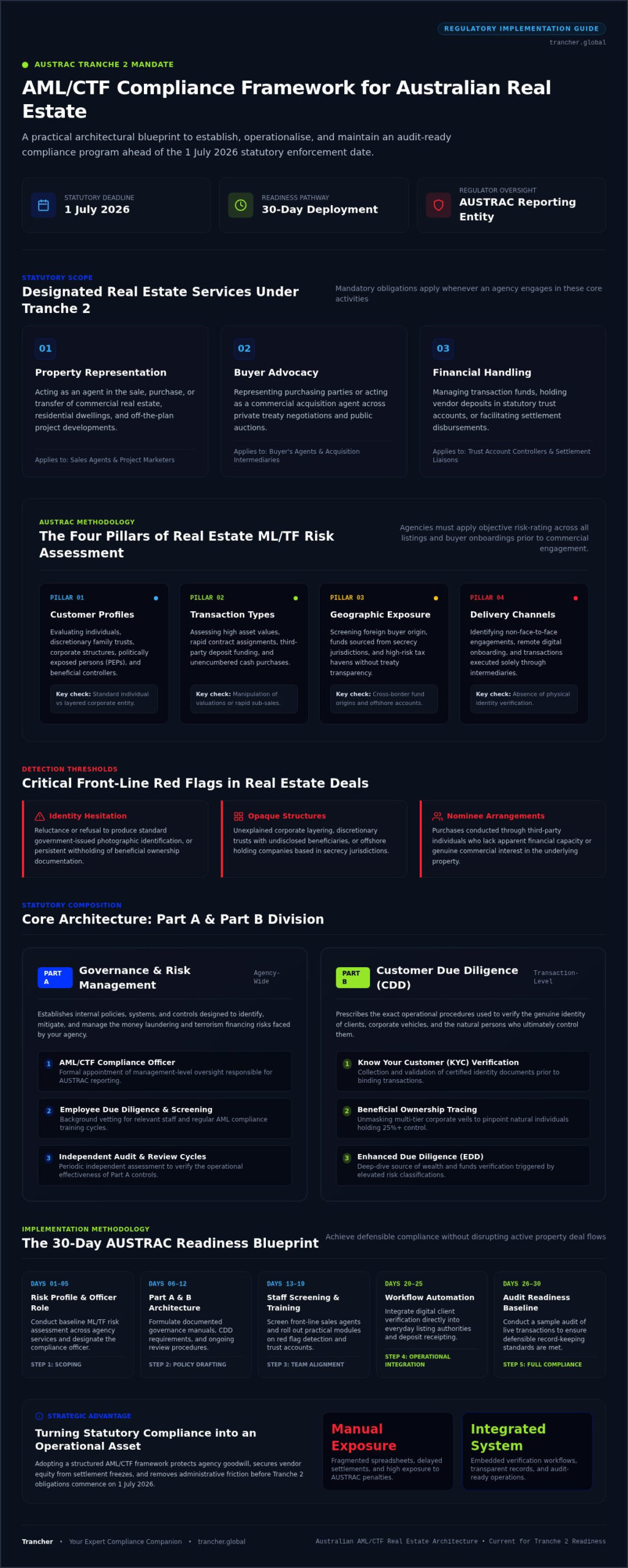
Obligations activate whenever your agency delivers designated services defined under the reformed legislation. These operational triggers include:
- Property Representation: Acting as an agent in the sale, purchase, or transfer of commercial property, residential dwellings, and off-the-plan project developments.
- Buyer Advocacy: Representing purchasing parties or acting as a commercial acquisition agent across private treaties and public auctions.
- Financial Handling: Managing transaction funds, holding vendor deposits in statutory trust accounts, or facilitating settlement disbursements.
Why Real Estate Transactions Are Targeted by Illicit Funds
Australian property represents an attractive target for financial criminals due to high asset values that absorb significant volumes of illicit funds in single transactions. Complex legal vehicles, such as discretionary family trusts and offshore corporate structures, are often deployed to disguise the true beneficial controllers who direct the purchase behind nominee directors.
Property settlements provide an ideal vehicle for trade-based layering because criminals exploit rapid contract assignments, third-party funds transfers, and manipulated contract variations to obscure illicit origins before converting dirty capital into clean, legal equity. Implementing a practical, defensible AML program for real estate ensures your front-line team detects these structural anomalies early, protecting your business from regulatory intervention while preserving smooth, legitimate transactions.
Identifying Core Risk Factors for Money Laundering in Real Estate
Building a defensible AML program for real estate begins with understanding where illicit funds attempt to penetrate your agency. AUSTRAC requires every reporting entity to establish an objective, documented risk-rating methodology before entering commercial engagements or accepting listing authorities. Rather than relying on guesswork, your framework must systematically evaluate four primary risk pillars: customer profiles, transaction types, geographic exposure, and delivery channels.
A standard domestic buyer purchasing a family home presents a very different risk profile than an overseas entity acquiring commercial assets through layered trusts. According to AUSTRAC’s official guidance for the real estate sector, agencies must apply proportionate due diligence based on these distinct risk categories. Adopting a structured framework, like an AML risk assessment tool Australia, helps your agency standardise these evaluations across all listings without creating administrative bottlenecks.
Client and Purchaser Red Flags
Front-line sales teams and transaction coordinators need clear, objective indicators to spot elevated risks during onboarding. Watch for these client-level anomalies:
- Identity Hesitation: Reluctance to produce standard government-issued photographic identification or withholding beneficial ownership documentation.
- Opaque Structures: Unexplained corporate layering, discretionary trusts with undisclosed beneficiaries, or overseas holding companies based in secrecy jurisdictions.
- Nominee Arrangements: Purchases conducted through third-party individuals who lack apparent financial capacity or genuine commercial interest in the asset.
- PEP and Sanctions Exposure: Parties identified as politically exposed persons (PEPs), their close associates, or entities matching global sanctions lists.
Transaction and Payment Vulnerabilities
Money laundering typologies often reveal themselves at the payment stage rather than during initial property viewings. High-risk transaction red flags include:
- Unverified Funding Origins: Deposit or settlement funds transferred from unverified third-party accounts, multiple fragmented deposits, or high-risk offshore banking hubs.
- Last-Minute Entity Swaps: Requests to alter the purchasing entity, nominate unexpected buying parties, or redirect settlement proceeds immediately before contract exchange.
- Deposit Overpayments: Deliberate excess transfers followed by urgent requests to refund surplus balances into unrelated accounts.
Recognising these warning signs early keeps your agency compliant and protects valuable transaction momentum. If you want to streamline these checks across every deal, explore how Trancher automates client screening and risk monitoring to protect your property listings seamlessly.
Core Architecture: Structuring Part A and Part B of Your AML/CTF Program
AUSTRAC requires every reporting entity to document their compliance framework across two interconnected components: Part A and Part B. While modern regulatory guidance views this as a single unified framework, maintaining a clear functional distinction between operational governance and client-level execution is essential. Structuring an effective AML program for real estate requires agency principals to establish firm-wide policies while equipping front-office staff with practical customer verification procedures.
Part A governs how your business manages systemic exposure through risk assessments, internal reporting lines, and independent evaluations. Part B establishes your Know Your Customer (KYC) rules, dictating how your team verifies individual identities before facilitating property exchanges. To ensure your agency covers every mandatory structural pillar without missing statutory requirements, review our comprehensive AML program checklist Australia.
Part A: Governance, Oversight, and Independent Review
Your agency’s Part A foundation establishes administrative accountability and ongoing operational control. Key governance requirements include:
- Compliance Officer Designation: Formally appointing an AML/CTF Compliance Officer within executive or agency leadership who holds sufficient authority to manage statutory obligations.
- Tailored Staff Training: Delivering practical annual training that helps sales negotiators, buyer advocates, and property managers recognise typologies in daily deal interactions.
- Independent Operational Review: Scheduling an objective review of your AML/CTF program every two to three years to validate control effectiveness against evolving risks.
- Leadership Oversight: Securing documented board or agency partner sign-off, confirming executive ownership of your internal control systems.
Part B: Customer Due Diligence (CDD) and Verification
Part B operationalises your frontline defence by outlining exact protocols for customer identification and beneficial ownership discovery. Standard CDD procedures mandate verifying the identity of individual vendors, buyers, and legal representatives using dependable, independent documentation before completing any designated service.
When dealing with unlisted companies, foreign purchasers, or discretionary trusts, your framework must trigger Enhanced Due Diligence (EDD) to uncover the ultimate natural persons who own or control the transacting vehicle. You can consult the CDD and KYC requirements Australia guide for detailed structural frameworks. Part B must also mandate automated screening of all counterparties against Australian sanctions lists and global Politically Exposed Person (PEP) databases before contract signing, ensuring a defensible AML program for real estate that withstands AUSTRAC audit scrutiny.
Step-by-Step Implementation: From Agency Workflow to Transaction Monitoring
Rolling out an operational AML program for real estate does not require grinding your sales floor to a halt. By following a structured five-step methodology, agency principals can establish full AUSTRAC readiness within 30 days while protecting live deal negotiations:
- Step 1: Enrol with AUSTRAC: Register your business through the AUSTRAC Online portal before providing designated real estate services.
- Step 2: Formalise Program Documentation: Draft and adopt your written Part A governance controls and Part B verification rules, tailored to your agency’s transaction profile.
- Step 3: Integrate Digital Verification: Connect automated KYC and beneficial ownership checks straight into your listing agreements and contract exchange workflows.
- Step 4: Activate Transaction Monitoring: Systematically track fund movements, deposit sources, and counterparty alterations from initial listing through to final settlement.
- Step 5: Operationalise Escalation and Reporting: Equip your team to identify suspicious behaviour, lodge internal reports, and escalate statutory filings confidentially.
Step 4 & 5: Transaction Monitoring and Suspicious Matter Escalation
Transaction monitoring in property is not a one-off identity check; it’s an active process maintained throughout the settlement lifecycle. Your team must track deal milestones for sudden variations, such as unexpected funding sources, splitting payments to evade the $10,000 physical currency threshold, or changes to purchasing entities right before exchange.
When discrepancies arise, sales negotiators shouldn’t confront the buyer directly. Staff must immediately escalate observations internally to the appointed Compliance Officer. Understanding when to submit a suspicious matter report ensures your agency files required documentation with AUSTRAC within mandatory statutory windows, such as 24 hours for terrorism financing suspicions or three business days for money laundering concerns. Team members must also understand tipping-off provisions, which carry criminal penalties of up to two years’ imprisonment for alerting clients to regulatory reporting.
Staff Training and Practical Onboarding Tools
Policies only protect your agency when your staff know how to apply them. Deliver role-specific training modules so property managers, listing agents, and trust accountants understand their exact responsibilities. Equipping staff with clear client communication scripts helps them explain verification steps to vendors and buyers as standard consumer protections, preserving deal goodwill.
Principals can leverage practical templates from the compliance officer toolkit to quickly establish staff guidelines and audit logs. Ready to roll out an integrated system without administrative strain? Implement your 30-day AML compliance program with Trancher to automate client screening and monitoring across every listing today.
Maintaining Defensible Compliance Without Administrative Overhead
Relying on manual spreadsheets and paper files exposes your agency to significant operational risks. When busy sales teams attempt to track customer verification manually, critical details slip through the cracks. Verification certificates go missing, re-screening deadlines get overlooked, and audit trails break down. Modern RegTech platforms eliminate this friction by automating customer due diligence, sanctions screening, and audit log generation directly within your listing workflows.
Embracing digital automation also reframes regulatory duty into commercial value. Instead of viewing compliance as an administrative cost sink, structured platforms capture verification activity accurately. This visibility allows agencies to track operational effort and turn statutory obligations into recoverable, professional service capabilities that reinforce client confidence.
Audit-Ready Record-Keeping Protocols
AUSTRAC mandates that real estate agencies retain all compliance records for a minimum statutory period of seven years. This requirement covers customer identification records, beneficial ownership documentation, transaction monitoring histories, and internal escalation files.
Storing scanned paperwork across scattered computer folders won’t withstand regulatory examination. Defensible record keeping requires secure, time-stamped digital audit logs that track every identity check, risk scoring update, and Compliance Officer clearance. Structuring your files centrally guarantees immediate data extraction during AUSTRAC compliance assessments, proving that your agency maintains active, defensible supervision over every property deal.
Achieving Rapid 30-Day Compliance with Trancher
Preparing your agency for national AML/CTF obligations doesn’t have to be overwhelming or complex. Trancher delivers an integrated, end-to-end platform built to simplify AML program management for property professionals. By unifying digital identity verification, client risk profiling, and suspicious matter escalation into one seamless dashboard, Trancher removes manual burdens entirely.
With dedicated Australian specialist onboarding, your agency achieves guaranteed compliance readiness within 30 days of implementation. Agency principals can secure a complimentary 3-month trial with Trancher, which includes full platform functionality and an agency ROI efficiency report to help you deploy an audit-ready AML program for real estate with total confidence.
Build a Confident, Audit-Ready Agency
Preparing for national Tranche 2 obligations doesn’t mean sacrificing deal velocity or frustrating prospective buyers. By embedding objective risk scoring, automated identity checks, and disciplined transaction monitoring straight into your daily operations, you establish an AML program for real estate that actively protects your brand equity and agency goodwill.
You don’t have to navigate this transition on your own. Supported by dedicated local Australian specialist guidance, Trancher provides guaranteed AML/CTF compliance readiness within 30 days of implementation. Transform compliance obligations from an administrative hurdle into a professional, recoverable capability while keeping your listings moving forward smoothly.
Take the friction out of customer due diligence and discover measurable operational efficiencies with an included ROI report. Start your complimentary 3-month trial with Trancher today, and protect your agency with steady, assured expertise.
Frequently Asked Questions
Is an AML program legally mandatory for all Australian real estate agencies?
Yes, under the Tranche 2 reforms taking effect on 1 July 2026, any agency providing designated services must maintain a compliant AML program for real estate. This obligation applies whenever your firm facilitates property transactions, represents buyers or sellers, or handles deposit funds. AUSTRAC requires reporting entities to formally document internal governance and customer verification controls before offering designated property services to the public.
Can our agency rely on conveyancers or solicitors to perform customer due diligence?
You can utilise third-party reliance arrangements, but statutory responsibility remains strictly with your agency. If a legal practitioner or conveyancer fails to conduct adequate customer due diligence, AUSTRAC holds your business directly liable for the compliance breach. Relying on integrated digital platforms to collect and verify customer identity directly ensures your files remain audit-ready and avoids dangerous gaps caused by external parties.
How does an agency identify the beneficial owner of a private family trust?
Identifying beneficial ownership in a trust requires looking through the structure to find the natural persons who exercise ultimate effective control. Your team must identify and verify the individual trustees or corporate trustee directors, the appointor, and any named beneficiaries holding twenty-five per cent or more entitlement. Collecting the certified trust deed allows your agency to confirm voting rights and identify who genuinely controls asset distributions.
What happens if a property buyer refuses to provide identity verification documents?
If a purchaser refuses to supply standard identification or verify beneficial ownership, your agency must not proceed with providing designated services. Cease facilitating the transaction and decline deposit receipts into your trust account. Your Compliance Officer must evaluate the refusal under your agency’s risk assessment framework to decide whether to submit a Suspicious Matter Report (SMR) to AUSTRAC regarding the encounter.
How much time does it take to get an agency AML/CTF program audit-ready?
While manual framework drafting can take months of internal disruption, implementing a structured digital platform achieves full readiness much faster. With Trancher, agencies gain guaranteed compliance readiness within 30 days of implementation. This accelerated timeframe equips your team with tailored Part A governance, Part B customer due diligence workflows, and automated screening systems well ahead of regulatory deadlines.
What is the tipping-off offence, and how does it apply to real estate agents?
Tipping off is a criminal offence that prohibits informing anyone that an SMR has been submitted, or that an AUSTRAC investigation is underway. If an agent alerts a prospective buyer or seller that their transaction has raised compliance concerns, the individual faces penalties of up to two years’ imprisonment. Suspicious behaviour must always be escalated internally to your Compliance Officer in strict confidence.
What specific records must an agency keep to satisfy an AUSTRAC audit?
Agencies must retain comprehensive compliance records for a minimum statutory period of seven years. Your archive must include verified identity documentation, beneficial ownership proofs, Politically Exposed Person (PEP) screening results, and risk assessment scores. You must also preserve time-stamped transaction logs, internal escalation files, staff training records, and documentation of every independent review conducted on your AML program for real estate.