

What if the statutory obligations your firm dreads billing for could actually strengthen client trust? With Tranche 2 obligations now in full effect for Australian accounting practices, learning how to explain AML compliance costs to clients has become an essential commercial capability. You likely already feel the strain of absorbing customer due diligence, digital verification, and ongoing risk monitoring as a non-billable administrative burden. It is entirely natural to worry that introducing unexpected compliance fees might spark awkward pushback or jeopardise valued client relationships.
You don’t need to absorb these regulatory costs in silence, nor should your practice sacrifice its hard-earned margins. This practical guide equips you with the defensible billing models, transparent frameworks, and confident communication scripts required to discuss AUSTRAC mandates openly. Ahead, we explore how to transform mandated compliance from an exhausting overhead expense into a professional value-add that protects your clients and substantiates your firm’s expertise.
Key Takeaways
- Identify the true cost of Tranche 2 obligations across technology, verification, and dedicated staff labour to stop unbilled compliance hours eroding firm profitability.
- Compare three transparent billing structures to recover direct expenses and administrative time without damaging client goodwill.
- Implement a practical four-step framework on how to explain AML compliance costs to clients by reframing mandatory AUSTRAC checks as essential fraud protection.
- Gain confident, empathetic communication scripts to address common pushback from long-standing clients and counter competitors claiming to absorb fees.
- Discover how automated workflow tracking substantiates billable compliance activity and turns regulatory overhead into a structured professional service.
Understanding the True Cost of AML Compliance for Australian Practices
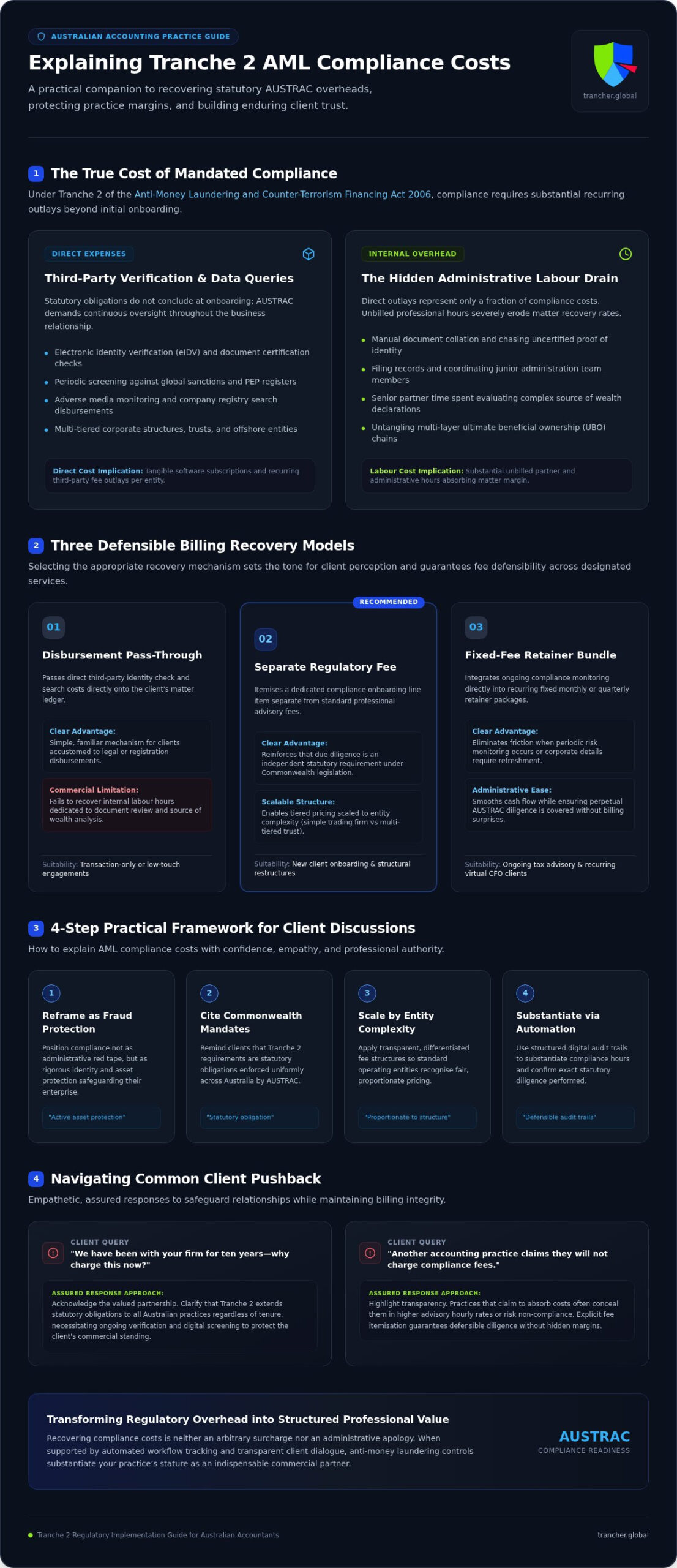
Guarding billable capacity is fundamental to running a sustainable accounting practice. Yet, many partners still treat anti-money laundering obligations as an internal overhead rather than a billable professional discipline. Absorbing these statutory requirements directly erodes practice profitability, particularly under Tranche 2 obligations where compliance demands combined software subscriptions, third-party verification fees, and substantial staff hours. Understanding these distinct cost components is the essential first step when determining how to explain AML compliance costs to clients with complete commercial confidence. When you position these requirements as active asset and identity protection, compliance ceases to feel like red tape and becomes a clear statement of professional care.
Direct Verification Expenses and Ongoing Risk Monitoring
Initial client onboarding incurs immediate out-of-pocket expenses through electronic identity verification, document checking, and company registry searches. However, statutory obligations don’t conclude once an engagement letter is signed. Operating under AUSTRAC regulatory oversight requires continuous monitoring throughout the entire business relationship. Firms must periodically screen client profiles against global sanctions, politically exposed persons (PEP) registers, and adverse media databases. For multi-tiered corporate structures, complex family trusts, and entities with offshore links, this perpetual oversight demands ongoing data queries that represent a real, recurring operational expense.
The Hidden Drain of Manual Administrative Labour
Direct verification expenses represent only a fraction of the full equation. Manual document collation, chasing uncertified identity proofs, and filing paper records consume countless non-billable hours across administration and junior accounting teams. Senior partners often spend valuable time untangling beneficial ownership chains and evaluating source of wealth declarations. Left unmanaged, this administrative drag severely diminishes matter recovery rates. Adopting proactive strategies for AML CTF compliance costs reduction allows your firm to streamline manual data handling, preserve staff capacity, and capture defensible activity records that justify transparent billing.
Selecting a Client-Friendly Billing Model for Compliance Recovery
Every firm handles client invoicing differently, yet recovering regulatory overhead demands a deliberate pricing strategy. When considering how to explain AML compliance costs to clients, the billing model you select sets the tone for the entire commercial relationship. Practices typically weigh three approaches: passing through direct verification outlays as out-of-pocket disbursements, charging a distinct statutory compliance fee, or integrating the operational expense directly into fixed monthly retainers. Each mechanism carries clear implications for cash flow, client perception, and billing transparency across designated accounting services governed by the Anti-Money Laundering and Counter-Terrorism Financing Act 2006.
A pure disbursement model passes direct third-party identity check costs straight onto the matter ledger. While straightforward, it fails to recover internal labour spent reviewing documentation or completing source of wealth checks. For firms seeking full recovery, adopting a more comprehensive commercial model is vital.
The Separate Compliance and Regulatory Fee Model
Itemising an upfront regulatory onboarding fee separates statutory diligence from standard advisory work. This clear line item underscores that customer due diligence is an independent statutory obligation mandated by Commonwealth law, not arbitrary practice padding. It also offers helpful commercial flexibility; your firm can scale the fee based on structural complexity, ensuring standard trading companies and intricate multi-tiered trusts are billed according to the actual diligence required.
Incorporating Compliance into Fixed-Fee Service Packages
Bundling compliance into ongoing retainer agreements works exceptionally well for recurring advisory and tax clients. Instead of creating invoicing friction with periodic charges whenever a director changes or a trust deed is refreshed, firms build periodic risk monitoring into their monthly service tiers. This predictable approach smooths cash flow and protects recovery margins, particularly when paired with automated systems. Choosing an operational management platform like Trancher makes it simple to track client activity and ensure recurring compliance retainers reflect real practice effort.
Whichever billing structure suits your firm best, complete transparency remains essential. Disclosing your recovery methodology clearly within initial engagement documentation removes uncertainty, ensuring clients view compliance management as a standard professional discipline from day one.
Client Communication Frameworks: Scripts and Engagement Letters
Explaining regulatory charges doesn’t need to be uncomfortable. When team members understand how to explain AML compliance costs to clients with calm authority, fee resistance quickly evaporates. The most effective approach follows a simple four-step framework: explain the statutory context, highlight the direct client protection, describe the verification process, and state the fee clearly. Framing identity checks as a vital commercial safeguard helps clients recognise that rigorous due diligence protects their business against identity theft, corporate hijacking, and payment fraud.
Consistency across your practice is crucial. When every staff member articulates these requirements using the same structured approach, clients accept compliance fees as standard professional practice.
Updating Engagement Letters and Terms of Business
Modern engagement letters should articulate regulatory expectations in plain Australian English rather than dense legal disclaimers. Clearly outline your obligations under Commonwealth legislation, setting expectations around CDD and KYC requirements Australia before commencing any substantive accounting work. Your terms should specify client responsibilities around promptly providing certified records, declaring corporate structures, and notifying your firm of any material changes in beneficial ownership. Transparent disclosures eliminate billing ambiguity from the outset.
Conversational Scripts for Onboarding and Fee Inquiries
When clients ask why a compliance fee appears on their proposal, your team can respond with a warm, reassuring script:
“Like all registered accounting practices, our firm complies with federal AUSTRAC mandates to secure commercial transactions. We use secure, sovereign-hosted verification technology to validate entity structures and protect your business against fraudulent impersonation. The compliance fee on your invoice covers these mandatory third-party verification checks and regular statutory register updates, ensuring your business stays fully compliant and your banking facilities remain uninterrupted.”
This phrasing grounds the cost in mutual benefit. It reassures clients that their private data is handled securely while demonstrating that thorough diligence protects their commercial standing and vital banking relationships.
Overcoming Common Client Objections to Compliance Charges
Even with clear engagement letters, fee pushback can occasionally arise. Knowing how to explain AML compliance costs to clients during these delicate moments separates thriving practices from those that needlessly leak billable hours. Client hesitation rarely stems from malice; it usually reflects confusion about why an accounting practice now requires formal identity verification. By meeting objections with empathy, clear boundaries, and statutory context, your team can resolve doubts quickly while reinforcing your position as a trusted adviser.
Handling the “We Have Worked Together for Years” Objection
Long-standing clients often express surprise when asked for updated identification documents. They may feel personal trust is being questioned after years of collaboration. Reassure them warmly that the relationship remains deeply valued, while explaining that federal law applies uniformly across all business entities. Commonwealth rules do not permit personal familiarity to substitute for documented customer due diligence. Emphasise that maintaining verified records actively shields their corporate structures during third-party financial audits and bank loan assessments, while modern digital onboarding keeps their personal time commitment to just a few minutes.
Responding to Competitor Undercutting and Fee Resistance
Clients sometimes point to competing firms claiming not to charge compliance fees. When this arises, highlight that regulatory adherence cannot simply be ignored under Australian law. Practices that appear not to charge for compliance often do one of two things:
- Conceal expenses: They inflate standard hourly rates or general overhead markups to quietly absorb the overhead.
- Cut corners: They fail to implement adequate compliance controls, exposing themselves and their clients to severe operational disruption and regulatory scrutiny.
Explain that transparent pricing reflects rigorous governance. Transparent line items ensure clients only pay for the precise diligence their entity requires. If your team needs structured frameworks to navigate these conversations seamlessly, access Trancher’s client notification templates to standardise fee communications and uphold professional confidence across your client base.
Streamlining Verification to Maximise Fee Recovery with Trancher
Manual spreadsheets, paper checklists, and fragmented network drives quickly turn regulatory duties into an administrative sinkhole. When team members cannot easily quantify the time spent on customer due diligence, writing off those hours becomes an expensive default habit. Trancher transforms this dynamic by centralising electronic verification, PEP and sanctions screening, and perpetual risk monitoring into a unified platform. Equipped with pre-built client notification templates, your firm gains the exact operational backing needed when determining how to explain AML compliance costs to clients clearly, calmly, and professionally.
Automating Evidence Generation and Billing Substantiation
Defending a compliance fee requires tangible proof of work. Trancher features dedicated compliance activity tracking that records every identity check, entity lookup, and risk review as it happens. By implementing compliance ROI tracking software, practice managers can convert what was once unbilled administrative overhead into measurable, recoverable professional service. The platform generates clear activity summaries that can accompany client invoices, demonstrating the exact diligence performed to safeguard their corporate structures and eliminating invoice disputes before they arise.
Fast-Tracking Readiness Ahead of 1 July 2026
Preparing your practice for statutory obligations should feel structured, manageable, and commercially rewarding. Trancher provides standardised risk evaluation workflows and staff training modules engineered specifically for Australian accounting practices. With our guarantee to achieve compliance readiness within 30 days, your firm can establish an audit-ready AML/CTF program without disrupting everyday client delivery. You can also explore these benefits firsthand through a complimentary 3-month trial, which includes formal ROI efficiency reporting to evaluate recovered hours and prove the bottom-line value of automated compliance management.
Transform Regulatory Compliance into Billable Practice Value
Mastering how to explain AML compliance costs to clients protects both your practice’s profitability and client trust. By adopting a defensible billing model, standardising engagement disclosures, and reframing customer due diligence as proactive asset protection, your team can discuss regulatory fees with absolute confidence. Compliance doesn’t have to remain a non-billable administrative burden.
You don’t have to navigate this operational shift alone. Trancher is guaranteed to make your practice AML/CTF compliance-ready within 30 days. Start your complimentary 3-month trial of Trancher today to access automated activity tracking, client notification templates, and a dedicated ROI efficiency and profitability report. Plus, save 20% on your first 12-month subscription following the trial. Taking control of your compliance processes has never been simpler, and your firm is well prepared to lead the way.
Frequently Asked Questions
Can Australian accounting firms legally charge clients for AML compliance checks?
Yes, Australian accounting practices can legally recover the costs associated with mandatory customer due diligence. Professional ethical standards require that all fees and expense recoveries are disclosed clearly in engagement documentation before work commences. While direct third-party search costs can be passed through as disbursements, general overheads like staff labour and compliance systems must be billed as transparent professional service fees or incorporated into engagement retainers.
What is the best way to explain AML compliance costs to a long-standing client?
The best approach is to lead with mutual protection and regulatory equality rather than administrative red tape. When learning how to explain AML compliance costs to clients who have worked with you for years, remind them that Commonwealth mandates apply uniformly to every business. Frame identity verification as an active safeguard that protects their corporate identity from fraud while ensuring uninterrupted banking and lending facilities.
Should AML compliance fees be charged as a separate disbursement or included in professional fees?
Your choice depends on the specific cost incurred and your commercial billing strategy. Direct third-party verification costs can be passed through as disbursements if they represent an exact out-of-pocket expense for that specific matter. Conversely, internal partner review time, ongoing risk screening, and operational management must be billed as structured compliance fees or built into recurring fixed retainers to maintain transparent fee disclosure.
What happens if an Australian client refuses to pay the compliance fee or provide identity documents?
If a client refuses to provide mandatory identity documents, Australian law prohibits your firm from delivering designated accounting services. Customer due diligence is a statutory requirement, not an optional request. If pushback relates solely to the fee, your practice can decide commercially whether to adjust the engagement scope, absorb the cost, or explain that ongoing service delivery requires covering mandatory regulatory maintenance.
How much staff time does an Australian accounting practice typically spend on manual AML checks?
Manual compliance workflows consume multiple non-billable hours across administration teams and senior partners for every complex client onboarding. Staff lose considerable time chasing uncertified identity proofs, cross-referencing company extracts, and manually reviewing trust structures. Without dedicated compliance automation, this administrative burden quietly erodes matter recovery rates and pulls experienced practitioners away from high-value advisory work.
How do Tranche 2 reforms beginning 1 July 2026 change client fee structures for accountants?
Tranche 2 obligations expand regulatory reporting across everyday accounting activities, requiring ongoing client risk monitoring and perpetual entity reviews. To protect operating margins, forward-thinking practices are restructuring standard engagement agreements. Knowing how to explain AML compliance costs to clients enables firms to introduce separate annual compliance items or adjust monthly retainers, ensuring that statutory duties are funded sustainably.
How does dedicated AML compliance software assist practices in recovering compliance expenditure?
Specialised software automates customer verification while capturing tangible evidence of compliance activity. Platforms like Trancher track electronic identity searches, beneficial ownership checks, and ongoing risk monitoring in real time. These activity logs generate clear documentation to substantiate compliance charges on client invoices, transforming time-consuming AUSTRAC obligations into an organised, defensible, and recoverable professional service.