

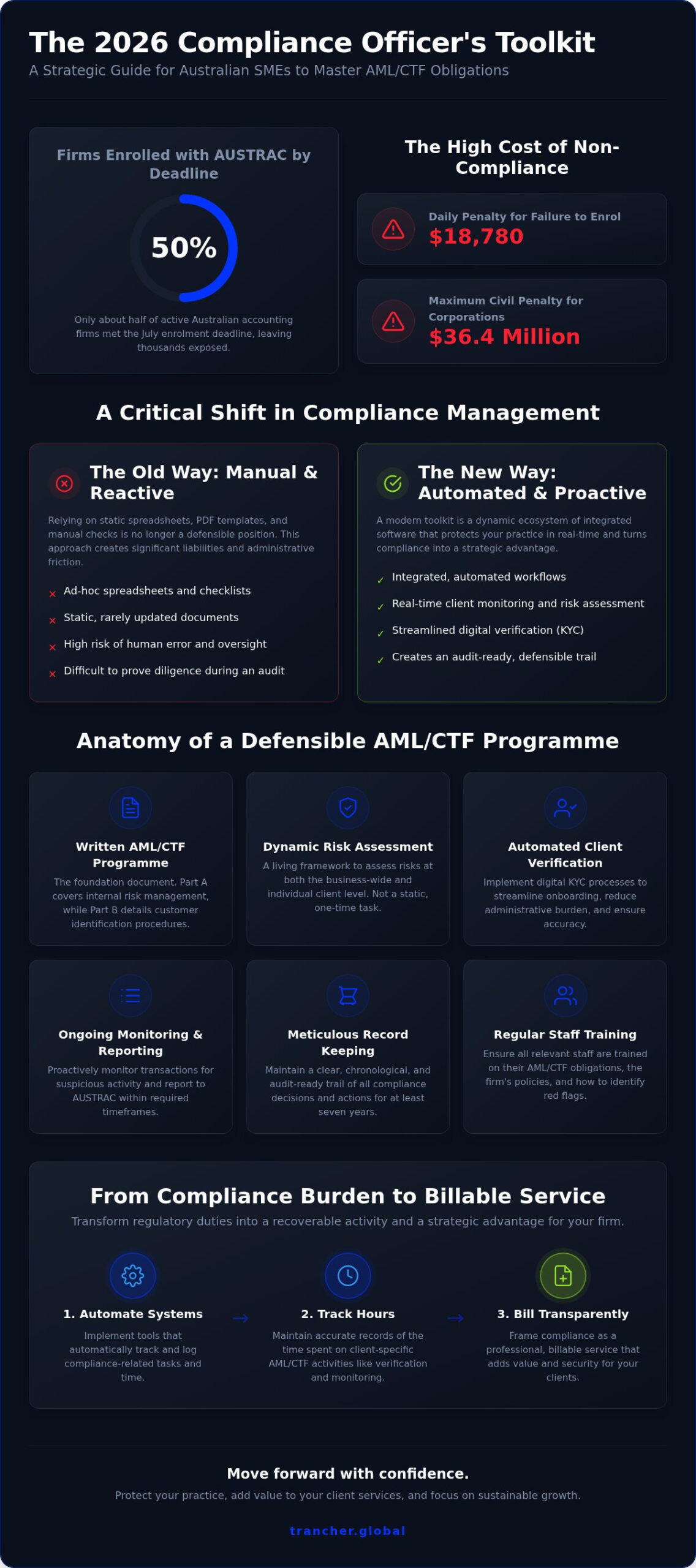
Only about 50% of active Australian accounting firms successfully enrolled with AUSTRAC by the July deadline, leaving thousands of practices exposed to daily penalties of $18,780. Since the Tranche 2 obligations officially commenced on 1 July 2026, it’s understandable if you feel a sense of urgency to ensure your systems are fully compliant. The transition to a formal AML/CTF program is a significant shift, especially when you’re balancing complex client work with new administrative requirements.
We’re here to act as your strategic guide, providing the clarity you need to move forward with confidence. This article outlines a comprehensive compliance officer toolkit designed to help Australian SMEs master their obligations and protect their practice from civil penalties that can reach $36.4 million for corporations. You’ll discover how to implement the essential frameworks and automated tools required to maintain a defensible program without sacrificing your firm’s productivity.
Our focus is on transforming these obligations into a strategic advantage for your business. We’ll preview the integration of client verification, risk monitoring, and revenue-tracking systems that turn compliance into a streamlined, billable professional service. By moving beyond manual spreadsheets and adopting automated workflows, you can ensure your firm remains resilient, compliant, and focused on sustainable growth.
Key Takeaways
- Understand why the 1 July 2026 AUSTRAC deadline necessitates a move away from manual spreadsheets toward integrated, automated systems.
- Identify the essential components of a defensible AML/CTF Program, focusing on the specific frameworks required for Part A and Part B compliance.
- Discover how a modern compliance officer toolkit can significantly reduce administrative friction by automating digital verification and KYC processes.
- Learn to frame regulatory duties as a “recoverable activity” by implementing systems that track compliance hours for transparent client billing.
- Follow a structured, 30-day roadmap to achieve full compliance readiness, protecting your practice from substantial regulatory penalties and risks.
The 2026 Compliance Officer Toolkit: Why the Landscape has Shifted
The regulatory environment for Australian accounting firms changed permanently on 1 July 2026. Before this date, anti-money laundering (AML) protocols were often viewed as a best practice suggestion for large financial institutions. Today, they’re a strict legal requirement for every SME providing designated services. A modern compliance officer toolkit is no longer just a collection of static PDF templates or a dusty ring-binder; it’s a dynamic ecosystem of digital frameworks and automated software designed to protect your practice in real-time.
The transition from voluntary adherence to mandatory regulation means the “old way” of managing compliance, relying on manual folders and ad-hoc spreadsheets, is now a significant liability. With AUSTRAC already issuing information-gathering notices to firms that failed to enrol by the July deadline, the shift toward automated systems isn’t just about efficiency. It’s about maintaining a defensible position against penalties that can reach $36.4 million for corporate breaches.
The Role of the AML/CTF Compliance Officer in 2026
The responsibilities of a Chief Compliance Officer (CCO) have moved from the high-rise offices of major banks into the heart of suburban SME firms. In a smaller practice, this specialist role usually falls to a senior partner or director. You’re now responsible for overseeing the firm’s AML/CTF programme, ensuring staff are regularly trained, and acting as the primary point of contact for AUSTRAC. This isn’t a task that you can set and forget. It requires active partner-level accountability to ensure that risk assessments are updated and suspicious matters are reported within the required timeframes. We see this as an opportunity for leaders to gain deeper oversight of their client base while strengthening the firm’s internal governance.
Navigating the AUSTRAC Tranche 2 Deadline
The 1 July 2026 deadline brought a wide range of designated services under the regulatory umbrella. If your firm assists with company formation, manages client funds, or provides a registered business address, you’re now a reporting entity. Research published in August 2026 indicated that only about 50% of active firms had enrolled by the 29 July deadline, creating a massive compliance gap that regulators are now closing. Operating without enrolment carries a daily penalty of $18,780, making the implementation of a robust compliance officer toolkit a matter of immediate financial health. However, this shift also offers a chance to innovate. By moving away from administrative friction and adopting automated KYC and billing systems, you can transform these new duties into a transparent, billable professional service that adds value to the client experience.
Core Components of a Defensible AML/CTF Toolkit
A defensible AML/CTF programme requires more than just good intentions. It demands a structured approach that AUSTRAC can verify during a formal review. The foundation of your compliance officer toolkit must be a written AML/CTF Programme, traditionally divided into Part A and Part B. Part A focuses on your firm’s internal processes for identifying, mitigating, and managing risk, while Part B details your specific procedures for customer identification and verification.
Without a robust AML risk assessment tool Australia, many firms struggle to quantify the specific threats inherent in their service lines. A defensible toolkit ensures that your risk assessment remains a living document rather than a static folder sitting on a shelf. This proactive approach allows you to demonstrate to regulators that you’re actively monitoring for suspicious activity and maintaining audit-ready records. AUSTRAC expects to see a clear, chronological trail of how you reached your risk conclusions, making meticulous record keeping a core pillar of your daily operations.
Risk Assessment Frameworks and Templates
Effective risk management happens at two distinct levels. First, you need a business-wide assessment that examines your overall service offerings, delivery channels, and geographical reach. Second, you must profile individual clients to identify specific “red flags” related to their industry or source of wealth. Using structured templates helps standardise this process across your entire team, ensuring no one misses a critical detail. Instead of a once-a-year review, dynamic assessments allow you to update a client’s risk profile whenever their circumstances change. This might include a shift in business ownership, a sudden influx of large cash transactions, or an unexpected change in their typical activity patterns.
Client Due Diligence (CDD) and KYC Tools
Verifying a long-term client might seem straightforward, but the CDD and KYC requirements Australia mandates for 2026 are particularly rigorous. You’re now required to look beneath the surface of complex trust structures to identify the ultimate beneficial owners. This involves verifying the identity of any individual who owns or controls 25% or more of the entity, even if they aren’t your primary contact. It’s about understanding the “who” and the “why” behind every transaction your firm facilitates.
Relying on manual checks for these details is time-consuming and often results in accuracy risks. A modern compliance officer toolkit integrates digital verification tools that cross-reference data in seconds, providing a seamless experience for your clients. If you’re looking to simplify this transition, you might consider how automated programme management can centralise these core components into a single, audit-ready dashboard.
Manual vs. Automated Toolkits: A Performance Comparison
Selecting the right compliance officer toolkit often involves a choice between traditional manual processes and modern digital automation. While some firms still rely on physical folders and Excel sheets, the performance gap between these two approaches is stark. Manual KYC verification can take hours, or even days, to complete as staff chase identity documents and manually cross-reference databases. Automated digital verification completes these same checks in seconds. This isn’t just about saving time; it’s about eliminating the human error that inevitably creeps into manual data entry during high-pressure periods.
Automation ensures a level of consistency that manual systems simply cannot match. When every staff member follows the same digital workflow, the risk of a missed step or a forgotten document is virtually eliminated. This creates a culture of reliability across the whole firm. Instead of scattered paper files that are difficult to locate, an automated platform provides a centralised source of truth. This structured approach is what makes a firm truly “audit-ready,” allowing you to face an AUSTRAC review with calm confidence rather than administrative panic.
The Hidden Costs of Spreadsheet Compliance
Relying on spreadsheets for AML/CTF tracking often feels like a cost-effective solution, but the hidden expenses are significant. We’ve found that the billable hours lost to manual data entry and document chasing can quickly erode a firm’s profit margins. Beyond the immediate time cost, manual systems carry a high risk of oversight. A missed suspicious matter report or an expired risk assessment can lead to the severe penalties we discussed earlier. Manual systems often fail during an AUSTRAC independent audit because they lack the time-stamped, immutable audit trail that regulators require to prove ongoing compliance.
Benefits of Integrated Compliance Software
Modern software transforms compliance from a reactive burden into a proactive business process. Integrated tools provide real-time PEP (Politically Exposed Persons) and sanctions screening, ensuring you’re alerted to client risks the moment they arise. You don’t have to worry about missing a review date because automated reminders handle the scheduling for ongoing customer due diligence. Most importantly, these systems maintain audit-ready compliance records in a single, secure location. By centralising your compliance officer toolkit within a dedicated platform, you ensure that every risk assessment and verification check is documented, dated, and ready for inspection at a moment’s notice.
Transforming Your Toolkit into a Revenue Generator
Many SME firms view the 1 July 2026 obligations as a pure cost centre that drains resources and billable hours. However, shifting your perspective can turn your compliance officer toolkit into a powerful revenue generator. By reframing these duties as a “recoverable activity”, you can move away from the mindset of administrative overhead and toward a professional service model. This approach is central to effective AML CTF compliance costs reduction, as it allows you to recoup the time spent on complex regulatory tasks that were previously written off as non-billable work.
Modern compliance isn’t just about avoiding AUSTRAC penalties; it’s about providing a higher level of professional rigour. When you perform deep-dive risk assessments or verify complex corporate structures, you’re delivering an essential service that protects both your firm and your client. By using a structured compliance officer toolkit that integrates time-tracking and reporting, you can demonstrate the specific value provided during the onboarding and monitoring phases, making it easier to justify reasonable compliance fees in your engagement letters.
Tracking Billable Compliance Activities
The key to recovering costs is meticulous documentation. When your team performs enhanced due diligence on a high-risk client, that time should be captured with the same precision as any other advisory work. You can use integrated software to generate automated evidence logs that show exactly which verification checks were performed and how long they took. This transparency helps you communicate the value of compliance to your clients, explaining that these measures are necessary to secure their financial interests and meet Australian law. It transforms a potentially awkward conversation about fees into a professional discussion about risk mitigation and security.
Identifying New Advisory Revenue Streams
As an accountant, you’re already a trusted advisor. The Tranche 2 reforms create a natural opportunity to expand into structured AML advisory services. Many of your clients may be struggling with their own regulatory requirements and will look to you for guidance on risk frameworks and internal controls. By leveraging compliance ROI tracking software, you can build a clear business case for your clients, showing them how automated systems reduce their long-term risk profile. This proactive stance positions your firm as an innovator that helps clients navigate changing landscapes with operational ease. If you’re ready to start tracking the value of your regulatory work, you can explore our revenue-tracking tools to see how compliance becomes a billable asset.
Building Your Toolkit with Trancher: The 30-Day Path
Implementing a comprehensive compliance officer toolkit shouldn’t be a multi-year project that stalls your firm’s growth. At Trancher, we’ve developed a streamlined approach to end-to-end programme management specifically for Australian accounting firms. We understand that since the 1 July 2026 deadline has passed, the pressure to be fully operational is high. That’s why we offer a guaranteed path to being AML/CTF compliance-ready within 30 days. It’s about moving from uncertainty to total operational control without the stress of navigating complex legislation alone.
To help your firm transition with confidence, we provide a complimentary three-month trial. This isn’t just a software demo; it’s a full implementation that includes ROI reporting. You’ll be able to see exactly how the platform saves time and identifies billable opportunities before you commit to a long-term arrangement. With AUSTRAC already issuing notices to non-enrolled entities, starting your integration immediately is the most effective way to protect your practice and your partners.
Operational Readiness and Onboarding
Success in compliance depends on more than just software. It requires a partner who understands the local landscape. Our 100% local Australian support team acts as your expert guide, ensuring your compliance officer toolkit integrates seamlessly with your existing accounting workflows. During the initial setup, we focus on practical application. We train your staff, help you configure your risk settings, and ensure your Part A and Part B programmes are audit-ready. This hands-on approach ensures that your team feels supported rather than overwhelmed by new administrative processes.
Securing Your Firm’s Future
The ultimate goal of an automated system is peace of mind. By digitising your KYC, ongoing monitoring, and record keeping, you significantly mitigate the risk of reputational damage and severe regulatory penalties. You’re not just ticking boxes; you’re building a resilient firm that’s ready for any future AUSTRAC scrutiny. A defensible programme is your best insurance policy against the shifting regulatory environment. We invite you to start a conversation with Aaron Soh today to discuss your firm’s specific needs. Let’s transform your compliance obligations into a strategic asset that secures your firm’s long-term success.
Securing Your Firm’s Future in the Tranche 2 Era
The 1 July 2026 deadline has redefined operational standards for Australian SMEs. We’ve explored how a modern compliance officer toolkit replaces the friction of manual spreadsheets with the precision of automated workflows. By integrating risk assessments and digital verification, your firm can move from a defensive posture to one of strategic growth. You now have the frameworks to transform regulatory obligations into a recoverable, billable professional service. This shift protects your margins while ensuring total regulatory alignment.
We’re here to help you navigate this transition with operational ease. Start your complimentary 3-month Trancher trial today to experience a system that guarantees you’ll be compliance-ready in 30 days. Your trial includes a full ROI report and is backed by our expert Australian-based support team. You don’t have to face these changes alone. With a steady partner and the right resources, you can lead your firm toward a more secure and profitable future with absolute confidence.
Frequently Asked Questions
What are the minimum requirements for an AML compliance officer Australia?
At a minimum, an AML compliance officer in Australia must be a senior staff member, such as a director or partner, with sufficient authority to manage the firm’s regulatory obligations. They’re responsible for overseeing the development of the AML/CTF programme and acting as the primary liaison with AUSTRAC. This isn’t just an administrative role; it requires the power to allocate resources and ensure the firm meets all reporting and record-keeping duties.
How much does it cost to implement an AML program for a small firm?
Costs vary based on the size of your firm and the complexity of your client base. While some practices try to manage obligations manually, the hidden costs in billable hours often exceed the price of a dedicated compliance officer toolkit. We recommend looking for solutions that offer a try-before-you-buy model. For example, Trancher provides a complimentary three-month trial to help firms evaluate the ROI before committing to a subscription.
Does my firm need a toolkit if we only have a few high-risk clients?
Yes, because your obligations are triggered by the “designated services” you provide, not just the risk level of your clients. Even with a low-risk portfolio, you must have a formal AML/CTF programme, conduct KYC checks, and maintain audit-ready records. A structured toolkit ensures these processes are handled consistently, protecting you if a client’s risk profile suddenly changes or if AUSTRAC requests a review of your compliance frameworks.
Can I use a generic compliance toolkit for AUSTRAC Tranche 2?
While generic templates exist, they often lack the specific Australian data integrations and AUSTRAC-aligned workflows required for Tranche 2. A specialised compliance officer toolkit is designed for the local regulatory environment, ensuring you meet the exact requirements of the AML/CTF Act. Using a generic solution can leave gaps in your risk assessment or record keeping, which may result in significant penalties during a formal regulatory audit.
What is the difference between Part A and Part B of an AML program?
Part A of your AML/CTF programme focuses on your firm’s internal governance, risk assessment, and mitigation strategies. It outlines how you identify and manage money laundering risks across your entire practice. Part B is more granular, detailing your specific procedures for customer identification and verification (KYC/CDD). Both parts are mandatory and must be documented in writing to prove your firm is meeting its regulatory duties under the current Australian framework.
How do I demonstrate AML compliance to an AUSTRAC auditor?
Demonstrating compliance requires a clear, chronological audit trail of all your regulatory activities. You must be able to produce your written programme, business-wide risk assessments, and proof of client verification for any designated services provided. Auditors look for evidence that your programme is being actively followed rather than just sitting in a folder. Automated systems make this easier by providing time-stamped records and centralised documentation that’s ready for immediate inspection.
Is staff training a mandatory part of the compliance officer toolkit?
Staff training is a non-negotiable requirement under the AML/CTF Act. Your team must understand the risks associated with financial crime, as well as their specific roles in your firm’s compliance programme. A robust toolkit should include structured training modules and a system for tracking completion. This ensures every employee can identify “red flags” and knows how to escalate suspicious matters to the compliance officer in a timely and professional manner.
What happens if we miss the 1 July 2026 deadline for Tranche 2?
The 1 July 2026 deadline has already passed, meaning compliance is now mandatory for all Tranche 2 entities. If your firm provides designated services and hasn’t enrolled with AUSTRAC or implemented a programme, you’re currently at risk of significant penalties. AUSTRAC has already begun issuing section 167 notices to investigate non-enrolled firms. We recommend starting your implementation immediately to mitigate these risks and demonstrate a proactive commitment to your regulatory obligations.