

What if the looming 1 July 2026 deadline wasn’t a threat to your firm’s productivity, but actually the key to unlocking a new, high-value revenue stream? Many Australian practitioners feel understandably weighed down by Tranche 2 jargon and the pressure of potential AUSTRAC penalties. It’s common to worry that these new requirements will simply add to your non-billable administrative burden. However, you don’t have to face this transition with uncertainty or stress.
This guide shows you how to master your obligations using a defensible business risk assessment AML template tailored specifically for the Australian accounting sector. We’ll provide a clear path to achieving 100% compliance readiness well before the deadline, ensuring your practice is protected and prepared. You’ll learn how to move beyond manual spreadsheets by adopting a structured framework that simplifies your regulatory duties. We’ll also explore how to automate the risk assessment process, allowing you to turn mandatory compliance into a professional, billable service that adds genuine value to your client relationships. By the end of this article, you’ll have the insights needed to transform a perceived hurdle into a strategic advantage for your firm’s long-term growth.
Key Takeaways
- Understand why a Business Risk Assessment is the non-negotiable foundation for meeting your Tranche 2 obligations by 1 July 2026.
- Identify the critical components of a defensible framework, including how to evaluate firm complexity and high-risk customer types.
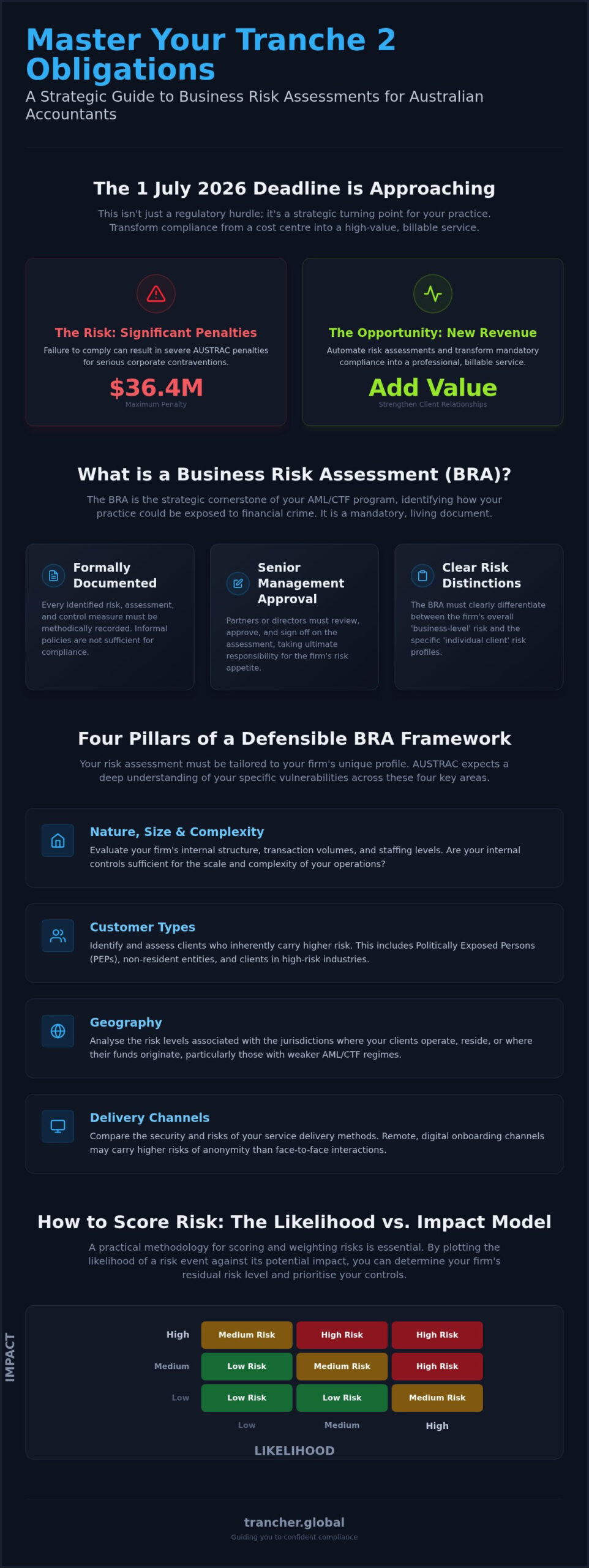
- Master a practical methodology for scoring risks using the Likelihood vs. Impact model to determine your firm’s residual risk levels.
- Learn how to replace inefficient manual processes with a high-quality business risk assessment AML template that integrates seamlessly into your workflow.
- Discover how to achieve full compliance readiness in just 30 days while turning mandatory administrative tasks into billable professional services.
What is an AML Business Risk Assessment (BRA)?
A Business Risk Assessment (BRA) serves as the strategic cornerstone of your firm’s compliance architecture. It’s a comprehensive review designed to identify exactly how your specific practice might be exploited by criminal elements. While it’s helpful to understand what anti-money laundering is from a global perspective, a BRA focuses on your local operations. It’s now a mandatory requirement for all Tranche 2 entities, including accounting practices that provide designated services. Think of it as the foundation of your entire AML/CTF Program. Without it, your firm’s defences lack direction and purpose.
Your BRA isn’t a “one and done” exercise. It must be a living document that undergoes regular review to keep pace with changing market conditions and new service offerings. To be compliant, the assessment must meet several criteria:
- Formally Documented: You can’t rely on verbal agreements or informal policies. Every risk must be recorded.
- Senior Management Approval: The partners or directors of your firm must review and sign off on the assessment, taking ultimate responsibility for the risk appetite of the business.
- Clear Distinctions: It must distinguish between “business-level” risk, which looks at your firm’s overall exposure, and “individual client” risk, which focuses on the specific profile of a customer.
The Role of the BRA in Tranche 2 Readiness
The 1 July 2026 deadline isn’t just a date on the calendar; it’s the point where operational stability meets regulatory scrutiny. Starting your BRA early ensures you aren’t rushing to meet requirements in a panic. This assessment informs every other part of your compliance work, from how you perform due diligence to how you monitor ongoing transactions. Failing to produce a robust assessment can lead to severe consequences, including AUSTRAC fines that reach up to $36,400,000 for serious corporate contraventions. Using a structured business risk assessment AML template helps you avoid these pitfalls and build a defensible framework from day one.
Designated Services for Accountants
Not every accounting task triggers AML obligations. However, specific “designated services” bring your firm under the Tranche 2 umbrella. A designated service is any professional activity defined by the AML/CTF Act that involves financial transactions or the management of assets, such as trust formation, managing client money, or assisting with real estate transactions. Your business risk assessment AML template must account for the specific risk profile of these services. For example, setting up a complex trust structure for a foreign entity carries a vastly different risk weight than providing basic tax advice to a local sole trader. Identifying these triggers early allows you to focus your compliance efforts where they matter most.
Core Components of a Defensible AML Risk Template
Building a robust framework starts with understanding that your firm is unique. A generic business risk assessment AML template must be adapted to reflect your internal structure, the nature of your operations, and the complexity of the services you provide. AUSTRAC expects you to demonstrate a deep understanding of how your specific business model might be vulnerable to financial crime. This involves looking inward at your firm’s size and outward at how you deliver services. For instance, a sole practitioner focusing on domestic tax returns faces different risks than a mid-sized firm managing international wealth transfers.
There are four primary pillars to consider when populating your template:
- Nature, Size, and Complexity: Assessing whether your internal controls are sufficient for your transaction volumes and staff numbers.
- Customer Types: Identifying clients who inherently carry higher risk, such as Politically Exposed Persons (PEPs) or non-resident entities.
- Geography: Evaluating the risk levels of the jurisdictions where your clients reside or where their funds originate.
- Delivery Channels: Comparing the security of face-to-face interactions against the increased anonymity of remote, digital onboarding.
Product and Service Risk Factors
Certain accounting services are naturally more attractive to those seeking to obscure illicit funds. Complex structures like discretionary trusts and Self-Managed Super Funds (SMSFs) are considered higher risk because they can be used to hide the true source of wealth. You must also distinguish between high-volume, low-value transactions and occasional high-value transfers that could signal a serious breach. Ensuring these factors are linked directly to your AML program checklist Australia provides a clear audit trail for regulators. If you find this mapping process overwhelming, using a platform like Trancher can help you integrate these assessments into your daily workflow without the manual stress.
Geographic and Customer Risk
Geography plays a vital role in your risk profile. You need to identify jurisdictions with weak AML/CTF controls, often highlighted on the Financial Action Task Force (FATF) grey or black lists. While Australian domestic clients are generally lower risk, foreign entities require a much higher level of scrutiny. A key part of this process is profiling “beneficial owners”. You must look through the layers of a company or trust to identify the actual individuals who benefit from the assets. Your business risk assessment AML template should provide a clear methodology for identifying these individuals, ensuring you aren’t unknowingly facilitating transactions for high-risk parties.
Methodology: How to Score and Weight Risks
Once you’ve identified your firm’s risk pillars, you need a consistent way to measure them. Quantifying risk allows you to prioritise your resources effectively rather than treating every client with the same level of suspicion. A business risk assessment AML template provides the necessary structure, but your methodology provides the substance. By applying a logical scoring system, you move away from guesswork and toward a defensible position that AUSTRAC will respect. This process involves calculating your inherent risk, applying your internal controls, and determining what’s left over: your residual risk.
Your “Risk Appetite” is a critical part of this methodology. It’s the formal statement of how much risk your partners are willing to accept to achieve their business goals. For example, you might decide that clients from certain high-risk jurisdictions are simply too risky for your firm’s current compliance capacity. Defining these boundaries early prevents “scope creep” in your risk exposure and ensures every staff member knows when to escalate a file. While a static Word template is a good starting point, a dynamic scoring system is far more effective at catching changes in client behaviour over time.
Likelihood and Impact Scoring
For most SME practices, a simple 3×3 or 5×5 matrix is the most practical tool. You define “Likelihood” as the probability of a money laundering event occurring within a specific service or client group. “Impact” measures the potential damage to your firm if that event takes place. This isn’t just about the financial cost of a fine; it includes reputational damage and the risk of losing your professional license. By multiplying Likelihood by Impact, you get a clear numerical score for your inherent risk. This straightforward approach ensures your team can actually use the business risk assessment AML template without needing a degree in statistics.
Evaluating Control Effectiveness
Your current controls are the shields that protect your practice. These might include staff training, automated KYC software, or manual partner reviews of high-value transactions. To find your residual risk, you must honestly evaluate whether these controls are “Satisfactory,” “Needs Improvement,” or “Weak.” If you have a high-risk service but only a weak manual control in place, your residual risk remains dangerously high. The formula is simple: Inherent Risk minus Control Effectiveness equals Residual Risk. Aiming for a low residual risk across all designated services is the ultimate goal for 2026 readiness, as it demonstrates that your firm’s defences are proportional to the threats you face.
Implementing Your BRA: From Template to Automation
While many practitioners start with a basic Word document, relying on a manual business risk assessment AML template often leads to what we call “audit anxiety.” This happens when records are scattered across different folders or versions, making it difficult to prove your compliance logic during an AUSTRAC review. Transitioning from static spreadsheets to dedicated AML risk assessment tools in Australia ensures your findings are centralised and consistent. This shift isn’t just about technology; it’s about integrating risk awareness into your team’s daily workflow so that compliance becomes second nature rather than a periodic panic.
Communicating these findings to your staff is just as vital as the documentation itself. When your team understands why a specific service carries a “High” risk rating, they’re better equipped to spot red flags during client interactions. This shared knowledge creates a culture of vigilance that protects the entire practice. By moving away from a siloed approach, you ensure that the insights gained from your risk assessment actually inform the way you do business every day.
Reducing the Administrative Burden
Automation is the most effective way to manage the heavy lifting of Tranche 2 requirements. Moving away from manual documentation can save up to 80% of the time typically spent on compliance administration, allowing your team to focus on high-value client work. A dynamic business risk assessment AML template within an automated platform ensures that every change to your risk profile is time-stamped and justified. This transforms your BRA into a living document that grows with your firm. Instead of a dusty file on a shelf, your risk assessment becomes a proactive shield that updates automatically as you onboard new client types or expand into new service areas.
Compliance as a Profit Centre
The most successful firms are those that frame AML obligations as a professional advisory service rather than a sunk cost. Your BRA data is a goldmine for identifying clients who require Enhanced Due Diligence (EDD). These aren’t just administrative hurdles; they’re opportunities to charge for the specialised risk management work you’re performing. By leveraging compliance ROI tracking software, you can see exactly how much revenue these activities generate. This approach turns a regulatory burden into a clear billable asset that supports your firm’s financial health. To see how you can start automating your compliance today, explore the Trancher platform and its 30-day compliance guarantee.
Achieve 2026 Readiness with the Trancher BRA Framework
Transitioning from a manual spreadsheet to a fully automated compliance ecosystem doesn’t have to be a multi-year project. Trancher provides a pre-configured, AUSTRAC-aligned business risk assessment AML template specifically engineered for the nuances of Australian accounting practices. Instead of starting with a blank page, you begin with a framework that already understands the risk profiles of trusts, SMSFs, and complex corporate structures. This proactive approach allows you to move from zero to compliance-ready in just one month, backed by our 30-day guarantee. It’s about replacing uncertainty with a structured, defensible program that stands up to regulatory scrutiny.
A static assessment is only the beginning of your journey toward 1 July 2026. To maintain a truly robust posture, your BRA must integrate seamlessly with ongoing risk monitoring software. This connection ensures that if a client’s behaviour changes or their risk profile shifts, your business-level assessment remains accurate and up to date. We invite you to start a 3-month complimentary trial today to build your defensible program and experience how automation removes the friction from your administrative duties.
The Trancher Advantage for SME Firms
Small and medium-sized firms often struggle with offshore generic software that doesn’t account for local Australian regulations. Trancher offers local support and expert guidance, ensuring you’re never left to interpret complex Tranche 2 jargon alone. Our platform features automated ROI reporting, which tracks every billable compliance hour and identifies revenue opportunities from enhanced due diligence. To ensure your whole practice is aligned, we provide role-based training modules. These ensure every team member, from graduates to partners, understands the business risk assessment AML template findings and knows how to apply them in their daily tasks.
Next Steps for Your Practice
Preparation is the best antidote to regulatory stress. We recommend taking these immediate steps to secure your firm’s future:
- Audit Your Services: Review your current “designated services” against the official Tranche 2 list to identify exactly where your obligations lie.
- Consult an Expert: Book a consultation with Aaron Soh to discuss your specific risk profile and how to tailor a framework to your firm’s needs.
- Access the Suite: Sign up for the Trancher platform to access our full automated template suite and start your 3-month trial.
By taking action now, you aren’t just meeting a requirement; you’re building a more resilient, profitable, and technologically advanced practice. Let us help you turn the 2026 transition into your firm’s next strategic advantage.
Secure Your Practice for 2026 and Beyond
The transition to Tranche 2 represents a significant shift for Australian practitioners, yet it also offers a unique chance to refine your internal systems and improve operational efficiency. By establishing a robust methodology and moving beyond static spreadsheets, you protect your firm from regulatory risk while creating new avenues for billable advisory work. A well-structured business risk assessment AML template is the foundation of this evolution, ensuring your compliance posture is both defensible and efficient.
Trancher provides the tools you need to meet these obligations with confidence. Our AUSTRAC-aligned frameworks are designed specifically for the accounting sector, and we stand behind our platform with a 30-day compliance guarantee. You can Get Started with a Complimentary 3-Month Trial of Trancher today and receive a 20% discount should you choose to continue after the trial period. We’re here to act as your expert companion, helping you turn mandatory requirements into a strategic advantage for your firm’s future. You have the expertise to navigate these changes, and we’re ready to support you every step of the way.
Frequently Asked Questions
Is a business risk assessment mandatory for all Australian accountants?
It’s mandatory for any Australian accountant providing designated services as defined by the AML/CTF Act. Under the Tranche 2 reforms commencing 1 July 2026, firms must formally document how their specific practice is vulnerable to being exploited for financial crime. This isn’t just a recommendation; it’s a core regulatory requirement. Failing to maintain a current assessment can lead to significant penalties, making it essential to establish your framework well before the mid-2026 deadline.
What is the difference between a BRA and a customer risk assessment?
A Business Risk Assessment (BRA) evaluates the firm-wide exposure based on your specific services and internal structure, while a customer risk assessment focuses on the unique profile of an individual client. Your BRA provides the high-level context that informs how you treat different customer groups across your entire practice. For example, your BRA might identify trusts as a high-risk service, which then dictates a more rigorous customer risk assessment whenever a new trust client is onboarded.
How often should I update my AML business risk assessment?
You should review and update your assessment regularly or whenever there’s a material change to your practice. This includes offering new designated services, expanding your client base into new jurisdictions, or significant changes in your firm’s structure. AUSTRAC expects your business risk assessment AML template to be a living document. Most firms find that an annual formal review, supplemented by updates during major operational shifts, ensures their compliance program remains defensible, accurate, and aligned with current regulations.
Can I use a generic AML template for my accounting practice?
While you can start with a template, it must be specifically tailored to the unique risk profile of an Australian accounting practice. Generic offshore templates often miss the nuances of local designated services or AUSTRAC’s specific expectations. A high-quality business risk assessment AML template should provide a structured starting point that you then customise to reflect your firm’s actual size, client types, and delivery channels to ensure your compliance program is truly defensible.
What does AUSTRAC look for in a business risk assessment during an audit?
AUSTRAC looks for evidence that your assessment is documented, approved by senior management, and based on a logical methodology. They want to see that you’ve genuinely considered your firm’s specific vulnerabilities rather than just ticking boxes. Auditors check if your controls are proportional to the risks you’ve identified. Providing audit-ready documentation that shows the “why” behind your risk ratings is the best way to demonstrate a good-faith effort toward compliance and avoid potential enforcement actions.
How long does it take to complete a business risk assessment using Trancher?
Trancher is designed to accelerate your readiness, offering a formal guarantee that your firm will be AML/CTF compliance-ready within 30 days of starting. Our automated workflows remove the manual heavy lifting associated with traditional spreadsheets. By using our pre-configured frameworks, you can move from a standing start to a fully documented, AUSTRAC-aligned program in a fraction of the time it would take to build a manual system, ensuring you meet the 1 July 2026 deadline.
What happens if my residual risk remains “High” after applying controls?
If your residual risk remains high after applying controls, you must decide if that level of risk fits within your firm’s defined Risk Appetite. You may need to implement more rigorous Enhanced Due Diligence or additional monitoring to mitigate the threat. In some cases, if the risk cannot be managed effectively, the most prudent course of action is to decline the client or cease providing that specific high-risk service to protect your practice’s professional integrity and regulatory standing.
Does the BRA need to be submitted to AUSTRAC regularly?
You don’t usually need to submit your BRA to AUSTRAC on a regular basis, but you must have it available immediately if they request it for an audit or review. However, you’ll be required to submit an annual compliance report that confirms your program, including your risk assessment, is in place and functioning. Maintaining audit-ready records within a centralised system ensures you can provide this proof without the stress of a last-minute administrative scramble or lost documentation.