

Could your next AUSTRAC audit be the moment your remittance business stops growing, or the day you prove its resilience? For many, the constant pressure of maintaining robust AML for remittance providers feels like a trade-off between staying compliant and staying profitable. You’ve likely felt the stress of manual KYC processes or the complexity of reporting IFTIs and SMRs within strict deadlines. It’s a heavy burden to carry, but it doesn’t have to be a barrier to your success.
We understand that your primary goal is to move money safely while protecting your hard-earned registration. This guide will show you how to build a defensible, AUSTRAC-aligned AML/CTF programme that replaces manual headaches with automated ease. You’ll learn how to streamline your customer onboarding and manage reporting obligations with complete confidence. We’ll walk through the practical steps to ensure your business is ready for the future, including the significant Tranche 2 changes coming on 1 July 2026, so you can focus on growth with absolute peace of mind.
Key Takeaways
- Establish a rock-solid foundation by structuring your Part A and Part B AML/CTF programmes to meet AUSTRAC’s specific expectations for the remittance sector.
- Master the art of balancing strict KYC verification with a seamless customer journey to ensure AML for remittance providers supports rather than hinders your growth.
- Learn how to simplify complex reporting obligations, including IFTIs and the $10,000 TTR threshold, to maintain a defensible compliance posture.
- Future-proof your operations for the 1 July 2026 Tranche 2 reforms by moving away from manual tracking toward automated, audit-ready systems.
- Gain peace of mind by implementing a compliance framework that prioritises operational ease and ensures you are always prepared for an AUSTRAC audit.
Navigating the AUSTRAC Landscape for Remittance Providers
The Anti-Money Laundering and Counter-Terrorism Financing Act 2006 defines a remittance service provider as any entity that moves money or value on behalf of a customer. Because these services often involve rapid, cross-border transfers and high volumes of physical currency, AUSTRAC classifies the sector as a high-risk designated service. This designation means that implementing effective Anti-money laundering (AML) protocols isn’t just a suggestion; it’s a fundamental requirement for staying in business. AUSTRAC is watching. The regulator has demonstrated a targeted enforcement approach in 2026, focusing on vulnerabilities in digital assets and cash-intensive businesses. Effective AML for remittance providers starts with understanding where you fit in this regulatory framework.
Ignoring these obligations carries heavy weight. Non-compliance can lead to massive civil penalties, and in severe cases, AUSTRAC may cancel your registration entirely. This effectively shuts down your ability to operate in Australia. The landscape is also shifting. The Tranche 2 reforms, commencing 1 July 2026, extend these regulations to lawyers and accountants. While you are already regulated, this change signals a broader, more rigorous compliance environment across the entire Australian economy. It’s a clear message that the days of manual, spreadsheet-based tracking are ending.
Identifying Your Registration Category
Your specific compliance workload depends on how you’re registered. Independent Remittance Dealers must develop and maintain their own bespoke AML/CTF programmes. This gives you total control but requires a deep understanding of your unique risk profile. Remittance Network Providers (RNPs) act as a hub, supporting a fleet of affiliates with a shared framework. If you’re an Affiliate, you operate under an RNP’s umbrella. While you use their programme, you’re still responsible for maintaining accurate local records and ensuring your staff are properly trained. Knowing your category ensures you don’t over-invest in unnecessary structures or, conversely, leave dangerous gaps in your oversight.
The Enrolment and Registration Process
Getting onto the AUSTRAC Register is a multi-step journey through the AUSTRAC Online portal. You’ll need to provide detailed information about your business structure, key personnel, and your planned AML/CTF programme. The regulator requires police checks and a formal ML/TF risk assessment as part of a successful application. Once registered, the work doesn’t stop. You must submit an annual Compliance Report between January and March each year. This report is your chance to prove your systems are working. Trancher helps streamline this by providing audit-ready documentation, moving you from administrative stress to operational excellence in under 30 days.
How to Build Your AML/CTF Program from the Ground Up
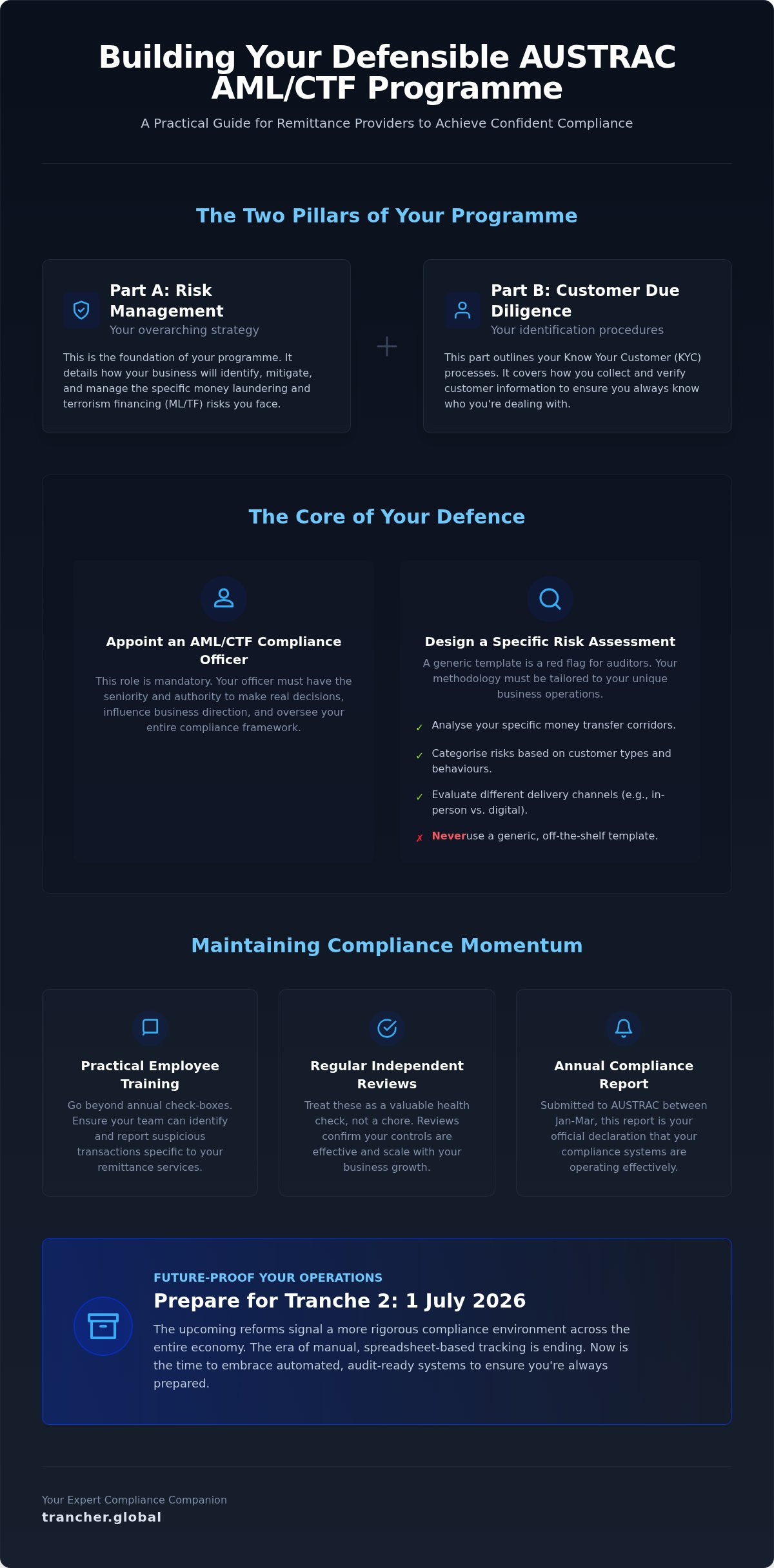
Building a compliance programme isn’t just about paperwork. It’s about creating a living system that protects your business from financial crime. A standard programme is split into two distinct parts. Part A focuses on your risk management strategies. Part B covers your customer identification procedures. Together, they form the backbone of effective AML for remittance providers. To ensure these policies are actually followed, you must appoint an AML/CTF Compliance Officer. This person needs enough seniority to make real decisions and influence the business direction.
Designing Your Risk Assessment Methodology
Your methodology must be specific to the money transfer corridors you operate in. Generic templates won’t satisfy a regulator during an audit. You need to categorise risks based on customer types, country factors, and the delivery channels you use. For example, a high-frequency sender to a high-risk jurisdiction requires different oversight than a local one-off transfer. Using a dedicated AML risk assessment tool Australia ensures consistency across your team. It helps you identify vulnerabilities before they become liabilities.
Training shouldn’t be a once-a-year event that staff ignore. It needs to be practical. Your team should know exactly what a suspicious transaction looks like in the context of your specific services. Additionally, your programme must undergo regular independent reviews. These reviews act as a safety net. They confirm your controls remain effective as your business scales. Referencing AUSTRAC’s overview for remittance providers can help you align your internal reviews with the regulator’s latest expectations.
Governance and Senior Management Oversight
Compliance starts at the top. We often refer to this as the “Tone from the Centre.” If the owners or board don’t take the rules seriously, the rest of the team won’t either. It’s vital to document board or owner approval for all your AML policies. This evidence is a key requirement during an AUSTRAC audit. By creating a culture where compliance is seen as a strategic advantage rather than a box-ticking exercise, you build a more resilient company. This high-level commitment is the final piece of the puzzle for successful AML for remittance providers. Transitioning from manual spreadsheets to an integrated system makes this whole process feel much lighter. You might consider how to automate your compliance management to maintain this high standard without the administrative headache.
KYC and CDD: Balancing Compliance with Customer Experience
Remittance customers expect near-instant service. They’re often sending money to support families or settle urgent business debts across borders. However, for you, speed cannot come at the expense of safety. Effective AML for remittance providers requires a sophisticated approach to Know Your Customer (KYC) and Customer Due Diligence (CDD). By 2026, the standard has shifted firmly toward digital-first verification. Electronic data sources now provide a more reliable and faster result than physical document inspection, allowing you to verify identities without slowing down the transaction.
Sometimes, standard checks aren’t enough. You must trigger Enhanced Due Diligence (EDD) when dealing with high-value transfers, transactions involving high-risk jurisdictions, or Politically Exposed Persons (PEPs). For your corporate clients, this means peeling back layers of ownership to identify the ultimate beneficial owners. It’s about knowing exactly who is behind the money. Screening against global sanctions lists is also a non-negotiable daily task. It ensures you aren’t inadvertently facilitating prohibited transfers, which protects your business from severe regulatory fallout.
Streamlining the Onboarding Workflow
Moving away from manual ID copies to digital verification is the most effective way to reduce operational friction. Digital systems allow you to handle remote client verification securely, which is essential for modern remittance services. You can make CDD and KYC requirements Australia clear to your customers by using intuitive interfaces that guide them through the process. This transparency builds trust. It ensures you collect the right information the first time, preventing growth-stalling delays during the onboarding phase.
Ongoing Customer Due Diligence (OCDD)
Compliance isn’t a “one and done” event. It’s a continuous cycle of oversight. Your relationship with a customer evolves, and so does their risk profile. Setting specific triggers to refresh customer information is vital for a defensible programme. This might include a change in their typical transaction volume or a move to a new country. Many firms now use ongoing risk monitoring software to flag unusual activity automatically. This proactive approach allows you to catch red flags in real-time, ensuring your AML for remittance providers remains robust without requiring constant manual intervention.
Reporting is the primary way AUSTRAC monitors the financial system. For those managing AML for remittance providers, it represents the most significant ongoing administrative task. Accuracy here isn’t just about avoiding letters from the regulator; it’s about contributing to the integrity of the global financial network. You’re effectively the front line in identifying and stopping illicit funds. Every report you submit helps build a clearer picture of financial activity across Australia.
International Funds Transfer Instructions (IFTIs) are the most common reports you’ll handle. Every cross-border transfer, whether inbound or outbound, must be reported to AUSTRAC within 10 business days. There is no monetary threshold for an IFTI. If it crosses a border, it gets reported. Threshold Transaction Reports (TTRs), however, are triggered by physical currency. If a transaction involves $10,000 or more in cash, or the foreign currency equivalent, you have 10 business days to submit a TTR. It’s a clear, objective rule that requires consistent monitoring.
Mastering the SMR Process
Suspicious Matter Reports (SMRs) require more judgment. Suspicion doesn’t require proof of a crime. It’s a feeling or observation that a transaction could be linked to something illicit. You might notice a customer making multiple small transfers just under the $10,000 limit. This behaviour, often called “structuring,” is a classic red flag in the remittance sector. Your team needs to be trained to spot these patterns without hesitation.
Speed is essential. If you suspect a matter relates to terrorism financing, you must report it within 24 hours. For all other suspicions, the deadline is three business days. Crucially, you must never “tip off” the customer. Telling someone you’re filing an SMR is a criminal offence that can jeopardise an active investigation and your own business registration. It’s a sensitive area that requires a calm, professional approach from your compliance officer.
Automating Regulatory Reporting
Manual data entry is a significant risk factor. A single typo in a passport number or a missed deadline can lead to compliance breaches. Integrating your money transfer system with specialised software reduces this friction. It ensures that audit-ready compliance records are generated as transactions happen. This removes the stress of the 10-day countdown and ensures your data is always precise.
By 1 July 2026, new reporting forms with expanded details became mandatory for all new AUSTRAC enrollees. Keeping up with these changes manually is exhausting. Automation allows you to focus on serving your customers while the system handles the heavy lifting of data transmission. If you want to see how this works in practice, you can explore Trancher’s automated reporting tools to simplify your AUSTRAC obligations.
Scaling Your Remittance Business with Automated Compliance
Viewing regulatory requirements as a mere cost of doing business is a missed opportunity. While traditional models treat AML for remittance providers as an administrative weight, the Trancher approach reframes it as a driver of operational excellence. By automating the friction-filled parts of your workflow, you don’t just stay compliant; you build a faster, more reliable service for your customers. This transition allows you to move away from the anxiety of manual oversight toward a scalable business model that thrives under scrutiny.
Achieving AUSTRAC readiness shouldn’t take months of legal consultations or internal confusion. We focus on speed. Getting your systems aligned with the regulator’s expectations happens in under 30 days. This rapid deployment is backed by a 30-day compliance guarantee. It provides the certainty you need to focus on your commercial goals. By leveraging local Australian expertise, you ensure your programme is tailored to the specific nuances of the local market, including the upcoming Tranche 2 changes in 2026.
Tracking Your Compliance ROI
Compliance can be a recoverable activity rather than a sunk cost. Using compliance ROI tracking software allows you to justify your investment by visualising the efficiency gains across your team. You can precisely calculate the hours saved through automated KYC and reporting, which were previously lost to spreadsheets and manual data entry. These deeper client insights also reveal new service opportunities, as you understand your customers’ patterns better than ever before. It turns a mandatory obligation into a strategic asset for your firm’s growth.
Getting Started with a Steady Partner
The journey toward a defensible programme starts with a clear understanding of your current position. We offer a complimentary 3-month trial. This allows you to experience the benefits of automation without immediate financial commitment. During your first 30 days of implementation, our team provides intensive local support. We make sure your onboarding is seamless and your staff are fully trained. You can reach out to Aaron Soh and the team for a bespoke compliance health check to identify any gaps in your current framework. This proactive partnership ensures that your AML for remittance providers remains a source of strength as you navigate the changing regulatory landscape.
Future-Proofing Your Remittance Operations
Building a robust framework for AML for remittance providers is no longer just a regulatory hurdle; it’s a foundation for scalable growth. By replacing manual spreadsheets with automated workflows, you eliminate the administrative friction that often stalls progress. You’ve seen how streamlining KYC and reporting can transform your compliance posture into a defensible, audit-ready asset. It’s about moving from reactive management to proactive excellence while keeping your focus on your customers.
As the regulatory landscape shifts toward the 1 July 2026 reforms, staying ahead of the curve ensures your business remains resilient. We’re here to act as your steady partner, providing Australian-based expert support to navigate every complexity. With our comprehensive ROI and efficiency reporting, you can finally see the tangible value your compliance programme brings to your bottom line. We’re committed to making this transition feel manageable and even advantageous for your firm.
Regulatory readiness should feel like a strategic advantage, not a burden. Take the first step toward complete operational ease with our guaranteed AML/CTF compliance within 30 days. Start your complimentary 3-month Trancher trial today and experience the peace of mind that comes with a truly robust system. We look forward to helping your business thrive in a changing landscape.
Frequently Asked Questions
Do I need an AML/CTF programme if I am only a small remittance affiliate?
Yes, you are still required to have a programme in place. Even as an affiliate, you are a reporting entity under the AML/CTF Act. While you may use the framework provided by your Remittance Network Provider, you are responsible for its local implementation. This includes maintaining accurate records and ensuring your staff receive regular training. Trancher helps affiliates manage these obligations consistently, ensuring you remain audit-ready without the administrative burden.
How long do I need to keep customer identification records in Australia?
You must retain all customer identification records for seven years after the relationship with the customer ends. This requirement ensures that AUSTRAC or law enforcement can access historical data during investigations. Records include the information used to verify the customer’s identity and any documents obtained during the process. Using automated systems for AML for remittance providers makes this record-keeping seamless, as digital logs are stored securely and retrieved easily during an audit.
What is the penalty for failing to report an IFTI to AUSTRAC?
Failing to report an International Funds Transfer Instruction (IFTI) can lead to significant civil penalties and court-imposed fines. AUSTRAC has the authority to issue formal directions or even suspend your business registration for repeated breaches. These consequences can effectively halt your operations. It is essential to report every cross-border transfer within 10 business days to maintain your standing. Automation reduces this risk by flagging every reportable instruction as it happens.
Can I use digital ID verification for my remittance customers?
Yes, digital ID verification is not only permitted but is considered a best practice for 2026. Electronic verification allows you to cross-reference customer data against reliable government and commercial databases in real-time. This method is significantly faster than physical document inspection and reduces the friction for your customers. Trancher integrates these digital verification tools directly into your workflow, allowing you to onboard clients securely and meet your KYC obligations in seconds.
How often should I conduct an independent review of my AML programme?
You should conduct an independent review at regular intervals based on your business’s specific risk profile. While the legislation doesn’t mandate a set timeframe, industry standards typically suggest a review every two to three years. You must also trigger a review if there are significant changes to your services or the regulatory environment, such as the Tranche 2 reforms. These reviews confirm that your Part A and Part B programmes remain effective and defensible.
What is the difference between a Threshold Transaction Report and an IFTI?
The primary difference lies in the trigger: cash versus geography. A Threshold Transaction Report (TTR) is required for any transaction involving $10,000 or more in physical currency. In contrast, an IFTI is required for every cross-border transfer, regardless of the amount or the payment method used. Both reports must be submitted to AUSTRAC within 10 business days. Understanding these distinct triggers is vital for maintaining a compliant reporting schedule for your remittance business.
How do I handle a customer who refuses to provide source of wealth information?
If a customer refuses to provide necessary source of wealth information, you should not proceed with the transaction. Under your Enhanced Due Diligence obligations, you must verify where funds originated for high-risk transfers. Proceeding without this information exposes your business to severe regulatory risk. In such cases, you should also consider whether the refusal warrants the filing of a Suspicious Matter Report. Having a clear policy in your AML/CTF programme helps staff handle these situations confidently.
Is there a specific AML software for small remittance providers in Australia?
Trancher is specifically designed to meet the needs of Australian SMEs and remittance providers. Our platform provides a comprehensive system for managing KYC, risk monitoring, and AUSTRAC reporting in one integrated workflow. We focus on removing the administrative weight of compliance, allowing you to achieve readiness within 30 days. Our solution also includes ROI tracking, helping you transform mandatory AML for remittance providers into an efficient, recoverable activity that supports your business’s long-term growth.