

Did you know that law firms prioritising a digital-first intake experience earn, on average, 50% more revenue than those relying on legacy systems? It’s a striking figure that highlights why simplifying client onboarding for law firms is no longer just an operational goal; it’s a strategic necessity. With the 1 July 2026 deadline for Tranche 2 obligations fast approaching, the pressure to balance rigorous AUSTRAC compliance with a seamless client experience has never been higher.
We understand that the prospect of manual KYC checks and complex CDD workflows can feel like an overwhelming administrative burden. You’re likely concerned about potential client friction or the heavy penalties for non-compliance, which can reach $31.3 million for a body corporate. This guide promises to show you how to navigate these changes with confidence, transforming regulatory requirements into a manageable, billable part of your practice. We’ll explore how to automate your workflows, meet your 2026 obligations within 30 days, and ensure every minute spent on compliance contributes to your firm’s bottom line.
Key Takeaways
- Identify the critical differences between manual data entry and automated KYC/CDD workflows to reduce administrative bulk and human error.
- Master the “non-negotiable” technical features required for simplifying client onboarding for law firms while maintaining a premium client experience.
- Implement a proven 30-day transition strategy to move from regulatory uncertainty to full AUSTRAC compliance-readiness.
- Discover how to reframe compliance as a recoverable professional service by using specialised ROI tracking software to capture time spent on due diligence.
- Learn to navigate the 1 July 2026 Tranche 2 deadline with a proactive, solution-oriented approach that turns obligations into operational advantages.
The Evolving Landscape of Client Onboarding for Australian Law Firms
Modern client onboarding has matured far beyond simple data collection. It now represents the critical intersection of identity verification, comprehensive risk assessment, and precise data gathering. For Australian legal practices, this shift isn’t just about efficiency; it’s about survival. The 1 July 2026 Tranche 2 deadline marks a pivotal moment where AUSTRAC obligations become mandatory for the legal profession. Relying on traditional paper-based forms or long-form email chains is no longer a viable strategy. These manual methods create significant regulatory gaps and lack the secure, audit-ready documentation required by modern standards. Transitioning to a digital-first approach is the only way of simplifying client onboarding for law firms while ensuring every new matter starts on a compliant footing.
We see this transition as a strategic opportunity. By moving away from fragmented admin tasks, your firm can establish a robust compliance engine that protects your reputation. The goal is to move from a reactive posture to a proactive one, where compliance feels like a natural extension of your professional service rather than a hurdle to overcome.
Why Tranche 2 Changes Everything for Intake
The introduction of Tranche 2 reforms means that providing “designated services” now triggers strict AML/CTF obligations. This includes common tasks like property transfers, managing client funds, or setting up companies and trusts. Central to these requirements are Know Your Customer (KYC) regulations, which require firms to verify the identity of their clients and understand the nature of their business. Before 2026, many firms operated with informal intake processes that relied on professional trust. Post-2026, this must be replaced by rigorous Customer Due Diligence (CDD) standards. This evolution transforms onboarding from a back-office administrative task into a high-stakes compliance function that protects the firm from criminal exploitation.
The True Cost of Onboarding Friction
Efficiency in your intake process directly correlates with your firm’s financial health. When onboarding is slow, cash flow stalls because work cannot commence and billing is delayed. Beyond the balance sheet, complex manual processes frustrate clients. Research indicates that firms focusing on a smooth digital intake experience earn 50% more revenue on average. There’s also the delicate risk of “tipping off” or inadvertently admitting high-risk clients without the necessary screening. Onboarding friction is the primary barrier to firm growth in 2026. By simplifying client onboarding for law firms, you remove these hurdles, allowing your team to focus on legal excellence rather than administrative bulk.
Manual vs. Automated Systems: Comparing Onboarding Frameworks
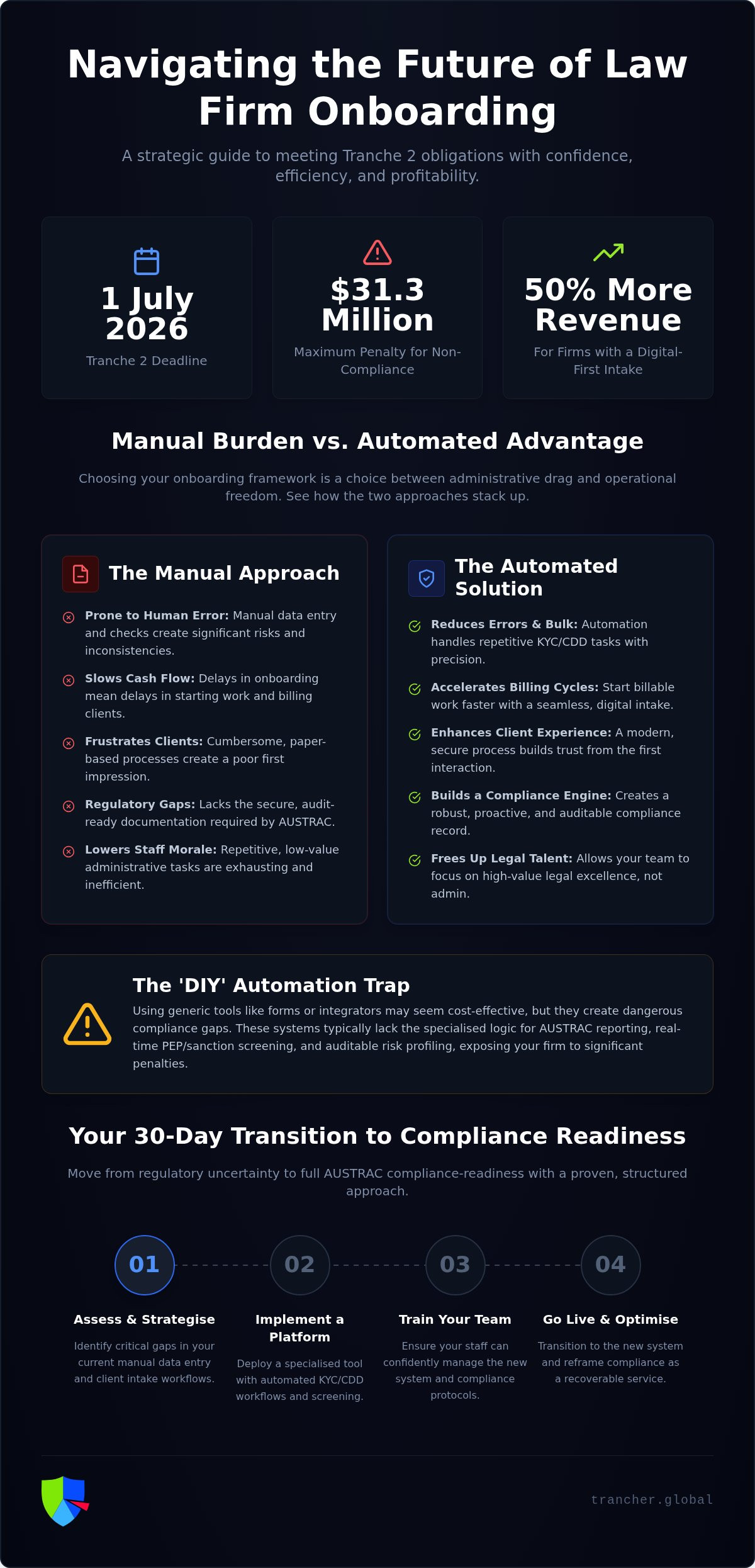
Choosing between manual processes and automated systems is often a choice between administrative burden and operational freedom. Manual data entry isn’t just slow; it’s fundamentally prone to human error. When staff are forced to chase clients for physical ID documents and manually cross-reference PEP or sanction lists, morale inevitably drops. This labour-intensive model makes simplifying client onboarding for law firms nearly impossible to achieve at scale. In contrast, automated workflows handle these repetitive tasks with precision, ensuring that compliance is a byproduct of the process rather than a separate, exhausting chore. Adopting client communication best practices through automation helps build trust from the very first interaction, showing clients that your firm is both modern and secure.
The ‘DIY’ Automation Trap
Many firms attempt to bridge the gap by using generic tools like Microsoft Forms or Zapier. While these might seem like cost-effective shortcuts, they often fail to meet the specific CDD and KYC requirements Australia mandates. Generic tools lack the built-in logic to trigger AUSTRAC-specific reporting prompts or conduct real-time screening against global databases. Maintaining fragmented integrations also carries a hidden cost in technical debt and staff time. Without specialised compliance features, these “DIY” setups leave dangerous gaps in your risk profiling that can lead to significant penalties. It’s a high-risk strategy that trades long-term security for a temporary, fragile fix.
Integrated Compliance Platforms: A New Standard
Specialised platforms set a new benchmark by centralising identity verification and risk profiling into a single, cohesive workflow. These systems provide a “single source of truth,” ensuring you have audit ready compliance records available at a moment’s notice. While a manual configuration might take months to perfect, an integrated system can be fully operational within 30 days. This speed of implementation is vital for firms looking to meet the 2026 deadline without disrupting their current operations. If you’re considering transitioning to an automated framework, focusing on end-to-end integration is the most reliable path forward. By simplifying client onboarding for law firms through a dedicated platform, you ensure that every document is stored correctly and every check is logged, creating a transparent, defensible trail for future AUSTRAC audits.
Essential Features for Simplifying Law Firm Onboarding
To succeed in simplifying client onboarding for law firms, your technology stack must function as a sophisticated regulatory gatekeeper. It’s no longer sufficient to merely collect names and addresses. You need a system that actively identifies risks without creating unnecessary hurdles for your clients. A mobile-friendly, digital-first experience is now a non-negotiable requirement. Most clients expect to complete their intake on a smartphone during a spare moment, rather than dealing with the frustration of printing, signing, and scanning physical documents. This shift in delivery doesn’t just improve satisfaction; it ensures that data is captured accurately at the source.
Automated screening for Politically Exposed Persons (PEPs) and Sanctions is another essential pillar. Manual research is a significant drain on staff resources and is often prone to oversight. By automating these checks, you reduce research time from hours to seconds. Dynamic risk assessment tools then take this data and adapt the intake flow based on the client type. Whether you’re dealing with a local individual or a complex foreign entity, the system should prompt for the specific information required by AUSTRAC, ensuring no critical step is missed.
Digital Identity Verification (IDV)
The legal profession is moving rapidly beyond the era of photocopying passports at the front desk. Modern Digital Identity Verification (IDV) utilises biometric checks and direct database verification to confirm a client’s identity in real-time. This transition significantly reduces the risk of identity fraud in sensitive conveyancing and commercial matters. It also provides a much higher standard of data security. Using encrypted, purpose-built platforms ensures that sensitive KYC information is handled with a level of care that unencrypted email attachments simply cannot match. It’s a more secure, professional way to start the solicitor-client relationship.
Automated Risk Scoring & CDD
Consistency is the foundation of any defensible compliance program. Without a standardised approach, different team members might assess the same client risk differently. Implementing a dedicated AML risk assessment tool Australia ensures that your entire firm follows a unified methodology. This tool helps you categorise clients into “high-risk” or “low-risk” brackets based on objective criteria, making your Customer Due Diligence (CDD) both faster and more accurate. Remember that simplifying client onboarding for law firms is about more than just the first meeting. The right system also supports ongoing monitoring, allowing you to track changes in a client’s risk profile throughout their lifecycle with your firm.
A 30-Day Transition Plan for Implementing New Onboarding Systems
Transitioning your firm to a digital-first model doesn’t require months of disruption or a massive internal overhaul. A methodical 30-day plan can take you from regulatory uncertainty to full operational readiness. During Days 1 to 7, focus on assessing current bottlenecks. Pinpoint where manual KYC checks are stalling your workflow or where chasing client emails is draining staff resources. From Days 8 to 14, select a platform that offers a 30-day compliance guarantee. This ensures your systems are AUSTRAC-ready by the 2026 deadline without the need for complex manual configuration. Days 15 to 21 involve staff training and integrating role-based workflows. Finally, Days 22 to 30 are for client communication and going live. This structured approach is the most effective way of simplifying client onboarding for law firms.
Preparing Your Team for the Shift
Staff often view new compliance requirements as “more paperwork.” You can alleviate this concern by demonstrating how automation removes the manual burden of identity verification. Focus on the time saved: instead of manually cross-referencing sanction lists, the system provides an instant result. Clearly define the role of your AML Compliance Officer within the new digital system. By setting up role-based workflows, you ensure that junior staff can initiate checks while senior practitioners provide the final oversight. Utilising expert guidance during this phase allows your team to bypass the steep learning curve of AUSTRAC rules and stay focused on delivering high-value legal advice.
Communicating Changes to Clients
Clients generally appreciate transparency and enhanced security. When requesting additional identity checks, frame the requirement as a security benefit that protects their sensitive information and the integrity of their transactions. Using digital portals makes the process feel modern and professional, rather than an administrative hurdle. You can use standardised templates to explain the 2026 changes clearly, ensuring simplifying client onboarding for law firms remains a positive experience for everyone involved. Professionalism at this stage builds trust and sets a high standard for the ongoing solicitor-client relationship. Ready to secure your firm’s future? You can start your 30-day compliance journey today and meet the 2026 deadline with total confidence.
Transforming Onboarding from an Overhead into a Profitable Service
Most firms view regulatory requirements as a necessary evil. However, there’s a significant paradigm shift occurring where leading practices treat compliance as a recoverable professional service. By simplifying client onboarding for law firms, you aren’t just saving time; you’re creating a framework to capture the true value of that time. Deeper client due diligence often reveals complex corporate structures, international beneficial ownership, or intricate trust arrangements that require sophisticated legal analysis. Identifying these complexities early allows you to provide high-level advisory services that clients value for their risk-mitigation benefits. Trancher provides the tools to help you justify and communicate these fees transparently, ensuring clients understand the rigorous protection being provided to their interests.
Capturing Billable Compliance Hours
Tracking time spent on Customer Due Diligence (CDD) shouldn’t be an extra task for your solicitors. Using specialised compliance ROI tracking software allows your team to automatically log every minute spent on identity verification and risk profiling. These hours can then be integrated directly with your existing firm billing systems, ensuring that compliance work is no longer a hidden cost centre. Recoverable compliance is the key to maintaining firm margins under Tranche 2. It ensures that the increased administrative requirements of 2026 don’t erode your profitability, but instead become a sustainable, billable part of your service model.
The Long-Term ROI of Readiness
Investing in automation now pays dividends well beyond the initial setup phase. You can significantly reduce AML CTF compliance costs by eliminating the need for manual research and physical document storage. Long-term automation handles the heavy lifting of ongoing monitoring, allowing your staff to focus on high-level advisory work rather than administrative data entry. Beyond the immediate billable hours, the ultimate ROI lies in avoiding the massive financial penalties and reputational damage associated with AUSTRAC audits. Before committing to a particular compliance approach, it’s worth reviewing a detailed breakdown of AML software vs consultant cost Australia to ensure your firm selects the most cost-effective path forward. A proactive stance demonstrates to regulators and clients alike that your firm is a steady, reliable partner. Simplifying client onboarding for law firms is the first step toward a more resilient business model. We invite you to see the difference for yourself by starting your journey with a complimentary 3-month trial of Trancher today.
Secure Your Firm’s Future for 2026 and Beyond
Preparing for the 1 July 2026 deadline doesn’t have to be a source of stress or administrative bulk. By simplifying client onboarding for law firms, you’re doing more than just ticking a compliance box; you’re building a more efficient, profitable practice. We’ve explored how moving from manual, fragmented processes to an integrated digital framework ensures you’re always audit-ready while protecting your team from burnout. Remember that compliance, when handled correctly, is a billable professional service that adds tangible value to your client relationships.
Our team is here to act as your steady guide through every step of this transition. With our 30-day compliance-ready guarantee and specialised ROI reporting, you can turn regulatory obligations into a strategic advantage. You’ll also have access to local Australian expert support to ensure your firm remains on the right track. It’s time to move forward with confidence and operational ease. Secure your firm’s future with a complimentary 3-month Trancher trial and discover how manageable this journey can be. We’re excited to help you transform your intake process into a seamless, revenue-generating engine.
Frequently Asked Questions
How long does it take to become compliant with Tranche 2 obligations?
You can achieve full AML/CTF compliance-readiness within 30 days by following a structured, guided transition plan. While the official Tranche 2 obligations for Australian law firms commence on 1 July 2026, waiting until the final deadline increases the risk of operational bottlenecks. Early adoption allows your team to refine digital workflows and integrate automated systems without the pressure of an immediate regulatory audit or the rush of last-minute enrollment with AUSTRAC.
Can we still use manual spreadsheets for client onboarding after July 2026?
While no law explicitly bans spreadsheets, they are increasingly insufficient for meeting the rigorous AUSTRAC standards required under the new reforms. Manual tracking makes simplifying client onboarding for law firms difficult because it lacks real-time screening, automated risk scoring, and secure record-keeping. Spreadsheets are prone to human error and version control issues, which can lead to significant gaps during an independent audit. Transitioning to a dedicated platform ensures your documentation is consistent and secure.
What are the specific AUSTRAC requirements for law firms in Australia?
Law firms providing designated services must enrol with AUSTRAC by 29 July 2026 and implement a formal AML/CTF program. This program must include Customer Due Diligence (CDD) procedures, ongoing risk monitoring, and a system for reporting suspicious matters. You are also required to conduct regular staff training and maintain audit-ready records of all compliance activities. These requirements ensure that legal professionals act as effective gatekeepers against financial crime within the Australian legal system.
How do I explain the new onboarding requirements and fees to my clients?
Transparency is essential when introducing new compliance steps to your client base. We recommend framing these additional identity checks as a premium security benefit that protects the client’s interests and the integrity of their transactions. You can use standardised templates to explain that these measures are a mandatory requirement under Australian law. Clearly communicating that compliance work is a recoverable professional service helps justify associated fees while maintaining a modern, professional solicitor-client relationship.
Is digital identity verification legally sufficient for AUSTRAC standards?
Yes, digital identity verification (IDV) is legally sufficient and often preferred, provided the system meets AUSTRAC’s safe harbour or reasonable satisfaction standards. Modern IDV tools use biometric technology and direct database links to verify documents more accurately than traditional manual photocopying. This approach significantly reduces the risk of identity fraud in sensitive conveyancing and commercial matters. Using a certified platform ensures that the data you collect is encrypted and stored in accordance with Australian regulations.
What happens if our firm misses the 1 July 2026 deadline?
Missing the 1 July 2026 deadline exposes your firm to substantial regulatory risks and financial penalties. AUSTRAC can impose civil penalties of up to $31.3 million for a body corporate for a single breach. Additionally, failing to enrol while providing designated services can result in daily fines of up to $18,780. Beyond the financial impact, non-compliance can lead to mandatory independent audits, enforceable undertakings, or significant reputational damage that could affect your practice’s long-term standing.
How does Trancher guarantee compliance within 30 days?
We provide a structured, end-to-end framework that replaces months of manual configuration with a streamlined 30-day implementation plan. This guarantee is backed by our specialised workflows, AUSTRAC-aligned templates, and dedicated Australian expert support. By simplifying client onboarding for law firms, we remove the guesswork from risk assessments and KYC procedures. Our platform is pre-configured with the necessary triggers and reporting prompts, allowing your team to achieve full operational readiness with minimal disruption to your daily work.
Can I track the ROI of my compliance activities?
Yes, our platform includes specialised ROI reporting tools designed to track the time and resources spent on every compliance task. This allows you to identify recoverable professional service hours and integrate them directly into your firm’s billing system. Instead of viewing AML/CTF obligations as a non-billable overhead, you can clearly see the revenue generated from compliance-related advisory work. This data-driven approach helps you maintain firm margins while demonstrating the value of your services to clients.