

Did you know that a single oversight under the new Tranche 2 regulations can now expose an accounting firm to civil penalties of up to $36.4 million per contravention? With the 1 July 2026 commencement date already behind us, the pressure to maintain a flawless compliance programme is real. We understand that the administrative weight of manual monitoring can feel overwhelming, especially when you’re trying to balance client service with the need to spot increasingly sophisticated money laundering red flags for accountants.
You aren’t alone in feeling that these new obligations represent a significant shift for the profession. However, meeting these standards doesn’t have to be a hurdle that slows your growth. This guide promises to help you manage AML/CTF warning signs confidently by providing a clear, actionable checklist of red flags and a defensible process for reporting. We’ll explore how to identify suspicious client behaviours and complex structures, ensuring your firm remains a secure, compliant, and profitable leader in this new regulatory landscape.
Key Takeaways
- Recognise that red flags are risk indicators designed to protect your firm following the 1 July 2026 Tranche 2 commencement.
- Master the art of spotting money laundering red flags for accountants during the initial onboarding and identity verification process.
- Identify complex business structures and “layering” techniques that may be used to obscure beneficial ownership or source of wealth.
- Implement a robust “stop, record, and escalate” methodology to handle suspicious matters while strictly avoiding the “tipping off” offence.
- Learn how to turn these mandatory obligations into a recoverable professional service that adds tangible value to your client advisory offerings.
Understanding the AUSTRAC Tranche 2 Shift: Why Red Flags Matter in 2026
The 1 July 2026 commencement of Tranche 2 obligations has fundamentally changed the Australian accounting landscape. For many firms, identifying money laundering red flags for accountants is no longer a matter of professional intuition; it’s a core regulatory requirement. A red flag isn’t necessarily evidence of a crime. Instead, think of it as a risk indicator that requires further scrutiny. By understanding What is Money Laundering? and the methods used to disguise illicit funds, you can better protect your practice from being exploited by criminal actors.
AUSTRAC considers the accounting sector a high-risk “gatekeeper” profession. You have unique visibility into business structures and financial flows that others simply miss. Moving from passive observation to proactive risk management isn’t just about compliance. It’s about safeguarding the integrity of your firm and the broader financial system. We’re here to help you turn these new requirements into a steady, manageable part of your professional service.
The Legal Obligation for SME Firms
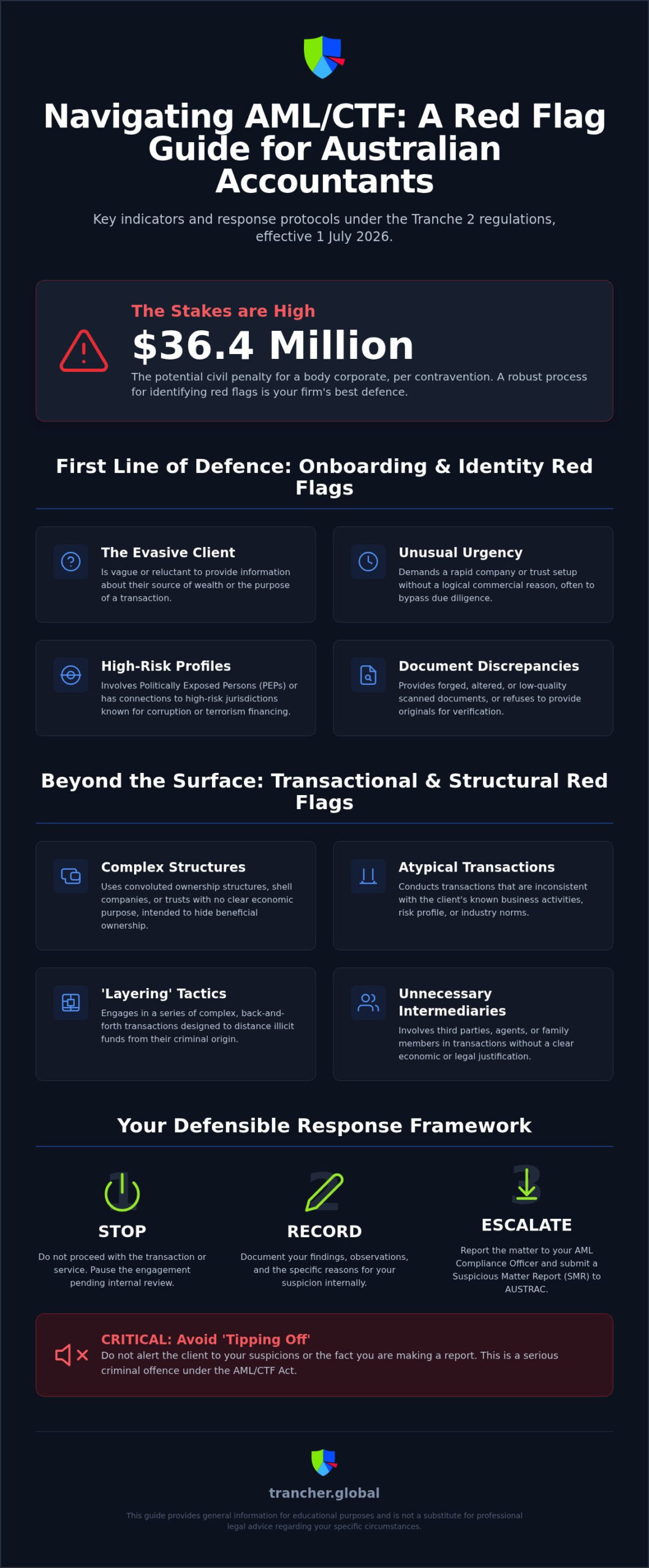
Under the AML/CTF Act, providing “designated services” now triggers mandatory reporting and due diligence duties. The shift from a voluntary approach to a mandatory regime is significant for SME firms. You’re now required to enrol with AUSTRAC and report suspicious matters within tight timeframes. The stakes are high. As of 1 July 2026, the value of a penalty unit is $364. This means civil penalties can reach up to $36.4 million for a body corporate per contravention. It’s a serious figure, but one that can be avoided with the right systems in place.
Red Flags as a Component of Your AML/CTF Programme
Effective risk management starts with a robust AML risk assessment tool Australia. Your ability to spot and record red flags should be a seamless part of your daily workflow. These indicators help you determine if a client’s activity aligns with your firm’s risk appetite. Don’t view this as an administrative burden. View it as an opportunity to improve your internal systems and provide deeper value to your clients. Comprehensive documentation is your best defence during an AUSTRAC audit. It demonstrates that you’ve taken reasonable steps to identify, manage, and mitigate potential risks before they become critical issues.
Onboarding and Identity Red Flags: Spotting Issues Early
The onboarding phase is your firm’s first line of defence. It’s the moment where professional curiosity transitions into a formal regulatory duty. Identifying money laundering red flags for accountants during this initial phase prevents high-risk entities from entering your client base in the first place. You’ll often find that compliant clients appreciate the thoroughness of your process; it’s the bad actors who tend to push back.
A primary indicator is a client who remains evasive about their source of wealth. This secrecy often manifests during the CDD and KYC requirements Australia mandates. You might also encounter “unusual urgency.” This is when a prospect demands a rapid company setup or trust structure without a logical commercial reason. They’re often trying to bypass your due diligence by creating a sense of panic. Similarly, be alert to Politically Exposed Persons (PEPs) or clients with ties to high-risk jurisdictions. These aren’t automatic deal-breakers, but they do require enhanced scrutiny to ensure your firm isn’t being used to facilitate the movement of illicit funds.
Identity and Documentation Discrepancies
Digital onboarding has made life easier, but it also presents new challenges for verification. Watch for forged or altered documents, such as passports with inconsistent fonts or watermarks. Some clients may flatly refuse to provide original documents for remote verification, insisting on low-quality scans instead. This is often a tactic to hide tampering. Implementing automated screening helps you instantly cross-reference names against global sanctions lists and adverse media. If you’re looking to streamline this process, you can integrate automated verification into your workflow to remove the manual guesswork.
The Reluctant Client Profile
A client who consistently avoids face-to-face or video meetings without a valid justification should trigger immediate concern. This reluctance often masks the fact that the person you’re dealing with isn’t the actual beneficial owner. You should also look for a “wealth gap” where a client’s stated profession doesn’t align with the multi-million dollar assets they’re looking to manage. Source of wealth verification is the critical process of confirming how a client legitimately acquired their total net worth over time. When these pieces don’t fit together, it’s time to pause and document your findings.
Transactional and Structural Indicators: Beyond the Surface
Once a client is onboarded, your focus shifts to their operational behaviour. Identifying money laundering red flags for accountants often requires looking past the surface of legitimate-looking transactions to find the underlying intent. Criminals frequently use professional services to facilitate “layering,” which involves moving funds through a series of complex business structures to distance the money from its illicit source. This is particularly common in Trust and Company Service Provider (TCSP) engagements, where the creation of shell companies or offshore entities serves no clear commercial purpose other than obscuring beneficial ownership.
Effective oversight relies on robust ongoing risk monitoring. Without automated systems, spotting subtle shifts in a client’s transactional patterns becomes an impossible manual task. You should be alert to any sudden activation of a dormant company or the use of multiple accounts to move funds rapidly without a logical business reason. We’ve found that firms with clear visibility into these patterns feel much more confident when AUSTRAC comes knocking.
Complex Australian Business Structures
Australia’s reliance on trusts and Self-Managed Superannuation Funds (SMSFs) creates specific vulnerabilities that generic international guides often miss. Be wary of discretionary or family trusts where the beneficiaries are unclear or where assets are moved in and out with unusual frequency. SMSF red flags often include rapid asset turnover or contributions that don’t align with the member’s known financial profile. Additionally, the presence of “nominee” directors or shareholders who appear to have no active role in the business is a significant indicator that the structure is designed for concealment.
Unusual Financial Activity Patterns
Transactional logic is your best guide. Round-sum transfers that lack supporting documentation or commercial justification are classic indicators of illicit activity. You might also see funds being moved through several layers of accounts within your own firm’s trust account for no apparent purpose. Structuring involves deliberately breaking down large sums of cash into smaller deposits under $10,000 to avoid AUSTRAC reporting thresholds, and it remains a primary red flag for the accounting sector. By staying vigilant during these routine engagements, you act as a steady hand, ensuring your firm’s expertise is used only for legitimate wealth creation.
The Response Framework: Escalation and Avoiding Tipping Off
Acting on a red flag is a delicate balance of professional duty and legal caution. When money laundering red flags for accountants appear, your primary goal is to protect the firm without alerting the client to your suspicions. This requires a shift in how your team handles client interactions. Instead of the usual collaborative approach, you must adopt a stance of professional distance. This ensures you can conduct enhanced due diligence without compromising any potential investigation that AUSTRAC or law enforcement may undertake.
The “Tipping Off” offence is perhaps the most critical legal trap to avoid. Under the AML/CTF Act, it’s a criminal offence to disclose to a client that a Suspicious Matter Report (SMR) has been filed or that they’re under internal scrutiny. Doing so can lead to severe penalties, including up to 2 years imprisonment. To manage this risk, we advocate for a “stop, record, escalate” methodology. Staff should stop the specific activity, record the details objectively, and escalate the matter to the designated Compliance Officer immediately. This process keeps your team safe and ensures your firm’s response is both uniform and legally sound.
Internal Reporting and Documentation
Effective internal reporting relies on discretion. You must record red flags in a manner that remains invisible to the client during routine engagements. This means keeping compliance notes separate from standard project folders or client-facing portals. Your Compliance Officer acts as the central pivot, evaluating whether an indicator meets the threshold of “reasonable suspicion.” Maintaining audit-ready compliance records is your best strategy for demonstrating a proactive culture. If AUSTRAC reviews your files, they’ll look for a clear, chronological trail that shows you’ve taken every indicator seriously and documented your rationale for either reporting or clearing the risk.
Filing a Suspicious Matter Report (SMR)
If the internal evaluation confirms a suspicion, you must lodge an SMR via the AUSTRAC Online portal. Time is of the essence here. For general money laundering concerns, you have a 3-business-day window to file from the moment the suspicion was formed. If you suspect terrorism financing, that timeframe drops to just 24 hours. A high-quality report is factual and avoids speculative language; it should focus on the specific behaviours and transactions that triggered the alarm. Managing the client relationship after filing is often a challenge, but you must continue to act naturally to avoid tipping them off. To ensure your team never misses these critical deadlines, you can streamline your regulatory reporting with our automated tools.
Transforming AML Compliance into a Professional Advisory Service
Many firms still view the identification of money laundering red flags for accountants as a purely administrative burden that drains resources. However, this perspective overlooks the significant commercial opportunity that robust risk management presents. By framing AML/CTF obligations as a “recoverable compliance activity,” you can transform a mandatory cost centre into a billable professional service. Your expertise in protecting the firm and its clients from criminal exploitation is a high-value asset that deserves to be recognised within your fee structure, ensuring your firm remains both compliant and profitable.
A structured approach allows you to offer clients a “Compliance Health Check” as a standalone advisory service. This isn’t just about spotting illicit activity; it’s about providing clients with the confidence that their business structures are resilient and secure. Using our client risk profiling tool, you can demonstrate the depth of your due diligence and justify advisory fees based on the specific risk profile of the client. Trancher automates the detection of money laundering red flags for accountants, allowing your team to focus on high-level analysis rather than manual data entry, which significantly improves your firm’s operational ROI and overall readiness.
Building a Profitable Compliance Workflow
To make compliance profitable, you must treat it with the same professional rigour as tax or audit engagements. This ensures your efforts contribute directly to the firm’s financial health while removing the friction of unbilled administrative work.
- Track time: Log every hour spent on AML/CTF checks to ensure compliance is a recoverable activity for client billing.
- Identify opportunities: Use risk assessments to uncover needs for governance advice, structural changes, or trust restructuring.
- Communicate value: Explain how these checks protect the client’s reputation and financial integrity from external threats.
Achieving 2026 Readiness in 30 Days
Trancher’s 30-day readiness guarantee removes the stress of regulatory transitions by providing an automated, audit-ready framework. Our local Australian support ensures your onboarding is seamless and efficient, regardless of your firm’s current size. We invite you to test the platform’s ROI through our complimentary 3-month trial, allowing you to track revenue growth before making a long-term commitment. It’s a risk-free path to turning a regulatory hurdle into a strategic advantage for your practice.
Start your 3-month complimentary trial with Trancher today
Future-Proofing Your Practice for Tranche 2 and Beyond
The transition to Tranche 2 obligations represents an opportunity to refine your firm’s operational excellence. By mastering the identification of money laundering red flags for accountants, you’re doing more than just meeting a legal requirement; you’re building a more resilient, advisory-led practice. We’ve seen how early detection and a robust response framework can turn complex regulations into a manageable, even profitable, part of your daily workflow.
Transitioning to an automated system removes the friction of manual monitoring and ensures your documentation is always audit-ready. Trancher is designed specifically for Australian SME accounting firms, providing the local expertise you need to stay ahead of regulatory shifts. You can secure your firm for 2026 with Trancher’s 30-day compliance guarantee and start seeing the ROI for yourself with our complimentary 3-month trial.
Compliance doesn’t have to be a burden when you have a steady partner by your side. With the right systems in place, you can move forward with the confidence that your practice is protected, your clients are secure, and your growth is sustainable. We’re here to help you lead the way in this new era of professional standards.
Frequently Asked Questions
What is the most common money laundering red flag for Australian accountants?
The most common indicator involves clients being evasive about their source of wealth or insisting on unnecessarily complex business structures without a clear commercial purpose. You might also notice “structuring,” where a client deliberately breaks down large cash deposits into amounts under the $10,000 threshold to avoid detection. These money laundering red flags for accountants often appear during routine tax planning or when setting up new trusts. Identifying these signs early is the first step in protecting your firm’s professional integrity.
How long do I have to report a suspicious matter to AUSTRAC?
You must lodge a Suspicious Matter Report (SMR) with AUSTRAC within three business days of forming a reasonable suspicion. However, if the matter relates to terrorism financing, the deadline is much stricter at 24 hours. These timeframes are non-negotiable and start as soon as you have grounds for suspicion. Using a structured system ensures your team can escalate these matters internally and meet your regulatory deadlines without the stress of manual tracking.
Can I tell my client that I am filing a Suspicious Matter Report?
No, you cannot inform your client about a report. Telling a client they’re the subject of a Suspicious Matter Report is a criminal offence known as “tipping off.” This can result in severe legal consequences, including up to two years imprisonment. The goal is to maintain a professional distance while continuing your engagement naturally. This ensures that any potential investigation by law enforcement isn’t compromised by the client being alerted to your suspicions.
Do I need to report red flags for existing clients or only new ones?
Your obligations apply to both new and existing clients. While the initial onboarding phase is critical for spotting identity-based risks, you must also conduct ongoing risk monitoring for your current client base. Criminal behaviour can emerge at any point in a professional relationship, making periodic reviews and transaction monitoring essential. This proactive approach ensures that your firm remains compliant with the AML/CTF Act throughout the entire lifecycle of every client engagement.
What are the penalties for an accountant who ignores money laundering red flags?
Failing to identify and act on indicators can lead to significant civil and criminal penalties. As of 1 July 2026, a body corporate can face fines of up to $36.4 million per contravention, while individuals may be liable for up to $7.28 million. Beyond financial costs, serious breaches can result in criminal investigations or the cancellation of your registration with AUSTRAC. It’s far better to invest in robust systems now than to face these severe consequences later.
How can I automate the process of spotting red flags in my accounting firm?
You can automate red flag detection by integrating a dedicated platform like Trancher into your existing workflow. Our system handles client verification, KYC/CDD screening, and ongoing risk monitoring automatically, flagging discrepancies so your team doesn’t have to search for them manually. This automation not only improves accuracy but also transforms compliance into a billable activity. By removing the administrative friction, you can focus on high-value advisory work while maintaining a steady compliance posture.
What is Tranche 2 and how does it change my reporting obligations in 2026?
Tranche 2 refers to the expansion of the AML/CTF Act to include “gatekeeper” professions such as accountants, lawyers, and real estate agents. From 1 July 2026, firms providing designated services must implement a formal AML/CTF programme. This shift moves reporting from a voluntary best practice to a mandatory legal requirement. It’s a significant change, but with a structured 30-day implementation plan, your firm can transition smoothly and avoid the risks of non-compliance.
How do I document red flags so that my firm is audit-ready?
To ensure your firm is audit-ready, you must maintain a clear, chronological trail of all identified money laundering red flags for accountants and the subsequent actions taken. This includes documenting why a suspicion was formed and how it was evaluated by your Compliance Officer. We recommend keeping these records in a secure, separate system rather than in standard client project folders. This ensures your documentation is structured for regulatory review without the risk of accidental disclosure.