

With an estimated 100,000 new entities now under AUSTRAC’s regulatory lens, the era of the simple “handshake” property deal is officially over. Since the Tranche 2 reforms commenced on 1 July 2026, the requirement for a robust source of funds declaration for real estate Australia has moved from a best-practice suggestion to a non-negotiable legal mandate. We understand that the administrative weight of these new obligations can feel like a significant burden on your daily operations. It’s natural to worry about potential friction during client onboarding or the looming shadow of heavy penalties for non-compliance.
The good news is that these regulatory shifts don’t have to be a hurdle to your growth. This guide will show you how to master the complexities of fund verification to ensure your transactions remain fully compliant while actually enhancing your professional service. We’ll explore the specific documentation required under the 2024 Amendment Act, the difference between source of funds and wealth, and how to implement a defensible AML/CTF program that works with your business, not against it.
Key Takeaways
- Recognise the critical distinction between Source of Funds and Source of Wealth to ensure your due diligence is both accurate and proportional to risk.
- Implement a seamless source of funds declaration for real estate Australia to meet the new Tranche 2 requirements while keeping client friction to a minimum.
- Identify which supporting documents, such as bank statements or sale records, are necessary to provide a defensible evidence trail for AUSTRAC.
- Learn a step-by-step workflow for integrating fund verification into your existing processes without increasing your administrative workload.
- Discover how automation can turn compliance into a strategic advantage, protecting your firm’s reputation and bottom line from significant penalties.
What is a Source of Funds Declaration in Australian Real Estate?
A source of funds declaration for real estate Australia is a formal, written statement provided by a client that explains exactly where the money for a specific property purchase originated. Essentially, a Source of Funds declaration is the trail of a specific sum of money used for a transaction, rather than a record of a client’s lifetime of earnings. Under the Anti-Money Laundering and Counter-Terrorism Financing Act 2006, real estate professionals are required to identify and mitigate risks associated with financial crime.
This declaration is a core pillar of Enhanced Customer Due Diligence (ECDD). When a transaction is flagged as higher risk, you must go beyond basic identity checks to verify the legitimacy of the capital involved. Understanding What is Money Laundering? helps clarify why AUSTRAC insists on this level of transparency. By documenting the origin of funds, you protect your firm from being used as a conduit for illicit wealth and ensure your operations remain beyond reproach.
Why the 1 July 2026 Deadline Changes Everything
The commencement of Tranche 2 obligations on 1 July 2026 brought real estate agents, conveyancers, and lawyers directly under AUSTRAC’s regulatory oversight. Before this date, many firms relied on informal protocols or personal relationships to verify clients. That is no longer sufficient. You must now maintain structured, audit-ready records that can withstand regulatory scrutiny at any time.
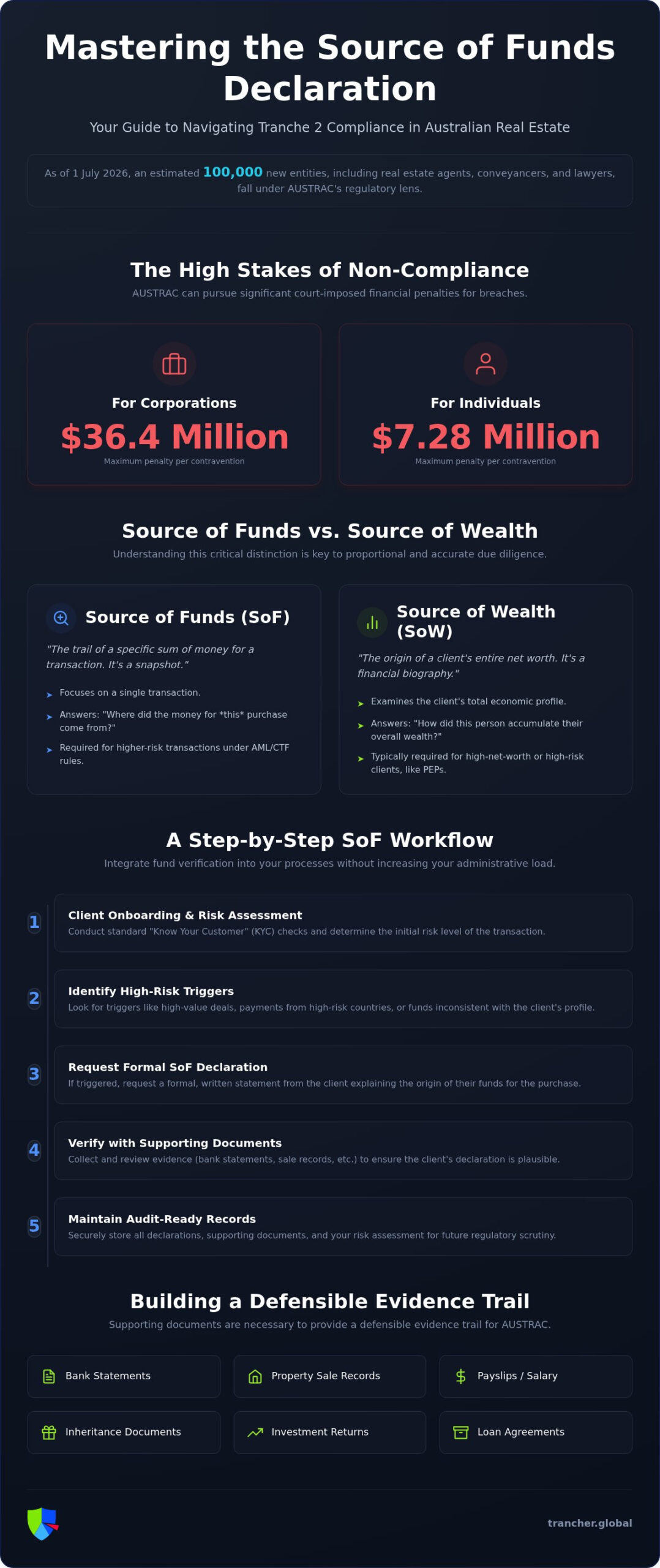
The stakes for failing to implement a defensible AML/CTF program are high. AUSTRAC has the power to pursue significant court-imposed financial penalties for non-compliance. For corporations, these can reach a maximum of $36.4 million per contravention, while individuals face up to $7.28 million. Transitioning to a formalised source of funds declaration for real estate Australia isn’t just about avoiding fines; it’s a catalyst for upgrading your internal systems and providing a more secure service to your clients. Before you can fulfil these obligations, your firm must also be properly registered, and following an AUSTRAC enrolment checklist for Australian SMEs is the essential first step to ensuring your business is correctly listed on the Reporting Entities Roll.
The Legal Basis: AML/CTF Act and AUSTRAC Rules
Under the Act, providing real estate services is classified as a “designated service.” This classification triggers mandatory “Know Your Customer” (KYC) standards. A formal declaration ensures you meet these standards by verifying that the money used in a deal isn’t linked to criminal proceeds.
Key components of this legal framework include:
- Designated Services: Activities like acting as a real estate agent or providing legal services for property transfers that are now subject to reporting.
- KYC Standards: The requirement to not only verify a client’s identity but also understand their financial profile and risk level.
- The Compliance Officer: Every firm must appoint an AML/CTF Compliance Officer to oversee these declarations and ensure the program remains effective.
Your Compliance Officer plays a vital role in reviewing these declarations. They determine if the explanation provided by the client is plausible and supported by evidence, ensuring your firm stays on the right side of the law while maintaining a smooth onboarding experience.
Source of Funds vs. Source of Wealth: Knowing the Difference
Distinguishing between Source of Funds (SoF) and Source of Wealth (SoW) is a common stumbling block for firms adapting to the new regulatory landscape. While they sound similar, treating them as interchangeable can lead to either insufficient data or over-collecting information that frustrates your clients. A source of funds declaration for real estate Australia primarily addresses the ‘how’ of the specific money being used for a purchase. In contrast, Source of Wealth looks at the ‘why’ behind a client’s total net worth. One is a snapshot of a specific bank transfer; the other is a biography of financial accumulation over many years.
When to Request a Source of Funds Declaration
You don’t need to deep-dive into every client’s life story for every standard residential sale. However, specific triggers require you to formalise a declaration to remain compliant. Standard triggers often include high-value transactions that exceed your firm’s established risk threshold or payment patterns that seem out of character for the individual. Regulatory triggers are also non-negotiable. If a client is identified as a Politically Exposed Person (PEP) or if the funds are originating from a high-risk jurisdiction, a declaration is essential. Internal triggers are just as vital. If a young buyer suddenly produces a seven-figure deposit that doesn’t align with their known employment history, it’s your responsibility to seek clarity.
It is also vital to distinguish these from ‘Proof of Funds’. While a bank statement might prove a client has the cash, it doesn’t explain the origin. Your source of funds declaration for real estate Australia bridges that gap by providing the narrative behind the balance. It ensures you aren’t just seeing the money, but understanding its journey to the client’s account.
When Source of Wealth Becomes Necessary
Source of Wealth (SoW) is typically reserved for instances of Enhanced Customer Due Diligence (ECDD). This process isn’t just about where the deposit came from, but how the client built their entire financial portfolio. Common examples include significant inheritances, proceeds from a business divestment, or growth from long-term investment portfolios. Transitioning this conversation with a client requires a steady, professional hand. Frame it as a standard part of your premium service. You can explain that because the transaction meets specific regulatory criteria, you are simply fulfilling your obligation to verify the broader financial context. Using a structured compliance platform helps automate these requests, making the process feel like a routine administrative step rather than a personal hurdle. This approach maintains the client relationship while ensuring your firm stays audit-ready.
Essential Evidence: What Documents Support an SoF Declaration?
A signed source of funds declaration for real estate Australia is a vital starting point, but it rarely stands alone in the eyes of the regulator. AUSTRAC expects firms to take “reasonable measures” to verify the claims made by a client. This means you need a paper trail that matches the narrative. If a client says their deposit came from a decade of disciplined saving, you need to see that accumulation. If they claim it was a gift, you need to verify the donor’s capacity to give. Documenting this “money trail” is what creates an audit-ready compliance record that protects your business from future scrutiny.
The volume and type of evidence you collect should always be proportional to the customer’s risk rating. For a long-term local client with a steady job, basic bank statements might suffice. For a high-net-worth individual or a transaction involving complex structures, you’ll naturally need to dig deeper. While collecting this data, it’s essential to remember your Australian privacy obligations. You’re handling sensitive financial information, so ensure your storage systems are secure and your data collection is limited to what’s strictly necessary for compliance.
Standard Documentation for Common Funding Sources
For the majority of transactions, the funding source is straightforward. Providing clear guidance to your clients on what’s required can significantly reduce friction during the onboarding process. Clear communication helps clients understand that these requests are a standard part of a secure transaction.
- Savings: Request bank statements covering at least three to six months. This shows the steady accumulation of funds and ensures the money hasn’t just appeared overnight from an unknown source.
- Property Sale: If the funds are proceeds from a prior divestment, settlement statements or a signed contract of sale are the gold standard for evidence.
- Salary and Income: Recent payslips or a formal tax assessment notice from the ATO provide clear proof of a client’s earning capacity and the legitimacy of their wealth.
Verifying Complex or High-Risk Funding
When funds arrive from less conventional sources, the verification process must be more rigorous. These scenarios often trigger Enhanced Customer Due Diligence (ECDD) and require a more detailed source of funds declaration for real estate Australia to satisfy regulatory standards. This is particularly relevant when clients present funds originating from cryptocurrency holdings or digital asset liquidations, where automating transaction monitoring for crypto exchanges has become an essential part of a compliant verification process under the 2024 Amendment Act.
- Gifts: A simple letter isn’t enough. You should request a statutory declaration from the donor and, in higher-risk cases, evidence of how the donor acquired those funds themselves.
- Inheritance: A grant of probate or a formal letter from the solicitor or executor of the estate provides the necessary legal link between the deceased’s assets and your client’s funds.
- Trust Distributions: This requires a copy of the trust deed to identify the beneficiaries and bank records showing the actual transfer from the trust account to the client.
By following these structured evidence requirements, you transform a potentially awkward conversation into a professional, high-value service that protects all parties involved.
How to Implement an SoF Workflow: A Step-by-Step Guide
Moving from an ad-hoc approach to a structured workflow is the most effective way to manage your new obligations without slowing down your business. A well-defined process ensures that every source of funds declaration for real estate Australia is handled consistently, reducing the risk of human error and ensuring your firm remains audit-ready. By following a logical sequence, you turn a complex regulatory requirement into a repeatable professional service.
- Step 1: Initial Risk Assessment. Before requesting any documents, perform a preliminary risk assessment of the client and the transaction. This identifies whether a standard or enhanced level of due diligence is required.
- Step 2: Issue a Digital Declaration. Use a standardised digital form to collect the client’s statement. Digital tools ensure that no required fields are missed and provide a professional experience for the buyer or seller.
- Step 3: Evidence Review. Compare the provided documentation against the declaration. You’re looking for consistency; if a client declares the funds are from a property sale but the bank statement shows a series of small cash deposits, you’ve identified a discrepancy.
- Step 4: Internal Escalation. If you find “red flags” or high-risk indicators, escalate the file to your AML/CTF Compliance Officer. They’ll determine if further evidence is needed or if the transaction requires closer monitoring.
- Step 5: Secure Record Keeping. Once the verification is complete, store the declaration and all supporting evidence securely. Under Australian law, you must retain these records for a mandated seven-year period.
Reducing Client Friction During the Process
It’s natural for clients to feel a little hesitant when asked for detailed financial information. You can alleviate this stress by using warm, assured language to explain that these checks are a standard regulatory requirement for all property transactions in Australia. Providing clear templates or checklists helps clients understand exactly what’s needed, which prevents the frustration of back-and-forth emails. You can also how to explain AML compliance costs to clients to help frame these requirements as a value-add service that protects their investment. When clients see you as a knowledgeable partner rather than a hurdle, they’re far more likely to cooperate quickly.
Managing Red Flags and Suspicious Matters
While most transactions are legitimate, you must be prepared for instances where the source of funds declaration for real estate Australia reveals cause for concern. A client’s outright refusal to provide a declaration is a significant red flag that cannot be ignored. You should also be trained to recognise attempts at “layering” or “integration,” where illicit funds are moved through multiple accounts or assets to hide their origin. If a verification fails and the discrepancies cannot be reasonably explained, you have a legal obligation to file a Suspicious Matter Report (SMR) with AUSTRAC. Handling these situations with professional discretion is vital to maintaining your firm’s integrity. To see how you can streamline these complex reviews, you can explore our end-to-end AML/CTF program management tools.
Automating SoF Compliance with Trancher
Trancher provides an end-to-end AML/CTF program management platform specifically engineered for the unique demands of the Australian property sector. While earlier sections highlighted the complexity of verifying a source of funds declaration for real estate Australia, our platform is designed to remove that administrative friction entirely. By automating the collection and verification of these declarations, your firm can significantly reduce the hours spent on manual document chasing. This isn’t just about saving time; it’s about generating high-quality, audit-ready documentation that demonstrates your firm’s steady hand and commitment to regulatory standards.
Our approach transforms compliance from a necessary overhead into a streamlined professional service. You can now track the efficiency of your workflows and ensure that every step taken toward meeting your Tranche 2 obligations is documented and defensible. We help you move away from manual spreadsheets and into an automated environment where risk is managed proactively.
The 30-Day Compliance-Ready Guarantee
We know that the transition to Tranche 2 can feel daunting, which is why Trancher offers a 30-day compliance-ready guarantee. This ensures your firm is operationally prepared to meet all regulatory requirements within a single month. Our platform is built to integrate seamlessly with your existing workflows, meaning your sales cycle remains uninterrupted while your security is enhanced. You won’t be navigating this landscape alone. Our clients have access to local Australian expert support from compliance specialists like Aaron Soh, providing the steady guidance needed to manage changing landscapes with confidence. This local expertise ensures that your systems aren’t just compliant, but optimised for the Australian market.
Turning Compliance into a Billable Asset
One of the most significant advantages of our platform is the ability to view compliance as a recoverable activity rather than a sunk cost. By using Trancher’s compliance ROI tracking software, you can monitor recoverable activities and identify new advisory revenue streams. Rather than simply fulfilling a mandate, you’re providing your clients with a structured, high-value AML guidance service that justifies your professional fees. This level of transparency builds trust and positions your firm as a leader in professional standards.
This shift in perspective allows you to turn regulatory obligations into a strategic advantage for growth. You can start this journey today with our complimentary 3-month trial, allowing you to experience the efficiency gains and revenue potential first-hand. We’re here to help you turn a complex burden into a pillar of your firm’s operational health and long-term profitability.
Future-Proofing Your Firm’s Compliance
Mastering the source of funds declaration for real estate Australia is no longer just a regulatory hurdle; it’s a strategic opportunity to elevate your professional standards. By clearly distinguishing between source of funds and wealth and implementing a structured, digital-first workflow, you can protect your firm’s reputation while providing a seamless onboarding experience for your clients. Automation is the key to turning these complex obligations into a manageable, and even profitable, part of your business model.
We’re here to act as your expert compliance companion through every step of this transition. With our 30-day compliance-ready guarantee and local Australian expert support, you can navigate the Tranche 2 landscape with complete confidence. To help you get started, we’re also offering a 20% discount on your first 12-month subscription.
Get Tranche 2 Ready: Start Your Free 3-Month Trancher Trial
Don’t let administrative burdens hold your firm back. Embrace these changes as a pathway to operational excellence and a more secure future for your business.
Frequently Asked Questions
Is a Source of Funds declaration mandatory for every Australian property purchase?
No, it isn’t mandatory for every single purchase. However, it is required whenever a transaction is flagged as high-risk or triggers Enhanced Customer Due Diligence (ECDD). Your firm’s risk-based approach determines the necessity. Since 1 July 2026, you must have a system in place to request a source of funds declaration for real estate Australia whenever these triggers are met. This ensures you remain compliant with AUSTRAC’s Tranche 2 expectations and protects your reputation.
What happens if a buyer cannot prove where their deposit came from?
If a buyer is unable to provide sufficient evidence, you must assess whether the transaction poses an unacceptable risk of money laundering. You might need to delay the transaction or terminate the business relationship entirely. If the inability to prove the source of funds raises genuine suspicion of criminal activity, you have a legal obligation to file a Suspicious Matter Report (SMR) with AUSTRAC. Having a clear internal policy ensures your staff can act with confidence.
How far back do I need to check for a Source of Funds verification?
There is no fixed statutory period, but best practice typically involves reviewing the last three to six months of financial activity. The goal is to see a logical accumulation of wealth or a clear trail for a specific sum. If a large deposit appears suddenly without a clear history, you should investigate further. Your firm’s AML/CTF program should define these parameters based on the specific risk profile of the client and the nature of the transaction.
Can I rely on a bank’s AML checks instead of doing my own?
You cannot simply rely on a bank’s checks to satisfy your own regulatory obligations. While banks perform their own due diligence, the AML/CTF Act requires each reporting entity to conduct its own independent assessment. You are responsible for the compliance of your own designated services. Relying solely on a third party without your own verification process leaves your firm vulnerable to significant penalties if AUSTRAC identifies a failure in your specific compliance program.
How should real estate firms store sensitive financial documents for AML compliance?
You must store all AML-related documents, including any source of funds declaration for real estate Australia, in a secure, encrypted digital environment. These records must be retained for seven years after the transaction or the end of the business relationship. Access should be restricted to authorised personnel only, such as your Compliance Officer. Ensuring your storage meets Australian privacy standards is vital for protecting your clients and maintaining your firm’s professional integrity and legal standing.
What are the penalties for failing to verify Source of Funds under Tranche 2?
The penalties for non-compliance are substantial and designed to deter negligence. Corporations can face civil penalties of up to $36.4 million per contravention. Individual professionals, including agents and solicitors, can be fined up to $7.28 million. Beyond the financial impact, a failure to verify funds can lead to severe reputational damage and increased oversight from AUSTRAC. This can potentially disrupt your long-term business operations and your ability to provide a high-standard professional service.
How do I explain the need for an SoF declaration to a long-term client?
Frame the request as a standard, non-negotiable part of your premium professional service. Explain that since 1 July 2026, new national regulations require all real estate firms to verify the origin of funds to protect the property market’s integrity. Using warm, assured language helps the client understand that these checks are a routine administrative requirement rather than a personal interrogation. Position it as a necessary step that ensures their transaction remains secure and fully compliant with current law.
Does the SoF requirement apply to both residential and commercial real estate?
Yes, the requirement applies across both residential and commercial sectors. Any professional providing a designated service under the AML/CTF Act, such as acting as a real estate agent for a property transfer, must comply. Commercial transactions often involve more complex ownership structures and larger sums of money. This can actually increase the likelihood of triggering the need for a formal source of funds declaration and more rigorous, enhanced due diligence processes to satisfy regulatory standards.