

Did you know that a single oversight in your client onboarding could now result in a civil penalty of up to $36.4 million for your firm? Since the Tranche 2 reforms commenced on 1 July 2026, the stakes for Australian accounting practices have never been higher. It’s completely natural to feel a sense of urgency, or even a bit of confusion, when faced with manual record-keeping requirements and the dense definitions of designated services. You’ve worked hard to build a reputable practice, and the fear that AUSTRAC penalties for non-compliance could jeopardise that legacy is a heavy burden to carry.
We’re here to provide a steady hand through this transition. You’ll gain a clear understanding of the current regulatory risks and learn how to protect your practice effectively. This guide explores the specific enforcement actions AUSTRAC can take, from infringement notices to personal liability for directors, and shares a roadmap for turning these obligations into a seamless, profitable part of your advisory service. We’ll show you how to move beyond the stress of administration to reach a state of operational excellence where compliance actually fuels your firm’s growth.
Key Takeaways
- Understand why AUSTRAC acts as a proactive supervisor for accountants and how the 1 July 2026 commencement changes your regulatory obligations.
- Learn how the penalty unit system scales for firms and what you can do to mitigate the risk of significant AUSTRAC penalties for non-compliance.
- Discover the ‘hidden’ impacts of a breach, including the long-term effects on professional indemnity insurance and the high costs of mandated independent audits.
- Follow a clear, step-by-step roadmap to insulate your practice by appointing a Compliance Officer and conducting a thorough business-wide risk assessment.
- Explore how to transform compliance from a manual administrative burden into a billable advisory service that drives firm growth and operational excellence.
Understanding the AUSTRAC Penalty Framework for Accountants
AUSTRAC’s primary mission isn’t simply to issue fines. As the Australian Transaction Reports and Analysis Centre (AUSTRAC), its role is to protect the integrity of Australia’s financial system. For accounting firms, this means the regulator acts more as a supervisor than a punisher. They prefer to see practices that are engaged, proactive, and transparent. However, the commencement of Tranche 2 on 1 July 2026 has shifted the landscape permanently. Accountants are now officially recognised as gatekeepers, and with this new status comes a structured framework for enforcement.
The trigger for these obligations isn’t your entire practice. It’s the provision of designated services. This includes tasks like managing client money, acting as a nominee shareholder, or preparing for real estate transactions. When you perform these services, you enter a regulated space where AUSTRAC penalties for non-compliance become a real factor for your business. Understanding this framework allows you to move from a place of uncertainty to one of confident, operational control.
The Tranche 2 Regulatory Landscape in 2026
Accountants are now in scope because their professional services can be exploited to move or hide illicit funds. To counter this, you must now maintain a formal AML/CTF programme. This involves three core pillars: Know Your Customer (KYC) procedures, comprehensive business-wide risk assessments, and the timely reporting of suspicious matters. AUSTRAC uses a risk-based approach to identify firms for review. They don’t look at every firm equally; they focus their supervision on practices where the perceived risk to the financial system is highest.
The Definition of Non-Compliance
There’s a significant difference between a minor technical slip and a systemic failure. AUSTRAC is generally more concerned with firms that show a complete absence of a functional AML/CTF programme rather than those making occasional administrative errors. Non-compliance is a failure to meet any specific obligation under the AML/CTF Act. This might range from failing to enrol with the regulator to neglecting your ongoing customer due diligence.
The best way to demonstrate your commitment to these rules is by maintaining audit ready compliance records. Having these files organised and accessible proves that your firm isn’t just checking boxes, but is actively managing its risks. This level of readiness can be the difference between a supportive supervisory conversation and a formal enforcement action. It ensures that your firm remains on the right side of the regulator while protecting your professional reputation.
Civil Penalties and Enforcement Actions: What is at Stake?
Understanding the hierarchy of enforcement is the first step toward securing your firm’s future. AUSTRAC doesn’t move straight to the most severe measures for every slip-up. Instead, they utilise a graduated approach designed to encourage compliance while penalising systemic neglect. This scale begins with administrative warnings and moves through to court-mandated fines that can reach tens of millions of dollars. By recognising these triggers, you can implement the right safeguards early.
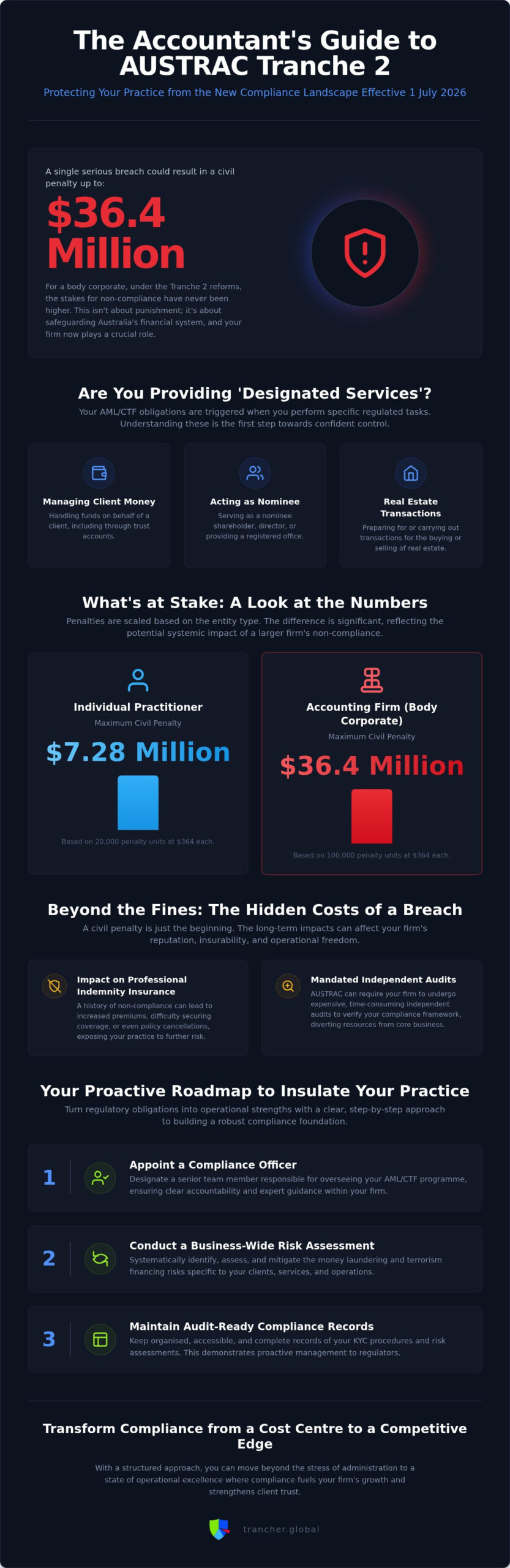
At the heart of this system is the “Penalty Unit.” At the time of contravention in 2026, a single Commonwealth penalty unit is valued at $364. For an individual practitioner, a serious contravention can attract a maximum of 20,000 penalty units, totalling $7,280,000. However, for a body corporate, such as a multi-partner accounting firm, the ceiling rises to 100,000 penalty units. This equates to a maximum civil penalty of $36,400,000 per serious breach. Implementing a structured approach to automated AML/CTF management can help ensure these notices never reach your desk.
Infringement Notices vs. Civil Penalty Orders
Infringement notices are essentially “on-the-spot” fines issued for specific, often administrative, breaches of the AML/CTF Act. These might include failing to lodge a compliance report on time or minor record-keeping oversights. They are designed to be a relatively quick resolution to a problem without the need for court intervention.
Civil penalty orders are a different matter entirely. These are reserved for more serious or systemic failures where AUSTRAC applies to the Federal Court for a financial penalty. While an infringement notice might be a manageable, if unpleasant, business expense, a civil penalty order is designed to be punitive. For a sole practitioner, such a fine could be practice-ending, whereas for a larger firm, it can cause significant financial strain and trigger a total overhaul of internal operations.
Enforceable Undertakings and Remedial Directions
An Enforceable Undertaking is a public, legally binding agreement between your firm and AUSTRAC. In this scenario, your practice admits to compliance gaps and commits to a specific, timed plan to fix them. While this avoids a court battle, it places your firm under intense scrutiny. Remedial Directions are even more direct; they are written instructions from the regulator forcing you to take specific actions to prevent further breaches.
It’s vital to remember the “public record” aspect of these actions. AUSTRAC publishes details of Enforceable Undertakings and infringement notices on its website. This transparency means that AUSTRAC penalties for non-compliance carry a weight far beyond the initial fine. In extreme cases, the regulator also holds the power to cancel or suspend your registration entirely, effectively preventing you from providing any designated services to your clients. Moving toward a model of operational excellence isn’t just about avoiding these outcomes; it’s about maintaining the trust you’ve built with your professional community.
The ‘Hidden’ Consequences: Beyond the Initial Fine
While the potential for multi-million dollar AUSTRAC penalties for non-compliance often captures the headlines, the secondary effects of a breach can be just as damaging to your firm’s health. These “hidden” costs don’t appear on a court order, but they manifest in your profit and loss statement, your professional relationships, and your team’s daily morale. Transitioning to a proactive stance isn’t just about avoiding a fine; it’s about protecting the operational continuity and trust you’ve worked so hard to build.
The Cost of an Independent Audit
If AUSTRAC identifies systemic issues within your practice, they have the power to require you to appoint an external auditor to review your systems. This audit must be conducted at your firm’s expense, which can quickly become a significant, unbudgeted liability. Beyond the auditor’s professional fees, the internal time-drain is immense. Your senior staff and partners will likely spend months supporting the process, retrieving legacy records, and explaining manual workflows that lack clear documentation.
This reactive work pulls your best people away from revenue-generating advisory services. When partners spend months addressing the fallout of AUSTRAC penalties for non-compliance, the opportunity cost to the firm’s billable targets is staggering. Utilising ongoing risk monitoring software allows you to catch these anomalies before they escalate into an audit trigger. By maintaining a constant, automated pulse on your client base, you ensure that your firm remains focused on growth rather than remediation.
Reputational Risk and Professional Standing
In the accounting profession, trust is your primary currency. Because AUSTRAC publishes enforcement actions, including infringement notices and enforceable undertakings, a compliance failure becomes a matter of public record. This visibility can have immediate consequences for your referral networks and bank relationships. Lenders and professional partners are increasingly risk-averse; being named in a regulatory action can lead to a review of your credit facilities or a cooling of once-reliable referral pipelines.
There is also the matter of your professional standing with bodies like CA ANZ, CPA Australia, or the IPA. A serious breach may lead to internal disciplinary proceedings, potentially resulting in the loss of your practice certificate. Your professional indemnity insurance provider is also likely to view a regulatory breach as a fundamental change in your risk profile. This often leads to significantly higher premiums or, in some cases, a refusal to renew cover entirely, leaving your practice vulnerable.
Ultimately, compliance is your licence to operate in a modern economy that demands transparency. By integrating these requirements into your daily operations, you don’t just avoid penalties; you build a more resilient and valuable practice. We see this transition as an opportunity to refine your internal systems, ensuring your firm is recognised not just for its expertise, but for its unwavering integrity.
A Proactive Roadmap: How to Insulate Your Practice
Insulating your practice from regulatory risk doesn’t require a total overhaul of your business model. Instead, it involves a series of logical, proactive steps that move your firm from a reactive posture to one of steady, operational ease. By establishing a clear framework now, you can effectively mitigate the risk of AUSTRAC penalties for non-compliance while enhancing the quality of your client onboarding. Think of this roadmap not as a series of hurdles, but as a strategic guide to professional resilience.
- Step 1: Enrol and Appoint. Register your firm with AUSTRAC and formally appoint a Compliance Officer who has the authority to oversee your AML/CTF obligations.
- Step 2: Risk Assessment. Conduct a comprehensive, business-wide risk assessment to identify where your specific services might be vulnerable to financial crime.
- Step 3: Tailored Programme. Develop and implement a written AML/CTF programme that is specifically designed for the designated services your firm provides.
- Step 4: Automate KYC and CDD. Move your verification processes into a digital environment to remove human error and the “spreadsheet risk” inherent in manual tracking.
- Step 5: Team Training. Ensure your staff are trained to identify red flags and understand the internal process for reporting suspicious matters.
Moving Away from Manual Spreadsheets
Manual tracking is the primary cause of technical non-compliance for many accounting firms. Spreadsheets are often prone to version control issues and accidental deletions, creating gaps that are difficult to defend during a regulatory review. A centralised dashboard provides the visibility you need to manage your obligations across the entire firm. Structured workflows ensure that CDD and KYC requirements in Australia are met consistently, creating a reliable audit trail that protects your partners.
The 30-Day Readiness Strategy
Achieving a “compliance-ready” status in just one month is a practical goal when you have the right support. By using guided prompts and expert templates, you can remove the implementation anxiety that often stalls these transitions. This approach focuses on making your obligations manageable rather than overwhelming. Significant AML CTF compliance costs reduction is a natural byproduct of this automation, as it frees your team from hours of non-billable administrative work.
You don’t have to navigate these complex changes on your own. We act as your expert compliance companion, providing the tools and steady guidance needed to secure your firm’s future. To see how these workflows can be integrated into your practice, explore our platform features today.
Trancher: Transforming Compliance from a Cost-Centre to a Competitive Edge
Navigating the complexities of the Tranche 2 era doesn’t have to be a solitary or stressful endeavour. Trancher is the only platform designed exclusively for Australian accounting firms, providing a tailored environment where regulatory obligations are met with precision and ease. We understand that the threat of AUSTRAC penalties for non-compliance can feel like a shadow over your practice. This is why we offer a 30-day compliance-ready guarantee. This promise is designed to remove the implementation anxiety that often delays essential system upgrades, ensuring your firm is fully protected in a single month.
We believe that your time is your most valuable asset. Our unique Compliance ROI reporting tracks billable activity directly within the platform, giving you a clear view of the value generated by your compliance workflows. Instead of viewing these requirements as a drain on your resources, you can now see them as a structured part of your firm’s profitability. This transparency ensures that every partner understands the financial health and regulatory standing of the practice at a glance.
Turning Obligations into Billable Advisory
Trancher helps you identify new advisory revenue streams by using client risk profiling as a springboard for deeper professional engagement. When you understand the specific risk factors affecting a client’s business, you’re better positioned to offer high-value strategic advice. Our Compliance Activity Tracking feature allows for accurate client billing, ensuring every minute spent on due diligence and ongoing monitoring is accounted for. Ultimately, compliance can be a profitable professional service rather than a burden when it’s integrated into your firm’s core value proposition.
Local Support for Australian Practitioners
You aren’t just adopting a new software tool; you’re gaining a dedicated partner that understands the Australian regulatory environment. Our local onboarding and expert support, led by Aaron Soh and our specialised team, ensure that your transition is smooth and supported at every stage. We maintain a warm and assured partnership model, acting as a steady hand as you refine your internal systems and train your staff. We invite you to experience this for yourself with a complimentary 3-month trial, allowing you to see the platform in action without any initial financial commitment. It’s time to move from regulatory risk to operational excellence. Start your conversation with Trancher today and secure the future of your practice.
Securing Your Practice for a Profitable Future
The commencement of Tranche 2 on 1 July 2026 represents a significant shift for the accounting profession, but it doesn’t have to be a source of stress. By moving away from manual spreadsheets and adopting structured workflows, you protect your practice from the severe financial and reputational fallout associated with AUSTRAC penalties for non-compliance. You’ve seen how these obligations can be reframed as a “licence to operate” that actually improves your internal systems and enhances client trust. It’s an opportunity to modernise your firm while meeting your professional duties with confidence.
Our goal is to act as your steady guide through this transition. With our detailed ROI reporting and 30-day compliance-ready guarantee, you can turn regulatory requirements into a transparent, billable advisory service. We invite you to secure your firm with a complimentary 3-month Trancher trial and experience the benefits of local Australian expert support firsthand. It’s time to trade implementation anxiety for operational excellence and long-term practice security. You’ve built a reputation on reliability; let’s ensure your compliance systems reflect that same standard of excellence.
Frequently Asked Questions
What is the maximum penalty for AUSTRAC non-compliance in 2026?
The maximum civil penalty for a body corporate is $36,400,000 per serious contravention. This figure is based on 100,000 penalty units at the current 2026 value of $364 per unit. For individuals, the limit is $7,280,000. It’s vital to remember that these AUSTRAC penalties for non-compliance are applied per breach; failing to conduct due diligence on multiple clients could lead to cumulative fines that far exceed these individual caps.
Can individual partners be held liable for firm-wide AML failures?
Yes, individual partners and directors can be held personally accountable for compliance failures within their firm. Under the AML/CTF Act, the Federal Court can impose civil penalties of up to $7,280,000 on an individual for serious breaches. This personal liability underscores the importance of having a robust, board-approved AML/CTF programme. It ensures that every leader in the practice is protected by a system that prioritises transparency and thorough record-keeping.
What does AUSTRAC consider a “serious” breach for an accounting firm?
AUSTRAC typically considers a breach “serious” when it involves systemic failures rather than isolated administrative errors. This includes operating without a formal AML/CTF programme, failing to enrol with the regulator, or neglecting to report suspicious matters. While the regulator focuses on supervision, they act decisively when a firm’s lack of oversight allows the financial system to be exploited. Maintaining audit-ready records is the best way to prove your firm’s commitment to compliance.
How much time do I have to fix a compliance gap after a remedial direction?
The timeframe for fixing a compliance gap is specified by AUSTRAC within the remedial direction itself. There isn’t a single universal deadline; the regulator sets a period they deem reasonable for the specific issue identified. It’s essential to act immediately once a direction is received, as failing to comply within the stated window is a separate offence. Proactive communication with the regulator during this period can help demonstrate your firm’s commitment to remediation.
Will AUSTRAC really audit a small accounting practice?
Yes, AUSTRAC has clearly stated its intention to proactively supervise newly regulated Tranche 2 entities, regardless of their size. They don’t only focus on major banks; small accounting practices are viewed as essential gatekeepers in the financial system. The regulator uses a risk-based approach to select firms for review. This means even a small practice can be audited if its service profile or client base is deemed to carry a higher risk to the system.
What are the most common reasons for AUSTRAC infringement notices?
Infringement notices are most commonly issued for administrative oversights that hinder AUSTRAC’s supervisory role. These include failing to enrol as a reporting entity, neglecting to lodge an annual compliance report, or failing to maintain accurate records of customer due diligence. These “on-the-spot” fines are designed to encourage better habits. You can avoid these AUSTRAC penalties for non-compliance by automating your reporting deadlines and using a centralised dashboard to track all your regulatory obligations.
How does Trancher guarantee compliance readiness in 30 days?
Trancher achieves this by providing a structured framework of expert templates and guided prompts tailored specifically for Australian accountants. We remove implementation anxiety by giving you a clear, step-by-step roadmap to follow. Our platform automates the most time-consuming aspects of KYC and risk assessment, allowing you to move from a standing start to a fully functional AML/CTF programme. This 30-day guarantee is supported by our local experts, who ensure your team is ready.
Can I bill my clients for the time spent on AML/CTF compliance?
You can certainly bill for compliance, and many firms now treat it as a high-value advisory service. Trancher includes a built-in feature that tracks billable compliance hours, allowing you to prove the ROI of your regulatory efforts. By profiling client risk and conducting deep due diligence, you’re providing a professional service that protects your client’s interests. This approach transforms a manual administrative burden into a profitable and transparent component of your firm’s advisory suite.