

On 1 July 2026, the definition of a “gatekeeper” in the Australian economy changes forever, making AML compliance for growing businesses Australia a non-negotiable priority for firms facing A$33 million in potential penalties. It’s natural to feel a sense of administrative dread as these Tranche 2 reforms approach. You likely view these new requirements as a non-billable overhead that threatens to overwhelm your team with manual KYC checks and complex reporting. We understand that your priority is sustainable growth, not getting lost in a sea of regulatory paperwork.
This article provides a clear strategy for navigating the evolving landscape, demonstrating how you can transform these obligations into a streamlined asset for your firm. You’ll learn how to navigate the 2026 requirements with confidence and implement automated workflows that save time. We’ll also show you how to move beyond mere “readiness” to a model where you can actually recover compliance costs from clients. From enrolment deadlines to ROI tracking, this is your roadmap to a secure and profitable future.
Key Takeaways
- Understand the critical shift in the regulatory landscape and why AML compliance for growing businesses Australia is now a central focus for AUSTRAC ahead of the 1 July 2026 deadline.
- Learn how to build a scalable compliance programme that uses automated KYC and risk monitoring to reduce administrative overwhelm and eliminate manual errors.
- Discover the “Compliance as a Profit Centre” model that allows your firm to recover costs and track ROI on every billable compliance activity.
- Follow a structured 30-day roadmap to transition from manual, time-consuming processes to an audit-ready, end-to-end management system.
- Identify why choosing a local Australian partner is vital for navigating complex reporting obligations and ensuring seamless integration with your existing workflows.
Understanding the 2026 AML Landscape for Growing Australian Firms
The regulatory environment in Australia is undergoing its most significant transformation in decades. For years, “gatekeeper” professions like accounting and law operated outside the stricter reporting requirements of the banking sector. That era ends on 1 July 2026. This shift isn’t just a bureaucratic hurdle; it’s a response to international pressure to bolster our financial defences. Integrating AML compliance for growing businesses Australia into your daily operations is now a foundational requirement for any firm looking to scale safely.
Growing firms are in the spotlight for a reason. As you expand, you handle more complex transactions and a wider variety of clients. This growth, while exciting, can inadvertently create vulnerabilities that criminals look to exploit. The Australian Transaction Reports and Analysis Centre (AUSTRAC) now expects you to act as an active participant in the fight against financial crime. Failing to meet these standards carries heavy consequences. Corporations face civil penalties of up to 100,000 penalty units, which currently equates to A$33 million per contravention. Beyond the financial impact, the reputational damage of being linked to money laundering can be impossible to recover from.
The Tranche 2 Transition: Why 1 July 2026 Matters
The countdown to 1 July 2026 is officially on. While the implementation date is mid-year, the preparation phase starts much earlier. Enrolment for Tranche 2 entities opened on 31 March 2026, and you must complete your registration by 29 July 2026. Transitioning from an unregulated entity to a formal reporting entity can feel daunting. It’s a shift in identity that requires moving from “business as usual” to a proactive risk-management mindset. We see this as a positive evolution for your firm, an opportunity to professionalise your internal systems and build a more resilient business model.
Identifying Your “Designated Services”
Not every task your firm performs will trigger reporting obligations. The law focuses on “designated services” that carry a higher risk of misuse. If your business provides any of the following, you are likely captured:
- Acting as a formation agent for companies or legal arrangements.
- Providing a registered office or business address for a company.
- Managing client money, securities, or other assets.
- Buying or selling real estate on behalf of a client.
- Acting as a trustee or nominee shareholder.
These services must have a geographical link to Australia to fall under the Act. Most growing firms find that a significant portion of their high-value work is now classified as a designated service. Identifying these early allows you to build specific workflows that capture data without disrupting the client experience. By categorising your services now, you ensure that your compliance efforts are targeted and efficient rather than a blanket administrative burden.
The Core Pillars of a Scalable AML/CTF Compliance Programme
Building a firm that scales requires more than just a growing client list; it needs a structure that supports that volume without introducing regulatory risk. For AML compliance for growing businesses Australia, this starts with a robust governance framework. You’ll need to appoint an AML/CTF Compliance Officer who has the authority and resources to manage your obligations effectively. This isn’t just a box-ticking exercise. It’s about having a steady hand at the helm who understands the Core Pillars of an AML/CTF Compliance Programme and can guide your team through complex transitions.
Once your leadership is in place, you must develop a tailored programme that reflects your firm’s specific risk profile. This isn’t a one-size-fits-all document. It must be a living strategy that evolves as your business grows and as new threats emerge in the financial landscape. By professionalising these internal policies now, you create a scalable foundation that protects your firm’s reputation and financial health.
Part A vs. Part B: Designing Your Internal Policy
Think of Part A as the “brain” of your programme. It focuses on identifying, mitigating, and managing the specific money laundering and terrorism financing risks your firm faces. This is where you document your risk assessment, staff training, and oversight processes. Conversely, Part B represents the “hands” that execute your strategy. Part B serves as the procedural foundation for client onboarding, detailing exactly how you verify a customer’s identity. Together, these two parts ensure your firm remains both compliant and agile.
Modern KYC and Client Verification
The days of manual passport photocopies and filing cabinets are behind us. Modern verification requires moving beyond basic ID checks to automated screening for Politically Exposed Persons (PEPs) and Sanctions. You can find more detail on these technical standards in our guide to CDD and KYC requirements Australia. For high-risk clients, you’ll need to implement “Enhanced Due Diligence” (EDD). This involves deeper investigation into the source of funds and wealth, ensuring you aren’t inadvertently facilitating illicit activity.
Automation is your greatest ally in this process. Setting up ongoing risk monitoring allows you to detect suspicious matter in real-time, rather than discovering issues months later during a stressful audit. By integrating these workflows into your existing systems, you remove friction from the client experience and free up your team for billable work. If you’re looking to streamline these processes, using an end-to-end platform can help you manage these pillars with confidence and ease.
Transforming Compliance from an Overhead into a Profit Centre
Many partners view regulatory requirements as a tax on their firm’s growth. It’s easy to see why. The administrative drag of manual KYC processes often pulls billable staff away from high-value advisory work, creating a bottleneck in your operations. However, for those implementing AML compliance for growing businesses Australia, this burden can be flipped. By reframing these tasks as “Recoverable Compliance Activity”, you transform a cost centre into a profit centre. A deeper Understanding the 2026 AML Landscape reveals that these duties are professional services performed for the client’s protection, not just bureaucratic hurdles.
When viewed through a strategic lens, compliance becomes an opportunity to refine internal operations. Automation is the key to this transition. By removing the manual labour from client verification, you reduce the time your senior staff spend on non-billable admin. This allows your team to focus on the work that actually drives revenue. Beyond simple cost recovery, there is a growing market for structured AML advisory. Clients often need guidance on their own risk profiles or help understanding their own obligations. By offering this as a premium service, you reinforce your position as a high-integrity partner while generating a new, sustainable revenue stream.
Tracking ROI on Regulatory Obligations
Measuring the time saved through automated workflows is the first step toward true profitability. You can’t manage what you don’t measure. When you use compliance ROI tracking software, you gain visibility into exactly how much effort is being expended on each client file. This data provides the concrete evidence needed for transparent client billing. Instead of guessing at the cost of compliance, you can produce audit-ready reports that justify a dedicated compliance fee. This shift ensures that your firm remains profitable even as regulatory scrutiny increases.
Communicating Value to Your Clients
How you frame these requirements to your clients determines their acceptance. Instead of presenting an AML fee as a mandatory tax, position it as a “protection service”. Explain that these checks are in place to safeguard their assets and the integrity of the financial system. Clients appreciate transparency. Using a structured onboarding process that explains the “why” behind every document request builds trust from day one. By being proactive, you position your firm as a high-integrity partner in the Australian market. This high standard becomes a competitive advantage, attracting premium clients who value security and professional rigour.
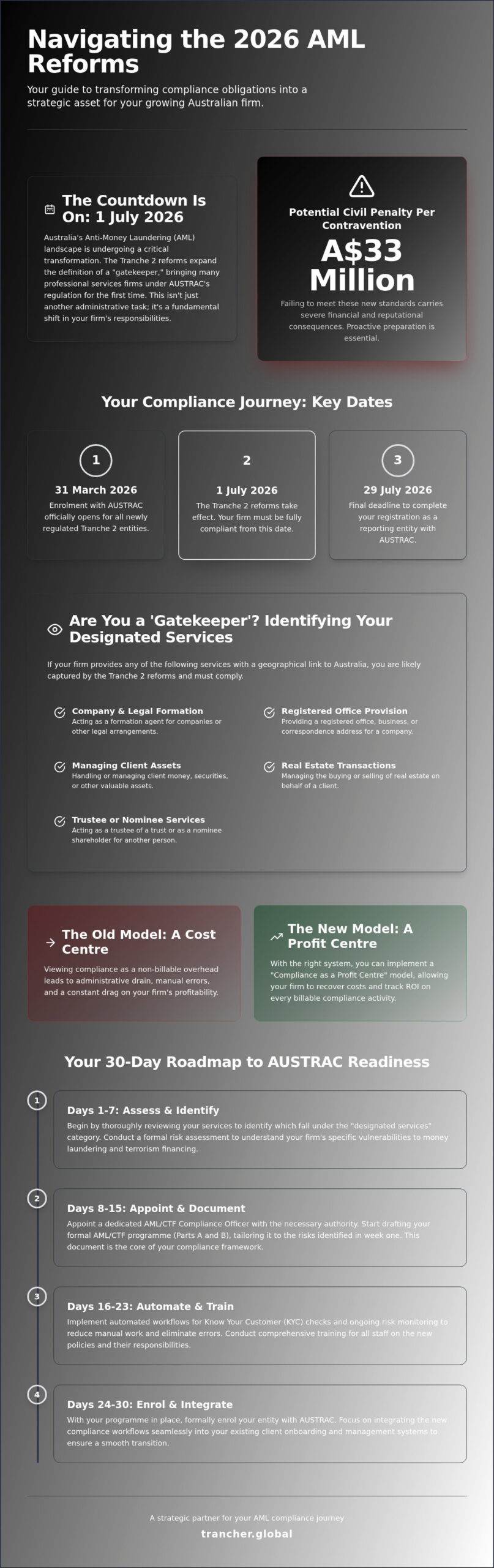
Your 30-Day Roadmap to AUSTRAC Readiness
Achieving AML compliance for growing businesses Australia doesn’t have to be a multi-year project. With a structured approach, you can move from uncertainty to audit-readiness in just four weeks. This timeline prioritises high-impact activities that secure your firm’s foundation while minimising disruption to your daily operations. By following this methodical path, you ensure that no critical obligation is overlooked as the 1 July 2026 deadline approaches.
- Week 1: Risk Assessment. Evaluate your client base and service offerings. Identify which “designated services” trigger your obligations, such as trust formations or managing client assets.
- Week 2: Governance and Documentation. Formally appoint your AML/CTF Compliance Officer. Draft your Part A (risk management) and Part B (KYC procedures) programmes to reflect your firm’s unique risk profile.
- Week 3: Technology Integration. Move away from manual processes. Integrate automated KYC/CDD tools into your practice management stack to ensure data flows seamlessly between systems.
- Week 4: Capability Building. Conduct staff training on “red flags” and Suspicious Matter Reporting (SMR). Ensure every team member knows how to identify and escalate potential risks.
Automating the Workflow Integration
Manual spreadsheets are the single biggest risk to a growing firm. They’re prone to human error, difficult to audit, and nearly impossible to scale as your client list expands. Instead, centre your compliance technology around your existing client data. This creates a single source of truth that simplifies both onboarding and long-term oversight. Implementing Ongoing risk monitoring software ensures that your firm stays safe long after the initial onboarding is complete.
Staff Training: Building a Compliance Culture
Generic, one-size-fits-all training modules rarely stick. For training to be effective, it must be role-based, addressing the specific risks that different team members encounter in their daily work. A junior clerk needs to know how to spot a suspicious ID, while a partner needs to understand the nuances of beneficial ownership. Always maintain audit-ready records of these activities to demonstrate your commitment to AUSTRAC. Ultimately, a strong compliance culture is the best defence against regulatory scrutiny. It ensures that every person in your firm acts as a vigilant guardian of your reputation. To see how we can help you implement this roadmap, request a demo of our end-to-end platform today.
Choosing an Australian Compliance Partner for Sustainable Growth
As your firm expands, the complexity of managing multiple regulatory streams increases. For AML compliance for growing businesses Australia, the choice of partner is as critical as the strategy itself. Relying on fragmented tools or manual workarounds creates a fragile system that can fail under the pressure of an audit. You need an end-to-end platform that handles everything from initial KYC to ongoing reporting within a single, unified workflow. This cohesion doesn’t just save time; it provides the structural integrity required to scale with confidence.
Working with a local partner who understands AUSTRAC’s specific nuances is invaluable. While global software might offer generic verification, it often lacks the deep integration with Australian data sources and the specific reporting logic required for our market. Trancher was built specifically for the 1 July 2026 Tranche 2 obligations, ensuring every feature aligns with the expectations of the Australian regulator. To remove the uncertainty of this transition, we offer a 30-day compliance-ready guarantee. This is backed by a complimentary 3-month trial that includes full ROI reporting, allowing you to witness the transition from cost centre to profit centre without financial risk.
Audit-Ready Documentation: The Final Piece
The ultimate goal of any compliance system is to withstand independent scrutiny. Your record-keeping must be structured so that an external auditor can trace every decision and verification step with ease. Fragmented systems often leave “documentation holes” that are only discovered when it’s too late. By centralising your data, you ensure that your Audit ready compliance records are always complete and accessible. This “steady hand” approach provides the peace of mind that comes from knowing your firm is protected, regardless of when AUSTRAC might call.
Next Steps: Starting the Conversation
The deadline of July 2026 may seem distant, but a proactive approach is always more effective than a reactive one. Onboarding with a dedicated compliance specialist now allows you to refine your workflows before the regulatory pressure peaks. We invite you to move beyond the stress of manual admin and embrace a more efficient, profitable way of working. It’s time to secure your firm’s future by partnering with a guide that understands your journey. Book a demo with Trancher to secure your firm’s future.
Building a Resilient and Profitable Compliance Framework
The shift toward 1 July 2026 represents a defining moment for professional firms. By adopting a proactive strategy, you can move beyond the fear of penalties and transform your regulatory duties into a streamlined, billable service. We’ve seen how automated KYC and structured risk assessments don’t just ensure safety; they create a foundation for sustainable growth. Mastering AML compliance for growing businesses Australia is ultimately about professionalising your internal systems to meet global standards with ease.
Trancher provides the steady guidance you need during this transition. Our platform reduces administrative burden by up to 80% and is backed by a 30-Day AUSTRAC Readiness Guarantee and dedicated local Australian support. Don’t let the 2026 deadline become a source of overwhelm. Start your complimentary 3-month Trancher trial today to witness how compliance can become your firm’s next profit centre. We’re ready to help you navigate this journey with confidence and clarity.
Frequently Asked Questions
What is the Tranche 2 AML deadline for Australian businesses?
The official commencement date for Tranche 2 reforms is 1 July 2026. This is the point where newly captured entities must have their compliance programmes fully operational. You should also note that enrolment with AUSTRAC opens on 31 March 2026 and must be completed by 29 July 2026. Starting your preparation early ensures a smooth transition and helps you avoid the stress of a last-minute rush as the deadline approaches.
Does my small accounting firm really need an AML/CTF programme?
Yes, if your firm provides any “designated services” as defined by the Act, a formal programme is mandatory. AUSTRAC focuses on the nature of the services provided, such as trust formation or managing client assets, rather than just your employee count. Implementing AML compliance for growing businesses Australia helps protect your firm from being exploited by criminal networks while ensuring you meet your legal obligations. It’s a foundational step for any firm looking to scale safely.
How much does AML compliance software cost for an SME?
The cost of compliance software varies based on your client volume and the level of automation required. Most SME firms find the investment is significantly lower than the cost of hiring a full-time specialist or facing non-compliance penalties. You should look for a solution that offers transparent ROI tracking, allowing you to see the value created through time savings and billable cost recovery. This ensures compliance remains a sustainable part of your growth strategy.
What happens if we miss the July 2026 AUSTRAC deadline?
Missing the 1 July 2026 deadline exposes your firm to significant civil penalties and reputational damage. AUSTRAC can apply fines of up to A$33 million for corporations and A$6.6 million for individuals per contravention. Beyond the financial impact, non-compliance can lead to increased regulatory scrutiny and loss of trust from your clients. It’s much safer to establish your framework now to ensure you are audit-ready well before the mandatory commencement date.
Can I charge my clients for AML compliance checks?
Absolutely, many firms choose to recover compliance costs by charging a dedicated fee for these essential services. Because KYC and due diligence are performed specifically to protect the client’s interests and the firm’s integrity, they are increasingly viewed as billable professional activities. Using a platform that tracks the time spent on these tasks makes it easier to provide transparent evidence to your clients, justifying a fee that reflects the value of the protection provided.
What is a “designated service” under the AML/CTF Act?
A “designated service” is a specific professional activity identified by the Act as having a higher risk for financial crime. Common examples for the professional sector include acting as a company formation agent, managing client money or assets, and buying or selling real estate. If your firm performs any of these tasks for clients, you are classified as a reporting entity. You must then comply with all AUSTRAC requirements to mitigate these specific risks effectively.
How long does it take to become AUSTRAC compliant?
While the timeline can vary, a well-structured approach to AML compliance for growing businesses Australia can lead to full readiness in approximately 30 days. This period allows you to conduct a risk assessment, appoint a compliance officer, and integrate automated tools into your practice management stack. Taking a methodical, step-by-step approach ensures your team isn’t overwhelmed. By starting now, you can build a robust system that scales naturally as your client base grows.
Do I need to hire a full-time AML Compliance Officer?
You don’t need a new hire to meet this requirement. An existing partner or senior manager can take on the role of AML/CTF Compliance Officer. This person must have sufficient authority within the firm to manage the programme and report to the board. Automating the heavy lifting of client verification and risk monitoring makes this role manageable for a busy professional, ensuring your firm stays compliant without increasing your permanent headcount or administrative overhead.