

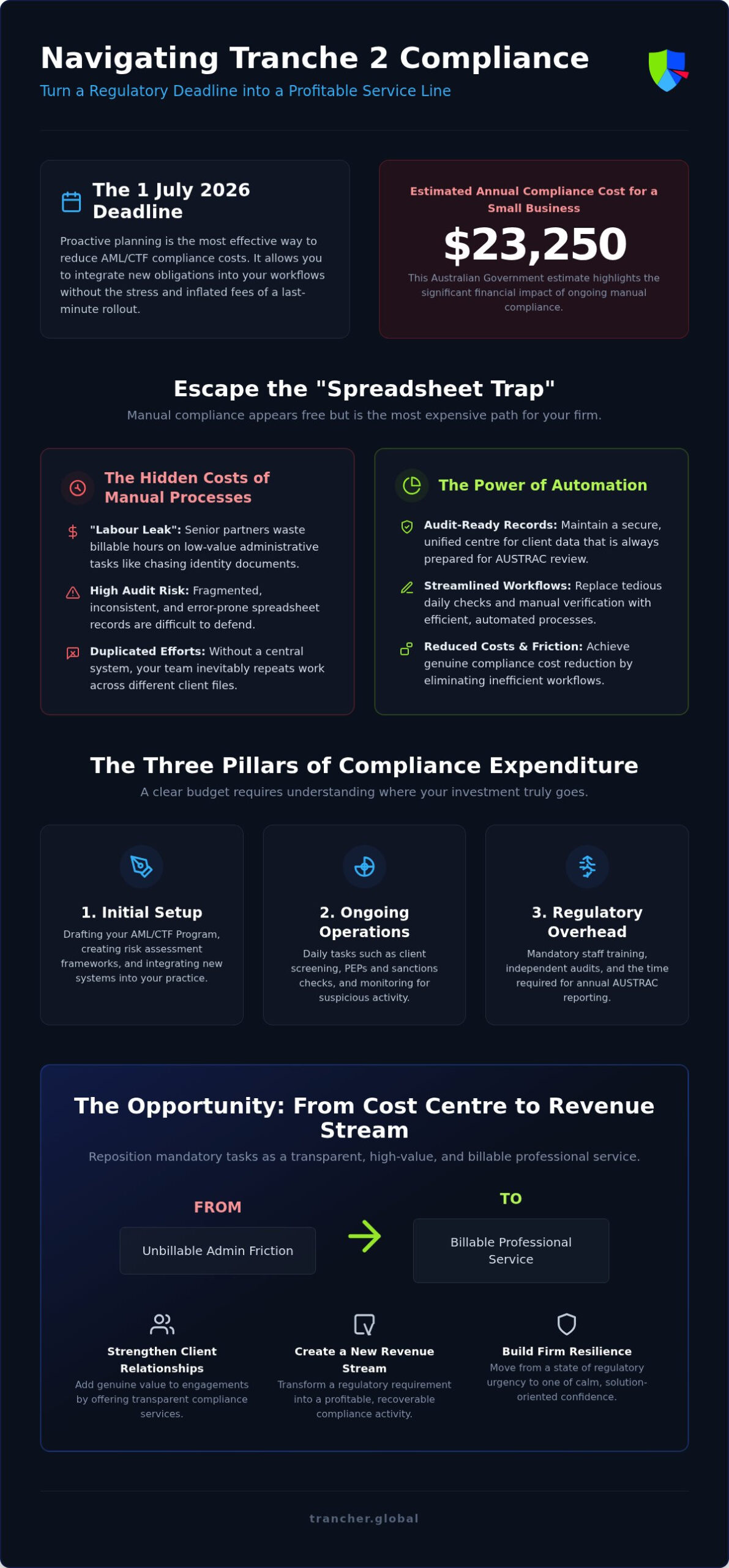
What if the 1 July 2026 Tranche 2 deadline wasn’t a looming financial drain, but actually the catalyst for your firm’s next profitable service line? It’s natural to feel concerned about the administrative weight of these new obligations, especially when the Australian Government estimates small businesses could face average ongoing compliance costs of $23,250 per year. Finding a sustainable path for AML CTF compliance costs reduction is no longer just a goal; it’s a necessity for maintaining a healthy, resilient practice.
We understand that your priority is protecting your firm while maintaining profitability. This article provides a clear roadmap to help you replace tedious manual processes with streamlined, automated workflows. You’ll learn how to transform mandatory regulatory tasks into a transparent, billable professional service that strengthens your client relationships rather than straining your internal resources. We aim to move your firm from a state of regulatory urgency to one of calm, solution-oriented confidence.
We’ll examine how to transition away from unbillable administrative friction toward a model of operational ease. We’ll also outline a strategy to ensure your records remain audit-ready at all times, allowing you to face AUSTRAC requirements with a sense of business-minded optimism and steady professional guidance.
Key Takeaways
- Prepare for the 1 July 2026 deadline by understanding the true financial impact of Tranche 2 obligations on your practice’s overhead.
- Implement a clear strategy for AML CTF compliance costs reduction by identifying the hidden labour expenses buried in manual spreadsheet processes.
- Leverage automation to eliminate administrative friction and ensure your firm remains audit-ready without the burden of daily manual checks.
- Transform mandatory regulatory requirements into a new revenue stream by positioning compliance as a high-value, billable professional service.
- Discover how to reach full AUSTRAC readiness within 30 days while maintaining a focus on long-term operational efficiency and ROI.
The Reality of Tranche 2: Why Compliance Costs are Climbing for Australian Accountants
It’s a mistake to think of compliance costs as just a line item for software. The true cost of meeting your obligations is a composite of three distinct factors: technology, professional labour, and regulatory risk. To effectively manage these, we must first understand what is money laundering and why the Australian Government is extending these requirements to the accounting profession. For many firms, the 1 July 2026 deadline represents a fundamental shift in how they protect their practice and their clients.
The Tranche 2 expansion brings tens of thousands of SME practices under the oversight of AUSTRAC. If you wait until June 2026 to begin your implementation, you’ll likely face inflated consultant fees and the stress of a rushed rollout. Proactive planning is the most effective method for AML CTF compliance costs reduction, as it allows you to integrate these requirements into your existing workflows without the “panic tax” of last-minute setup. We encourage you to view compliance not as a sunk cost, but as a “recoverable compliance activity.” By structuring these tasks correctly, you can shift the narrative from an overhead burden to a high-value professional service that adds genuine value to your client engagements.
The Three Pillars of Compliance Expenditure
Managing your budget requires a clear understanding of where the investment actually goes. We categorise these expenses into three primary areas:
- Initial setup: This involves drafting your AML/CTF Program, creating risk assessment frameworks, and integrating new systems into your practice.
- Ongoing operational costs: These are the daily tasks, such as client screening, PEPs and sanctions checks, and monitoring for suspicious activity.
- Regulatory overhead: This includes mandatory staff training, independent audits, and the time required for AUSTRAC annual reporting.
Why Traditional “Manual” Compliance is the Most Expensive Option
Many firms fall into the “spreadsheet trap,” assuming that manual tracking is free because it doesn’t have a software price tag. In reality, manual compliance is the most expensive path. It leads to a “labour leak,” where senior partners spend billable hours chasing identity documents or manually verifying signatures. The Australian Government estimates the average ongoing compliance cost for a small business to be $23,250 per year, a figure that grows rapidly if your team is bogged down by manual administration. AML CTF compliance costs reduction is best achieved by removing this friction. Automation ensures that your records are audit-ready without the manual labour; it also provides a secure centre for sensitive client data that meets modern privacy standards. Fragmented systems only lead to duplicated efforts; a unified approach is always more cost-effective.
The High Price of Manual Processes: Identifying Hidden Compliance Overhead
Many accounting practices fall into the “Spreadsheet Trap,” operating under the assumption that manual tracking is essentially free because it lacks a dedicated software subscription fee. This is a costly misconception. When you factor in the hourly rates of senior partners who find themselves mired in low-value administrative tasks, the financial burden becomes clear. Every hour spent manually cross-referencing data or managing version control on a shared drive is an hour of lost billable revenue. Achieving genuine AML CTF compliance costs reduction requires looking beyond the invoice and accounting for the professional time consumed by these inefficient workflows.
To accurately cost your compliance function, it’s vital to understand the granular nature of CDD and KYC requirements in Australia. These are not just one-off checks; they require ongoing maintenance and secure documentation. Without a structured system, your team will inevitably duplicate efforts across different client files, leading to a fragmented and expensive operational model. A strategic focus on AML CTF compliance costs reduction involves replacing these manual touchpoints with seamless digital verification.
Opportunity Cost: What Your Team Could Be Doing Instead
The most significant hidden cost is the diversion of talent. When your best people are “chasing passports” or following up on missing utility bills, they aren’t performing high-value advisory work. This friction doesn’t just impact your internal team; it degrades the client onboarding experience. A clunky, manual process can lead to lower conversion rates as prospective clients grow frustrated with the administrative hurdles. Manual records also frequently fail the “audit-ready” test. If AUSTRAC requests your files, finding that documents are missing or outdated leads to expensive, high-pressure remediation projects that could have been avoided with a more structured approach.
The Risk of Non-Compliance Penalties
We believe in a proactive approach because the alternative is financially devastating. AUSTRAC’s enforcement powers are substantial. As of 1 July 2026, the value of a Commonwealth penalty unit is $364. For a body corporate, the maximum civil penalty for serious breaches is $36,400,000 per contravention. Even a failure to enrol by the July deadline carries a potential penalty of $3,640,000 for a body corporate. Beyond the fines, the reputational cost of being named in a regulatory action can be irreparable. Clients trust accountants with their most sensitive financial data; a public non-compliance notice shatters that confidence. In the new Tranche 2 environment, “ignorance of the law” is a liability your firm cannot afford to carry. To protect your practice, consider how a specialised compliance partner can help you transition to a more secure, automated model.
Strategy for AML CTF Compliance Costs Reduction: The Power of Automation
Sustainable AML CTF compliance costs reduction is achieved by moving away from reactive manual tasks toward proactive, technology-driven systems. While manual processes rely on the constant attention of your team, automation acts as a silent, 24/7 guardian for your practice. By implementing ongoing risk monitoring software, your firm can shift from labour-intensive annual reviews to automated daily checks. This technology scans for changes in client risk profiles, such as new PEP status or adverse media mentions, without requiring a single minute of staff time until an actual alert is triggered.
A central component of this strategy is the “Single Source of Truth” model. In many firms, client data is scattered across tax software, document management systems, and local drives, leading to significant rework and data silos. Centralising this information into an automated compliance platform ensures that once a client is verified, that data remains accessible and up to date across the entire organisation. This eliminates the need for duplicated efforts and ensures that every team member is working with the same verified information, further driving AML CTF compliance costs reduction through operational efficiency.
Streamlining Client Onboarding and Verification
Digital KYC tools empower your clients to verify themselves, which dramatically reduces the number of staff touchpoints required to open a new file. Instead of your team chasing certified copies of passports, clients can securely upload and verify their identity via their own devices. For Australian accountants, the real value lies in automating the verification of complex trust and company structures. Rather than manually unravelling layers of beneficial ownership, automated systems can pull data directly from registers to map out structures in seconds. This allows you to reduce the cost per check through bulk screening and integrated workflows that fit seamlessly into your existing tech stack.
Centralising Record-Keeping for Audit Readiness
Maintaining audit-ready compliance records saves your firm weeks of high-pressure preparation time when AUSTRAC requests information. An automated system tracks every action, from the initial risk assessment to ongoing monitoring alerts, creating a permanent and unalterable audit trail. This level of organisation also simplifies the generation of suspicious matter reports (SMRs) and your annual compliance report, as the data is already captured and formatted for submission. Moving to cloud-based, encrypted document storage not only enhances security but also removes the physical and financial costs associated with traditional paper filing and off-site storage.
Turning Regulation into Revenue: Making AML a Billable Professional Service
We believe the most effective path toward AML CTF compliance costs reduction involves a fundamental shift in perspective. Rather than viewing these obligations as a non-negotiable overhead, we encourage you to frame them as a value-add service that enhances the integrity of your practice. By utilising compliance ROI tracking software, you can move away from unbillable administration toward a model where every check is a documented, billable professional activity. This transparency allows you to show clients the rigorous security standards you maintain to protect their interests, turning a regulatory hurdle into a badge of professional excellence.
Communicating these fees doesn’t have to be a source of friction. When you explain that these measures protect the client’s own reputation and financial safety, the conversation shifts from a “new cost” to a “security investment.” Most clients appreciate the peace of mind that comes with knowing their accountant operates at the highest level of regulatory readiness. It’s about demonstrating that your firm is a safe harbour in an increasingly complex financial landscape.
Tracking Billable Compliance Activity
Not all activities are equal in the eyes of the regulator or your billing system. It is essential to identify the “Designated Services” within your practice that trigger specific AML/CTF workflows. When these triggers occur, you can use Trancher to track the precise time spent on tasks like enhanced due diligence for high-risk entities or complex trust structures. This data allows you to generate evidence-based reports that support compliance line items on your invoices. It ensures that your firm is fairly compensated for the professional expertise required to navigate these complex regulations, rather than absorbing the cost as a loss. This level of granular tracking is a cornerstone of sustainable AML CTF compliance costs reduction.
Compliance as a Premium Advisory Offering
Your firm’s expertise in AML/CTF provides a unique opportunity to expand your advisory suite. Many of your business clients will be navigating their own regulatory challenges and will look to you for steady guidance. By offering “Compliance Readiness” consulting, you can help them understand their own risk profiles and internal systems. This proactive approach does more than just generate a new revenue stream; it attracts higher-quality, lower-risk clients who value professional standards and operational ease. To start transforming your compliance burden into a strategic advantage, you can learn more about our revenue recovery tools and how they integrate with your practice.
Achieving AUSTRAC Readiness in 30 Days with Trancher
Facing the 1 July 2026 deadline doesn’t need to be a multi-month ordeal that drains your firm’s resources. We’ve designed Trancher as an end-to-end solution specifically for Australian accountants, ensuring you can transition from uncertainty to full compliance in just 30 days. By choosing a platform built for your specific workflow, you can achieve significant AML CTF compliance costs reduction through rapid, structured deployment. Our 30-day compliance-ready guarantee provides the peace of mind you need to focus on your clients while we handle the regulatory heavy lifting.
We believe in the value our platform provides, which is why we offer a complimentary 3-month trial for accounting firms. This is a zero-risk opportunity to assess the ROI and see how automation removes administrative friction in real-time. For firms that choose to move from the trial to an annual subscription, we provide a 20% discount to further support your long-term operational efficiency. It’s a practical way to ensure your firm is protected without an immediate capital outlay.
The Trancher Implementation Roadmap
Our structured onboarding process ensures no detail is overlooked. We move methodically through three key phases to get your practice ready:
- Day 1-7: We focus on policy customisation and the setup of your risk assessment framework, ensuring your AML/CTF Program is tailored to your firm’s specific services.
- Day 8-21: This period is dedicated to team training and seamless integration with your existing practice management tools, ensuring the new system feels like a natural extension of your desk.
- Day 22-30: We finalise client data migration and initiate your first automated screenings, leaving you with a fully operational, audit-ready system.
Why Australian Firms Trust Trancher
We aren’t just a software provider; we’re your expert compliance companion. Our local Australian support team, led by Aaron Soh, understands the unique pressures facing SME practices. Unlike large-scale enterprise tools that can feel impersonal and overly complex, Trancher focuses on the profitability and operational ease of smaller firms. We provide steady guidance and practical support at every step, ensuring you never feel like you’re navigating these changes alone. It’s about building a resilient practice that views AML CTF compliance costs reduction as a strategic advantage rather than a hurdle. If you’re ready to secure your firm’s future, start your 3-month complimentary trial today.
Securing Your Practice for a Profitable Future
The transition to Tranche 2 compliance doesn’t have to be a financial burden that weighs down your firm’s growth. By embracing automation, you can eliminate the labour leak of manual administration and ensure your records remain audit-ready without the stress of constant oversight. Shifting your perspective from administrative overhead to a billable professional service allows you to protect your practice while simultaneously opening new revenue streams.
Achieving sustainable AML CTF compliance costs reduction is about working smarter, not harder. With our 30-day compliance-ready guarantee and dedicated local Australian support, you can navigate these changes with confidence and professional ease. We’re here to act as your steady guide, helping you turn regulatory obligations into a strategic advantage for your firm.
Secure your firm’s future with a 3-month complimentary trial of Trancher and enjoy a 20% discount on your first 12 months following the trial. We’re excited to help you build a more resilient and streamlined accounting practice.
Frequently Asked Questions
How much does Tranche 2 compliance typically cost an SME accounting firm?
The Australian Government estimates that the average ongoing compliance cost for a small business is $23,250 per year. For a typical small to medium firm with a turnover between $200,000 and $2 million, upfront setup costs are estimated at $28,650. These figures reflect the investment required for policy development, staff training, and the implementation of robust client due diligence systems before the 2026 deadline.
Can I charge my clients a specific fee for AML compliance work?
Yes, you can and should treat compliance as a billable professional service rather than a sunk overhead cost. By documenting the specific “Designated Services” you provide and the enhanced due diligence required for complex structures, you can transparently include these costs on your invoices. Most clients understand that these security measures protect their own financial integrity and reputation.
Will automating my AML program satisfy AUSTRAC’s independent audit requirements?
While automation provides the “audit-ready” records and unalterable trails AUSTRAC requires, an independent audit remains a distinct regulatory obligation. However, having a centralised, automated system significantly contributes to AML CTF compliance costs reduction during the audit process. It allows your independent auditor to access organised data quickly, which reduces the billable hours they spend on manual file reviews.
What is the most effective way to reduce the labour cost of KYC checks?
Digital verification is the most efficient method to lower labour expenses, as it allows clients to verify their own identity through secure mobile interfaces. This removes the need for your team to manually chase, certify, and store physical documents. Automating the verification of complex trust and company structures further reduces senior staff time, allowing them to focus on high-value advisory work instead of administration.
How does Trancher help me track the ROI of my compliance activities?
Trancher includes built-in ROI reporting and compliance billing support designed specifically for the accounting workflow. The platform tracks the time and resources spent on every client verification and ongoing monitoring task, allowing you to see exactly which activities are recoverable. This data ensures that your compliance function operates as a transparent, revenue-generating part of your practice rather than a financial drain.
Is it cheaper to outsource my AML Officer role or use software?
Software is generally the more cost-effective option for AML CTF compliance costs reduction compared to hiring external consultants. Research indicates that AML consultants can cost between $10,000 and $50,000 for initial setup alone. In contrast, specialised software provides a scalable, daily solution for a fraction of that cost, allowing your internal team to maintain control while benefiting from automated workflows.
What happens if my firm is not compliant by the July 2026 deadline?
Failing to meet the 1 July 2026 deadline exposes your firm to severe civil penalties and reputational damage. Providing a designated service without being enrolled carries a maximum civil penalty of $3,640,000 for a body corporate. For the most serious breaches of the AML/CTF Act, penalties can reach as high as $36,400,000 per contravention, making proactive readiness a vital business priority.
How long does it take to integrate AML software into my existing practice management stack?
A full integration typically takes 30 days to reach a state of total AUSTRAC readiness. This timeframe allows for the customisation of your AML/CTF Program, team training, and the migration of existing client data. A methodical, step by step approach ensures that the new system integrates seamlessly with your current tools without disrupting your daily operations or client service delivery.