

Did you know that approximately 90,000 Australian businesses, including your practice, are now navigating the most significant regulatory shift in a generation? As of 1 July 2026, AML compliance for law firms Australia has moved from a theoretical discussion to a mandatory legal obligation. We understand that the prospect of managing complex trust structures or facing civil penalties of up to $36.4 million feels like an immense weight on your shoulders. It’s natural to worry about losing billable hours to administrative tasks that don’t seem to move the needle for your clients.
This guide is designed to shift that perspective. We’ll show you how to navigate the AUSTRAC Tranche 2 reforms and transform your compliance requirements from a heavy burden into a streamlined, billable professional service. You’ll discover how to achieve 100% regulatory readiness while maintaining high-speed client onboarding. We’ll explore the practical steps to recover compliance costs through structured billing; ensuring your practice remains both protected and profitable as you adapt to this new landscape.
Key Takeaways
- Prepare for the 1 July 2026 deadline with a clear understanding of how early action prevents administrative bottlenecks and protects your firm from significant civil penalties.
- Determine if your practice provides “designated services” and learn to simplify the due diligence process for complex Australian trusts and corporate structures.
- Modernise your approach to AML compliance for law firms Australia by replacing manual spreadsheets with automated workflows that eliminate human error and recover lost billable hours.
- Follow a structured 30-day roadmap to achieve total AUSTRAC readiness, from initial enrolment and risk assessment to comprehensive staff training.
- Transform regulatory obligations into a professional advantage by using ROI tracking to identify and bill for compliance activities as a value-added service.
Navigating the Tranche 2 Landscape for Australian Legal Practices
The commencement of the Anti-Money Laundering and Counter-Terrorism Financing Amendment Act 2024, commonly known as Tranche 2, represents a pivotal shift for the legal profession. From 1 July 2026, law firms are officially integrated into Australia’s financial intelligence network. This change isn’t about adding red tape for the sake of it. It’s a strategic move to close a gap that criminals have historically used to move illicit funds through the “gatekeeper” professions. While the transition requires a change in mindset, it also offers an opportunity to modernise your internal systems and reinforce your firm’s reputation for integrity.
The 1 July 2026 deadline is a firm start date, not a soft target. Law firms providing designated services on or before this date must enrol with AUSTRAC by 29 July 2026. Waiting until the final weeks to prepare often leads to administrative bottlenecks and rushed, incomplete risk assessments. Early preparation allows your team to integrate these new workflows into their daily routines without disrupting client service. It’s the difference between a panicked scramble and a confident, professional transition.
The consequences of ignoring these changes are significant. As of July 2026, the value of a single Commonwealth penalty unit is $364. For a body corporate, the maximum civil penalty for non-compliance is 100,000 penalty units, which equates to $36.4 million. Beyond the financial risk, the reputational damage of being linked to money laundering activity can be irreparable. By prioritising AML compliance for law firms Australia now, you protect your firm’s assets and its standing in the legal community.
Who is Captured? Defining “Designated Services” in Law
Not every legal task triggers these obligations. The regime applies when you provide “designated services” that have a geographical link to Australia. This includes high-risk activities such as buying or selling real estate, managing client money or assets, and the creation or management of companies and trusts. Even small sole-practitioner firms must assess their exposure. If you handle a single property settlement or set up a discretionary trust, you’re captured by the Act. It’s essential to audit your service list early to confirm your status.
The Core Obligations: A High-Level Overview
Once you’ve identified that your firm provides designated services, three core pillars form your compliance foundation. First, you must enrol with the regulator. Second, you’re required to develop and maintain a written AML/CTF Program tailored to your firm’s specific risk profile. This isn’t a “set and forget” document; it must be risk-based and regularly reviewed. Finally, you’ll need to manage ongoing reporting, which includes submitting Suspicious Matter Reports (SMRs) and Annual Compliance Reports to ensure your practice remains in good standing.
Identifying Your Firm’s Risk: Is Your Practice Captured?
Risk assessment isn’t just a tick-box exercise; it’s the backbone of your firm’s protection strategy. For AML compliance for law firms Australia, you need to look at your client base through a regulatory lens. High-risk sectors include property development, international trade, and high-net-worth individuals using complex offshore structures. Conversely, simple probate or personal injury matters typically carry lower risk. You’ll need a formal, documented Risk Assessment to prove you’ve analysed these factors. A robust approach to AML compliance for law firms Australia starts with identifying these vulnerabilities before they become liabilities.
Australia’s love for trusts and proprietary limited companies creates a layer of opacity that AUSTRAC wants you to pierce. Shell companies can hide ultimate beneficial owners, making deep due diligence essential. It’s estimated that over $1 billion was laundered through the Australian real estate market in a single year, often via these very structures. You should be alert to specific red flags, such as:
- Unusual settlement patterns or requests to pay from multiple third-party accounts.
- Sudden changes in the source of funds mid-transaction.
- Clients who are reluctant to provide information about beneficial ownership or control.
KYC and CDD: Beyond Simple Identity Checks
Gone are the days when a quick glance at a driver’s licence sufficed. Modern CDD and KYC requirements Australia demand you understand the source of wealth and source of funds for high-risk clients. This means verifying where the money actually came from, not just where it’s being held. You must also screen for Politically Exposed Persons (PEPs) and international sanctions to ensure your firm isn’t inadvertently facilitating global financial crime. It’s about building a complete profile of who you’re really doing business with.
Managing Client Friction During Onboarding
Onboarding should be a handshake, not a hurdle. Long-term clients might feel affronted when asked for deeper documentation, so frame the conversation around protecting their interests and meeting national standards. Automated workflows make this process feel seamless. By standardising the experience, you ensure every client receives the same professional treatment while you gather the necessary data without the back-and-forth emails. To make this transition easier, you might consider an automated AML onboarding solution that handles the heavy lifting for you, allowing your team to focus on high-value legal work.
The High Cost of Manual Compliance vs. Automated Workflows
Many partners view regulatory requirements as a non-billable overhead, yet the true cost lies in the hidden “compliance tax” of manual data entry. When a senior lawyer spends hours manually verifying identity documents or chasing client information, those are billable hours permanently lost to the firm. Relying on manual logs for AML compliance for law firms Australia is a major vulnerability. AUSTRAC expects robust, searchable, and consistent records; qualities that fragmented spreadsheets simply cannot guarantee. If your firm aims to scale, ask yourself: can your current manual process handle 50 new clients a month without compromising accuracy or service speed?
A single source of truth is essential for modern legal practices. Without a centralised digital repository, compliance documentation often ends up scattered across local drives, email threads, and physical folders. This fragmentation makes responding to an AUSTRAC inquiry a stressful, time-consuming ordeal. Transitioning to an automated workflow ensures that every piece of due diligence is captured, timestamped, and easily accessible, turning a chaotic administrative burden into a structured professional asset.
Why Spreadsheets Risk Your Firm’s License
Maintaining audit-ready compliance records through manual entry is a high-stakes gamble. Spreadsheets suffer from version control issues and lack the sophisticated logic required to flag complex risks. A static document can’t provide real-time alerts if a client is added to an international sanctions list or becomes a Politically Exposed Person (PEP) overnight. Automation provides the persistent monitoring that manual logs lack, ensuring your firm remains protected against evolving threats without constant manual oversight.
The ROI of Compliance Automation
The financial argument for automation is clear: it reduces the time-to-onboard from several days to just a few minutes. By removing the administrative friction of KYC and CDD, your team can focus on high-value legal work rather than data collection. This efficiency eliminates the need to hire a dedicated, non-billable compliance officer even as your firm grows. Compliance ROI is the measurable financial gain achieved by redirecting administrative hours back into billable legal work while eliminating the overhead of manual oversight. Embracing technology ensures your practice stays competitive, compliant, and consistently profitable.
A 30-Day Roadmap to AUSTRAC Readiness
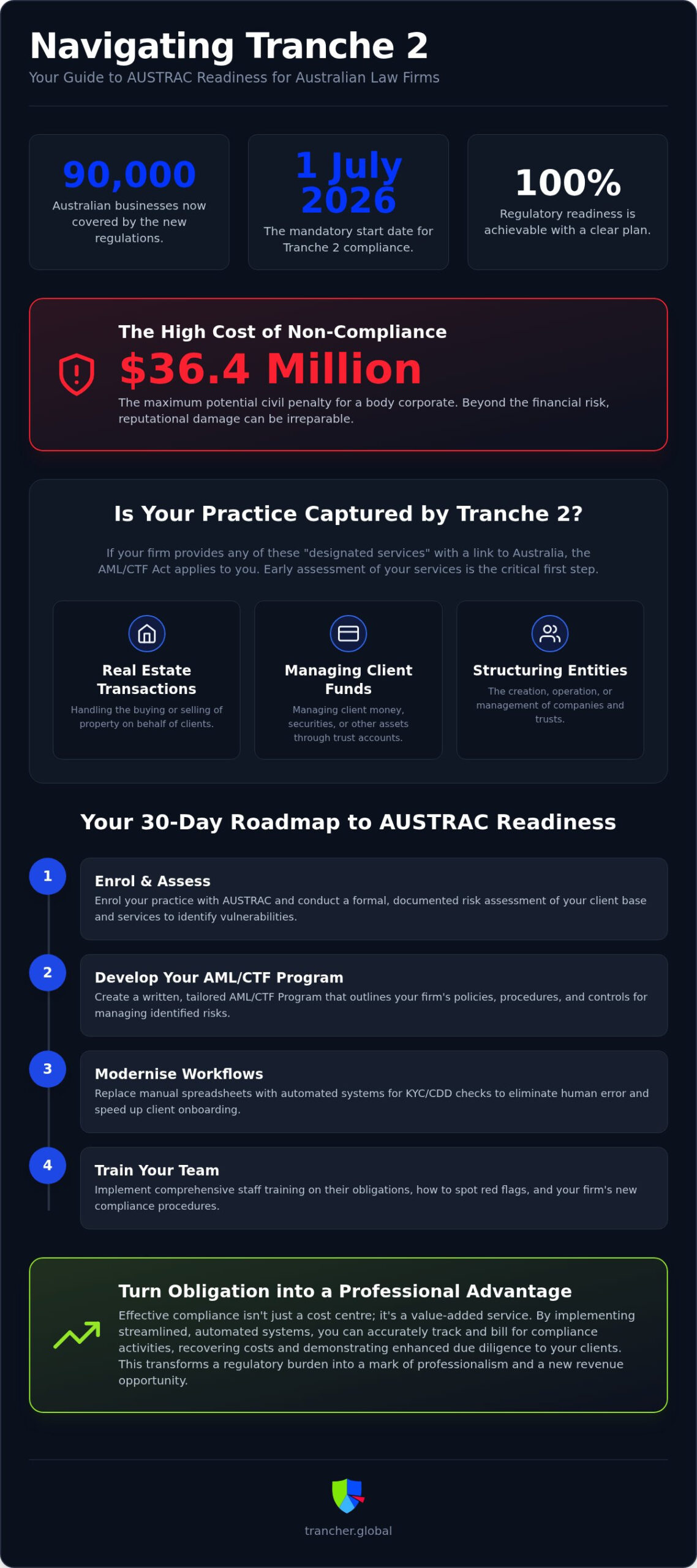
Achieving total regulatory alignment before the 1 July 2026 deadline is entirely manageable with a disciplined, week-by-week approach. You don’t need a year of planning; you simply need a structured path. During the first seven days, the focus is on enrolment with AUSTRAC and performing your initial risk assessment. This foundational stage identifies which services trigger obligations and sets the tone for your firm’s policy framework. By prioritising AML compliance for law firms Australia during this first week, you set a clear trajectory for success, understanding your specific exposure so you can build a defence that’s actually proportionate to your risk.
Days 8 to 21 are dedicated to the practical integration of automated KYC and CDD tools. This is the stage where you remove the friction from your onboarding process and begin staff training. By using technology to handle identity verification, your team learns to manage compliance as a standard professional workflow rather than an administrative hurdle. In the final week, from day 22 to 30, you’ll finalise your written AML/CTF Program and establish your ongoing monitoring routines. Our 30-day readiness guarantee is designed to give you peace of mind, ensuring your firm is fully prepared within one month without sacrificing billable performance.
Structuring Your AML/CTF Program
A compliant program is split into two distinct sections. Part A covers your firm’s general internal controls, including risk management strategies and employee due diligence. Part B focuses on customer-specific requirements, detailing how you identify and verify your clients. Tailoring these documents to your firm’s specific size and service offering is vital. A sole practitioner’s program should look very different from a mid-tier firm’s framework. This ensures your documentation is robust enough for an independent review or a formal AUSTRAC inspection while remaining practical for daily use.
Ongoing Monitoring and Reporting
Compliance doesn’t end once the client is onboarded. You must implement ongoing risk monitoring software to detect changes in client behaviour or risk profiles over time. Automating the generation of AUSTRAC reports, such as Suspicious Matter Reports, ensures you never miss a critical deadline due to human oversight. Remember that record-keeping is a legal requirement; all compliance documentation must be stored securely for a mandatory seven-year period. To see how we can streamline this for your practice, explore our end-to-end compliance solutions today.
Turning Regulatory Obligations into a Profitable Professional Service
Many partners view the Tranche 2 reforms with trepidation, seeing only a drain on resources. We encourage a total mindset shift. Instead of treating AML compliance for law firms Australia as a non-billable overhead, consider it a recoverable professional activity. Just as you bill for complex research or title searches, the due diligence required to protect your firm and the financial system has tangible value. Transparency is the key here. When you clearly communicate the necessity of these checks, you build deeper trust with your clients by demonstrating your firm’s commitment to high ethical standards and regulatory integrity.
Tracking Billable Compliance Hours
The challenge has always been quantifying the time spent on these tasks. By using compliance ROI tracking software, you can precisely log the minutes and hours dedicated to KYC, CDD, and risk assessments. Trancher allows you to integrate this data directly with your existing practice management billing systems. This means you can generate detailed ROI reports for your partners, proving the financial health of your compliance programme. It turns a perceived loss into a measurable contribution to the firm’s bottom line. You aren’t just meeting an obligation; you’re optimising your firm’s operational efficiency.
Beyond cost recovery, this transition unlocks fresh advisory opportunities. Your clients, particularly those in property development or corporate management, often face their own AML/CTF challenges. Your expertise in AML compliance for law firms Australia allows you to offer high-level guidance that adds another layer of value to your relationship. You become more than just a legal advisor; you become a strategic partner in their compliance journey. This proactive approach ensures your practice stays ahead of the curve while helping your clients navigate their own regulatory hurdles.
Next Steps: Getting Started with Trancher
We believe that seeing is believing. That’s why we offer a complimentary 3-month trial for Australian law firms. During this period, you’ll have access to a dedicated onboarding session where we’ll help you configure your workflows and train your staff. We act as your expert companion, ensuring that the transition is seamless and stress-free. There’s no need to wait for the 1 July 2026 deadline to start seeing results. Start your 30-day journey to AUSTRAC readiness today.
Securing Your Firm’s Future in the Tranche 2 Era
The 1 July 2026 deadline marks a new chapter for the legal profession, but it’s one that your firm can navigate with confidence. By identifying your specific risks and moving away from the inefficiency of manual spreadsheets, you protect your practice from heavy penalties while reclaiming lost billable hours. It’s clear that AML compliance for law firms Australia doesn’t have to be a drain on your resources. When you treat these obligations as a professional, billable service supported by automated workflows, you turn a regulatory requirement into a strategic advantage for your practice.
We’re here to act as your expert companion throughout this transition. Our platform provides a 30-day compliance guarantee, AU-based expert support, and detailed ROI reports to keep your partners informed. You don’t have to tackle these complex changes alone. Join our complimentary 3-month trial and get AUSTRAC-ready in 30 days. We look forward to helping you achieve total regulatory peace of mind while your firm continues to thrive.
Frequently Asked Questions
Is my small law firm really required to comply with AUSTRAC Tranche 2?
Yes, any firm providing “designated services” with a geographical link to Australia must comply from 1 July 2026. This includes sole practitioners and small partnerships handling property settlements, company formations, or managing client assets. Size doesn’t exempt you from AML compliance for law firms Australia; if you’re captured by the Act, you must enrol with AUSTRAC and maintain a compliant program. It’s about ensuring every practice, regardless of its footprint, protects the integrity of the financial system.
How much does it cost to implement an AML compliance program in Australia?
The cost of implementing a program depends on your firm’s complexity and whether you choose manual or automated systems. While there are initial setup requirements, the true measure is the return on investment. Automated solutions often pay for themselves by reclaiming billable hours that would otherwise be lost to manual data entry. By focusing on administrative efficiency, you can manage your obligations without the need for expensive, non-billable overheads or additional full-time staff.
Can I still use manual spreadsheets for my AML record-keeping?
You can technically use spreadsheets, but they are viewed as a significant vulnerability during an AUSTRAC inspection. Manual logs are prone to human error, lack version control, and cannot provide real-time alerts for sanctions or PEP hits. Transitioning to a digital platform ensures your records are audit-ready and searchable at a moment’s notice. It’s a move from a reactive, high-risk approach to a proactive and secure system that protects your firm’s licence.
What happens if our firm misses the July 2026 deadline?
Missing the 1 July 2026 deadline exposes your firm to substantial civil penalties and potential litigation. As of 2026, the maximum penalty for a body corporate is $36.4 million per contravention. Beyond the financial impact, the reputational damage can be devastating to any legal practice. AUSTRAC has indicated a focus on enforcement for those who willfully ignore their obligations, making early preparation the only reliable way to safeguard your firm’s future and standing.
Do I need to hire a dedicated AML Compliance Officer?
Most SME law firms don’t need a dedicated, full-time hire if they use effective automation. You are required to appoint a Compliance Officer, but this role is often held by a partner or senior manager. By using Trancher to automate the heavy lifting of KYC and risk monitoring, the administrative burden is reduced to a manageable level. This allows your leadership team to oversee compliance without sacrificing their billable legal work or hiring additional staff.
What is the difference between KYC and CDD for legal practitioners?
KYC is the initial process of verifying a client’s identity, whereas CDD is the ongoing, deeper analysis of the risks they present. For legal practitioners, CDD involves understanding the client’s source of wealth and the nature of their business transactions. It’s about looking past the driver’s licence to ensure the funds involved aren’t illicit. Both are essential components of AML compliance for law firms Australia, working together to create a comprehensive risk profile for every client.
How does Trancher integrate with my existing practice management software?
Trancher is designed to work seamlessly with your current systems through robust platform integrations. It pulls relevant client information directly into your compliance workflow, eliminating the need for double data entry. This creates a single source of truth for all your due diligence documentation. By synchronising with your practice management software, we ensure that compliance becomes a natural part of your onboarding process, reducing friction for both your staff and your clients.
Can I bill my clients for the time spent on AML compliance?
Absolutely; many Australian firms are now structuring compliance as a billable professional service. Because AUSTRAC requires deep due diligence, the time spent on these assessments provides a clear value to the client by securing their transaction. Being transparent about these fees builds trust and helps recover the costs of maintaining a high-standard compliance program. Using ROI tracking software allows you to accurately log and bill for these essential activities as part of your standard engagement.