

The 1 July 2026 deadline isn’t a hurdle to clear; it’s the date your firm’s internal systems finally catch up to your professional standards. We understand that for many Australian accountants, the prospect of managing new Tranche 2 obligations feels like a significant weight on your billable hours. You’ve likely heard about the free AUSTRAC resources designed to help, but you’re probably wondering if a basic AML program checklist Australia is enough to protect your practice from administrative overwhelm and potential penalties.
In this guide, we’ll explore exactly what’s inside the AUSTRAC program starter kits released on 30 January 2026 and how to use them as a foundation for your compliance framework. We’ll show you how to move beyond static templates toward a system that automates your documentation and turns regulatory requirements into a profitable part of your service offering. You’ll gain a clear understanding of your obligations and a methodical path to being audit-ready well before the 2026 deadline, ensuring your firm remains both compliant and commercially resilient.
Key Takeaways
- Understand how AUSTRAC’s new program starter kits provide a structured foundation for accountants and other Tranche 2 entities to meet their regulatory obligations.
- Explore the specific resources included in the kits, such as sector-specific risk assessment templates and customer due diligence policies tailored for Australian firms.
- Learn why a basic AML program checklist Australia is a helpful starting point, but why transitioning to automated systems is essential for protecting your billable hours.
- Discover the critical steps for enrolment and customisation to ensure your practice is fully compliant before the 1 July 2026 deadline.
- Identify ways to transform administrative requirements from a cost centre into a profitable advisory service through efficient tracking and ROI reporting.
What are AML Starter Kits? Defining the AUSTRAC Framework
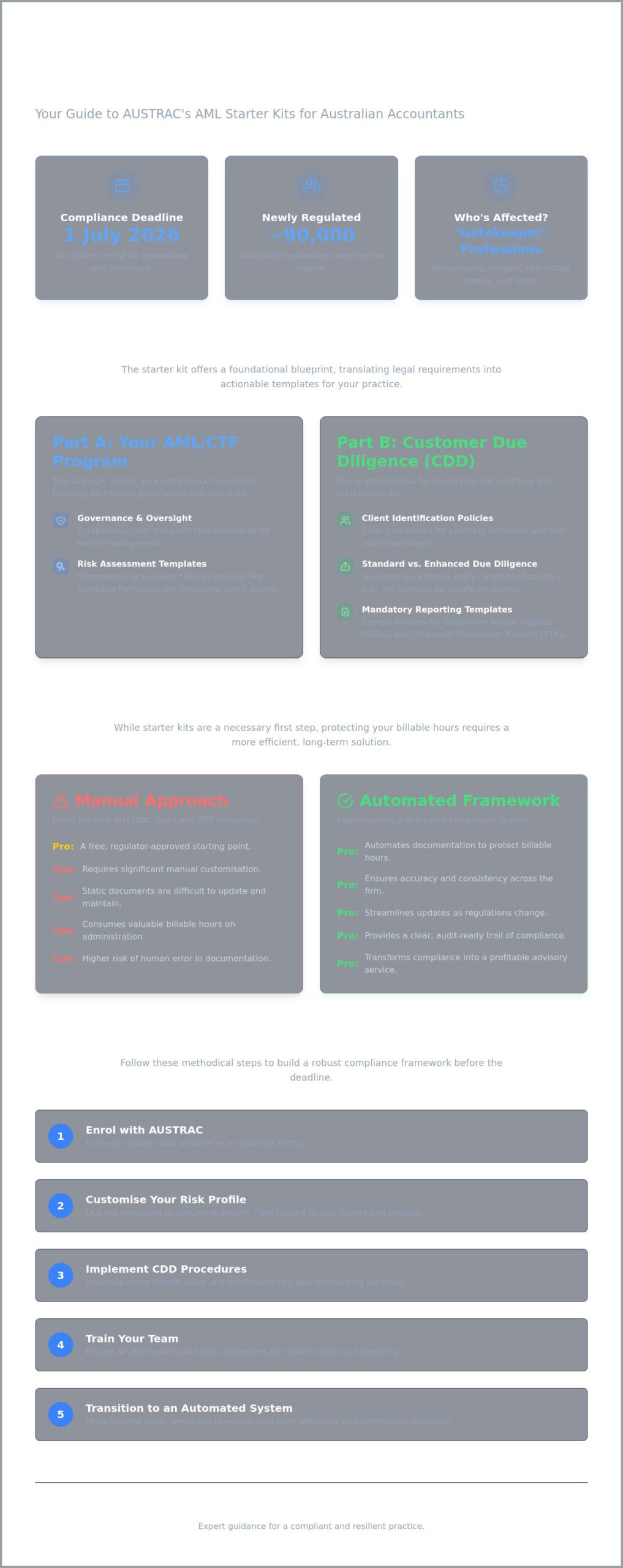
AUSTRAC’s program starter kits are official, free resources designed to help “gatekeeper” professions meet their new regulatory obligations. These kits serve as the foundational blueprint for businesses entering the regime under the Tranche 2 reforms. If you’re an accountant, lawyer, or real estate agent, these resources provide the basic scaffolding required to comply with the Anti-Money Laundering and Counter-Terrorism Financing Act 2006. They were released on 30 January 2026 to give approximately 90,000 newly regulated businesses a clear starting point.
While these tools are helpful, it’s important to view them as the “theory” of compliance. An AML program checklist Australia provided by the regulator outlines the minimum standards required to identify, mitigate, and manage money laundering risks. Before diving into the specifics of the templates, it’s useful to understand What is Anti-Money Laundering (AML)? and why it’s becoming a priority for the Australian government. The kits are essentially static documents, usually Word templates and PDFs, which require significant manual effort to customise for your specific firm’s risk profile.
Who needs to use an AUSTRAC starter kit?
The requirement applies to any practice providing “designated services.” For accountants, this typically includes managing client funds, property, or other assets, as well as providing certain company formation services. With the regulatory commencement date set for 1 July 2026, firms must have a compliant program operational by that morning. SME practices often find these kits useful because they don’t have the massive internal compliance departments found in major firms. If you’re currently managing your firm’s risk on a part-time basis, these kits offer a structured way to begin your journey toward readiness.
The core components of a standard kit
A standard AUSTRAC kit is divided into two primary sections that work together to protect your practice. Part A focuses on your general program, covering governance, risk assessment, and senior management oversight. It’s the strategic side of your compliance framework. Part B deals with Customer Due Diligence (CDD), specifically how you verify the identity of your clients and their beneficial owners. Additionally, the kits provide templates for mandatory reporting, such as Suspicious Matter Reports (SMRs) and Threshold Transaction Reports (TTRs). These tools ensure you have the correct format for communicating with AUSTRAC when specific triggers occur in your daily operations.
What is inside the Accountant Program Starter Kit?
The AUSTRAC kit is not a generic set of papers. It is a specialised resource mapped directly to the professional workflows of an Australian accounting practice. For many firms, this kit acts as a foundational AML program checklist Australia, providing the structure needed to align with the Anti-Money Laundering and Counter-Terrorism Financing Act 2006. It offers a practical starting point by translating high-level legal requirements into actionable templates that address the specific risks found in tax, insolvency, and business advisory services.
Risk assessment templates for accounting services
The kit places a heavy emphasis on identifying where your practice is most vulnerable to exploitation. It provides frameworks for evaluating risks associated with high-risk jurisdictions and complex trust structures, which are common areas of concern for the regulator. You will find tools to assess the specific threats inherent in services like company formation or the management of client assets. Designated services in the context of the AUSTRAC kit are the specific financial and business activities your firm performs that trigger legal obligations under the national regime. By using these templates, you can move from a vague sense of risk to a documented, defensible position. If you find the manual customisation of these risk profiles takes too much time, exploring an automated compliance framework can help maintain accuracy without sacrificing your billable hours.
Customer Due Diligence (CDD) policies
Verification is the cornerstone of any robust program. The kit outlines clear policies for both individual and non-individual clients, helping you understand when to apply Standard Due Diligence versus Enhanced Due Diligence (EDD). For example, if a client is a corporate entity with a complex ownership chain, the kit provides guidance on how to identify and verify the ultimate beneficial owner. This ensures you aren’t just ticking boxes but are genuinely understanding who you are doing business with. For a deeper dive into these specific procedural requirements, you can refer to our guide on CDD and KYC Requirements Australia.
Beyond these core policies, the kit includes vital record-keeping checklists. These are designed to ensure you are always audit-ready. AUSTRAC inspections often focus on the trail of documentation rather than just the final decision. The starter kit provides a baseline for what needs to be stored and for how long, covering everything from identity documents to the rationale behind a suspicious matter report. It helps you recognise red flags in client behaviour early, allowing your team to act with confidence and clarity when unusual patterns emerge in your advisory work.
Manual Templates vs. Automated Systems: A Comparison
While the AUSTRAC starter kits provide an excellent conceptual foundation, there’s a significant gap between owning a template and operating a compliant practice. Relying solely on a manual AML program checklist Australia might seem cost-effective initially, but the hidden drain on billable hours often outweighs the savings of a free resource. For a busy accounting firm, the transition from a static Word document to a dynamic platform is what separates a firm that is merely “prepared” from one that is truly protected.
Static templates are essentially a snapshot in time. They represent your policies on the day you downloaded them, but they don’t breathe with your business. When a new client joins or a regulatory update occurs, manual systems require a human to remember to update the spreadsheet, file the ID, and check the risk register. This creates a “compliance debt” that grows every month, eventually leading to administrative friction that can stall your firm’s growth.
The pitfalls of spreadsheet compliance
Spreadsheets are inherently prone to human error and version control issues. One of the most significant risks is the difficulty in tracking Politically Exposed Persons (PEPs) and sanctions screening in real-time. Manually checking global databases for every new client is a massive undertaking, and missing a single update can lead to severe oversight errors. Fragmented record-keeping also makes the required annual reporting a nightmare, as staff must hunt through disparate folders to compile data. Without a centralised system, your firm faces an increased risk of court-imposed financial penalties for simple administrative lapses that an automated system would have caught instantly.
Why automation is the Gold Standard for 2026
Modern compliance is about seamless integration. Instead of compliance being a weekend chore, automation ensures that your workflows are embedded directly into your existing practice management tech stack. This allows your team to focus on high-value advisory work while the software handles the heavy lifting of verification and filing. By moving to a platform like Trancher, you ensure that Ongoing Risk Monitoring happens in the background, providing peace of mind that your firm is always in alignment with the law.
Automation also simplifies the most stressful part of regulation: the audit. Instead of scrambling to prove your processes, you can generate Audit-Ready Compliance Records with a few clicks. This level of organisation demonstrates to AUSTRAC that your firm takes its obligations seriously and has a robust, repeatable system in place. It transforms compliance from a reactive burden into a proactive asset, allowing you to scale your services without needing to increase your administrative headcount.
Step-by-Step: How to use a Starter Kit to get AUSTRAC-Ready
Transitioning from a general understanding of regulations to a functional, compliant practice requires a methodical approach. While the AUSTRAC starter kits provide the raw materials, the responsibility for assembly rests with your firm’s leadership. To ensure you meet the 1 July 2026 commencement date without disrupting your core operations, following a structured AML program checklist Australia is the most efficient path forward. This process moves your firm from a position of potential vulnerability to one of documented regulatory resilience.
- Step 1: Enrol with AUSTRAC. Enrolment for Tranche 2 entities opened on 31 March 2026. You must identify which designated services your firm provides and complete your enrolment before the final deadline of 29 July 2026.
- Step 2: Customise the Part A framework. Download the kit relevant to the accounting sector and begin tailoring the policies. This isn’t a “set and forget” exercise; the document must reflect your actual internal controls.
- Step 3: Conduct a business-wide risk assessment. Evaluate your client base, the jurisdictions you operate in, and the delivery channels you use. This assessment forms the backbone of your entire program.
- Step 4: Train your staff. Compliance is a team effort. Your employees must understand the new policies and be able to identify specific red flag indicators in their daily advisory work.
- Step 5: Implement ongoing monitoring. Establish a system for regular client review and record-keeping. This ensures your documentation remains current and ready for inspection at any moment.
Customising the Part A Program
The Part A program is your firm’s strategic shield. It must be tailored to your specific size and client profile, as a sole practitioner’s risk looks very different from a mid-tier firm’s. A critical component is appointing an AML/CTF Compliance Officer. In many Australian SME practices, this role is often filled by a partner who has the authority to implement changes. You must also define a clear internal escalation process. When a staff member identifies a suspicious matter, they need to know exactly who to notify and what the next steps are for reporting to AUSTRAC.
Moving from the kit to operational readiness
If your firm is starting the transition closer to the deadline, a 30-day implementation plan becomes essential. Attempting to rush the process in the final week of June 2026 often leads to fragmented record-keeping and missed details. The goal is to have audit-ready documentation from day one. This means that every client onboarded after the commencement date must be processed through your new, verified system. If the prospect of manual customisation feels like an administrative burden, you can get compliant in 30 days with Trancher, ensuring your practice is protected by an automated, professionally managed framework.
Beyond the Basics: Turning Compliance into a Profit Centre
Most Australian accounting practices view the 1 July 2026 deadline with a sense of administrative dread. While a standard AML program checklist Australia is often perceived as a regulatory burden, forward-thinking firms are reframing these obligations as a high-value advisory opportunity. By integrating compliance into your professional service suite, you move from simply “ticking boxes” to providing essential risk management that protects both your firm and your clients’ interests.
The AUSTRAC starter kit provides the technical requirements, but it doesn’t offer a strategy for commercial sustainability. Transitioning to a model where compliance supports your bottom line requires a shift in how you value your team’s time. Instead of absorbing the cost of verification as overhead, leading firms are now treating these activities as billable professional services, backed by transparent reporting and clear client communication.
Recovering compliance costs
The heavy lifting involved in Know Your Customer (KYC) and Customer Due Diligence (CDD) represents a significant investment of professional expertise. Identifying billable activities within these processes is the first step toward protecting your practice margins. You can effectively communicate these fees to your clients by using professional templates that explain the necessity and value of robust identity and risk verification. To ensure your firm remains competitive while meeting these new demands, implementing AML CTF Compliance Costs Reduction strategies allows you to transform necessary admin into a streamlined, high-value service. This approach ensures that your expertise in navigating complex regulations is fairly compensated.
The Trancher Advantage: More than a template
A manual kit is a static resource; it cannot track your ROI or help you recover lost billable hours. This is where the gap between theory and practice becomes most apparent. Trancher is designed to bridge this gap by providing an automated platform that tracks the time spent on compliance activities, allowing you to see the specific financial health of your program in real-time. Our system moves you beyond a basic AML program checklist Australia toward a dynamic framework that grows with your firm.
We provide a 30-day readiness guarantee, ensuring that your transition from a basic starter kit to full operational compliance is seamless and stress-free. To help you experience the commercial benefits first-hand, we offer a trial period that includes detailed ROI reporting. This allows you to see exactly how automation removes friction and preserves your team’s capacity for high-level advisory work. Take the first step toward a more profitable, compliant future and start your complimentary 3-month trial of Trancher today.
Your Path to Operational Confidence
AUSTRAC’s starter kits provide a valuable foundation for navigating the Tranche 2 reforms. They offer necessary templates to begin building your framework. However, the true challenge lies in operationalising these documents without draining your firm’s resources. While an AML program checklist Australia provides the essential theory, relying on manual spreadsheets often leads to administrative friction and missed billable opportunities. Leading Australian SME accounting firms are now choosing to move beyond static Word documents toward automated systems that ensure audit readiness from day one.
You can bridge the gap between basic compliance and a profitable advisory model by leveraging tools that track and recover billable compliance hours. We provide a guaranteed path to AML/CTF compliance within 30 days, specifically tailored to the workflows of local practices. Secure your firm’s future with a complimentary 3-month Trancher trial to see the ROI for yourself. The transition to the new regime is a significant milestone for the industry. With a proactive approach, you can transform these requirements into a strategic advantage that strengthens your firm. We’re ready to guide you through it.
Frequently Asked Questions
Is the AUSTRAC program starter kit legally binding?
The AUSTRAC program starter kit is a guidance resource rather than a legally binding document. While using the kit itself isn’t mandatory, having a documented AML/CTF program is a strict legal requirement for all Tranche 2 entities under the Act. The kit provides a helpful baseline to ensure your AML program checklist Australia aligns with the regulator’s expectations, but you must customise it to reflect your firm’s specific risks and operational realities.
Can I just use the starter kit without any other software?
You can technically use the starter kit as a standalone manual resource, but doing so requires significant administrative effort. Manual implementation involves managing static Word documents and spreadsheets, which increases the risk of human error during client verification. Without integrated software, your firm may struggle with version control and real-time sanctions screening, potentially leaving you vulnerable during a formal AUSTRAC independent audit or inspection.
When is the deadline for Australian accountants to be AML compliant?
The deadline for Australian accountants to have a fully compliant AML/CTF program in place is 1 July 2026. This date marks the official commencement of the new regulations for Tranche 2 entities. Additionally, firms must ensure they are enrolled with AUSTRAC between 31 March 2026 and 29 July 2026 to avoid penalties. Starting your preparation early ensures your systems are tested and ready before these critical dates arrive.
What is the difference between Part A and Part B of an AML program?
Part A of an AML program focuses on your firm’s broad strategy, including risk assessment, governance, and employee training. It’s the framework that dictates how you manage money laundering threats across your entire practice. In contrast, Part B is dedicated to Customer Due Diligence (CDD) and Know Your Customer (KYC) procedures. This section outlines the specific steps you take to verify the identity of individual and corporate clients before providing services.
Do small accounting firms really need a full AML/CTF program?
Small accounting firms must implement a full AML/CTF program if they provide any designated services as defined by the legislation. The size of your practice doesn’t exempt you from these obligations if you manage client money, property, or assist with company formations. AUSTRAC expects all regulated entities to have a documented program that is proportionate to their risk level, ensuring that even SME firms are protected from exploitation by criminal elements.
How much does it cost to implement an AML starter kit manually?
Implementing an AML starter kit manually is free to download but often carries a high cost in lost billable hours. Your staff will need to spend considerable time customising templates, conducting manual risk assessments, and filing physical records. These administrative tasks often pull senior partners away from high-value advisory work. Many firms find that the ongoing internal labour costs of manual compliance far exceed the investment in a streamlined, automated solution.
What happens if my firm is not compliant by 1 July 2026?
Failing to meet the 1 July 2026 deadline exposes your firm to significant regulatory action and potential court-imposed financial penalties. AUSTRAC has the authority to conduct audits and issue infringement notices to businesses that lack a compliant AML program checklist Australia. Beyond the financial impact, non-compliance can lead to severe reputational damage, potentially affecting your relationships with professional bodies and clients who expect a high standard of regulatory integrity.
How does Trancher improve upon the basic AUSTRAC starter kits?
Trancher transforms the theoretical guidance of the AUSTRAC starter kits into a practical, automated workflow. While the kits provide static templates, our platform integrates directly with your existing systems to handle real-time screening and record-keeping. We offer a 30-day readiness guarantee and specialise in helping SME firms track and recover billable compliance hours. This ensures that your regulatory obligations become a streamlined, profitable part of your practice rather than an administrative burden.