

What if the 1 July 2026 deadline wasn’t a regulatory hurdle, but the single greatest opportunity to modernise your firm’s revenue model? For many practitioners, the sudden focus on AML compliance for accountants Australia feels like an overwhelming administrative weight. You’re likely concerned about AUSTRAC penalties and the mounting hours of non-billable time spent on manual client verification. We understand that navigating these new Tranche 2 obligations is a significant shift for your practice, and it’s natural to feel a sense of urgency as the enrolment window closes on 29 July.
This guide provides a clear, structured roadmap to help you achieve full readiness with total confidence. We’ll clarify exactly which services are designated, how to manage your reporting requirements, and how to implement a system that turns compliance into a professional, billable service. You’ll learn how to move beyond the fear of penalties and instead use these new standards to improve your internal systems. We’re here to show you that with the right approach, you can protect your firm and create a new stream of value for your clients simultaneously.
Key Takeaways
- Define which of your firm’s specific activities qualify as “designated services” to ensure your practice meets the new legal standards.
- Understand the essential components of a formal AML/CTF Programme and the critical role of the Compliance Officer in maintaining governance.
- Discover how to transform AML compliance for accountants Australia into a strategic advantage by automating manual tasks and tracking billable hours.
- Learn the exact steps to conduct a firm-wide risk assessment and customise a governance framework that fits your unique practice size.
- Explore how to achieve audit-ready status within a 30-day window without the administrative burden of traditional compliance methods.
Understanding AML Compliance for Accountants: Australia’s Tranche 2 Landscape
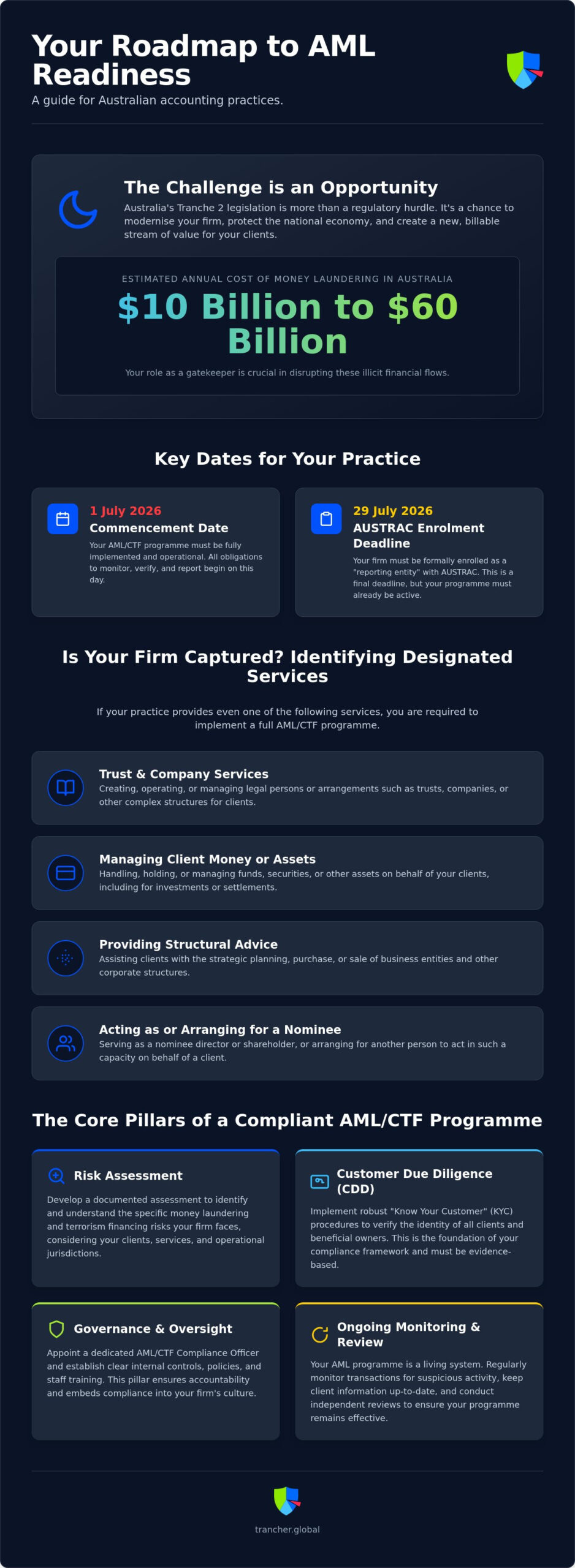
The regulatory environment for Australian practitioners changed permanently on 10 December 2024, when the Amendment Act received Royal Assent. This legislation officially brings accountants into the Global anti-money laundering (AML) framework, categorising many firms as “reporting entities” for the first time. For your practice, AML compliance for accountants Australia is no longer a distant concept discussed in international forums; it’s a fundamental shift in how you’ll manage client relationships and structural advice. This transition isn’t about adding administrative hurdles for their own sake. Instead, it’s a collective effort to protect the Australian economy from the estimated $10 billion to $60 billion lost to money laundering every year.
AUSTRAC has identified the accounting profession as a high-risk sector because of the “gatekeeper” role you play in the financial system. By 1 July 2026, firms providing specific services must have a robust, documented programme in place to detect and disrupt illicit financial flows. While this might sound daunting, it’s a manageable transition if you approach it with the right tools and a clear understanding of the requirements.
Why the 2026 Deadline Matters for Your Practice
The 1 July 2026 commencement date represents a hard line for operational readiness. AUSTRAC doesn’t expect you to just be “thinking” about compliance by this date; they expect your systems to be fully functional. You’ll have until 29 July 2026 to complete your formal enrolment with the agency, but your obligations to monitor transactions and verify identities begin the moment the clock strikes midnight on July 1. This shift requires moving away from informal “gut-feel” assessments toward a structured, evidence-based approach. Implementing scalable AML compliance solutions now allows your firm to absorb these changes without disrupting your peak tax season workflows. It’s about building a foundation that handles the heavy lifting of data collection so you can focus on your clients.
Designated Services: Is Your Firm Captured?
Not every service your firm offers will trigger the new laws. It’s vital to distinguish between standard tax compliance and “designated services” that fall under the Act. Generally, you’re captured if you perform any of the following:
- Managing client money or assets: This includes handling funds for investments or property settlements.
- Trust and company services: Creating, operating, or managing legal persons or arrangements like trusts and companies.
- Structural advice: Assisting with the purchase or sale of business entities.
- Acting as a nominee: Arranging for a person to act as a director or shareholder for a client.
If your firm provides even one of these services, you must implement a full AML/CTF programme across the entire practice. Standard individual tax returns or simple bookkeeping usually sit outside these requirements, but the moment your advice touches on structures or fund management, the obligation is triggered. Failing to meet these standards carries significant risks, ranging from substantial financial penalties to irreparable reputational damage. We’re here to help you navigate these definitions so you can move forward with certainty and professional pride.
The Core Pillars of an AUSTRAC-Compliant AML Programme
Building a compliant practice requires more than just a ticking a few boxes; it demands a documented, living strategy. Under the Act, your firm must develop and maintain a written AML/CTF Programme. This document serves as your operational manual, detailing how you’ll identify and mitigate risks specific to your client base and service offerings. Referencing the official AUSTRAC guidance for accountants is an excellent starting point to ensure your framework aligns with regulatory expectations. Your programme isn’t a “set and forget” file; it’s a foundational system that protects your firm’s reputation and legal standing.
A successful transition to AML compliance for accountants Australia involves four central pillars: risk assessment, customer due diligence, governance, and ongoing review. By structuring your firm around these elements now, you’ll find that the 1 July 2026 deadline becomes a manageable milestone rather than a source of stress. Each pillar works together to create a transparent environment where suspicious activity is easily identified and reported.
Part A vs. Part B: Risk and Identification
Your written programme is divided into two distinct sections. Part A focuses on the “how” – the internal systems and controls you use to manage Money Laundering and Terrorism Financing (ML/TF) risks. This includes your risk assessment and suspicious matter reporting procedures. Part B focuses on the “who” – the specific CDD and KYC requirements in Australia. This involves collecting granular data to verify the identity of individuals and identifying the ultimate beneficial owners of complex trust or company structures. You’ll need to ensure your data collection is thorough enough to meet AUSTRAC’s “safe harbour” provisions for identity verification.
Governance and Staff Training
Every reporting entity must appoint an AML/CTF Compliance Officer. In an SME or sole practitioner environment, this is typically a partner or the principal. This individual doesn’t need to be a regulatory specialist, but they must have the authority to oversee the programme and act as the primary contact for AUSTRAC. Alongside governance, staff training is a non-negotiable requirement. All team members must receive role-based training so they can recognise red flags in daily transactions. You’re also required to maintain audit-ready compliance records that document your personnel due diligence and training completion dates.
Finally, your programme must include a provision for an independent review. This ensures that your controls are actually working as intended and haven’t become outdated as your firm’s services evolve. If the prospect of managing these pillars manually feels daunting, you might find that automated compliance management offers a more efficient path to total readiness.
Manual vs. Automated Compliance: The ROI Reality
Many practitioners view the new requirements as a drain on resources, but the reality depends entirely on your choice of system. Relying on manual processes for AML compliance for accountants Australia often leads to a significant accumulation of non-billable hours. When you manually verify a client’s identity or cross-reference sanction lists, you’re not just losing time; you’re increasing the margin for human error. In contrast, automated screening provides an immediate, reliable result that fits seamlessly into your onboarding workflow. It’s the difference between chasing paperwork and having a system that works quietly in the background while you focus on high-value advisory work.
The transition to Tranche 2 isn’t just about avoiding fines. It’s an opportunity for AML CTF compliance costs reduction through the smart use of technology. By removing the administrative friction associated with due diligence, you can protect your firm’s profitability. Following the official AUSTRAC guidance for accountants is essential, but doing so manually through spreadsheets often creates more problems than it solves.
The Problem with the “Spreadsheet Approach”
Spreadsheets lack the robust version control and immutable audit trails required for a modern compliance programme. If AUSTRAC requests your records, a manual file often fails to demonstrate “consistent” record-keeping over time. Manual systems also make ongoing monitoring nearly impossible to scale. Without automated alerts for updated sanction lists or Politically Exposed Person (PEP) hits, your firm remains vulnerable to oversight. This inconsistency doesn’t just risk penalties; it creates an administrative burden that grows more complex with every new client you take on.
Transforming Compliance into a Billable Professional Service
We believe compliance should be a profit centre, not a cost centre. Automation allows you to track specific compliance activities with the same precision you apply to tax or audit work. When you can see exactly how much time is dedicated to due diligence, you can frame these tasks as a value-add advisory service for your clients. Trancher helps you identify these new revenue streams by tracking billable hours for every check performed. Instead of absorbing the cost, you’re providing a professional service that ensures your clients’ structures are transparent and legally sound. This approach transforms a regulatory obligation into an avenue for growth and improved internal systems.
A Step-by-Step Template for Your Firm’s AML Readiness
Achieving AML compliance for accountants Australia isn’t an overnight task, but it doesn’t need to be a multi-month ordeal either. By following a structured template, you can move from uncertainty to total operational readiness well before the 1 July 2026 commencement date. The key is to treat this as a sequence of logical phases that integrate naturally with your existing practice management systems. This methodical approach ensures that no regulatory requirement is overlooked while minimising the impact on your daily billable work.
Phase 1: Foundation and Risk Assessment
Phase 1 focuses on the foundation: identifying where your firm is most vulnerable. You’ll need to segment your client base by risk level, considering factors like geographic location and the nature of their business. High-risk segments, such as international clients or those with complex offshore structures, require enhanced due diligence compared to your local SME clients. Under the Anti-Money Laundering and Counter-Terrorism Financing Act 2006, designated services include specific financial and business activities, such as company formation or managing client assets, that require reporting entities to implement rigorous oversight. Documenting your risk appetite and mitigation strategies at this stage ensures that your firm remains protected and consistent in its decision-making.
Phase 2: Implementation and Training
Phase 2 moves from theory to action. This is where AML compliance workflow integration becomes vital. Instead of treating compliance as a separate silo, embed it into your onboarding process using your practice management technology. This allows for automated PEP and Sanctions screening the moment a new client is added to your database. You’ll also need to establish a clear internal workflow for Suspicious Matter Reporting (SMRs), ensuring that staff know exactly when and how to escalate concerns to the Compliance Officer. By storing all client data in an audit-ready format from the outset, you eliminate the stress of manual record-keeping and ensure that your firm is always prepared for an AUSTRAC review.
Once your systems are live, complete your enrolment with AUSTRAC before the 29 July 2026 deadline. Use the remaining time to train your team and begin the “hygiene” phase of re-verifying existing clients who receive designated services. This proactive approach ensures that by the time the laws take full effect, your firm is already operating at the new standard. If you’re ready to simplify this transition, you can start your 30-day readiness plan today with our expert support and guidance.
Achieving 30-Day Readiness with Trancher
The journey toward 1 July 2026 doesn’t have to be a solo trek through complex legislation. Trancher serves as your end-to-end expert companion, specifically designed to bridge the gap between regulatory requirements and the practical realities of running a busy practice. We’ve removed the administrative friction by creating a platform that handles the intricate details of AML compliance for accountants Australia, allowing you to maintain your focus on client service. With our 30-day compliance-ready guarantee, you can transition from your current state to full operational readiness without the typical administrative headache or the need for expensive external consultants.
We believe that seeing is believing. That’s why we offer a complimentary 3-month trial for accounting firms, providing you with full access to our automated KYC, risk monitoring, and reporting tools. During this period, you’ll receive a customised ROI report that tracks your billable compliance activity. This data demonstrates exactly how much non-billable time you’ve recovered and how compliance has been successfully integrated as a professional, revenue-generating service within your firm. It’s about giving you the confidence that your investment is working for your bottom line as much as it is for your regulatory standing.
Why Trancher is Built for SME Accounting Firms
Most compliance solutions are built for large financial institutions, leaving SME practices to struggle with overly complex interfaces. Trancher is different. We’ve prioritised simplicity and automation, ensuring our platform integrates directly with your existing accounting workflows. You won’t need to jump between disconnected systems or manually re-enter client data. Our local Australian support team and onboarding specialists understand the specific nuances of the Tranche 2 reforms. We provide the steady guidance you need to customise your AML/CTF programme, ensuring it reflects your firm’s unique risk profile while remaining strictly compliant with AUSTRAC standards.
Your Next Steps to AUSTRAC Readiness
Early preparation is the most effective way to avoid the last-minute scramble that often precedes major regulatory shifts. By starting your implementation now, you give your team ample time to familiarise themselves with the new processes in a low-pressure environment. For firms that choose to continue with us after their trial, we offer a 20% discount to support your long-term commitment to practice excellence. Don’t let the 2026 deadline become a source of stress for your partners and staff. Take the first step toward a more secure and efficient future by securing your practice today. Start your complimentary 3-month trial today and discover how simple professional compliance can be.
Future-Proofing Your Practice for July 2026 and Beyond
The transition to the Tranche 2 regime is a defining moment for the Australian accounting profession. It’s an opportunity to modernise your internal systems and elevate your firm’s role as a trusted economic gatekeeper. You’ve seen that AML compliance for accountants Australia doesn’t have to be a source of administrative friction. By moving away from manual spreadsheets and adopting automated workflows, you can protect your practice while turning a regulatory obligation into a billable professional service. This shift allows your team to maintain focus on high-value advisory work while ensuring your records remain audit-ready at all times.
We’re here to act as your expert companion throughout this journey. You can secure your firm’s future with Trancher’s 30-day AML readiness guarantee and experience a platform specifically designed for Australian SME accounting firms. With our complimentary 3-month trial, you’ll have the space to integrate these systems and see the ROI for yourself. We’re confident that with a structured plan and the right tools, you’ll navigate the 1 July 2026 deadline with total confidence and professional pride. Let’s build a more resilient practice together.
Frequently Asked Questions
Is AML compliance mandatory for all Australian accountants?
It is mandatory only if your firm provides “designated services” as defined by the AML/CTF Act. These services include managing client money, creating trusts or companies, and acting as a nominee director. While standard tax preparation for individuals might not be captured, most practitioners offering business advisory or structural advice will fall under the regime. It is vital to assess your service list to determine your reporting entity status.
What is the deadline for Tranche 2 AML compliance in Australia?
The official commencement date for Tranche 2 is 1 July 2026. By this date, your firm must have a documented AML/CTF programme in place and be ready to perform identity verifications. You also have a specific window to enrol with AUSTRAC, which closes on 29 July 2026. Preparing early ensures your team is trained and your systems are operational before these legal obligations take effect.
Can I manage my firm’s AML compliance using Excel spreadsheets?
While you can technically use spreadsheets, it is not recommended for maintaining long-term compliance. Manual files lack the immutable audit trails and version control that AUSTRAC expects during a review. Spreadsheets also fail to provide automated alerts for updated sanction lists or PEP hits. Transitioning to a dedicated platform ensures your records are consistent, secure, and ready for an independent review without the administrative burden of manual data entry.
How much does it cost to implement an AML/CTF programme?
The cost varies significantly depending on whether you choose a DIY approach, hire a consultant, or implement a dedicated software solution. A DIY approach using regulator templates involves no direct software cost but requires a substantial investment of non-billable staff time. Many firms find that automated platforms offer the best value by reducing administrative hours and providing a clear framework for tracking billable compliance activity to ensure a positive return on investment.
What is the difference between KYC and CDD for accountants?
Know Your Customer (KYC) is the initial process of verifying a client’s identity, whereas Customer Due Diligence (CDD) is a broader, ongoing obligation. CDD includes identifying beneficial owners of complex structures and understanding the nature of the client’s financial activities to assess risk. For AML compliance for accountants Australia, both are essential components of your Part B programme. KYC is the starting point, but CDD ensures you maintain a current risk profile for every client.
What happens if my firm is not compliant by July 2026?
Failing to comply by the July 2026 deadline exposes your firm to significant financial penalties and potential reputational damage. AUSTRAC has the authority to issue infringement notices or pursue civil penalty orders for non-compliance with the Act. Beyond the legal risks, a lack of robust systems can lead to your firm being wittingly or unwittingly used for illicit activities. Implementing a compliant programme protects your practice’s professional standing and ensures long-term operational security.
How does Trancher help with AUSTRAC reporting?
Trancher simplifies the reporting process by automating the detection and documentation of suspicious matters and threshold transactions. Our platform ensures that all required data is captured in an audit-ready format, making it easy to submit reports to AUSTRAC within the mandatory timeframes. By centralising your record-keeping, Trancher removes the stress of manual filing and provides a clear trail of all compliance activities, ensuring you meet your regulatory obligations with minimal effort.
Do I need a dedicated AML Compliance Officer if I am a sole trader?
Yes, every reporting entity must appoint an AML/CTF Compliance Officer, even if you are a sole practitioner. In a small firm, the principal or a partner typically takes on this role. The Compliance Officer is responsible for overseeing the firm’s AML compliance for accountants Australia and acting as the primary point of contact for AUSTRAC. It is a vital governance requirement that ensures there is a clear line of accountability for the firm’s regulatory obligations.